A complete issue · 64 pages · 1938
10 Story Book, August 1938
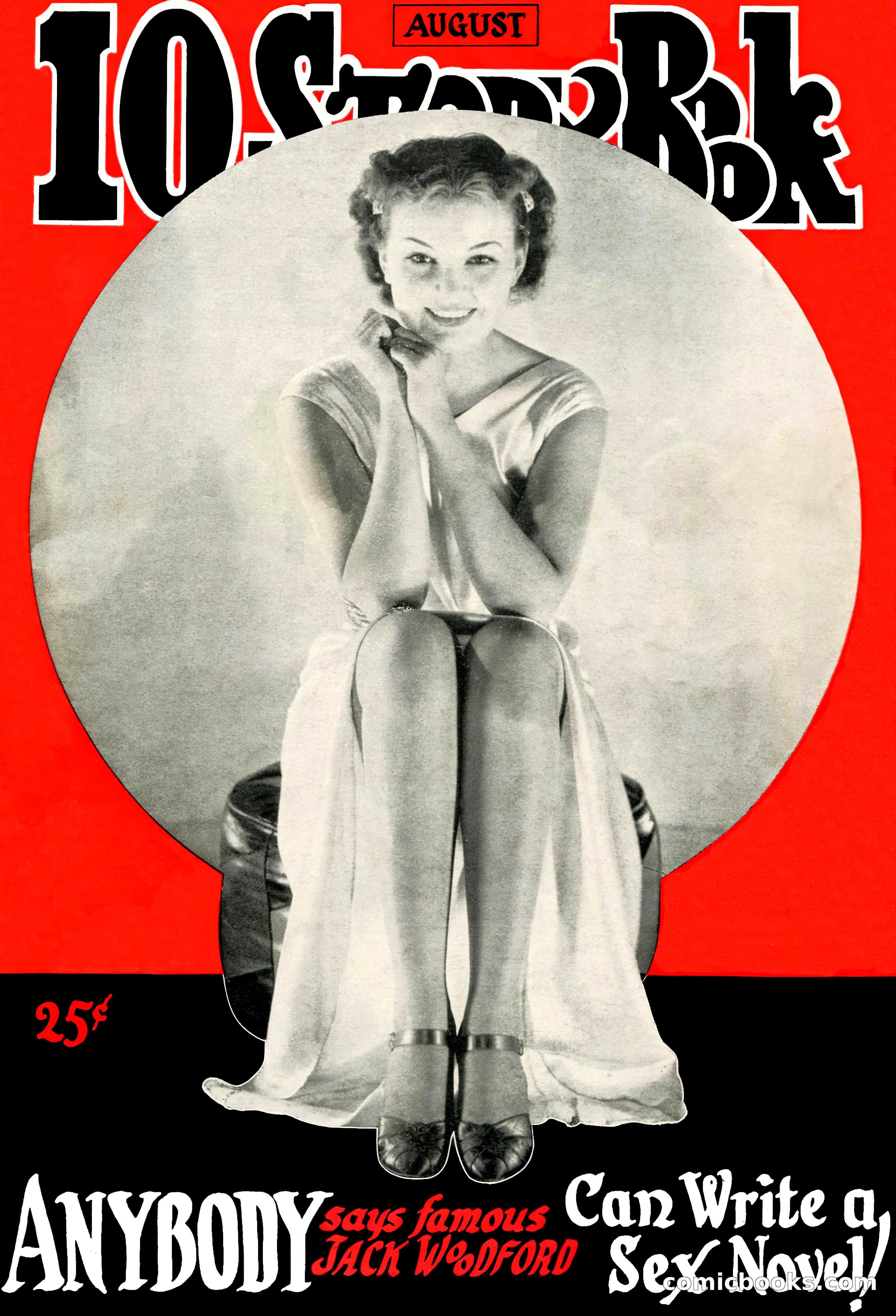
# Magazine Cover Analysis This is the cover of a pulp magazine titled "10 Story Book" (August issue, priced at 25 cents). It features a circular black-and-white photograph of a smiling woman in a light-colored dress, positioned against a bold red background. The visible text advertises that "Anybody says famous Jack Woodford Can Write a Sex Novel"—though the complete context is partially obscured by the circular frame. This appears to be promoting content by or about author Jack Woodford related to a novel of that type. The cover uses the distinctive visual style typical of 1920s-1930s pulp magazines, combining eye-catching typography with a glamorous photographic portrait to attract readers.
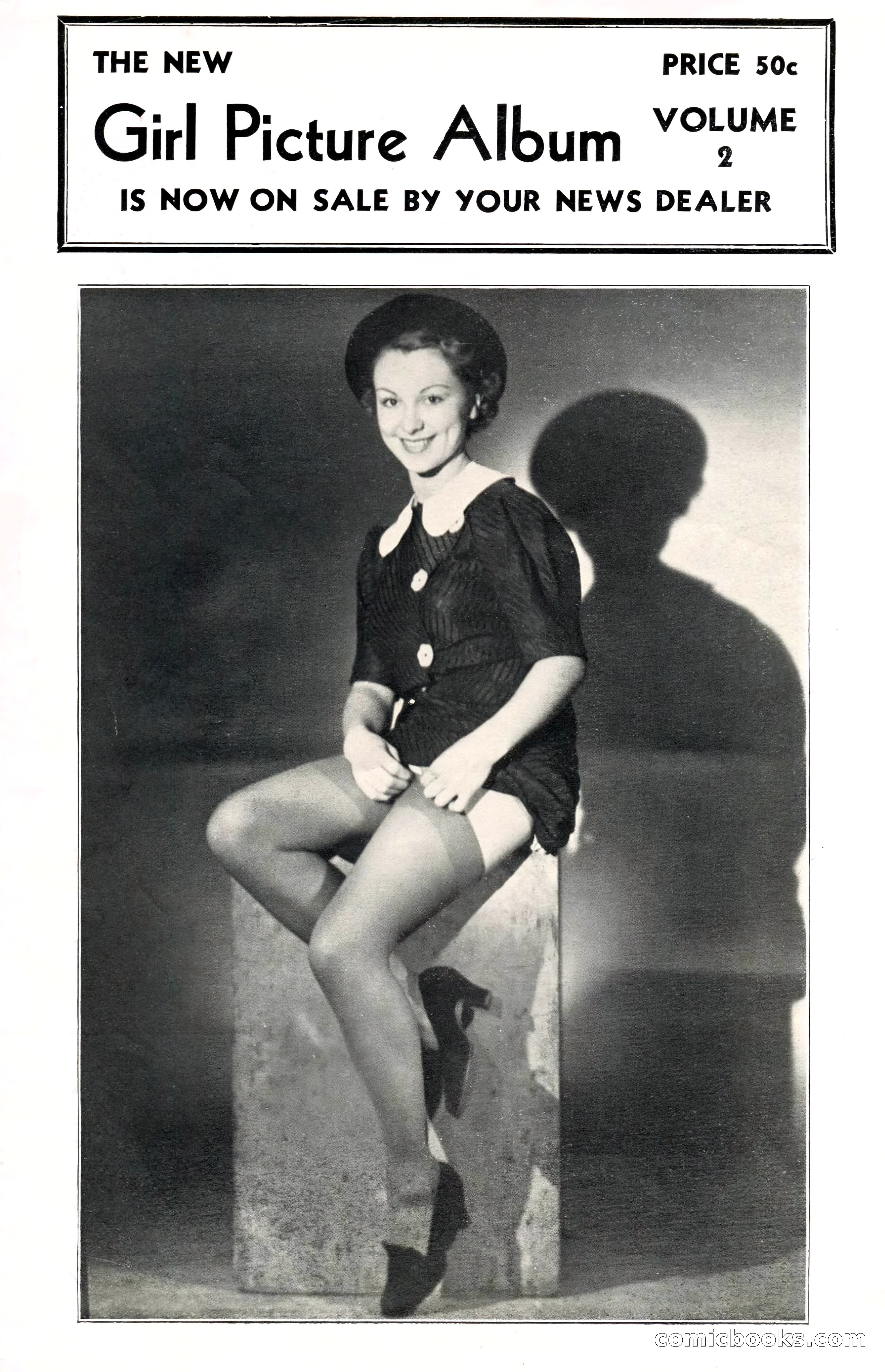
This is an advertisement page announcing the sale of "The New Girl Picture Album Volume 2" priced at 50 cents, available through news dealers. The image shows a black and white photograph of a smiling woman in a dark short-sleeved dress with white buttons, posed in a playful seated position with her legs crossed. The photograph appears to be a professional studio portrait with dramatic lighting that casts shadows on the background. The advertisement copy and photograph together constitute a promotional announcement for this pictorial collection, typical of pulp-era novelty merchandise marketed through newsstand distribution channels.
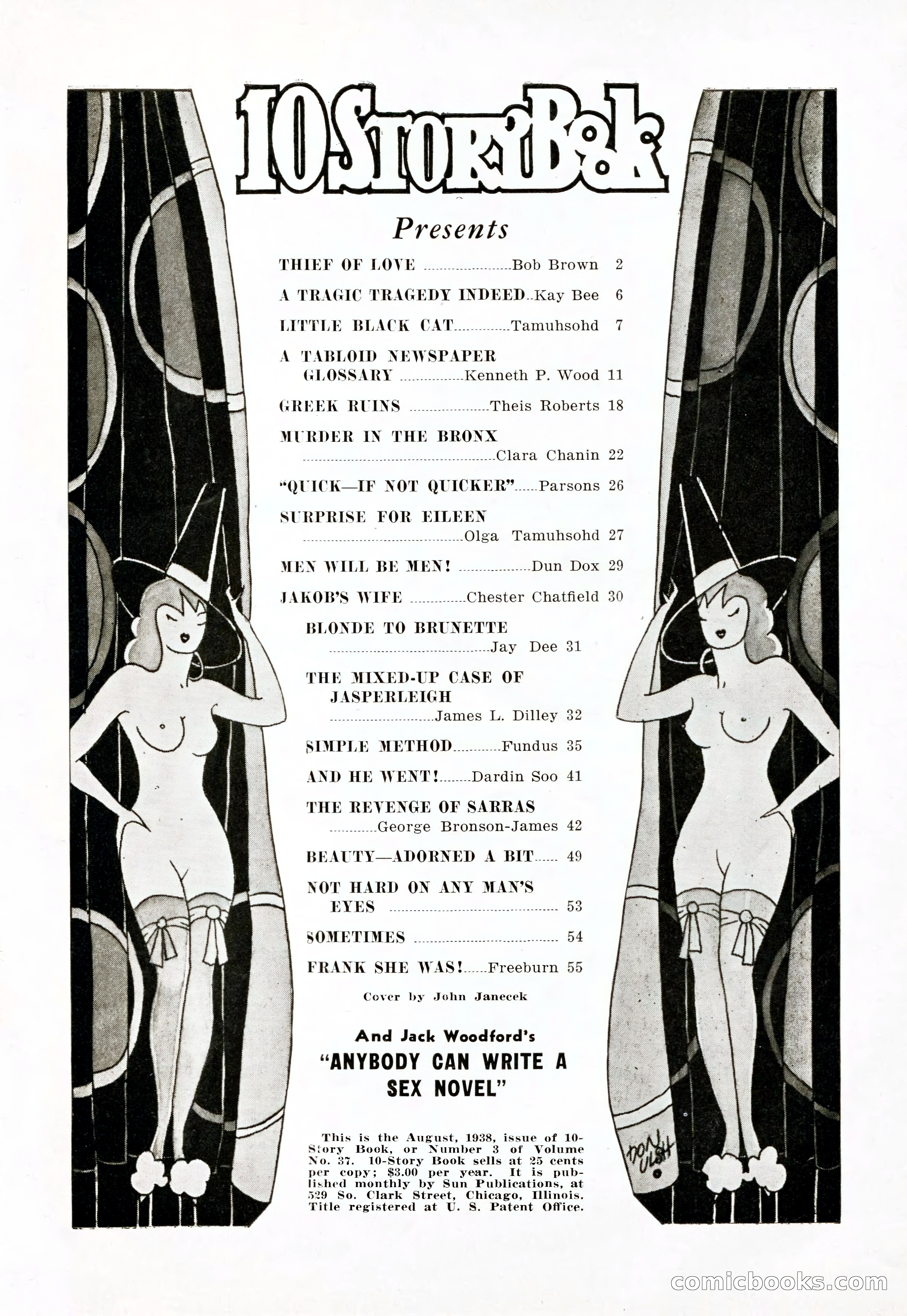
This is a table of contents page from the August 1938 issue of 10-Story Book magazine. The page lists approximately 20 short stories with their authors and page numbers, ranging from "Thief of Love" by Bob Brown to "Frank She Was!" by Freeburn. The publication information notes this is Volume 25, Number 3, selling for 25 cents and published monthly by Sun Publications in Chicago. The page features decorative Art Deco-style illustrations of stylized female figures on both sides of the text. At the bottom appears promotional text mentioning Jack Woodford's "Anybody Can Write a Sex Novel," indicating the magazine's sensationalist editorial approach typical of pulp fiction publications.
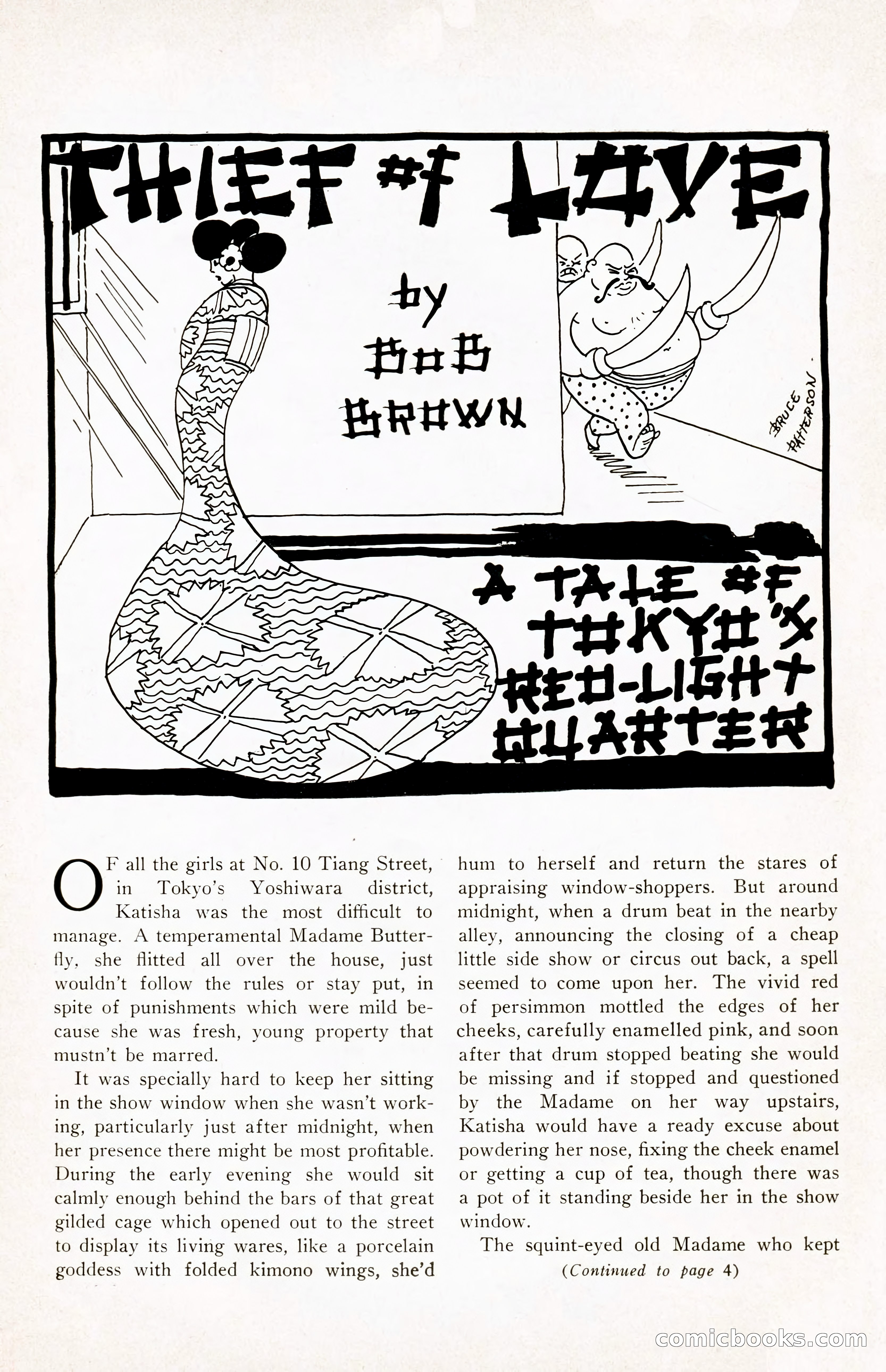
This page contains an interior story illustration and prose text from an early-20th-century pulp magazine. The illustration at the top appears to be a stylized, somewhat Art Deco-influenced drawing depicting figures in what seems to be an exotic or theatrical setting, with decorative patterning and dynamic poses. The prose below describes a character named Katisha, a difficult-to-manage girl working at a establishment on Tiang Street in Tokyo's Yoshiwara district. The text discusses her temperamental nature, her tendency to leave the display window, and her various excuses for doing so. The narrative suggests a story set in Japan involving the operations of what appears to be a brothel or similar establishment.
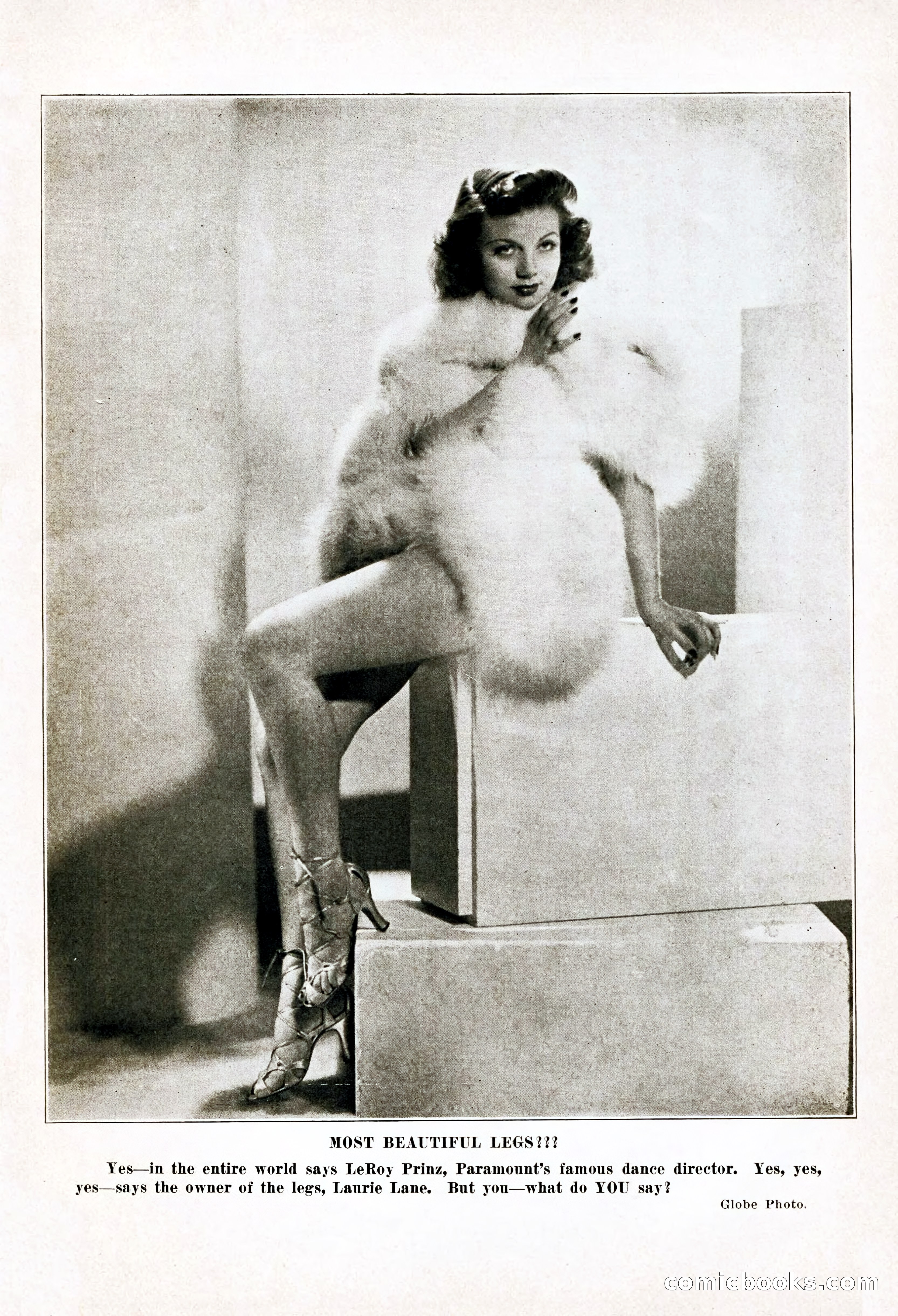
# Page Analysis This is an advertisement page from an early-20th-century publication, featuring a black-and-white photograph of a woman in a pose emphasizing her legs. The caption reads "MOST BEAUTIFUL LEGS???" and references LeRoy Prinz, identified as Paramount's dance director, and Laurie Lane as "the owner of the legs." The ad poses a rhetorical question to readers asking their opinion on the claim. The photograph credit indicates "Globe Photo." This appears to be a promotional piece, likely from the 1930s-1940s era, combining celebrity endorsement with reader engagement typical of pulp magazine advertising.
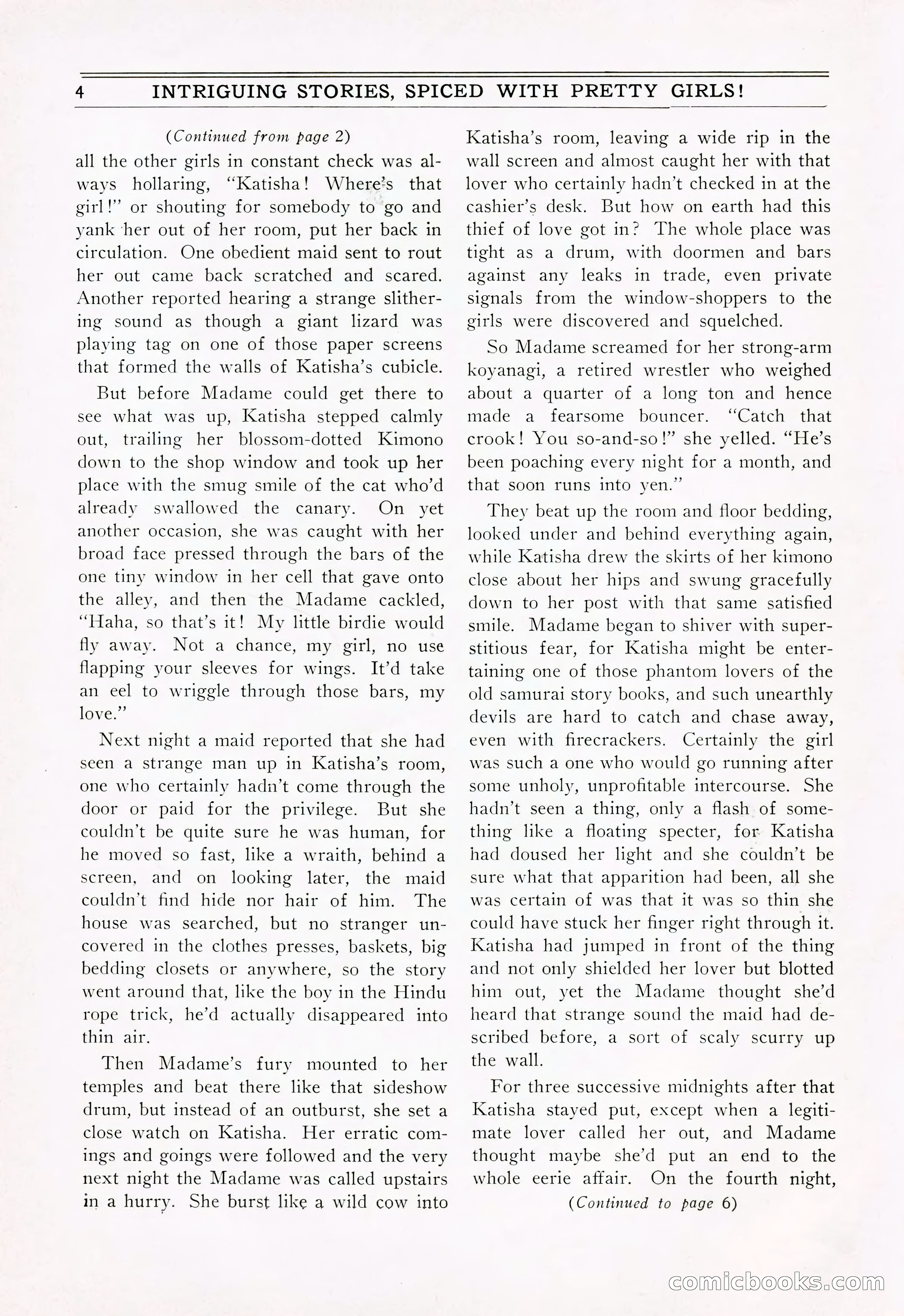
# Page Content Description This is a page of story prose from a pulp magazine, specifically page 4 from a story titled "Intriguing Stories, Spiced with Pretty Girls!" The text continues a narrative about a character named Katisha, a girl in what appears to be a Japanese-style establishment (possibly a geisha house). The story describes mysterious incidents—including an unexplained man appearing in Katisha's room and strange supernatural phenomena. Madame (the proprietor) becomes increasingly concerned about Katisha's activities and possible romantic escapades. The passage emphasizes the eerie, unexplained nature of these occurrences, suggesting either supernatural or criminal intrigue. The story continues to the next page.
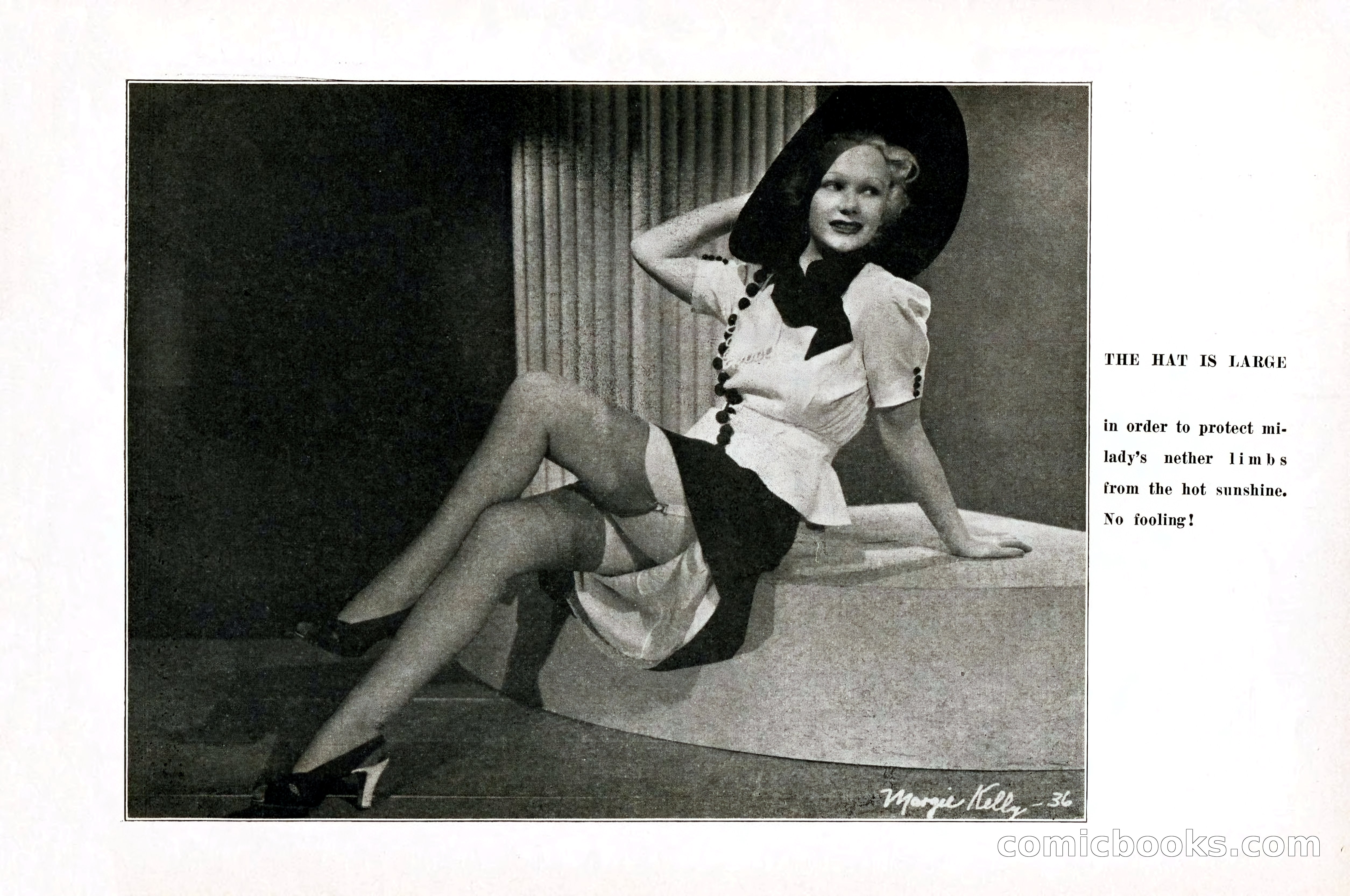
This is an advertisement page from a pulp magazine, featuring a black-and-white photograph of a woman in 1940s-style clothing posing on what appears to be a bench or ledge. She wears a wide-brimmed black hat, short-sleeved white blouse, and dark skirt. The accompanying text humorously explains that "THE HAT IS LARGE in order to protect mi-lady's nether limbs from the hot sunshine. No fooling!" The ad appears to be promoting either hats or summer fashion wear, using suggestive imagery and comedic copy typical of pulp magazine advertising from this era. A signature appears in the lower right corner of the photograph.
# Page Analysis This is a page of story prose from a pulp magazine, containing the conclusion of a narrative about a circus sideshow and a supernatural encounter. The upper section describes how a girl discovers that an apparent "phantom lover" visiting her at a circus is actually a living man—identified as the "Living Skeleton" performer—who has been sneaking through the bars. The story resolves when the circus owner stops the illicit meetings by securing the enclosure. Below this narrative conclusion is a separate, italicized first-person monologue from an unnamed character (appears to be a woman of disreputable profession) lamenting her social status and mistreatment, referencing locations from Shanghai to San Francisco and invoking Islamic and religious imagery about fate and judgment.
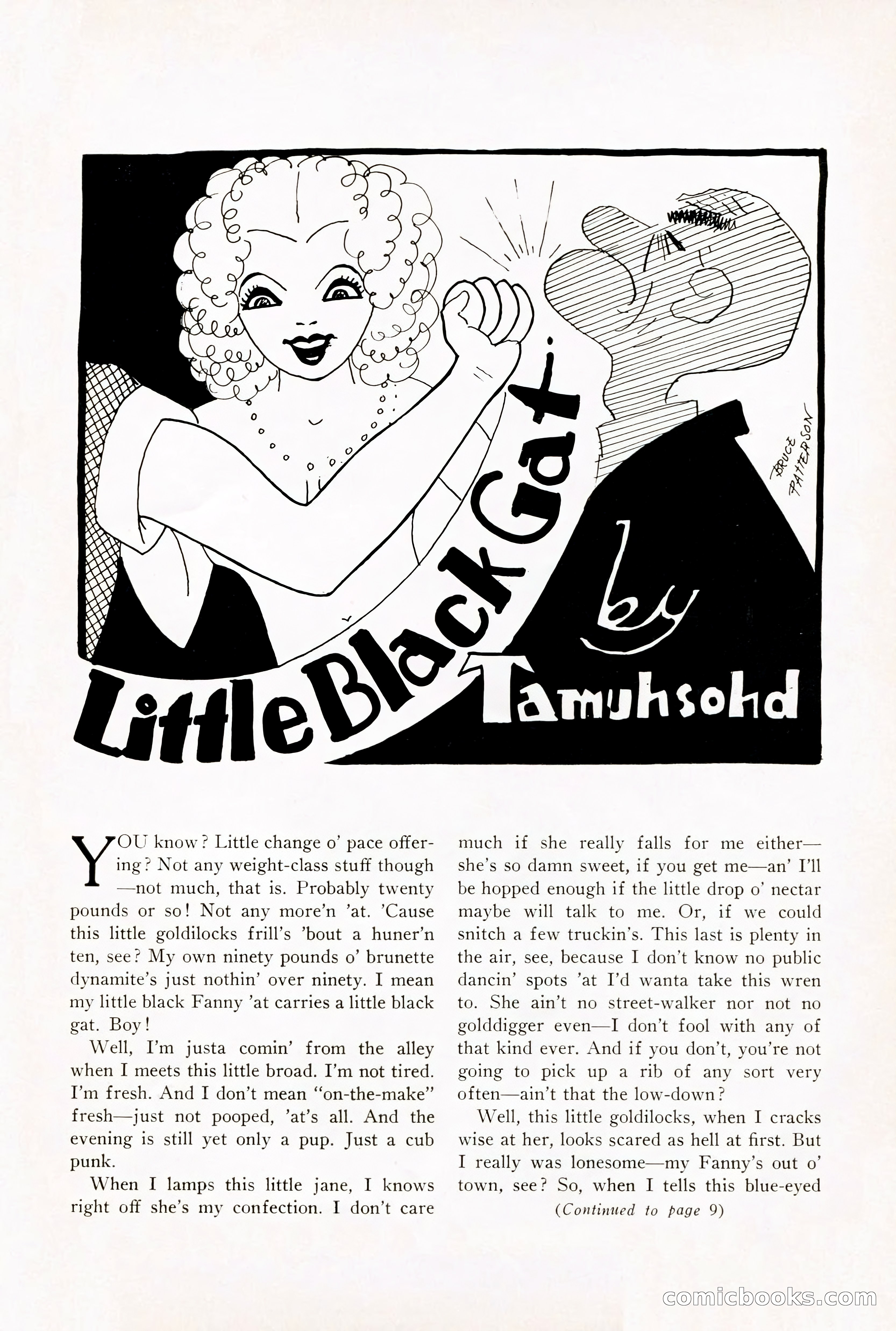
This is an interior story page featuring an illustration and prose text. The illustration shows a stylized woman with curled hair and jewelry, labeled "Little Black Gal" by what appears to be "Tamuhsohd" (signature unclear). Below the illustration is the beginning of a story written in first-person dialect narrative, in which a male narrator describes meeting a young woman and discusses his romantic intentions, commenting on her appearance and his own circumstances. The text continues to another page. The writing style and illustration are typical of early pulp fiction magazines, though the specific publication and story title remain unclear from this image alone.
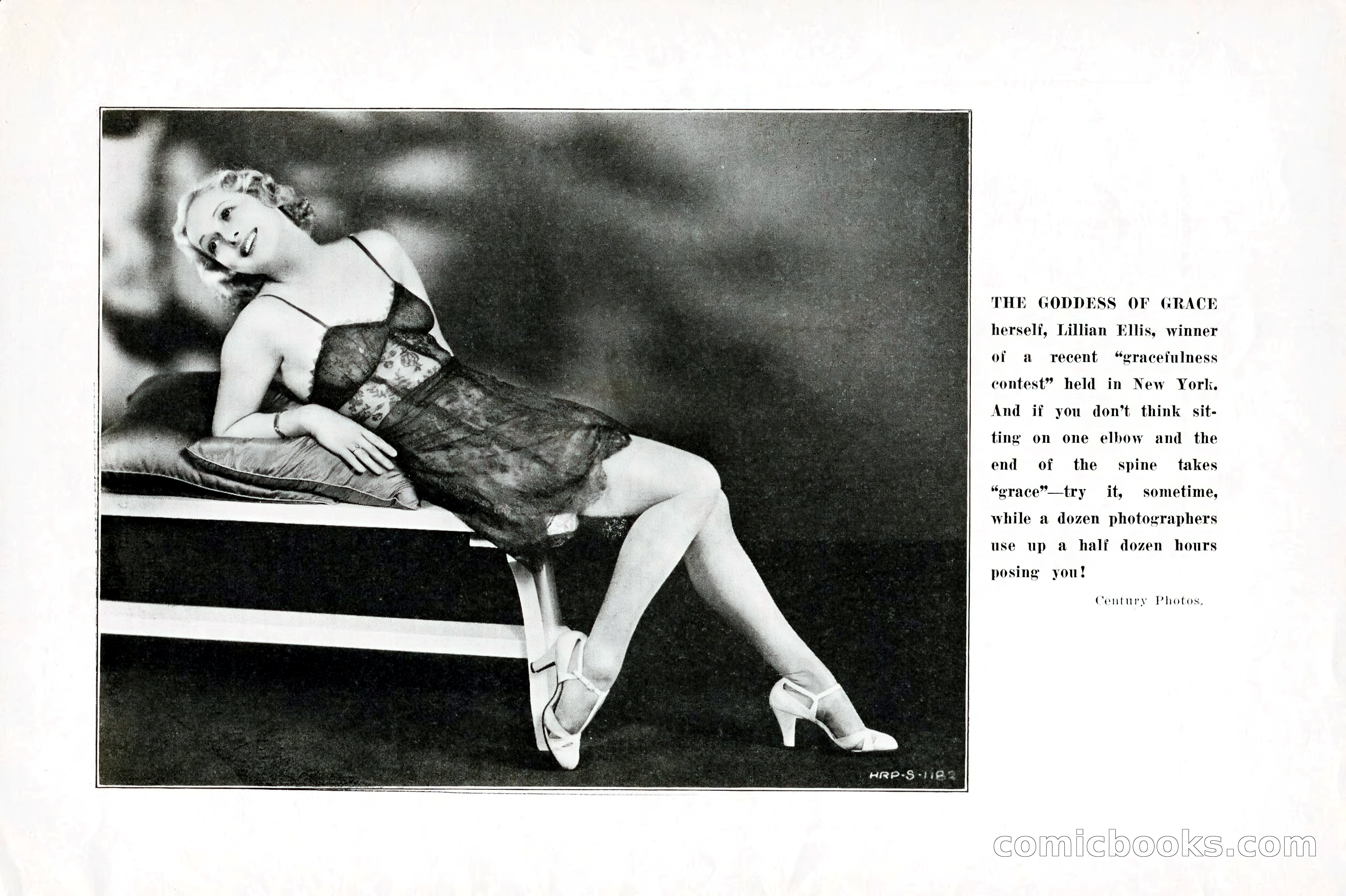
# Page Analysis This is an interior magazine page featuring a black-and-white photograph of a woman in glamorous pose on a bench, wearing heels and a patterned garment. The accompanying text identifies her as Lillian Ellis, winner of a recent "gracefulness contest" held in New York. The caption humorously notes the physical difficulty of achieving "grace" in the posed position—sitting on one elbow with the spine extended—while enduring hours of photography sessions with multiple photographers. The credit reads "Century Photos." This appears to be a entertainment/lifestyle feature rather than fiction content.
# Page Content Description This is a prose story page from a pulp magazine, specifically page 9 of a story titled "Intriguing Stories, Spiced with Pretty Girls!" The page continues a first-person narrative (appearing to be continued from page 7) about a male narrator's encounter with a woman at what seems to be a bar or social venue. The narrator describes his attraction to the woman, their flirtation, an incident involving another man getting hit with a hat, and the narrator's protective response. The text employs period slang and colloquial dialogue typical of early-20th-century hardboiled fiction, with the narrator using colorful language to describe the scene and his feelings toward his female companion.
# Page Analysis This is a prose story page from a pulp magazine, featuring two columns of text. The page number indicates this is page 10 from a publication titled "Intriguing Stories, Spiced with Pretty Girls!" The visible text appears to be a first-person narrative about a man describing a romantic encounter with a young woman at what seems to be a bar or social venue. The narrator mentions kissing her, ordering beer, and later having a conversation with a waiter about a woman named Fanny. The tone is casual and colloquial, typical of pulp fiction from the early-to-mid 20th century. No illustrations are visible on this page—it contains only text.
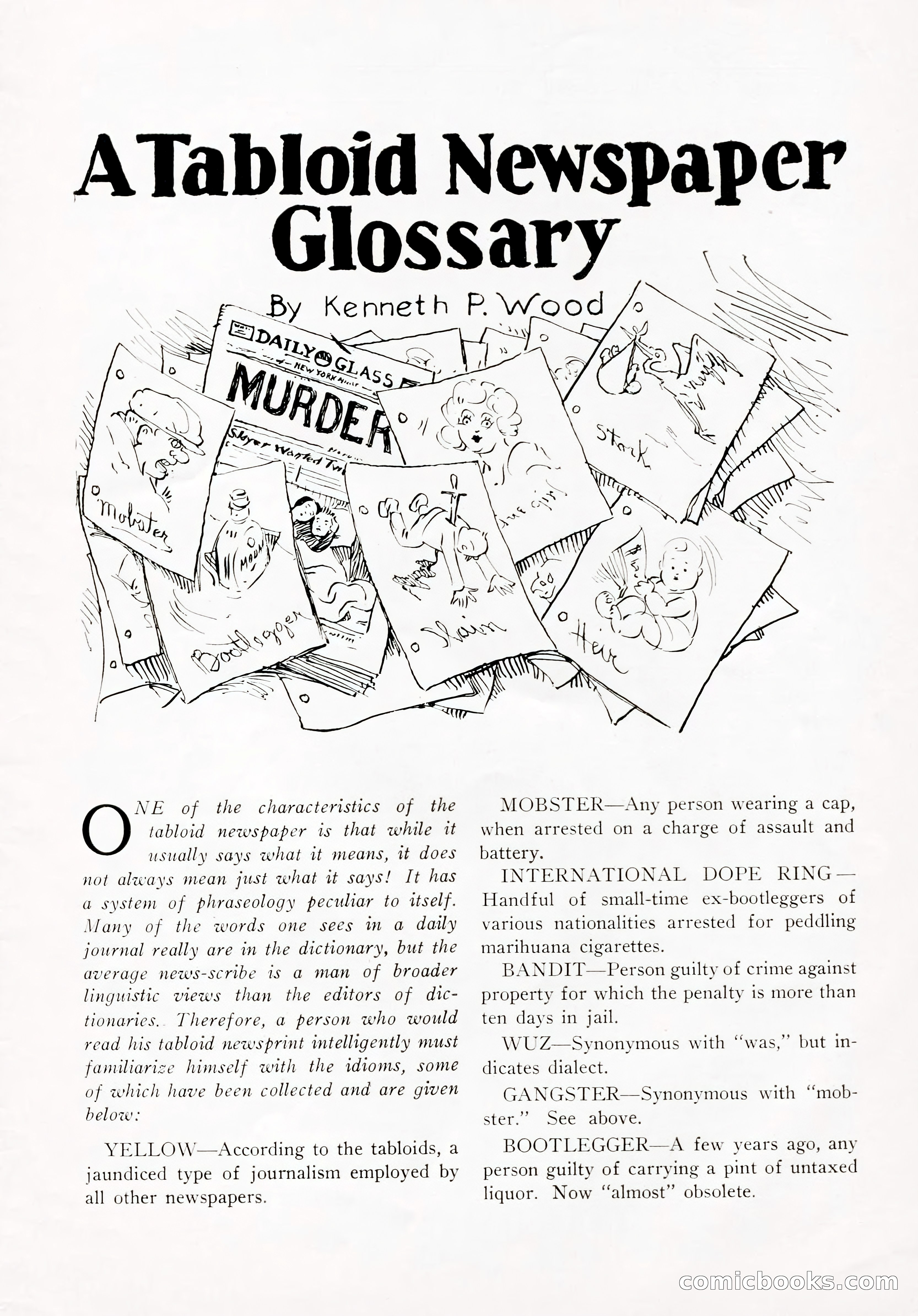
This is a glossary page titled "A Tabloid Newspaper Glossary" by Kenneth P. Wood. The illustration shows scattered newspapers and tabloid pages in a sketched style. The text defines slang terms and jargon specific to tabloid journalism and crime reporting, including "Yellow" (sensationalist journalism), "Mobster" (person wearing a cap arrested for assault and battery), "International Dope Ring" (drug smugglers), "Bandit" (property crime perpetrator), "Wuz" (dialectal for "was"), "Gangster" (synonym for mobster), and "Bootlegger" (once common, now nearly obsolete for illegal liquor carriers). The glossary appears designed to help readers understand tabloid newspaper terminology and criminal slang from the era.
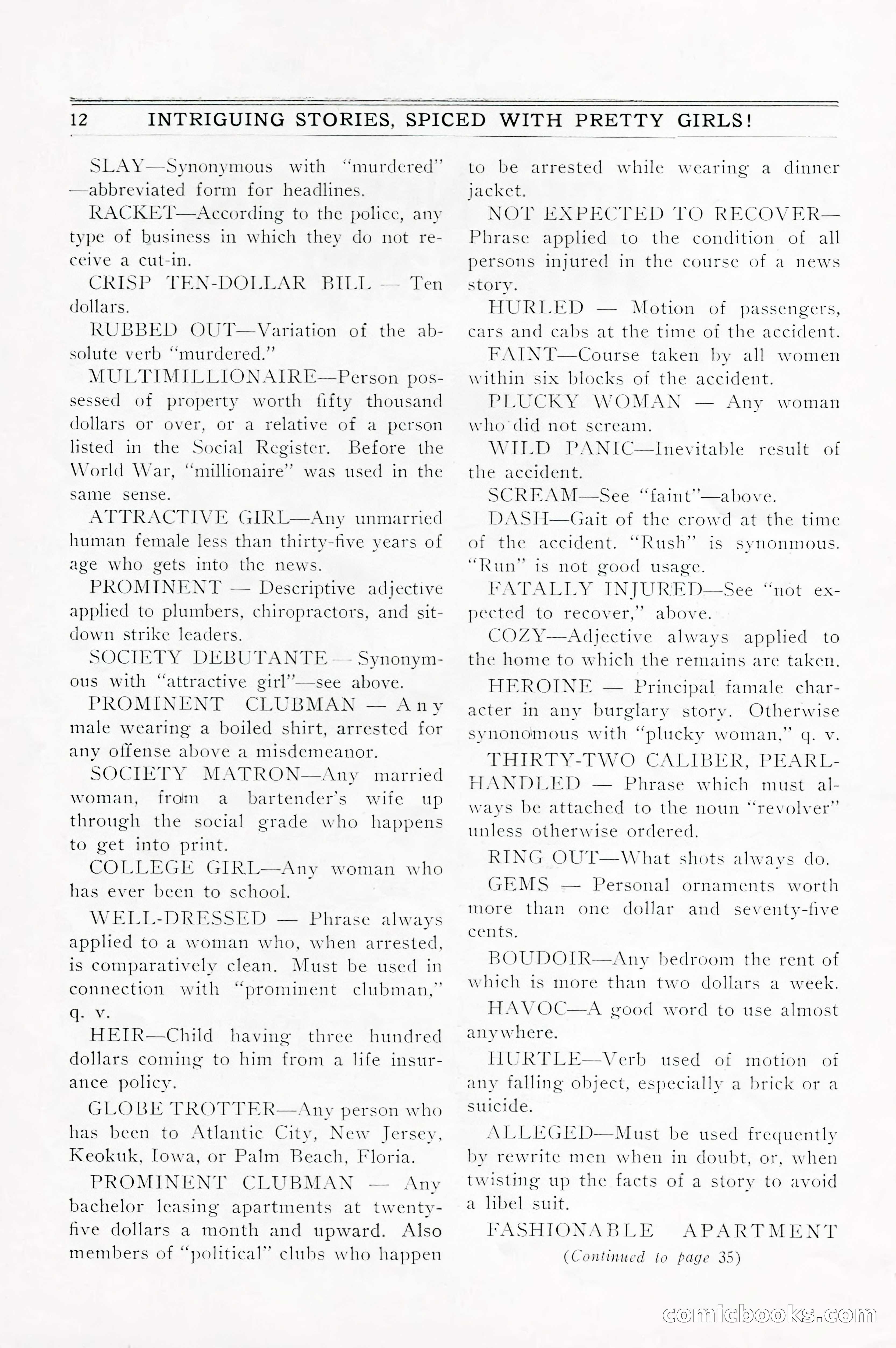
# Page Content Description This page is text-only prose — specifically, a glossary or reference guide titled "Intriguing Stories, Spiced with Pretty Girls!" It appears on page 12 of the publication. The page contains definitions of slang and jargon terms used in pulp fiction, particularly in crime and news stories. Terms defined include "slay," "racket," "crisp ten-dollar bill," "multimillionaire," "attractive girl," "prominent," and many others related to criminal activity, social status, and dramatic incident reporting. The definitions are written in a tongue-in-cheek style, explaining how these terms function within pulp narrative conventions. A note at the bottom indicates the glossary continues on page 35.
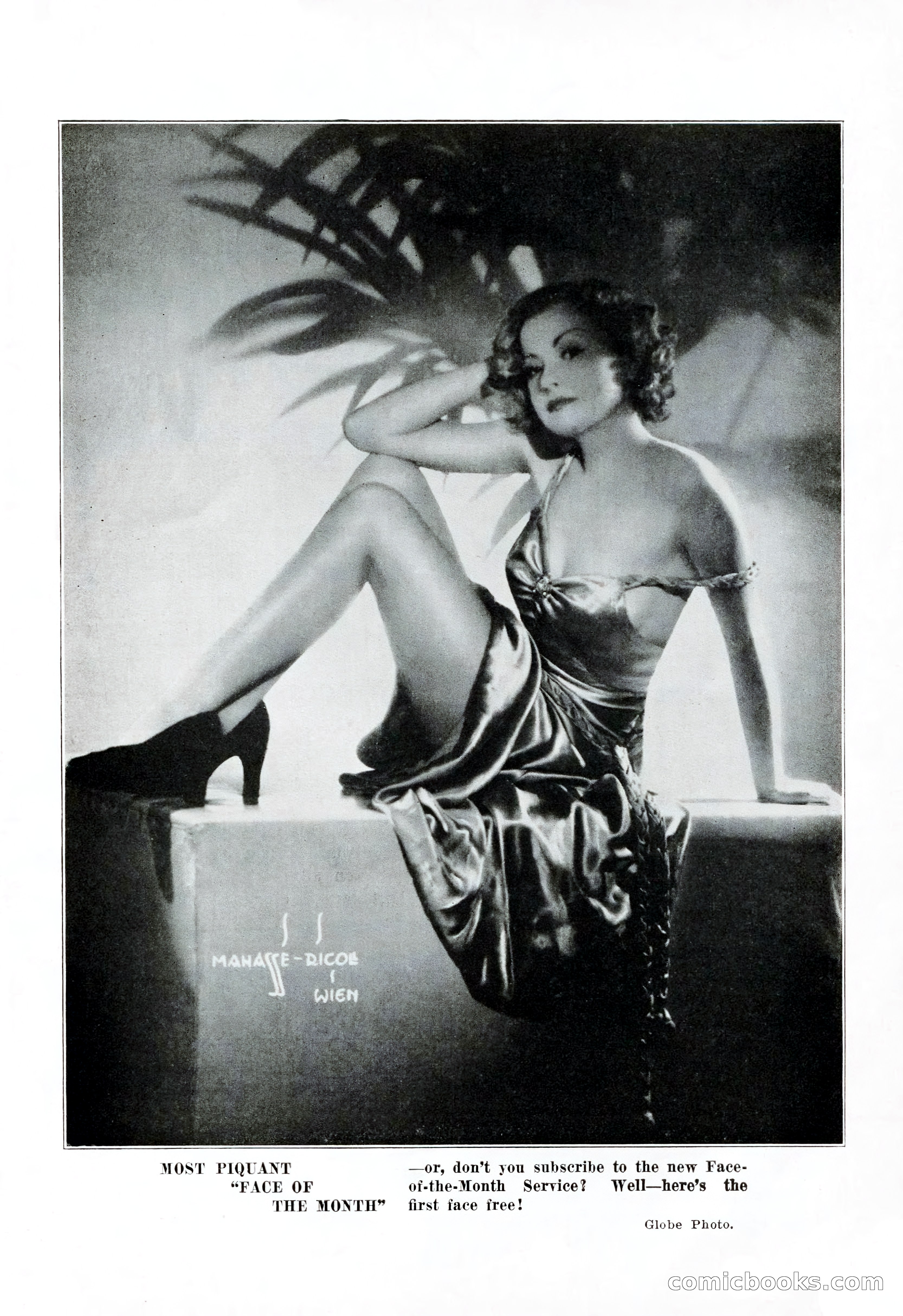
# Page Description This is an advertisement page featuring a glamorous black-and-white photograph of a woman in 1930s-style dress and heels, posed reclining on what appears to be furniture. The photo is credited to "Mahaitte-Bicol Wien" and "Globe Photo." The text below reads "MOST PIQUANT" and promotes a new "Face-of-the-Month Service," offering the pictured photograph as a free sample to encourage subscriptions. The advertisement uses suggestive language typical of pulp-era marketing, positioning this as an incentive for readers to join the service. The overall presentation is characteristic of early 20th-century entertainment and lifestyle advertising found in pulp magazines.
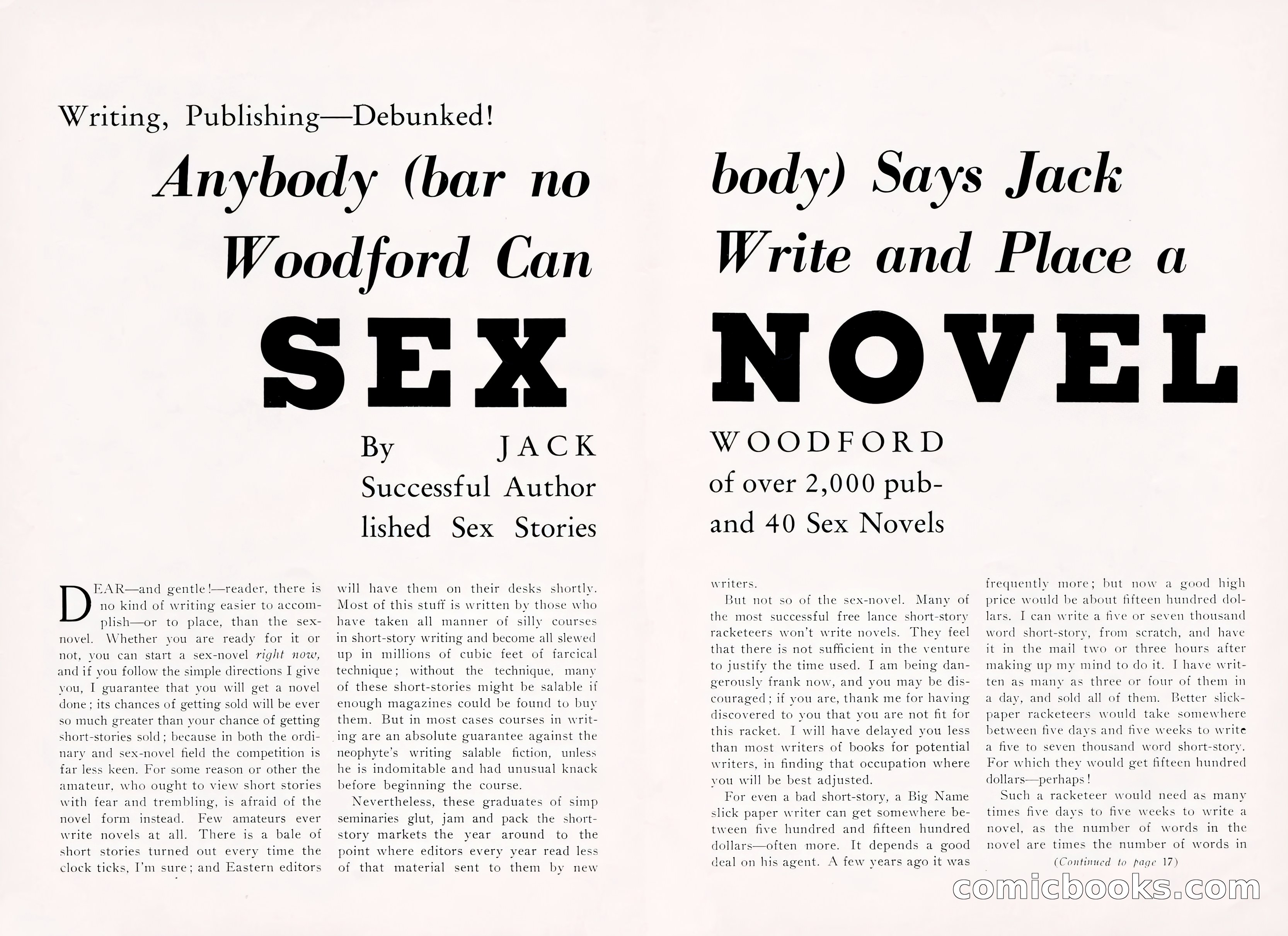
# Analysis of This Page This appears to be an article or advertisement page (not a story) from a pulp magazine. The page promotes Jack Woodford, described as a "Successful Author" of over 2,000 published sex stories and 40 sex novels. The visible text discusses writing and publishing sex novels. It claims that anybody can write and sell a sex novel, offering guidance on the genre's commercial viability. The page argues that sex novels face less competition than short stories in the marketplace, and suggests that even mediocre writers can find success in this particular publishing niche. The layout includes large bold typography advertising "SEX NOVEL" alongside the author's name and credentials, indicating this is promotional content rather than fictional narrative prose.
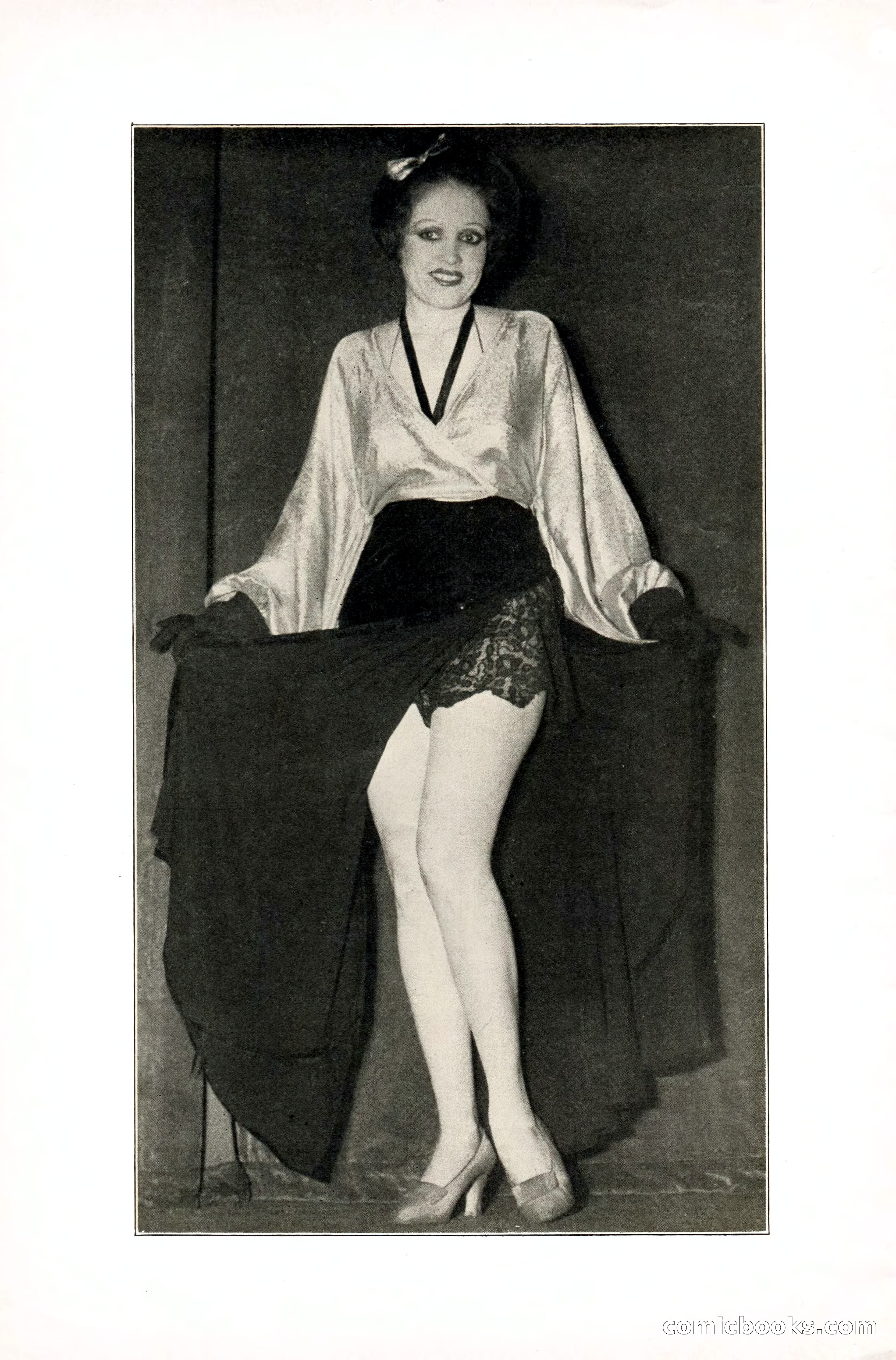
# Analysis This is a **full-page photograph or illustration**, likely from an early-20th-century pulp magazine. The image shows a woman in period costume consisting of a light-colored wrap or robe over dark undergarments, posed against a plain backdrop. She wears a decorative hair ornament and heeled shoes. The photograph appears to be a studio portrait rather than story illustration, though without visible OCR text on the page itself, the specific context is unclear. The styling and photography technique are consistent with pulp magazine entertainment photography from the 1920s-1930s era. No readable text is visible in the image to indicate the magazine title, story content, or accompanying article.
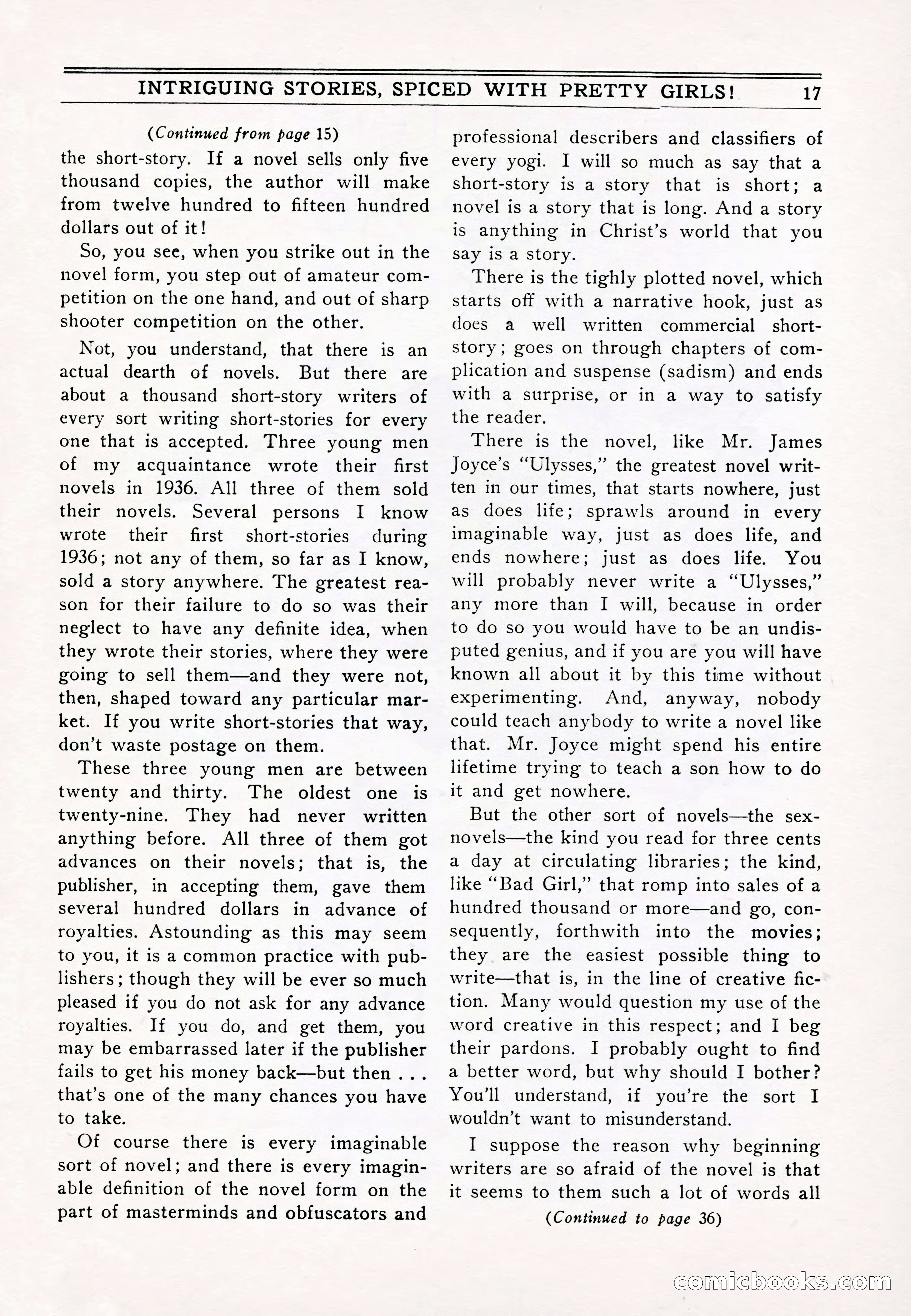
# Page 17: Story Prose This page contains prose text continuing from page 15, discussing the economics and craft of novel versus short-story writing. The author argues that short stories offer better financial returns for new writers than novels, and distinguishes between different novel types: tightly plotted commercial works versus experimental novels like James Joyce's "Ulysses." The text advises beginning writers that novels are difficult to teach and that "sex novels"—pulp fiction sold at circulating libraries—are easier to write and more commercially viable, frequently adapted into films. The piece expresses skepticism about the term "creative fiction" while discussing why new writers find novel-writing intimidating.
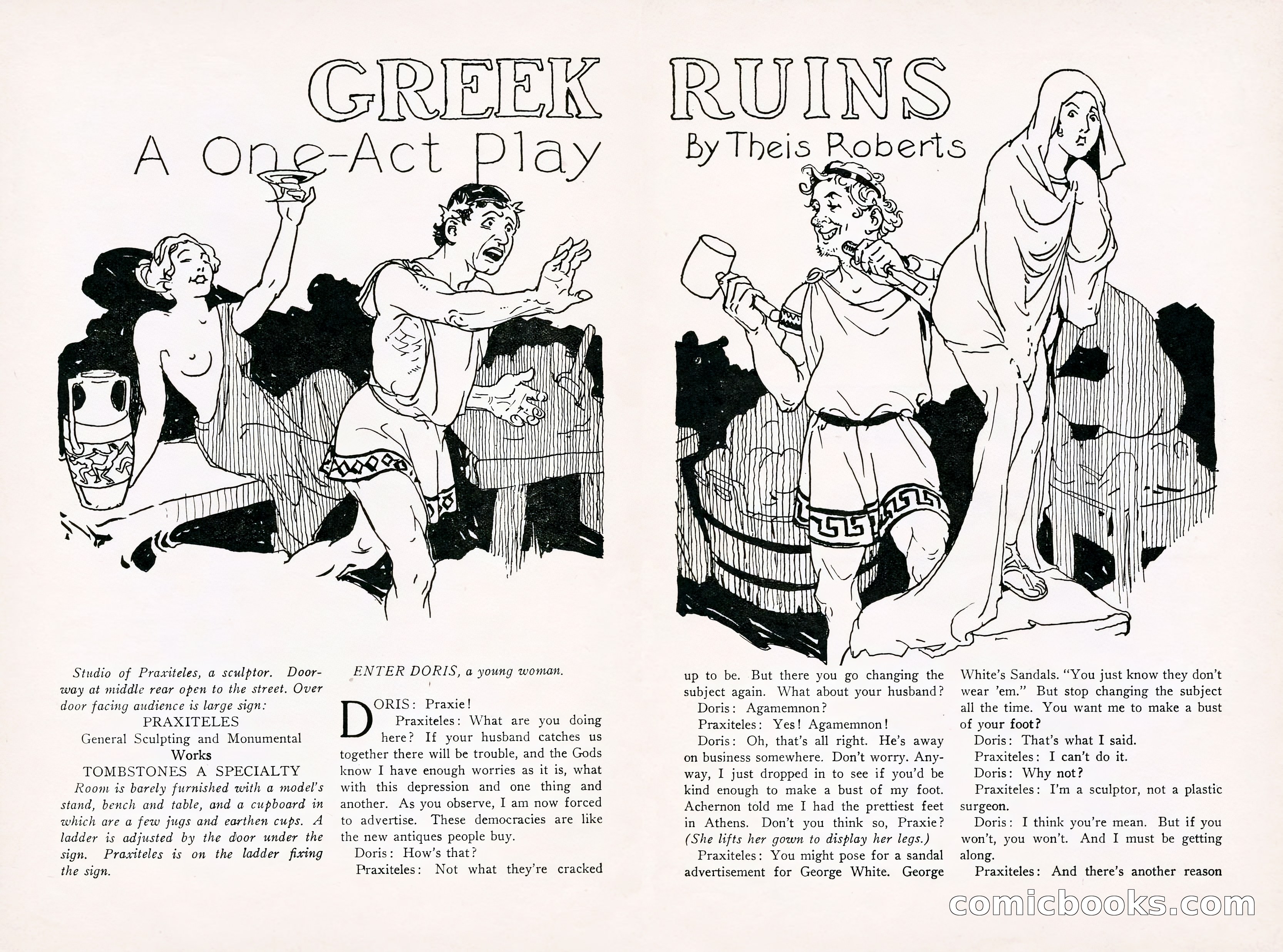
# Greek Ruins: A One-Act Play This page presents the opening of a one-act comedy play by Theis Roberts, featuring illustrated scenes of characters in classical Greek dress. The left illustration shows a lively party scene with figures in various states of undress and merriment, while the right illustration depicts what appears to be a more formal interaction between characters. The dialogue begins with a character named Doris entering and speaking with Praxiteles, a sculptor. The conversation concerns Doris's husband being away on business and her desire to commission Praxiteles to create a bust of her foot as an advertisement for George White's Scandals. The text includes stage directions and character interactions typical of theatrical comedy.
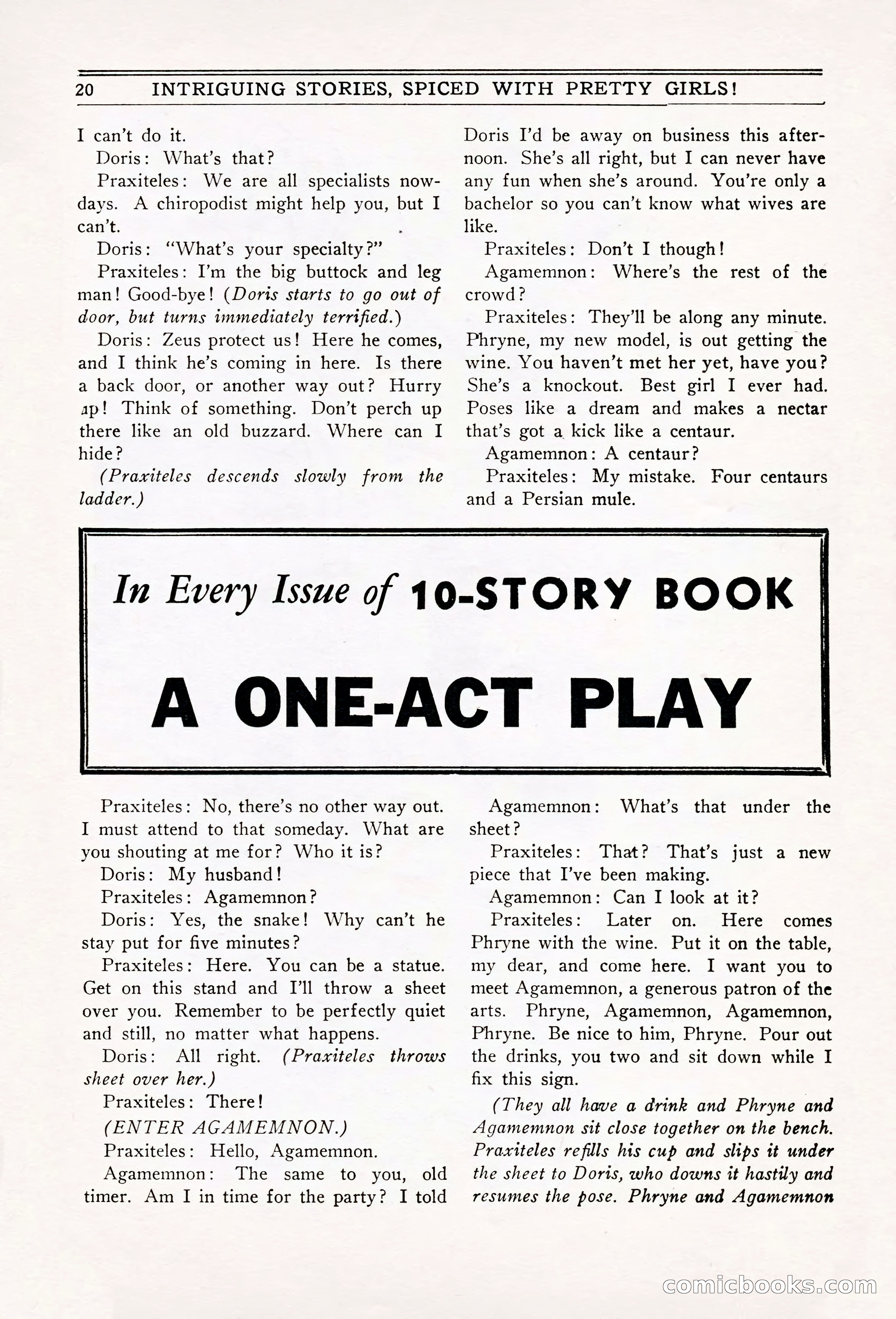
# Page Analysis This is a text page from a pulp magazine containing story prose and dialogue. The visible content shows a comedic one-act play titled "A ONE-ACT PLAY" (advertised as appearing in every issue of "10-STORY BOOK"). The dialogue involves characters named Doris, Praxiteles, and Agamemnon discussing a dinner party and art patronage. The scene appears humorous, with references to mythology (centaurs, Zeus, Persian mules) and domestic comedy—Doris is anxious about her absent husband's arrival while entertaining guests. Stage directions indicate physical comedy, including one character posing as a statue and another passing drinks under a sheet. The tone is light entertainment typical of early pulp magazine fiction.
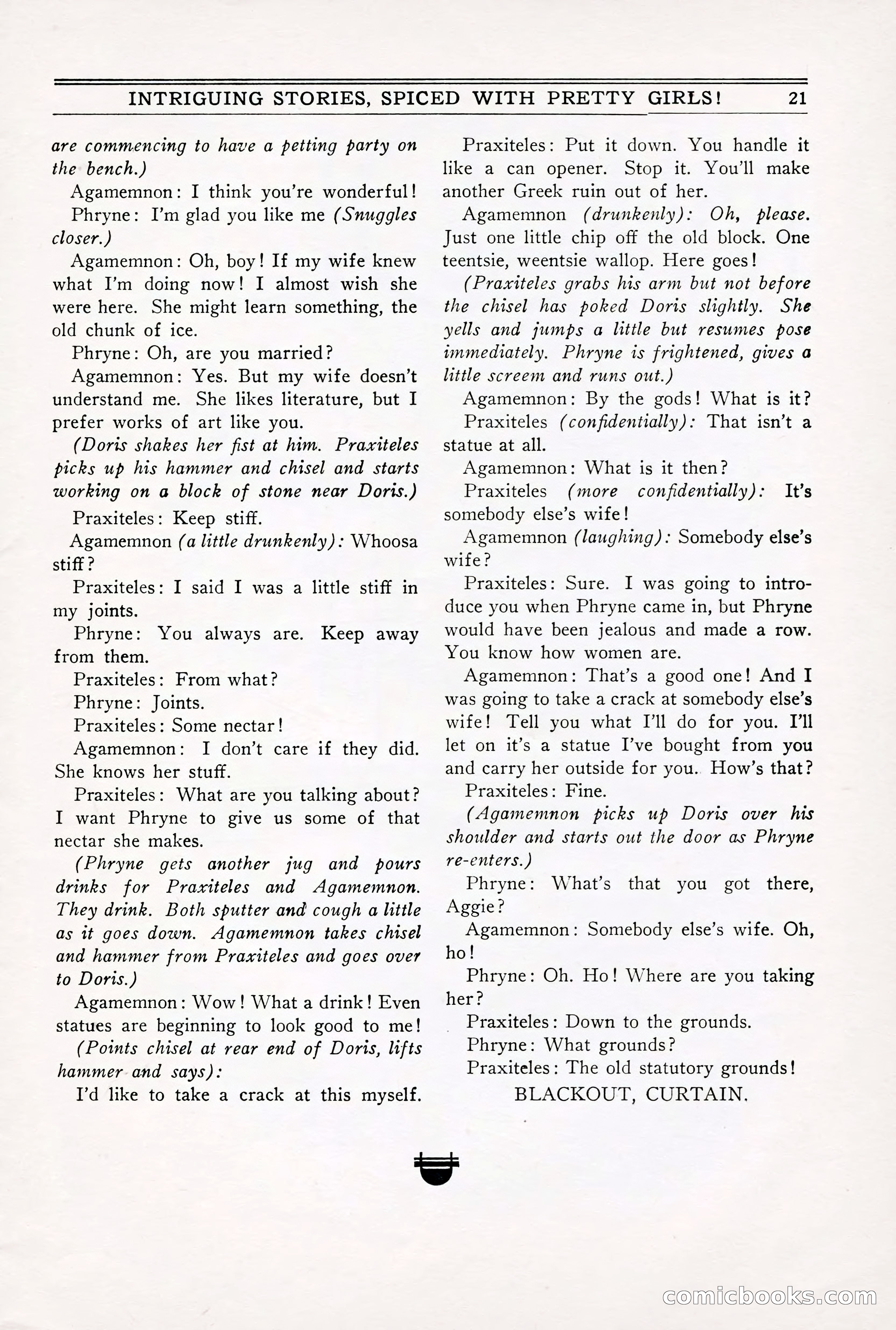
# Page 21 - Story Prose This page contains dialogue-heavy prose from a comedic theatrical piece titled "Intriguing Stories, Spiced with Pretty Girls!" The scene depicts characters named Agamemnon, Phryne, Praxiteles, and Doris in what appears to be a sculptor's studio. The plot involves Agamemnon attempting to commission a sculpture from Praxiteles, with humorous misunderstandings ensuing—particularly involving Praxiteles offering to show Agamemnon another man's wife (presented as a statue) rather than introduce him to Phryne. The scene culminates with Agamemnon leaving with the sculpture to take to "the old statutory grounds." The tone is light and flirtatious throughout.
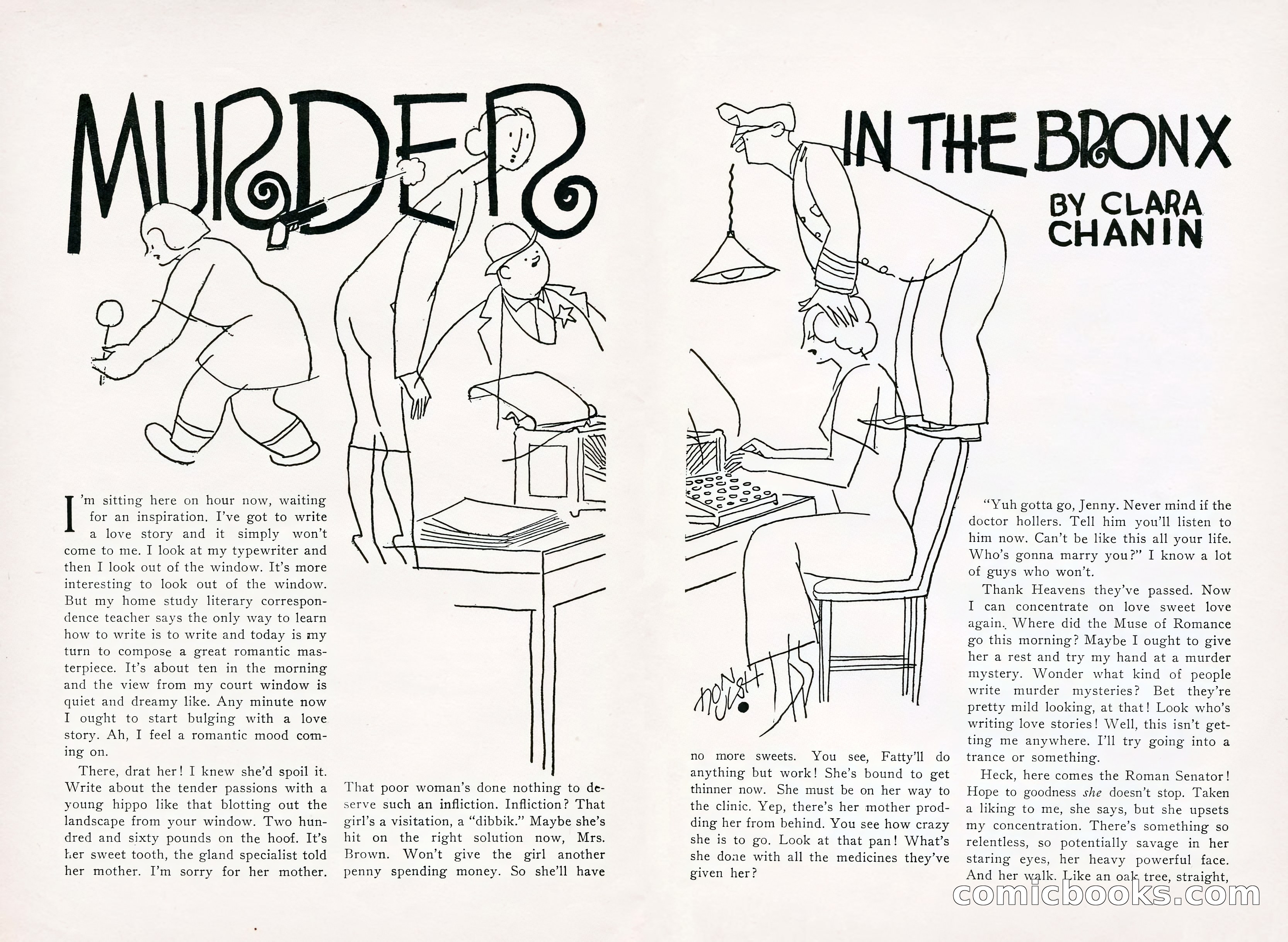
This page contains two illustrated short stories from an early pulp magazine. On the left is "Murder" (author unclear), depicting a scene with multiple figures in what appears to be a crime scenario, accompanying prose about a writer struggling with literary composition. On the right is "In the Bronx" by Clara Chanin, showing an interior domestic scene with figures, accompanying text about a character named Jenny and concerns regarding romantic relationships and a visit to a clinic. Both stories are presented with line-drawn illustrations in the typical pulp magazine style, with text wrapping around the artwork.
# Page Analysis This is story prose from a pulp magazine (page 24), with no illustrations visible. The text is a first-person narrative about the narrator's relationship with a woman nicknamed "Sphinx Face" or "Lucy" (real name Lucretia), who is characterized as eccentric, dark-minded, and dangerously intellectual—interested in poison, voodoo, cannibalism, and crime. The narrator describes her morbid fascinations and hints at her suspicious behavior, including what appears to be sneaking into someone else's house. The passage reads as noir or crime fiction with darkly comedic elements, establishing the woman as a potentially sinister character while the narrator contemplates whether she might commit "the perfect crime."
# Page 25: Story Prose This page contains dense prose fiction from a pulp magazine story titled "Intriguing Stories, Spiced with Pretty Girls!" The text presents a first-person narrative from what appears to be a murderer planning or reflecting on crimes, including poisoning and body disposal methods. The passage then shifts to describe police responding to an incident at an apartment, with dialogue between officers and a woman named Mrs. Brown regarding a victim. The prose is sensationalistic and graphic, typical of early pulp crime or horror fiction, focusing on violence and criminal psychology rather than any science fiction or fantasy elements.
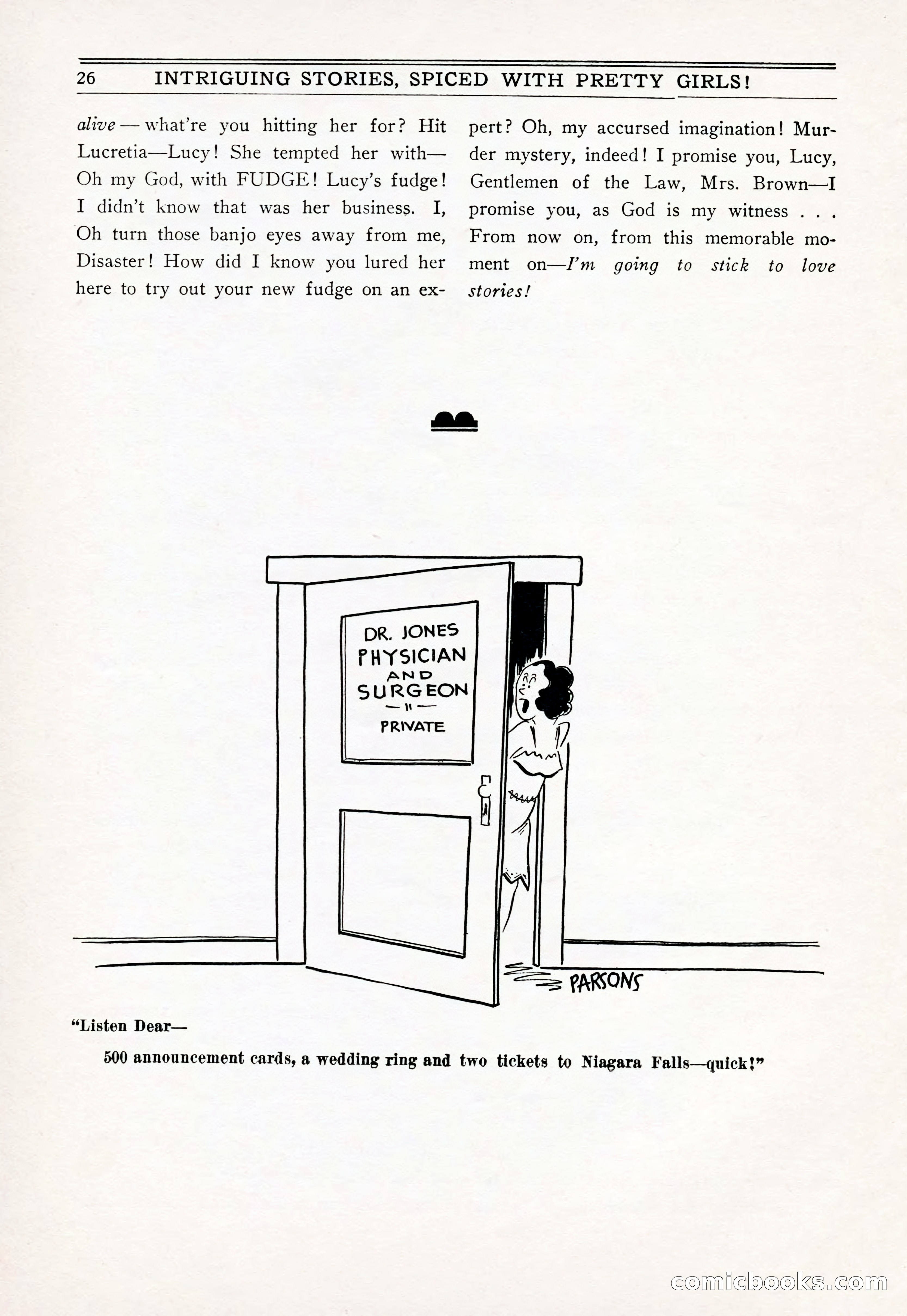
# Page Analysis This is an interior story page containing both prose and an illustration. The text at top concludes a dramatic scene where a man accuses a woman named Lucy of tempting him with fudge, then declares he's "going to stick to love stories!" Below is a cartoon illustration by Parsons showing a woman peering around a doorway at a doctor's office (labeled "DR. JONES PHYSICIAN AND SURGEON PRIVATE"). The caption beneath reads: "Listen Dear— 500 announcement cards, a wedding ring and two tickets to Niagara Falls—quick!" The humor appears to derive from the woman attempting to pressure the doctor into marriage using these inducements. The style and content are typical of early-20th-century pulp magazine humor.
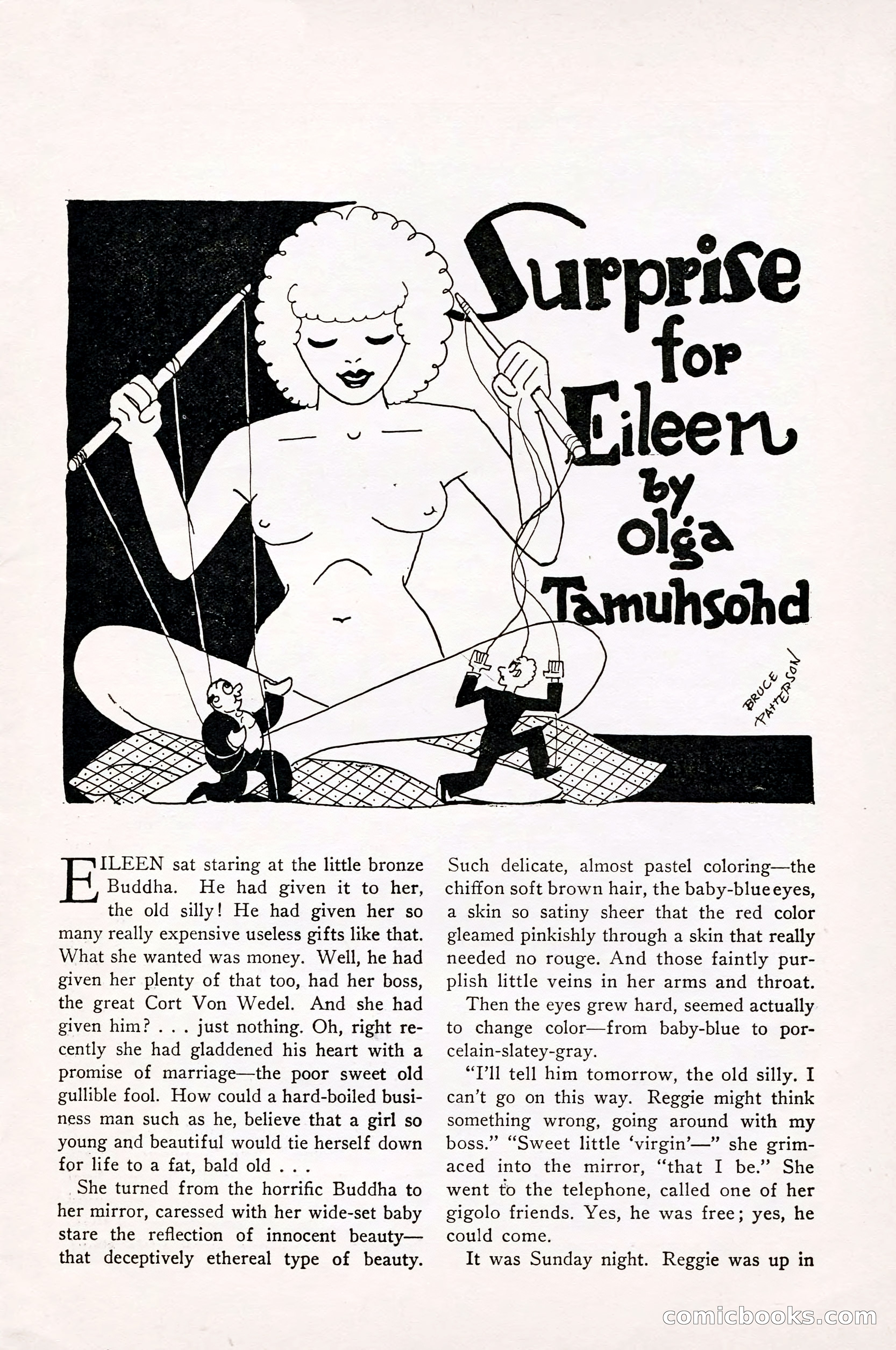
This is an interior story page from a pulp magazine, featuring both illustration and prose text. The illustration at the top shows a stylized art deco design with a large female figure and two smaller male figures below, credited to artist Bruce. The title reads "Surprise for Eileen by Olga Tamuhsohd." The prose below describes a character named Eileen contemplating her relationship with an older wealthy man named Cort Von Wedel, to whom she has promised marriage. The text reveals her dissatisfaction with expensive but useless gifts when she actually desires money and independence. She considers contacting a man named Reggie, noting it is Sunday night. The narrative tone is cynical regarding Eileen's mercenary motivations.
This page contains story prose from a pulp magazine titled "Intriguing Stories, Spiced with Pretty Girls!" (visible in the header). The text depicts a romantic drama involving a young woman named Eileen who works as a secretary to Cort Von Wedel, an older man. The narrative involves her resignation from the position, her engagement to a man her own age, and subsequent pressure from Von Wedel's son Reginald to attend a family party at a Berkshire bungalow. The prose is formatted in two columns and appears to be mid-story, focusing on workplace romance and social obligations rather than providing any visible illustrations.
# Page 29: Story Prose with Newspaper Clipping This page contains the conclusion of a short story about a man named Reggie who discovers his wife Maisie has been released from prison and is arriving to meet him. The narrative describes his surprise encounter with her in bed, her reaction to finding another woman (a gigolo) there, and his defensive response about their relationship. Below the story text is a newspaper clipping titled "Men Will Be Men!" from the Little Creek, Michigan Record, which reports that a woman named Mrs. Slowgoe filed for divorce, alleging her husband behaved strangely on their wedding night in June. The clipping appears designed to humorously relate to the fictional story above it.
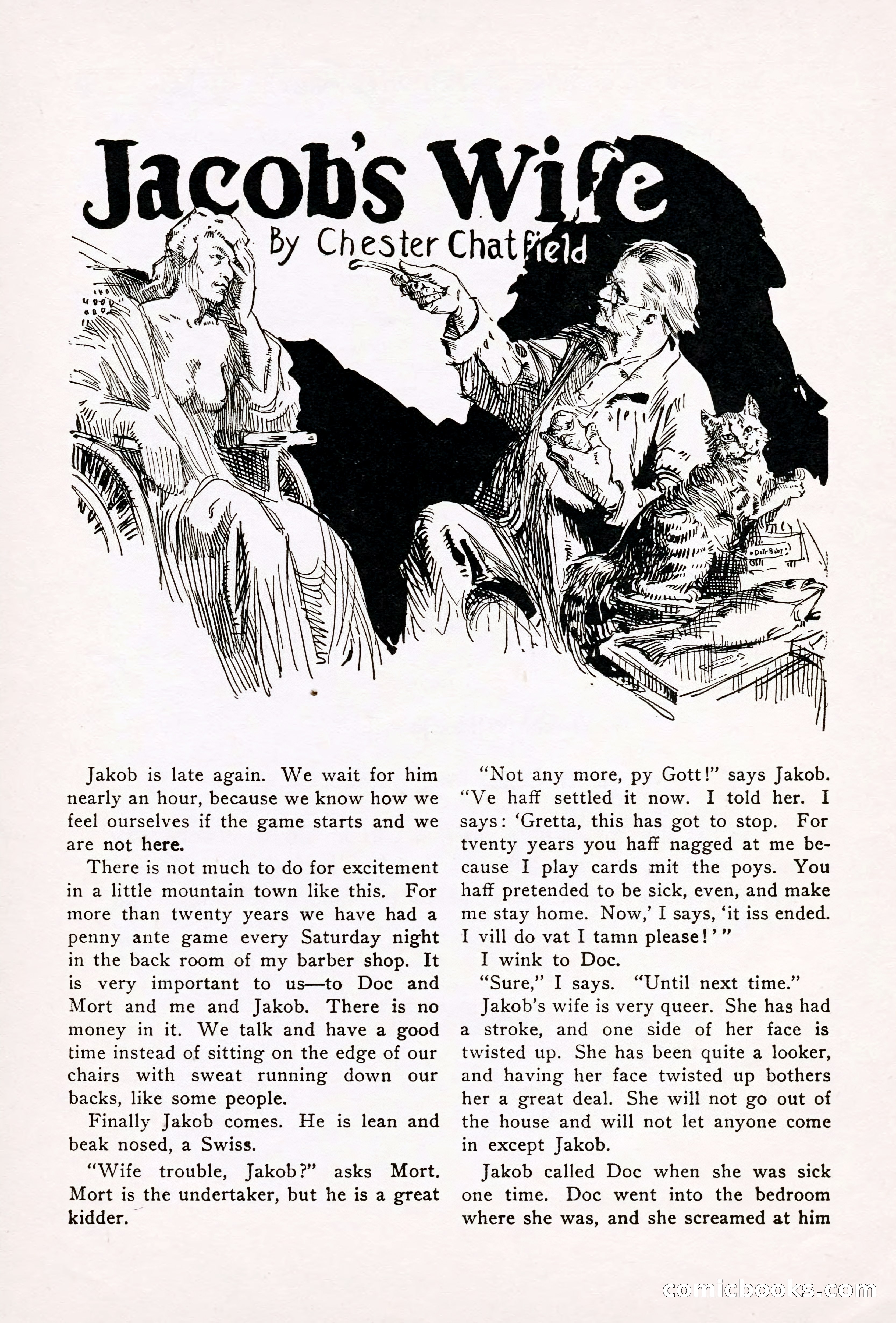
# Jacob's Wife by Chester Chatfield This page contains story prose illustrated with a black-and-white line drawing. The illustration shows three men in a barber shop setting, with one seated and others standing nearby. The narrative describes Jakob, who is chronically late to a weekly penny-ante card game held in the narrator's barber shop for the past twenty years. When Jakob finally arrives, the narrator asks about his wife troubles. The text reveals that Jakob's wife has had a stroke leaving her face twisted, and she refuses to leave the house or allow visitors except Jakob. Jakob reports he has recently told his wife he is ending his card-playing habit, though the resolution remains unclear at this page's conclusion.
# Page 31: Story Prose This page contains the continuation of a narrative story titled "Intriguing Stories, Spiced with Pretty Girls!" The text describes tragic events in what appears to be a small town: Jakob, a taxidermist and inventor, dies in a hotel fire while helping fight the blaze. The narrator and a character named Doc visit Jakob's wife to inform her of his death, finding her in a wheelchair, apparently having suffered a stroke. The narrator discovers Jakob's wife is actually taxidermied—she is dead, though a character named Mort plans to bury her despite her being preserved as "a work of art."
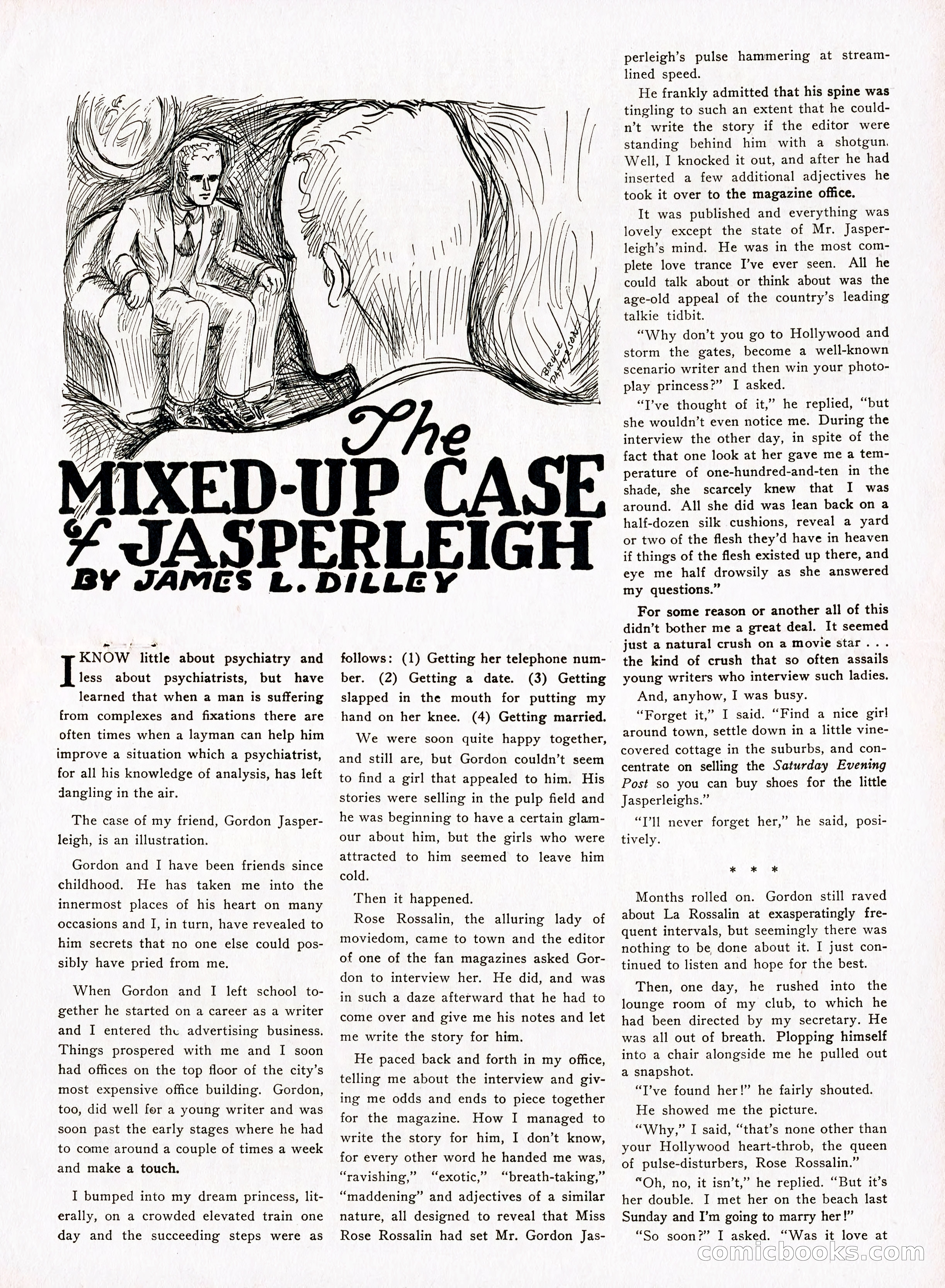
This page contains the opening of a short story titled "The Mixed-Up Case of Jasperleigh" by James L. Dilley. The illustration shows a man sitting in a chair, appearing anxious or troubled. The prose describes how the narrator, a writer in advertising, befriended Gordon Jasperleigh in childhood and later helped him by writing a magazine story based on an interview Gordon conducted with Rose Rossalin, a movie actress. The text suggests that Gordon became infatuated with Rose and announced his intention to marry her, though the narrator questions whether this romance is genuine or a delusion.
# Page Analysis This is a text-only story page from a pulp magazine titled "Intriguing Stories, Spiced with Pretty Girls!" (visible in the header). The page contains prose narrative dialogue between characters named Tom and Gordon, discussing Gordon's recent marriage to a woman named Marjorie. Gordon reveals he was previously infatuated with a woman named Rose Rossalin but married Marjorie instead, and appears to be confessing to Tom about experiencing some disillusionment with married life after three months. The conversation continues at the bottom with a note indicating the story continues on page 57. The page is numbered 34.
# Page Content Analysis This is a text-only page (page 35) from a pulp magazine containing satirical humor content. The page features "A Tabloid Newspaper Glossary," a comedic reference guide that defines journalism and tabloid jargon with cynical wit—for example, defining "HOUSE" as any dwelling with an elevator, and "STORK" as something always paired with "love nest." Below the glossary is a brief humorous anecdote titled "Line Forms to Right, Doughboys!" from the Elton, New York Eagle, concerning a hotel telegraph operator's instructions to American Legion guests. The page demonstrates the magazine's focus on satirical commentary about contemporary media and society.
# Page Analysis This is a text-only page from a pulp magazine (page 36) containing an article titled "Anybody Can Write a Sex Novel Says Jack Woodford," continued from page 17. The piece discusses novel writing practices in the publishing industry, focusing on word counts, editing, and the commercial viability of sex novels. Woodford shares anecdotes about his own publishing experiences, including details about a 1932 novel called "City Limits" and observations about other writers like Ben Hecht and Edgar Wallace. The article appears to be practical advice or commentary about the mechanics of commercial fiction writing during the early 20th century.
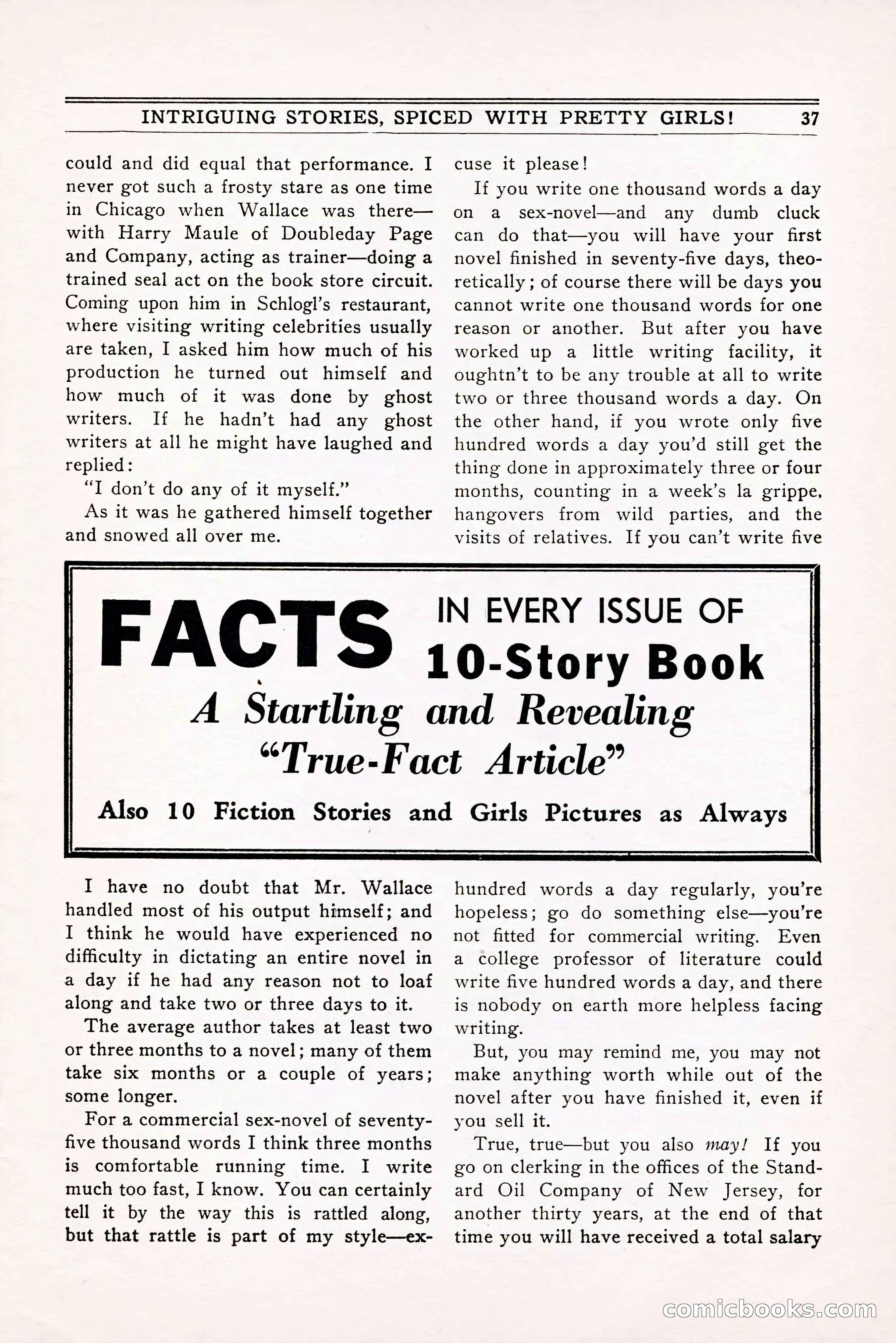
# Page Analysis This is a page of story prose from a pulp magazine. The text discusses writing productivity and commercial fiction output, apparently recounting a conversation with someone named Wallace about ghost writers and novel production. The author reflects on realistic writing speeds for commercial sex-novels, suggesting one thousand words daily as a target, though acknowledging most writers produce less consistently. An advertisement box interrupts the prose, promoting "10-Story Book" magazine, which claims to feature "true-fact articles" alongside fiction stories and pictures of girls. The page number indicates this is page 37 from a publication titled "Intriguing Stories, Spiced with Pretty Girls!"
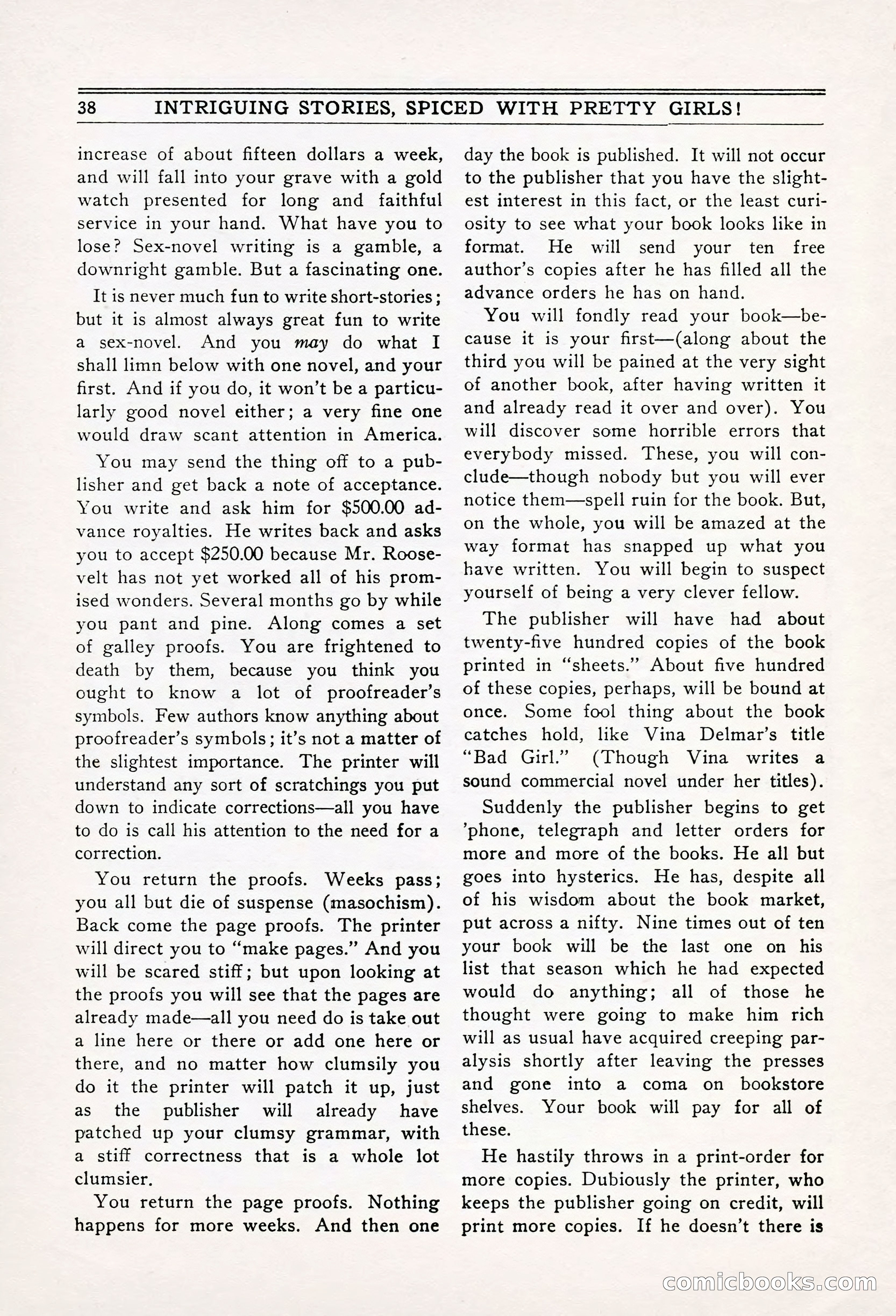
# Page Description This is story prose from a pulp magazine, specifically page 38 titled "INTRIGUING STORIES, SPICED WITH PRETTY GIRLS!" The text is a satirical guide addressing aspiring authors about the publishing process for pulp fiction novels. It describes the submission, acceptance, revision, and printing stages—from negotiating advances with publishers to dealing with galley proofs and printer corrections. The piece humorously chronicles how a first novel moves through production, including the author's anxiety about errors, the publisher's sudden enthusiasm when the book begins selling well, and the inevitable reprinting of additional copies. The tone is cynical and comedic about commercial publishing realities.
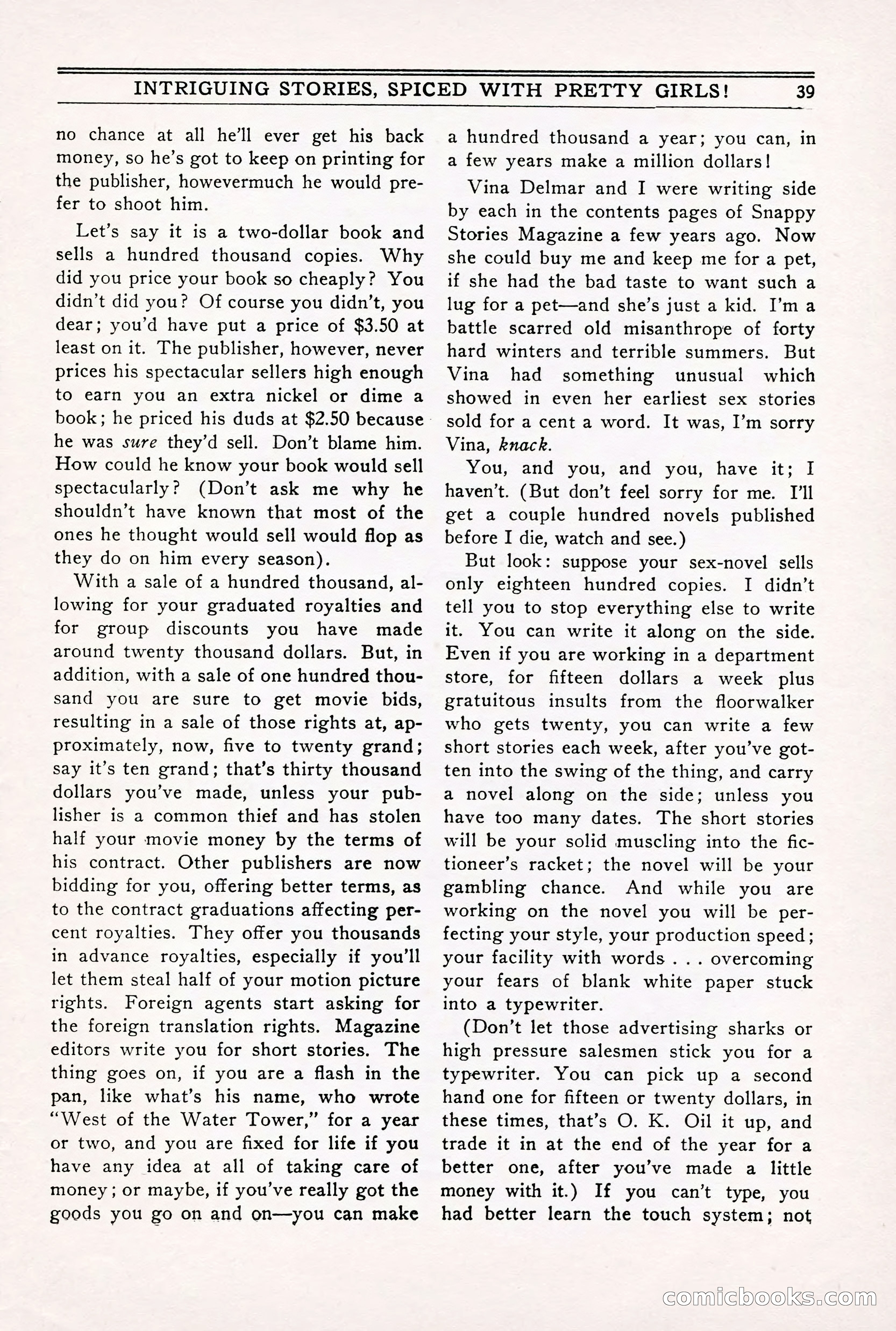
# Page Description This is a text-only page (page 39) from a pulp magazine, containing prose advice about writing and publishing pulp fiction stories. The author discusses the economics of pulp fiction publishing—book pricing, royalties, and sales figures—while offering practical guidance to aspiring writers. The passage mentions a writer named Vina Delmar and references to *Snappy Stories Magazine*. The author advises that even modest sales of sex-novels can be profitable, and encourages writers to work on short stories while developing longer novels simultaneously. The text concludes with practical tips about typewriter selection and typing proficiency for aspiring fiction writers.
# Page Description This is a text page (page 40) from a pulp magazine containing the conclusion of an article about typewriters for writers, followed by promotional material and a teaser for next month's content. The upper section concludes advice about using Underwood typewriters, warning that portable models are impractical for serious writers. A boxed note advertises Jack Woodford's writing guide "Trial and Error" (1937), published by Carlyle House, available at bookstores for $3. Below this, centered text announces next month's "Sensational FACT Article": **"The Neighborhood Sex Headquarters is The Beer Tavern,"** described as "As Told by a Real Tavern Keeper Who Is Disgusted With His Job." The page is primarily text-based with decorative dividers between sections.
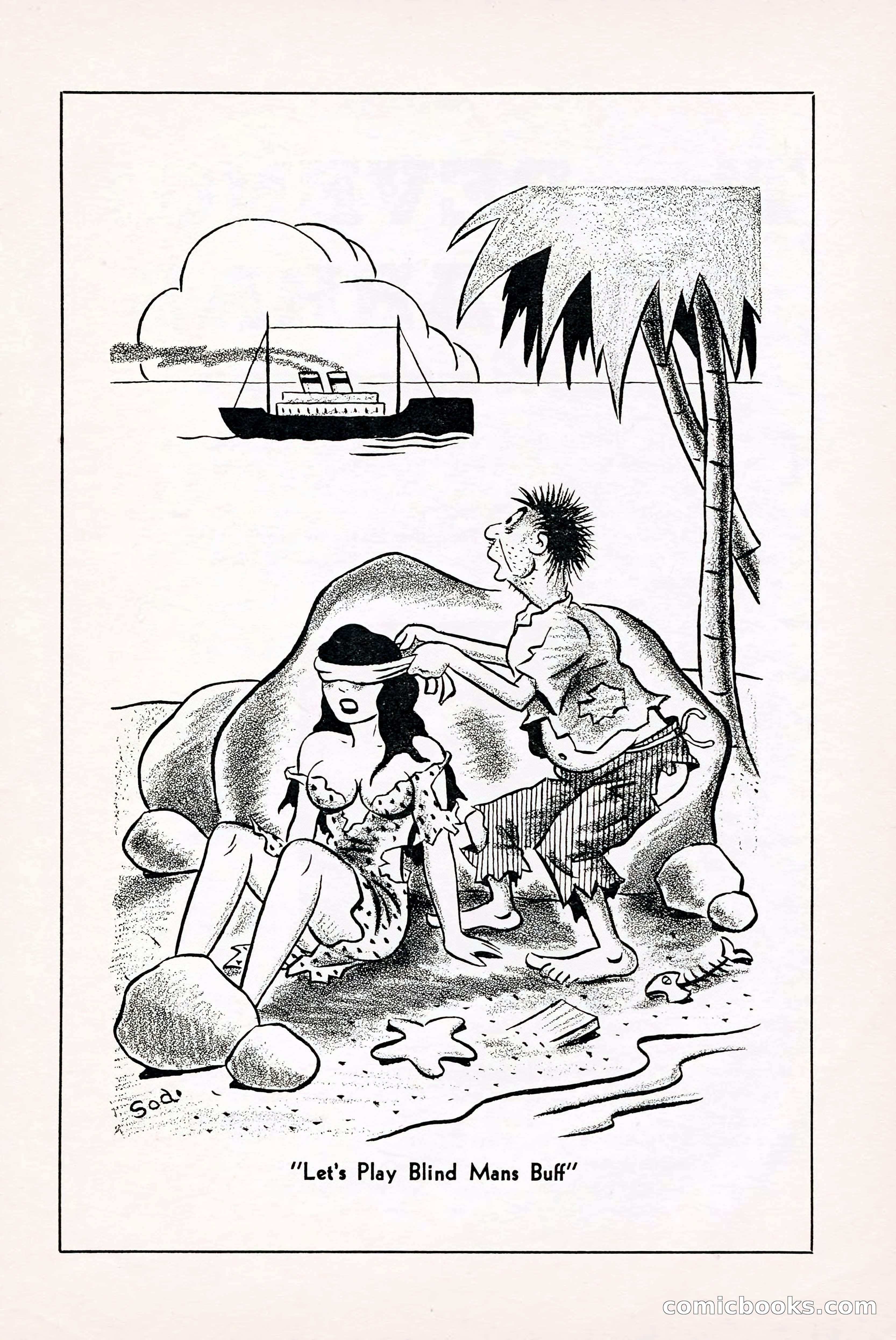
# Page Analysis This is a single-panel cartoon illustration from a pulp magazine, signed "Sod" in the lower left. The caption reads "Let's Play Blind Mans Buff." The drawing depicts two figures on a tropical beach near a palm tree and anchored ship. One figure wears a blindfold while the other appears to be posing or positioning themselves. The cartoon uses the children's game "Blind Man's Buff" as a humorous setup, playing on the double meaning suggested by the beach setting and the figures' appearances. The illustration is rendered in black ink with stippled shading typical of early-twentieth-century pulp magazine artwork.
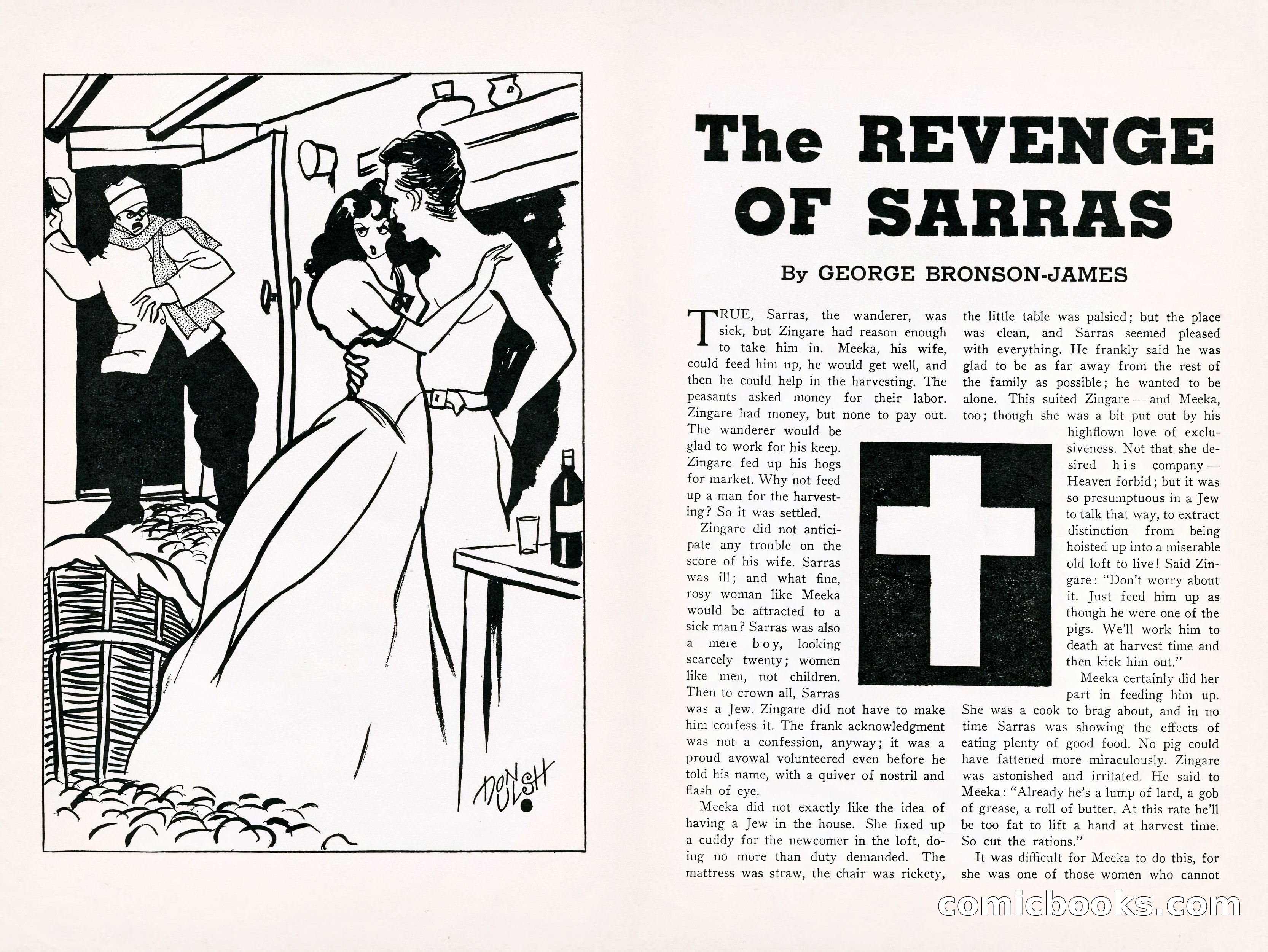
This page contains the opening of a short story titled "The Revenge of Sarras" by George Bronson-James. The left side features a black-and-white illustration showing what appears to be a domestic scene with multiple figures in a room. The right side presents the story's opening text in two columns, beginning with an account of Sarras, described as a wanderer who is ill and taken in by a character named Zingare. The narrative discusses Zingare's wife Meeka and their reluctance to feed the sick stranger, with mention of financial hardship among peasants. The text appears to be the story's opening exposition establishing the main characters and situation.
# Page 44: Story Prose This page contains prose fiction text from a story titled "Intriguing Stories, Spiced with Pretty Girls!" The narrative describes a domestic situation involving characters named Zingare, Meeka, and Sarras. Meeka tends to a sick youth in a loft, providing care and comfort while reflecting on his youth and Jewish identity. The passage includes Zingare's plan to have Sarras do household chores to free up time for field work, and Meeka's internal observations about the boy's appearance and her own prejudices. The text is dense with dialogue and character development, typical of early pulp fiction prose.
# Page Analysis This is a text-only story page (page 46) from a pulp magazine titled "INTRIGUING STORIES, SPICED WITH PRETTY GIRLS!" The visible prose depicts a violent domestic scene involving characters named Zingare, Meeka, and Sarras. A man named Zingare beats a woman named Meeka, forcing her to make religious oaths and kiss a crucifix while making degrading references to Jewish people and Jesus. The passage contains graphic violence, religious coercion, and antisemitic content. A character named Sarras intervenes, attacking Zingare with a poker and throwing him against a wall. The scene escalates into chaos involving brandy and a kitchen fire, with continued abuse and religious manipulation throughout.
# Page Analysis This is a page of story prose from a pulp magazine, numbered 47. The text appears to be part of a narrative titled "Intriguing Stories, Spiced with Pretty Girls!" and continues a story involving characters named Meeka, Zingare, and Sarras. The visible section depicts Meeka's subjugation by a master figure named Zingare, who establishes strict control over her behavior. The narrative then shifts to describe Zingare taking Meeka to church, where he shows her a large crucifix near the sanctuary. The prose suggests a melodramatic tale involving themes of control, religious imagery, and implied menace, typical of early pulp fiction conventions.
# Page 48: Story Prose This page contains story prose from a pulp fiction narrative titled "Intriguing Stories, Spiced with Pretty Girls!" The visible text describes a religious scene in which a woman named Meeka repeatedly visits a church to kiss the feet of a statue of Jesus, encouraged by a character named Zingare. The passage details Meeka's devotion and physical transformation—she becomes increasingly beautiful and refined. The narrative suggests a miraculous change has occurred in her, with Zingare observing that "The feet of Jesus had made a lady of her." The story continues to the next page.
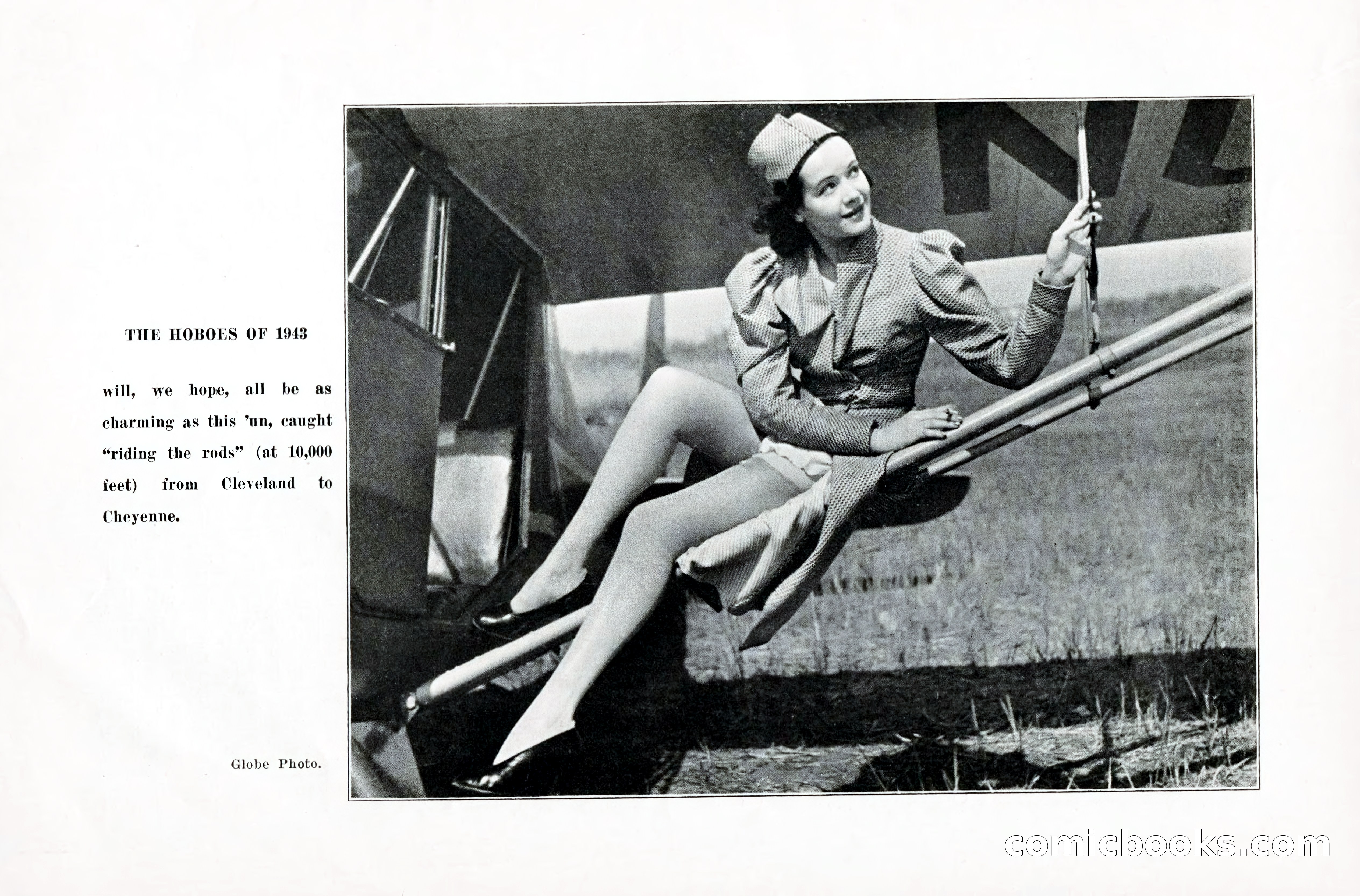
# Page Description This is an illustrated page from a 1943 pulp magazine featuring a black-and-white photograph labeled "THE HOBOES OF 1943." The image shows a woman in 1940s attire sitting on what appears to be a train or aircraft exterior, holding onto a rod or handle. The accompanying text humorously suggests readers will find the woman "as charming as this 'un, caught 'riding the rods' (at 10,000 feet) from Cleveland to Cheyenne." The credit reads "Globe Photo." This appears to be a lighthearted feature blending aviation imagery with hobo culture references, typical of pulp magazine entertainment content from the era.
# Page Content Description This is a text-only page (page 50) from a pulp magazine titled "Intriguing Stories, Spiced with Pretty Girls!" The page contains prose fiction continuing from page 48. The visible story concerns a character named Zingare and a woman named Meeka. The narrative describes their dramatic romantic conflict within a church setting, involving another character named Sarras. The text depicts Meeka kissing the feet of Jesus (a religious statue or crucifix), which shocks and confuses Zingare. The passage explores themes of jealousy, religious transgression, and passion. The prose style and content are typical of early-20th-century pulp fiction melodrama.
# Page Analysis This is a page of story prose from a pulp magazine, containing the continuation of a narrative titled "Intriguing Stories, Spiced with Pretty Girls!" The visible text (Section IV) describes a man named Zingare returning home to find his wife Meeka unchanged, while he develops an elaborate scheme involving jealousy and deception toward her lover Sarras. The passage details Zingare's internal conflict about how to exact revenge—considering various forms of torture and death—while Meeka and Sarras continue their clandestine meetings at church, with Meeka kissing sacred religious relics and Sarras following behind her. The narrative appears to be a romantic/dramatic story involving infidelity and contemplated vengeance, typical of early pulp fiction themes.
# Page Description This is a text page (page 52) from a pulp fiction magazine titled *Intriguing Stories, Spiced with Pretty Girls!* The page contains story prose in two columns. The visible text describes a man named Zingare who has become obsessed with revenge, growing thin and tormented while plotting something involving a church statue of Jesus. He manipulates a priest into covering the statue with black cloth except for its feet, then appears to perform some kind of ritualistic act involving rope loops attached to the statue's arms. The narrative suggests Zingare is unstable or mad, motivated by some prior wrong. The story continues to the next page.
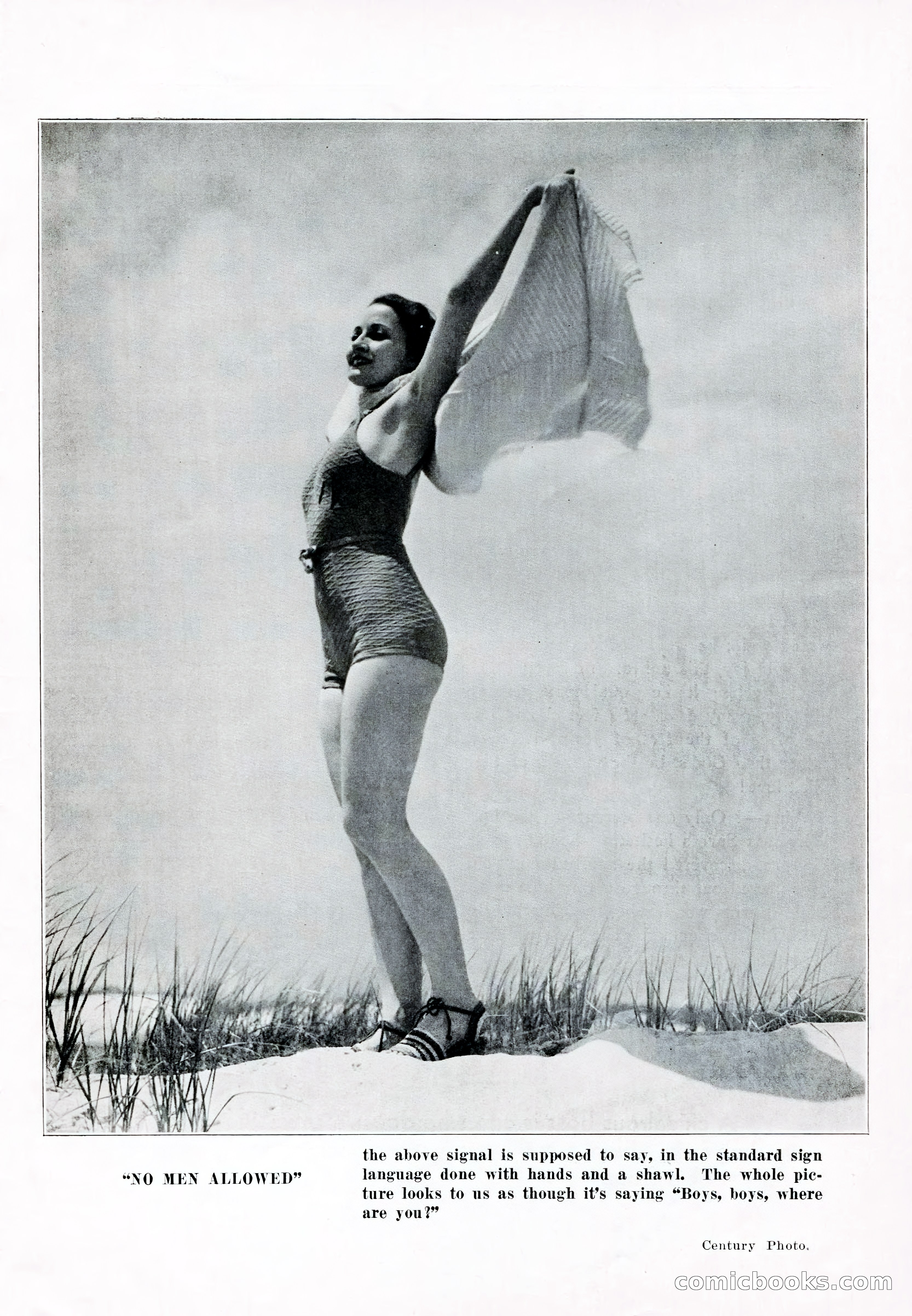
# Page Description This is an illustrated page from an early-20th-century pulp magazine featuring a black-and-white photograph of a woman in a bathing suit standing on a beach, holding a shawl above her head. The caption reads "NO MEN ALLOWED" and the accompanying text explains that the pose represents sign language conveying "Boys, boys, where are you?" The image appears to be intended as a humorous or suggestive illustration rather than serious documentary photography. The credit line indicates it's a "Century Photo." The page functions as an illustrated feature rather than prose fiction, using visual humor and wordplay to entertain readers.
This page contains story prose from a pulp fiction magazine. The narrative describes a dramatic scene in a church where a man named Zingare is hiding behind a cloth covering a statue of Jesus, waiting to surprise and humiliate another character named Sarras through a kiss. The passage takes a dark turn when the protagonist experiences excruciating pain—nails piercing his feet, hands, and heart—suggesting he has become physically identified with or transformed into the crucified Jesus statue. The text explores themes of revenge, blasphemy, and supernatural punishment. At the bottom is an unrelated humorous definition about a "chivalrous boss."
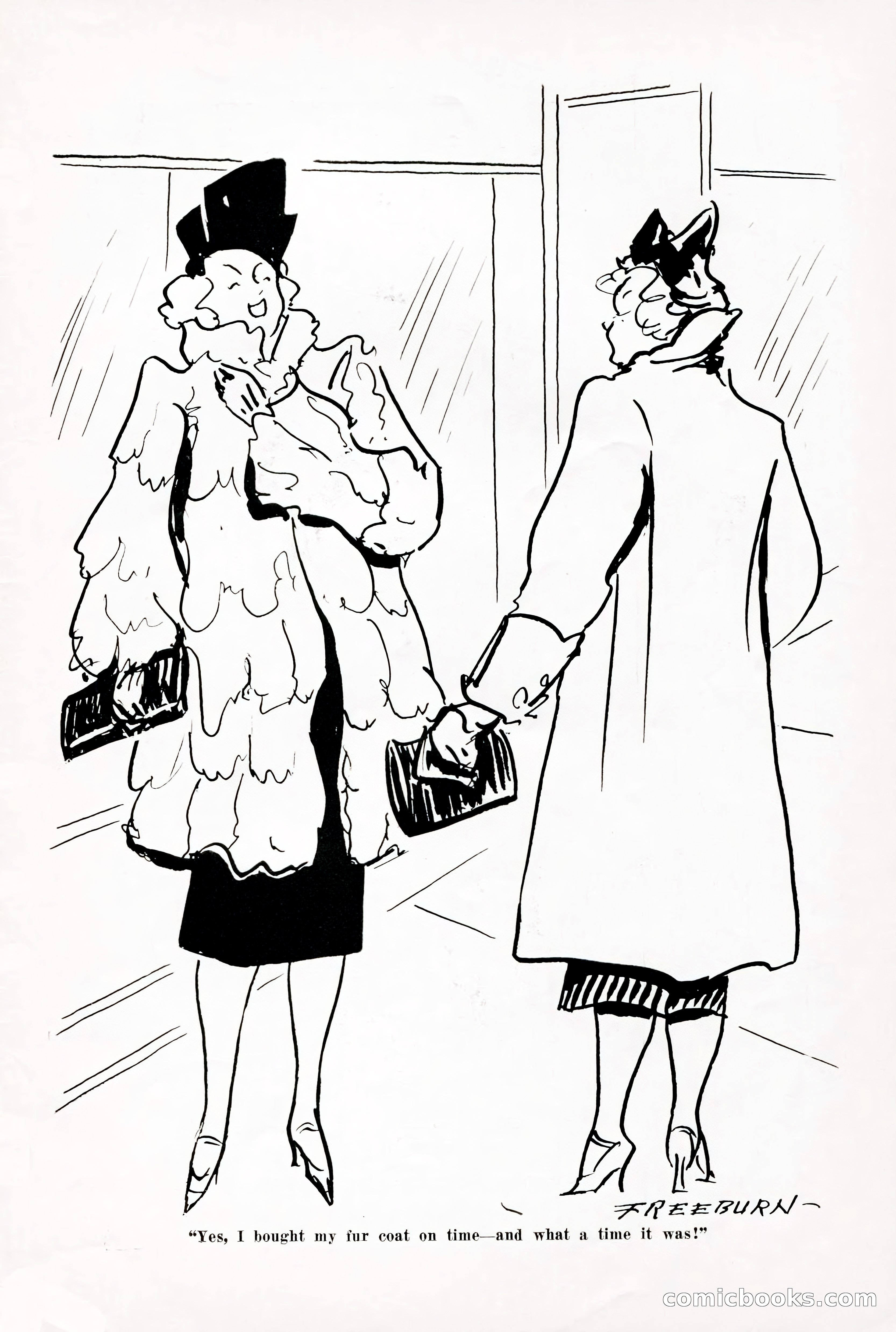
This is a single-panel cartoon illustration, likely from an early-20th-century American humor or general-interest magazine. The cartoon depicts two women meeting on a street; the woman on the left, wearing an elaborate fur coat, boasts to her companion about purchasing the coat "on time," adding emphatically "and what a time it was!" The humor appears to derive from a double meaning—the phrase "on time" (meaning on an installment plan) is contrasted with "what a time" (suggesting the shopping experience was eventful or difficult). The cartoon is signed "FREEBURN" and uses simple black ink line work typical of period comic illustrations.
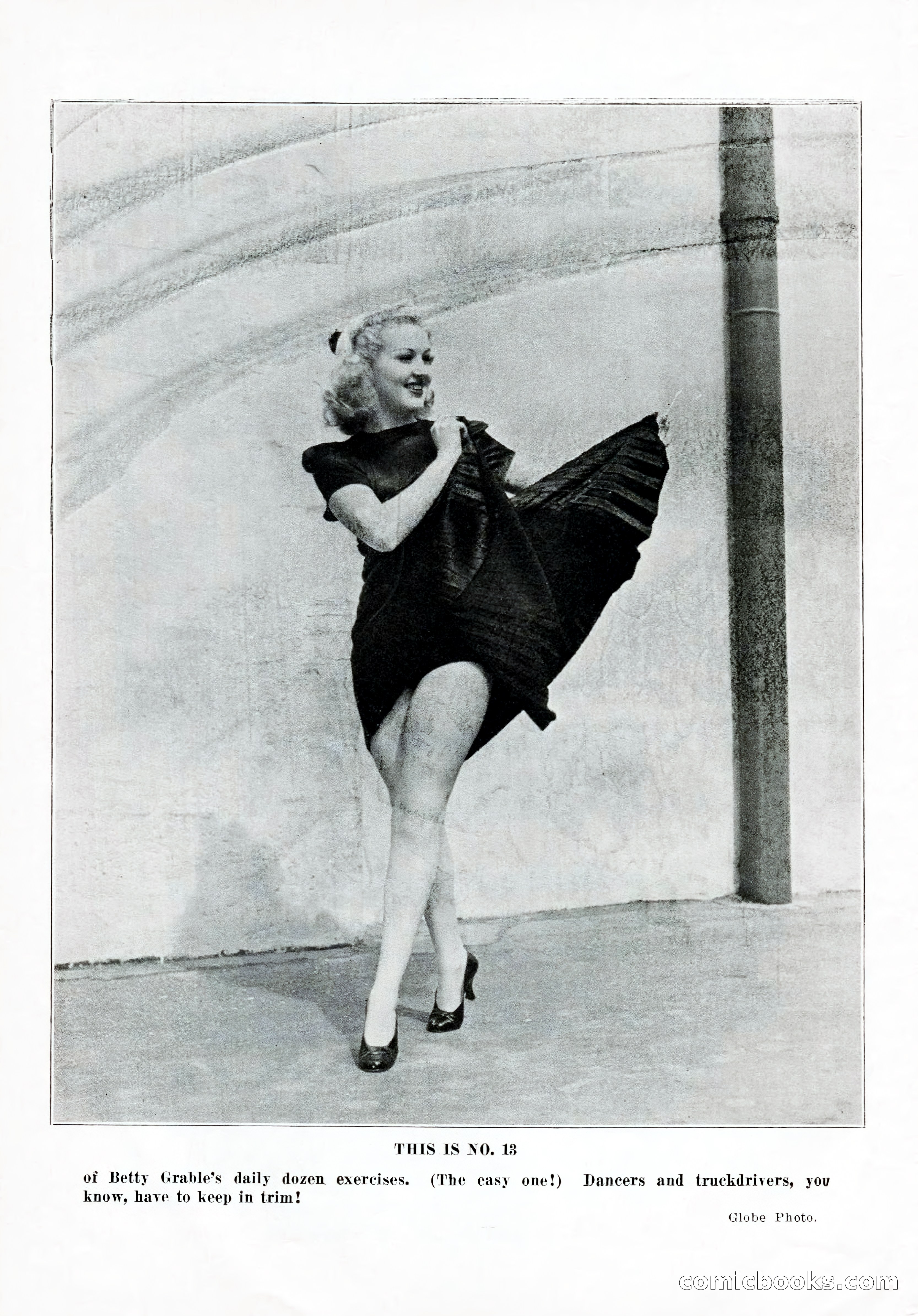
This is a black-and-white photograph showing a woman in a dark, short-sleeved dress performing what appears to be a dance or exercise move against a plain wall with a vertical pole visible. The caption reads "THIS IS NO. 13 of Betty Grable's daily dozen exercises. (The easy one!) Dancers and truckdrivers, you know, have to keep in trim!" The photo credit indicates "Globe Photo." This appears to be a feature or instructional page from a pulp magazine, presenting fitness exercises attributed to Betty Grable, presumably aimed at readers interested in maintaining physical fitness through celebrity-endorsed routines.
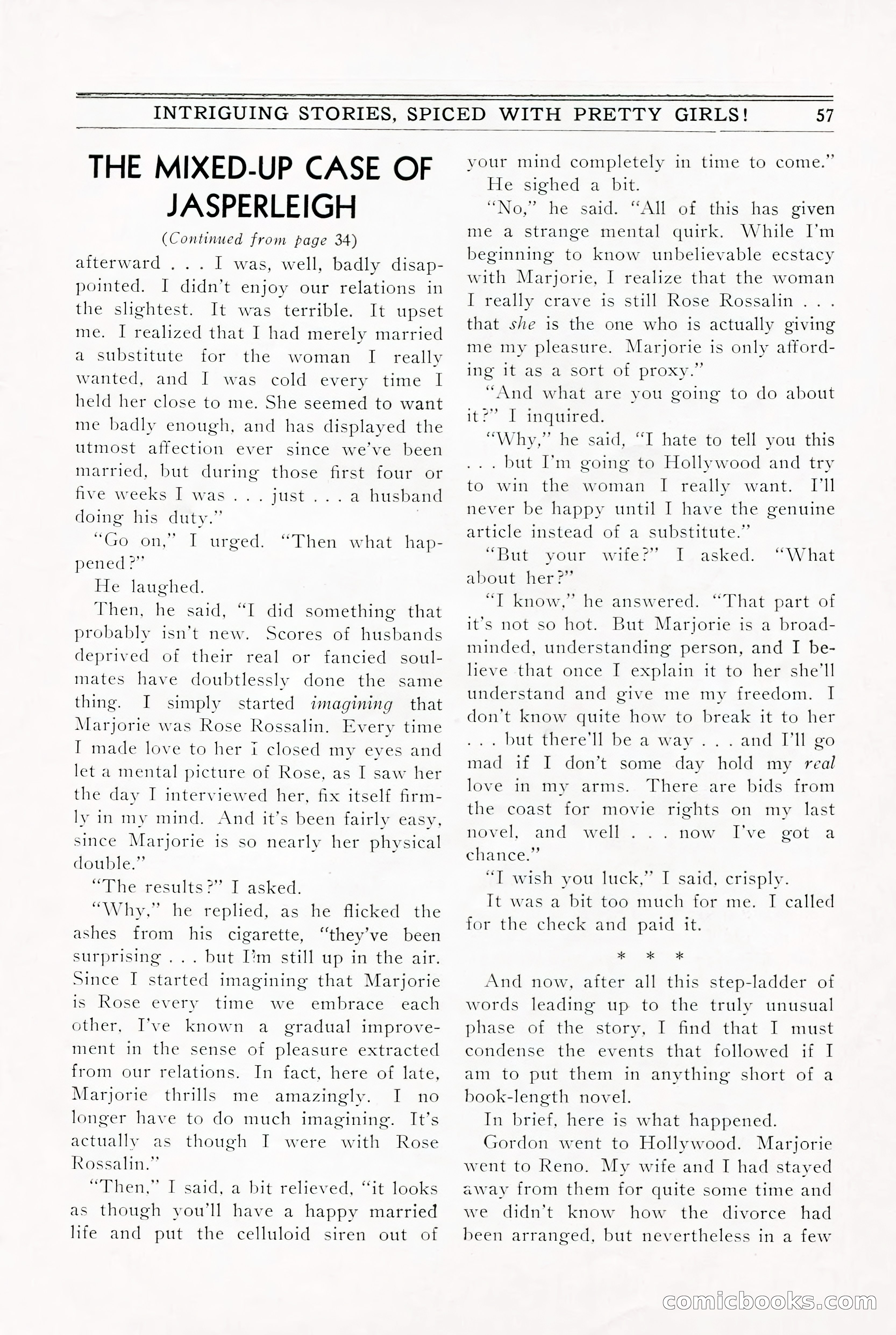
# Page 57: Story Prose — "The Mixed-Up Case of Jasperleigh" This page contains continuous prose fiction from a story titled "The Mixed-Up Case of Jasperleigh" (continued from page 34). The narrative describes a man's confession to his interviewer about his marriage and emotional infidelity. The protagonist admits he has been imagining his wife as actress Rose Rossalin during intimate moments, and reveals he plans to leave his wife to pursue the real actress in Hollywood. The story includes dialogue between the man and what appears to be a narrator or interviewer, with the passage concluding as the speaker leaves the conversation. The page is formatted in standard pulp magazine double-column layout with justified text.
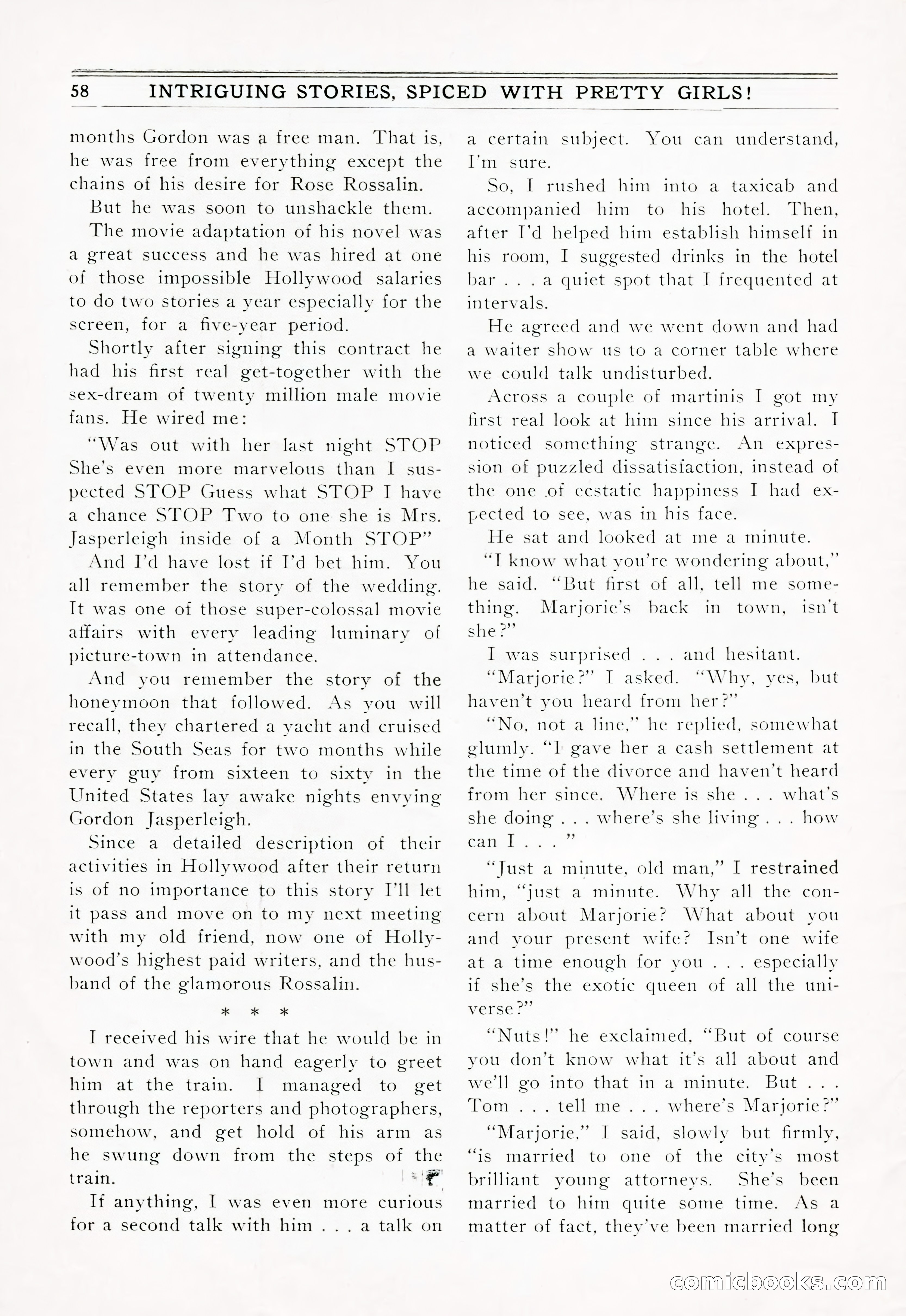
# Page 58: Story Prose This page contains story prose from a pulp magazine. The narrative appears to be a first-person account of the narrator's acquaintance with a successful Hollywood writer named Gordon Jasperleigh, who recently married actress Rose Rossalin. The text describes their initial meeting at a train station, their conversation in a hotel bar, and Jasperleigh's inquiries about a woman named Marjorie from the narrator's past. The narrator responds that Marjorie is married to a young attorney and has been settled for some time. The passage focuses on dialogue and character interaction, with no visible illustrations on this page.
This page contains two distinct sections. The upper portion presents story prose narrating a conversation between two men in what appears to be a bar setting, with one character describing his unhappy three-year marriage to a woman named Rose and his attraction to another woman named Marjorie. The lower half consists entirely of classified advertising—personal ads and small business advertisements typical of pulp magazines from this era, including listings for lonely hearts clubs, photo services, romance magazines, and mail-order opportunities. The page header reads "INTRIGUING STORIES, SPICED WITH PRETTY GIRLS!" The advertisements occupy significantly more space than the fiction text.
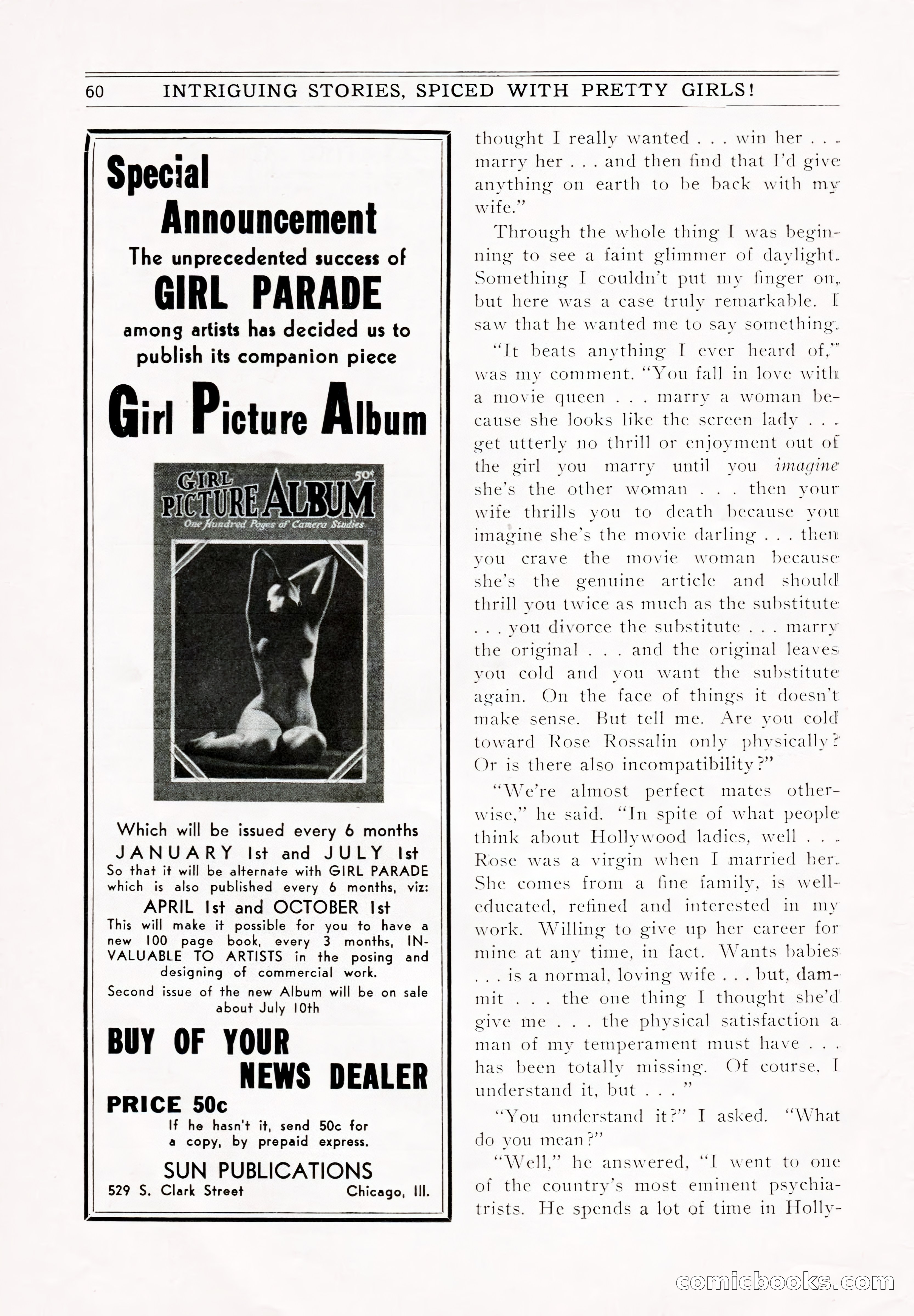
# Page Description This is a page of story prose with an advertisement. On the left side is a "Special Announcement" promoting two companion publications: *Girl Parade* and a new *Girl Picture Album*, to be issued alternately every six months starting January 1st and July 1st. The album costs 50 cents and is available through news dealers or by mail from Sun Publications in Chicago. On the right side is the continuation of a story involving a man discussing his marriage and romantic feelings. He mentions consulting a psychiatrist about his attraction to actress Rose Rossalin and his complicated feelings about his wife versus this idealized fantasy. The narrative explores themes of desire, marriage, and incompatibility.
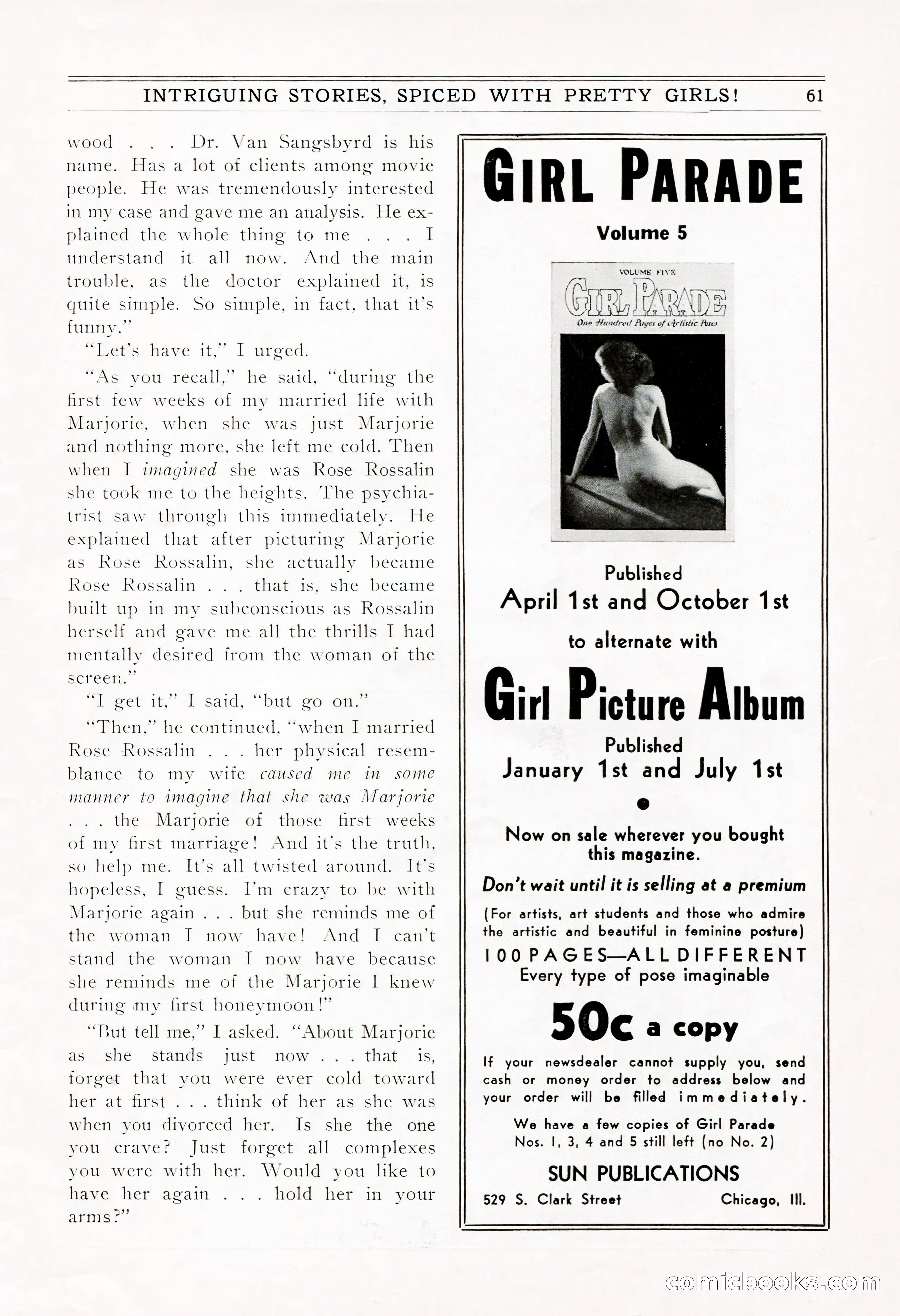
# Page Description This page contains story prose on the left and a full-page advertisement on the right. The narrative prose appears to be from an intriguing story involving a psychiatrist's explanation of a man's psychological troubles related to his wife's resemblance to actress Rose Rossalin. The right side advertises *Girl Parade* Volume 5 and *Girl Picture Album*, publications featuring artistic photographs of women in various poses. The ad emphasizes these are "100 pages—all different" and costs 50 cents per copy, available through Sun Publications in Chicago. The materials appear aimed at artists and art students interested in figure reference materials.
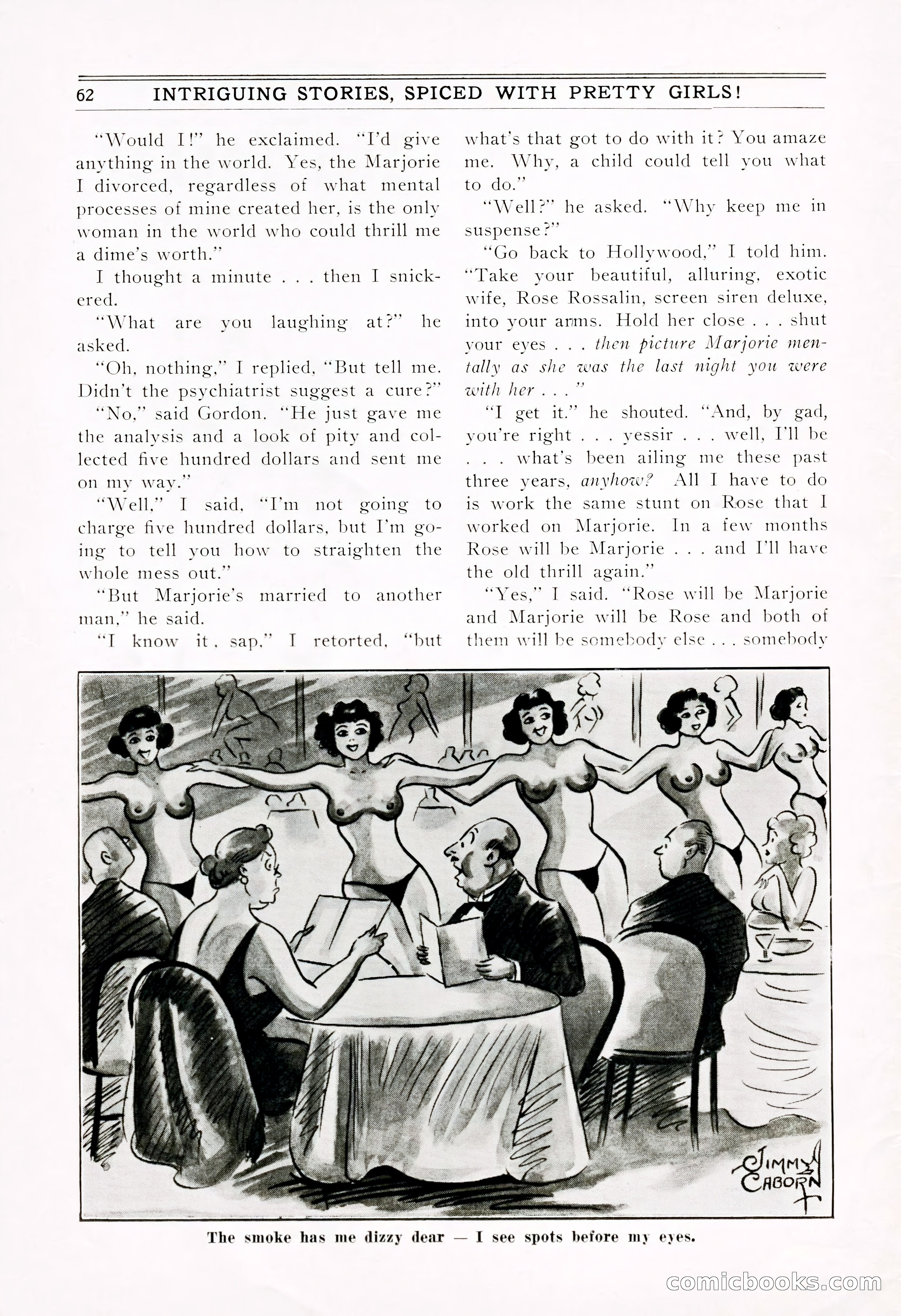
# Page 62: Story Prose with Illustration This page contains story prose under the heading "INTRIGUING STORIES, SPICED WITH PRETTY GIRLS!" The text depicts a conversation between two men discussing a woman named Marjorie and another woman named Rose Rossalin. One man appears to be seeking advice about rekindling romantic excitement by substituting one woman for another. Below the prose is a cartoon illustration by Jimmy Saborin (signed lower right) showing men seated at a table with nude or partially clothed women standing behind them. The cartoon's caption reads: "The smoke has me dizzy dear — I see spots before my eyes." The illustration is clearly meant as humorous commentary on the story's theme.
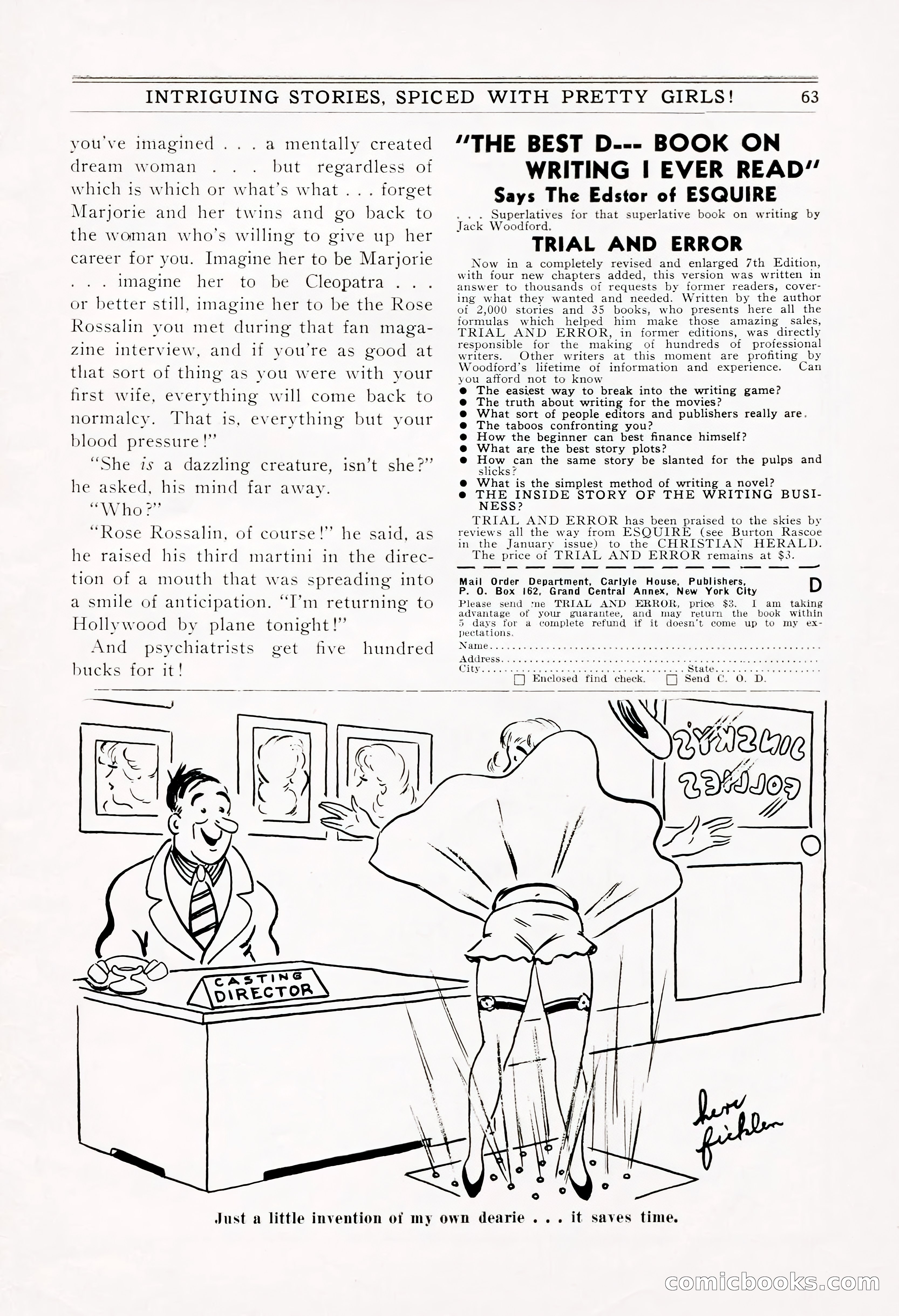
This page contains story prose alongside advertisements. The narrative text describes a man contemplating an idealized woman, referencing figures like Margarjorie, Cleopatra, and Rose Rossalin. He mentions returning to Hollywood by plane that night, with a sardonic comment about psychiatrists. Below is a cartoon illustration labeled "Just a little invention of my own dearie... it saves time," showing a casting director at a desk with a woman whose legs are mechanically kicking up. The page also features a large advertisement for "Trial and Error," described as a writing guide by Jack Woodford, endorsed by Esquire's editor, with a mail-order form at the bottom.
This is an advertisement page, likely from the back matter of a pulp magazine. It promotes "LULU," described as "the current newsstand sensation in humor magazines," with an August issue now on sale. The ad uses marketing language emphasizing the magazine's popularity ("Everybody's talking about it!") while encouraging potential customers to purchase a copy themselves rather than rely on word-of-mouth recommendations. The advertiser is Sun Publications, located at 529 South Clark Street in Chicago. The layout is simple black text on white background with a bordered frame, typical of period advertising design.
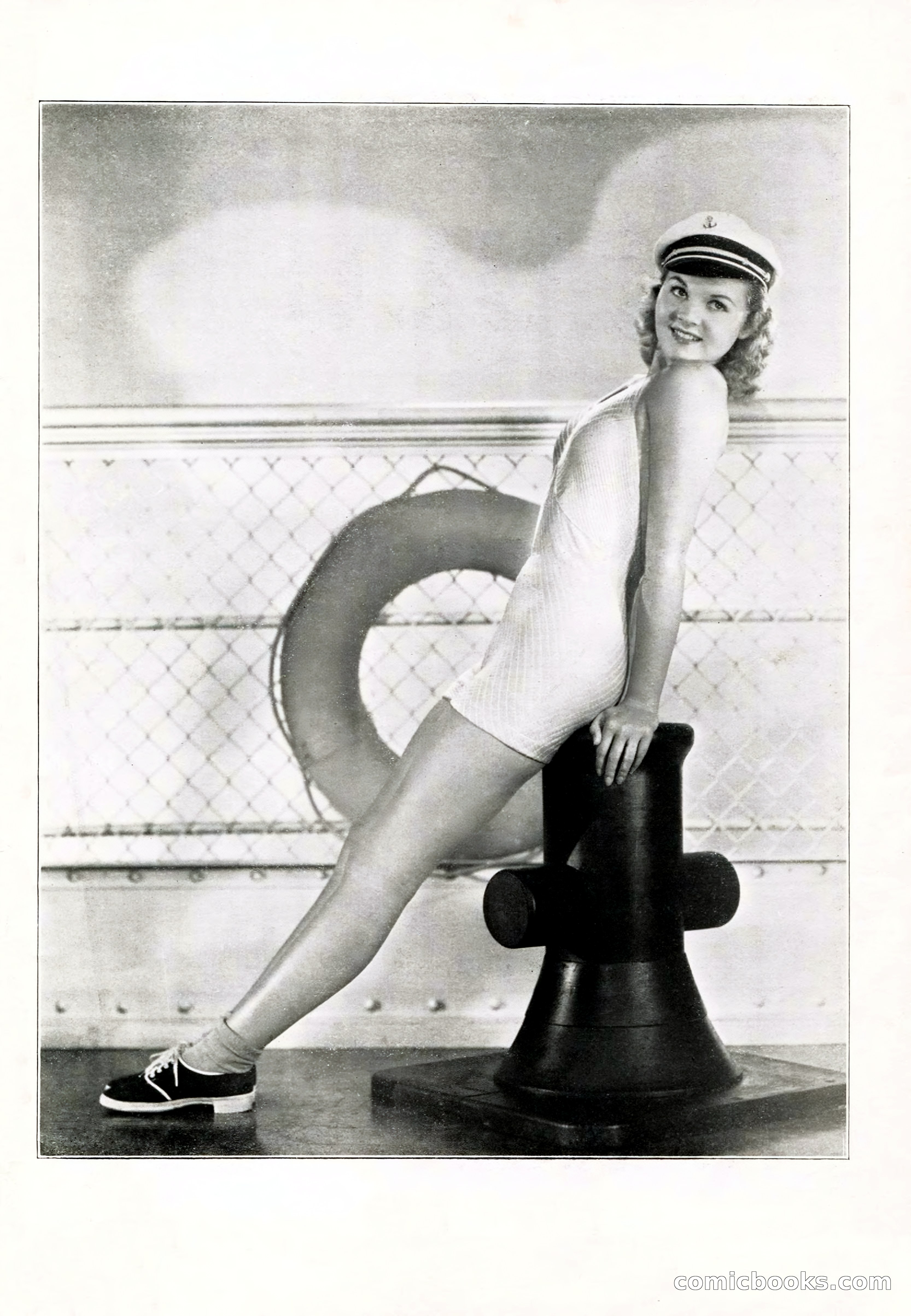
This is a full-page photograph or illustration from an early-20th-century pulp magazine, likely serving as cover art or a prominent interior illustration. The image shows a woman in a white one-piece swimsuit and sailor cap, posed playfully on what appears to be a large ship's anchor or similar nautical prop. The styling and photography technique are characteristic of 1920s-1930s pulp magazine aesthetics. The visible OCR text appears minimal or unclear in the provided transcription, making it difficult to identify the specific story or article this image accompanies. The nautical theme suggests the illustration relates to maritime adventure fiction common in period pulp publications.
This is a promotional photograph—likely a pin-up style publicity shot rather than story illustration—showing a woman in 1940s-style clothing (pinstriped blouse and light-colored shorts) posed against a white background. The image appears in a pulp magazine context, as indicated by the "comicbooks.com" watermark visible at bottom. No visible text on the page itself describes narrative content or identifies the subject. The photograph's style and composition suggest it served as decoration or advertisement within the magazine rather than as illustration for a specific story. The image represents the era's common practice of featuring glamour photography in pulp publications.
This page appears to be a comparison illustration from a pulp science fiction magazine, featuring two black-and-white photographs side by side. On the left is labeled "Scans" and shows an elderly man wearing a bowler hat and dark clothing with a long white beard. On the right, labeled "Edimcooks" (or possibly "Edmonds"), is a man in what appears to be a Starfleet-style uniform from the original Star Trek series, holding a phaser weapon. The juxtaposition suggests a humorous or thematic comparison, though the specific story context or purpose of this pairing remains unclear from the visible text alone.