
Pulp Fiction, 1938 · page 34 of 64
10 Story Book, August 1938 — page 34: what you’re looking at
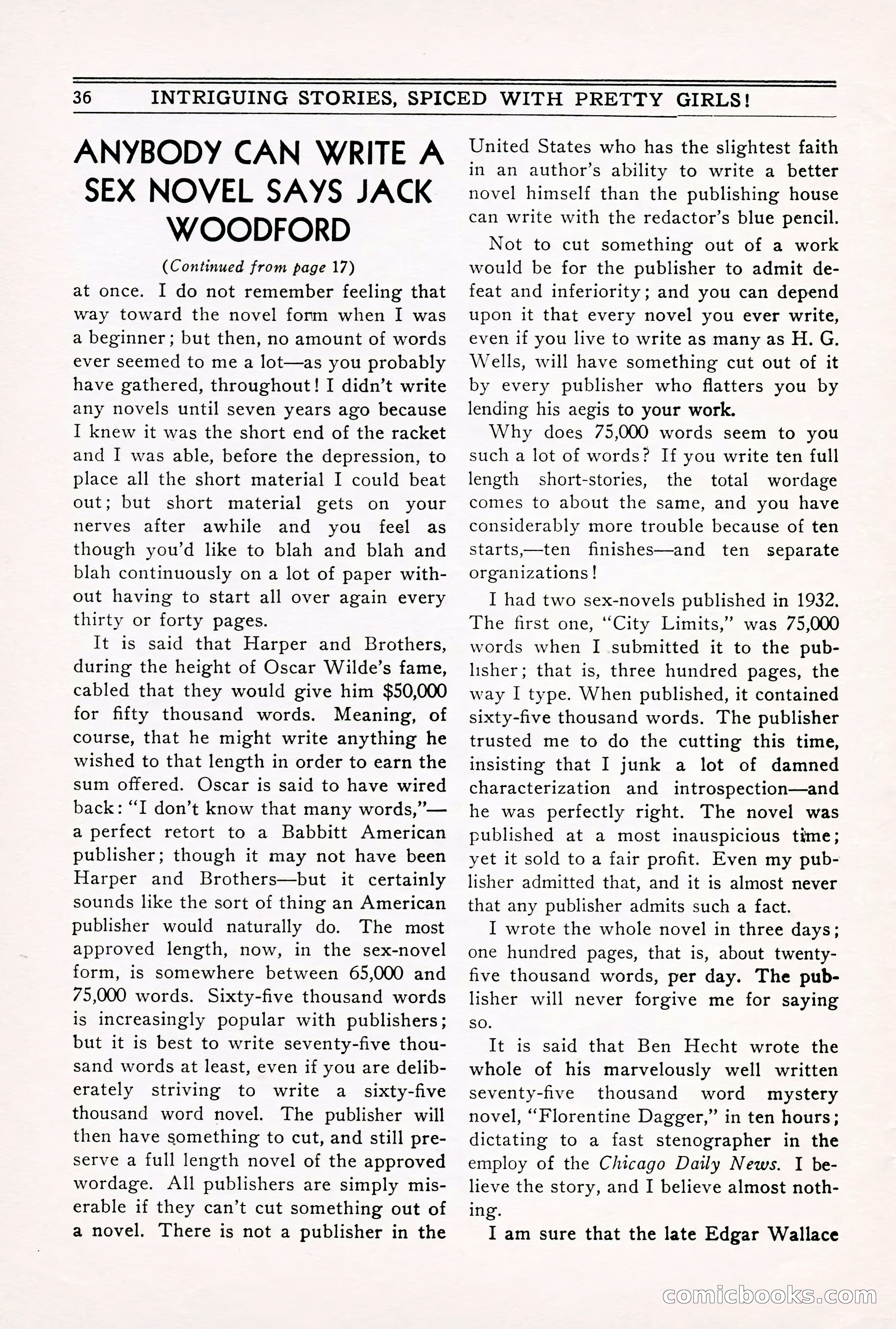
A restored page from Pulp Fiction, 1938. Page through the whole issue in the reader above.
📄 Transcribed text from this page (OCR, searchable)
Machine-transcribed from the original scan — historical spelling and the odd misread are preserved.
36 INTRIGUING STORIES, SPICED WITH PRETTY GIRLS! ANYBODY CAN WRITE A SEX NOVEL SAYS JACK WOODFORD (Continued from page 17) at once. I do not remember feeling that way toward the novel form when I was a beginner; but then, no amount of words ever seemed to me a lot—as you probably have gathered, throughout! I didn’t write any novels until seven years ago because I knew it was the short end of the racket and I was able, before the depression, to place all the short material I could beat out; but short material gets on your nerves after awhile and you feel as though you'd like to blah and blah and blah continuously on a lot of paper with- out having to start all over again every thirty or forty pages. It is said that Harper and Brothers, during the height of Oscar Wilde’s fame, cabled that they would give him $50,000 for fifty thousand words. Meaning, of course, that he might write anything he wished to that length in order to earn the sum offered. Oscar is said to have wired back: “I don’t know that many words,”’— a perfect retort to a Babbitt American publisher; though it may not have been Harper and Brothers—but it certainly sounds like the sort of thing an American publisher would naturally do. The most approved length, now, in the sex-novel form, is somewhere between 65,000 and 75,000 words. Sixty-five thousand words is increasingly popular with publishers; but it is best to write seventy-five thou- sand words at least, even if you are delib- erately striving to write a_ sixty-five thousand word novel. The publisher will then have something to cut, and still pre- serve a full length novel of the approved wordage. All publishers are simply mis- erable if they can’t cut something out of a novel. There is not a publisher in the United States who has the slightest faith in an author’s ability to write a better novel himself than the publishing house can write with the redactor’s blue pencil. Not to cut something out of a work would be for the publisher to admit de- feat and inferiority; and you can depend upon it that every novel you ever write, even if you live to write as many as H. G. Wells, will have something cut out of it by every publisher who flatters you by lending his aegis to your work. Why does 75,000 words seem to you such a lot of words? If you write ten full length short-stories, the total wordage comes to about the same, and you have considerably more trouble because of ten starts,—ten finishes—and ten separate organizations! I had two sex-novels published in 1932. The first one, “City Limits,” was 75,000 words when I submitted it to the pub- lisher; that is, three hundred pages, the way I type. When published, it contained sixty-five thousand words. The publisher trusted me to do the cutting this time, insisting that I junk a lot of damned characterization and introspection—and he was perfectly right. The novel was published at a most inauspicious time; yet it sold to a fair profit. Even my pub- lisher admitted that, and it is almost never that any publisher admits such a fact. I wrote the whole novel in three days; one hundred pages, that is, about twenty- five thousand words, per day. The pub- lisher will never forgive me for saying sO. It is said that Ben Hecht wrote the whole of his marvelously well written seventy-five thousand word mystery novel, “Florentine Dagger,” in ten hours; dictating to a fast stenographer in the employ of the Chicago Daily News. I be- lieve the story, and I believe almost noth- ing. I am sure that the late Edgar Wallace oO Comiclsoo S C@