
Pulp Fiction, 1938 · page 40 of 64
10 Story Book, August 1938 — page 40: what you’re looking at
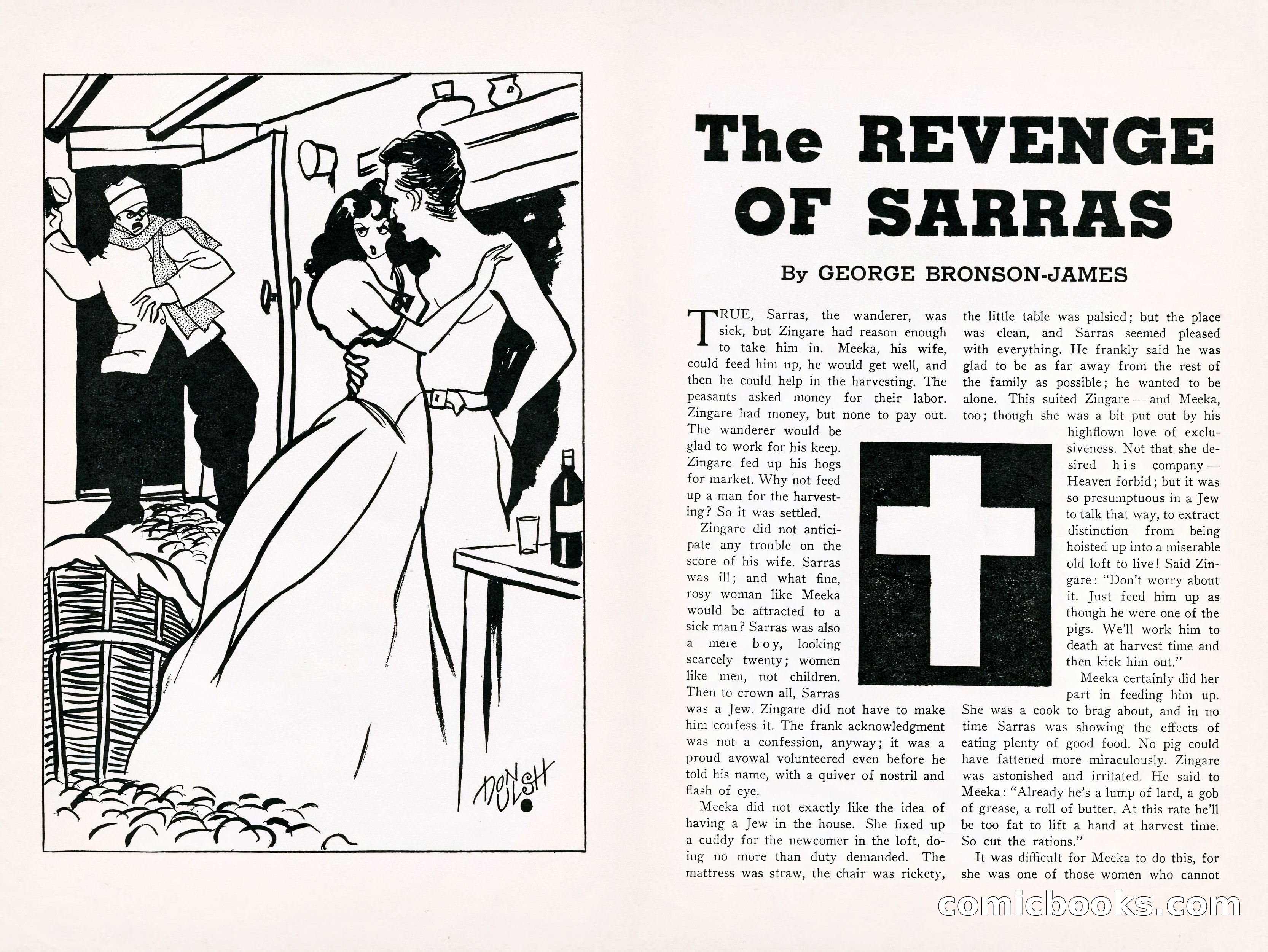
A restored page from Pulp Fiction, 1938. Page through the whole issue in the reader above.
📄 Transcribed text from this page (OCR, searchable)
Machine-transcribed from the original scan — historical spelling and the odd misread are preserved.
1 ] 4 = u 5 = | SVRL WI RURREERSESS KAR \niEES AlN SUT )») The REVENGE OF SARRAS By GEORGE BRONSON-JAMES RUE, Sarras, the wanderer, was |e but Zingare had reason enough to take him in. Meeka, his wife, could feed him up, he would get well, and then he could help in the harvesting. The peasants asked money for their labor. Zingare had money, but none to pay out. The wanderer would be glad to work for his keep. Zingare fed up his hogs for market. Why not feed up a man for the harvest- ing? So it was settled. Zingare did not antici- pate any trouble on the score of his wife. Sarras was ill; and what fine, rosy woman like Meeka would be attracted to a sick man? Sarras was also a mere boy, looking scarcely twenty; women like men, not children, Then to crown all, Sarras was a Jew. Zingare did not have to make him confess it. The frank acknowledgment was not a confession, anyway; it was a proud avowal volunteered even before he told his name, with a quiver of nostril and flash of eye. Meeka did not exactly like the idea of having a Jew in the house. She fixed up a cuddy for the newcomer in the loft, do- ing no more than duty demanded. The mattress was straw, the chair was rickety, C@ the little table was palsied; but the place was clean, and Sarras seemed pleased with everything. He frankly said he was glad to be as far away from the rest of the family as possible; he wanted to be alone. This suited Zingare —and Meeka, too; though she was a bit put out by his highflown love of exclu- siveness. Not that she de- sired his company — Heaven forbid; but it was so presumptuous in a Jew to talk that way, to extract distinction from being hoisted up into a miserable old loft to live! Said Zin- gare: “Don’t worry about it. Just feed him up as though he were one of the pigs. We’ll work him to death at harvest time and then kick him out.” Meeka certainly did her part in feeding him up. She was a cook to brag about, and in no time Sarras was showing the effects of eating plenty of good food. No pig could have fattened more miraculously. Zingare was astonished and irritated. He said to Meeka: “Already he’s a lump of lard, a gob of grease, a roll of butter. At this rate he’ll be too fat to lift a hand at harvest time. So cut the rations.” It was difficult for Meeka to do this, for she was one of those women who cannot MIGIOOKS Con)