
Pulp Fiction, 1938 · page 18 of 64
10 Story Book, August 1938 — page 18: what you’re looking at
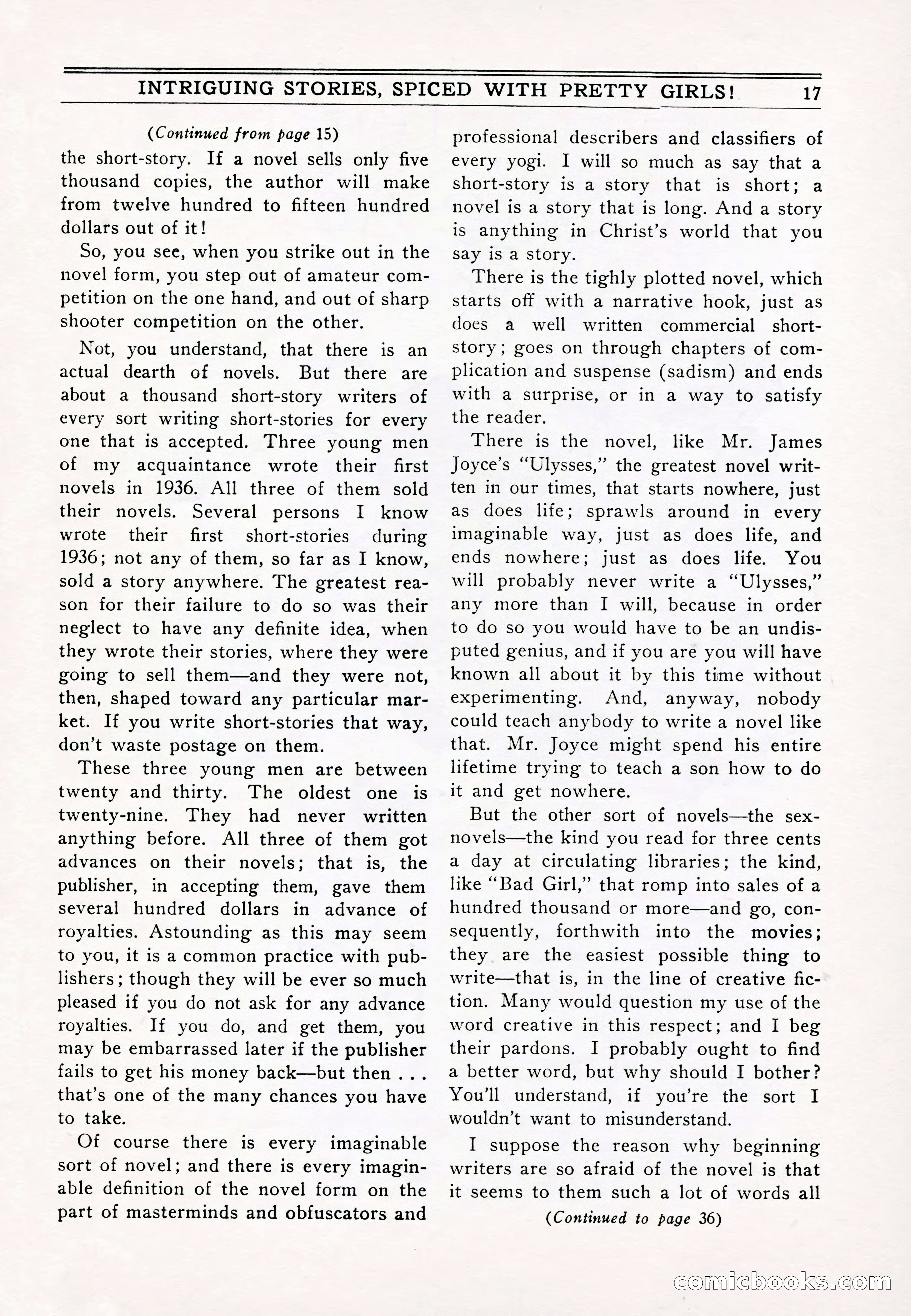
A restored page from Pulp Fiction, 1938. Page through the whole issue in the reader above.
📄 Transcribed text from this page (OCR, searchable)
Machine-transcribed from the original scan — historical spelling and the odd misread are preserved.
INTRIGUING STORIES, SPICED WITH PRETTY GIRLS! 17 an ee ee ee ee (Continued from page 15) the short-story. If a novel sells only five thousand copies, the author will make from twelve hundred to fifteen hundred dollars out of it! So, you see, when you strike out in the novel form, you step out of amateur com- petition on the one hand, and out of sharp shooter competition on the other. Not, you understand, that there is an actual dearth of novels. But there are about a thousand short-story writers of every sort writing short-stories for every one that is accepted. Three young men of my acquaintance wrote their first novels in 1936. All three of them sold their novels. Several persons I know wrote their first short-stories during 1936; not any of them, so far as I know, sold a story anywhere. The greatest rea- son for their failure to do so was their neglect to have any definite idea, when they wrote their stories, where they were going to sell them—and they were not, then, shaped toward any particular mar- ket. If you write short-stories that way, don’t waste postage on them. These three young men are between twenty and thirty. The oldest one is twenty-nine. They had never written anything before. All three of them got advances on their novels; that is, the publisher, in accepting them, gave them several hundred dollars in advance of royalties. Astounding as this may seem to you, it is a common practice with pub- lishers ; though they will be ever so much pleased if you do not ask for any advance royalties. If you do, and get them, you may be embarrassed later if the publisher fails to get his money back—but then... that’s one of the many chances you have to take. Of course there is every imaginable sort of novel; and there is every imagin- able definition of the novel form on the part of masterminds and obfuscators and professional describers and classifiers of every yogi. I will so much as say that a short-story is a story that is short; a novel is a story that is long. And a story is anything in Christ’s world that you say is a story. There is the tighly plotted novel, which starts off with a narrative hook, just as does a well written commercial short- story; goes on through chapters of com- plication and suspense (sadism) and ends with a surprise, or in a way to satisfy the reader. There is the novel, like Mr. James Joyce’s “Ulysses,” the greatest novel writ- ten in our times, that starts nowhere, just as does life; sprawls around in every imaginable way, just as does life, and ends nowhere; just as does life. You will probably never write a “Ulysses,” any more than I will, because in order to do so you would have to be an undis- puted genius, and if you are you will have known all about it by this time without experimenting. And, anyway, nobody could teach anybody to write a novel like that. Mr. Joyce might spend his entire lifetime trying to teach a son how to do it and get nowhere. But the other sort of novels—the sex- novels—the kind you read for three cents a day at circulating libraries; the kind, like “Bad Girl,” that romp into sales of a hundred thousand or more—and go, con- sequently, forthwith into the movies; they are the easiest possible thing to write—that is, in the line of creative fic- tion. Many would question my use of the word creative in this respect; and I beg their pardons. I probably ought to find a better word, but why should I bother? You'll understand, if you’re the sort I wouldn’t want to misunderstand. I suppose the reason why beginning writers are so afraid of the novel is that it seems to them such a lot of words all (Continued to page 36) oO CoMmicbooOoks.€© inn