
Pulp Fiction, 1938 · page 36 of 64
10 Story Book, August 1938 — page 36: what you’re looking at
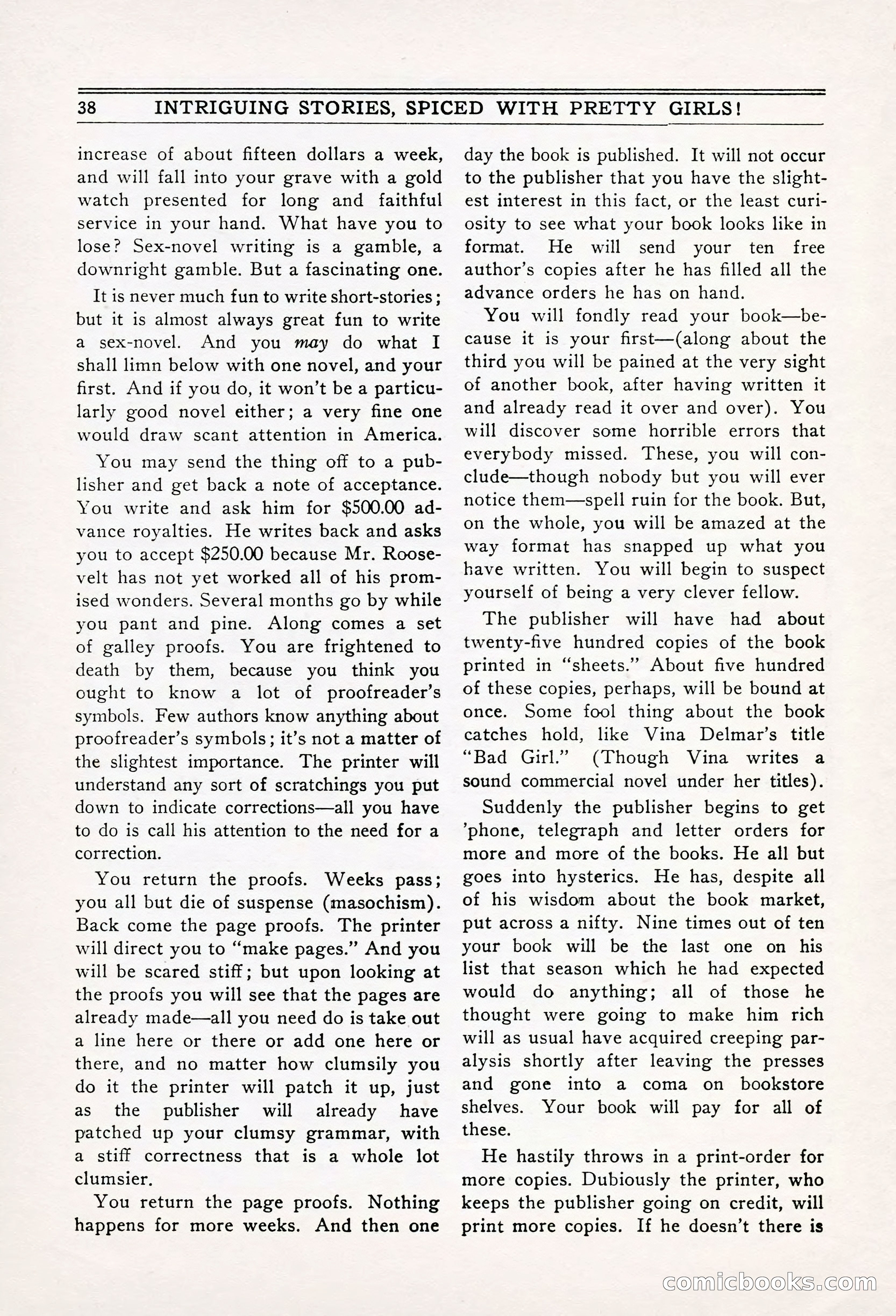
A restored page from Pulp Fiction, 1938. Page through the whole issue in the reader above.
📄 Transcribed text from this page (OCR, searchable)
Machine-transcribed from the original scan — historical spelling and the odd misread are preserved.
38 INTRIGUING STORIES, SPICED WITH PRETTY GIRLS! increase of about fifteen dollars a week, and will fall into your grave with a gold watch presented for long and _ faithful service in your hand. What have you to lose? Sex-novel writing is a gamble, a downright gamble. But a fascinating one. It is never much fun to write short-stories ; but it is almost always great fun to write a sex-novel. And you may do what I shall limn below with one novel, and your first. And if you do, it won’t be a particu- larly good novel either; a very fine one would draw scant attention in America. You may send the thing off to a pub- lisher and get back a note of acceptance. You write and ask him for $500.00 ad- vance royalties. He writes back and asks you to accept $250.00 because Mr. Roose- velt has not yet worked all of his prom- ised wonders. Several months go by while you pant and pine. Along comes a set of galley proofs. You are frightened to death by them, because you think you ought to know a lot of proofreader’s symbols. Few authors know anything about proofreader’s symbols; it’s not a matter of the slightest importance. The printer will understand any sort of scratchings you put down to indicate corrections—all you have to do is call his attention to the need for a correction. You return the proofs. Weeks pass; you all but die of suspense (masochism). Back come the page proofs. The printer will direct you to “make pages.” And you will be scared stiff; but upon looking at the proofs you will see that the pages are already made—all you need do is take out a line here or there or add one here or there, and no matter how clumsily you do it the printer will patch it up, just as the publisher will already have patched up your clumsy grammar, with a stiff correctness that is a whole lot clumsier, You return the page proofs. Nothing happens for more weeks. And then one day the book is published. It will not occur to the publisher that you have the slight- est interest in this fact, or the least curi- osity to see what your book looks like in format. He will send your ten free author’s copies after he has filled all the advance orders he has on hand. You will fondly read your book—be- cause it is your first—(along about the third you will be pained at the very sight of another book, after having written it and already read it over and over). You will discover some horrible errors that everybody missed. These, you will con- clude—though nobody but you will ever notice them—spell ruin for the book. But, on the whole, you will be amazed at the way format has snapped up what you have written. You will begin to suspect yourself of being a very clever fellow. The publisher will have had about twenty-five hundred copies of the book printed in “sheets.” About five hundred of these copies, perhaps, will be bound at once. Some fool thing about the book catches hold, like Vina Delmar’s title “Bad Girl.” (Though Vina writes a sound commercial novel under her titles). Suddenly the publisher begins to get ‘phone, telegraph and letter orders for more and more of the books. He all but goes into hysterics. He has, despite all of his wisdom about the book market, put across a nifty. Nine times out of ten your book will be the last one on his list that season which he had expected would do anything; all of those he thought were going to make him rich will as usual have acquired creeping par- alysis shortly after leaving the presses and gone into a coma on_ bookstore shelves. Your book will pay for all of these. He hastily throws in a print-order for more copies. Dubiously the printer, who keeps the publisher going on credit, will print more copies. If he doesn’t there is Comicboook<s C@