
Pulp Fiction, 1938 · page 35 of 64
10 Story Book, August 1938 — page 35: what you’re looking at
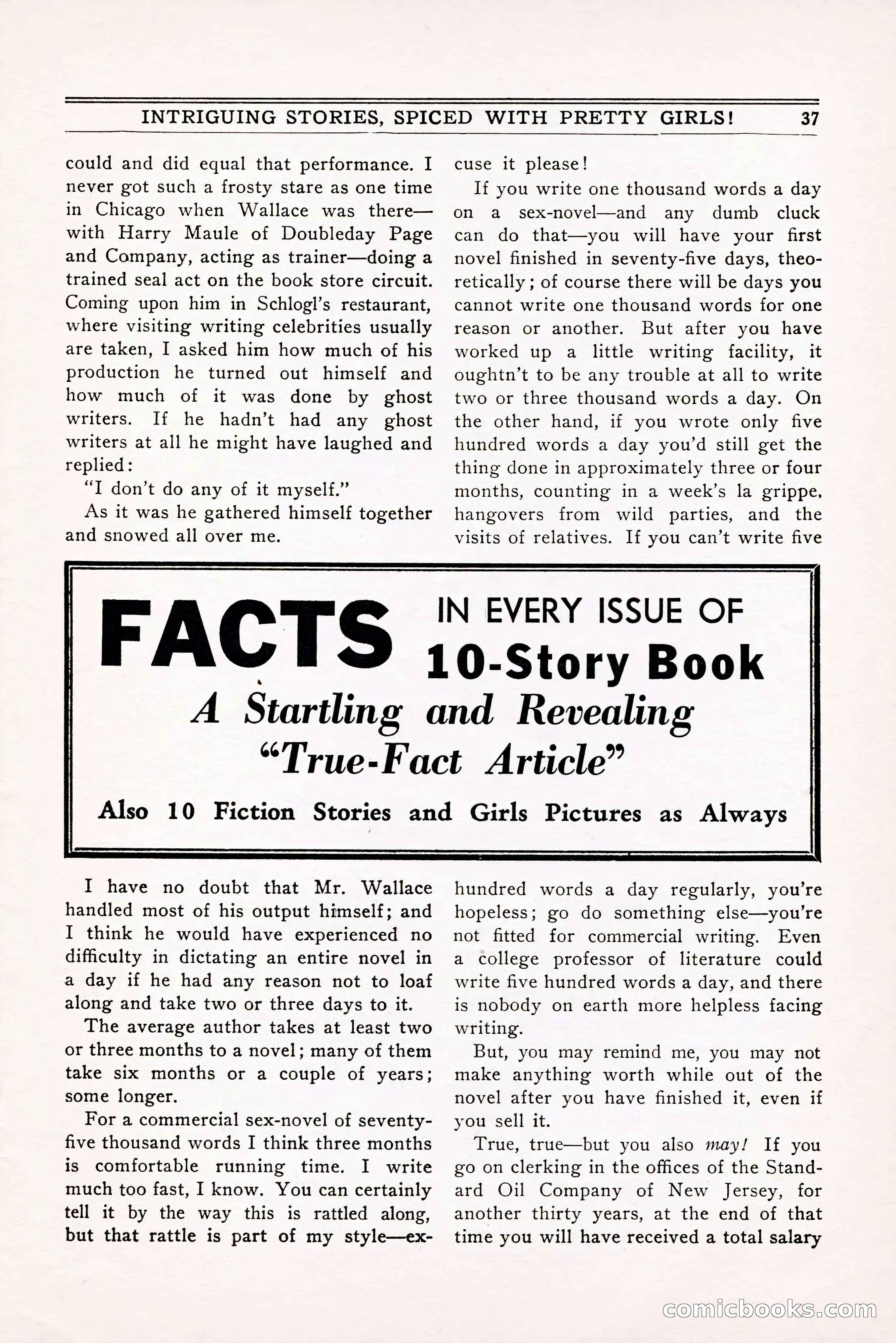
A restored page from Pulp Fiction, 1938. Page through the whole issue in the reader above.
📄 Transcribed text from this page (OCR, searchable)
Machine-transcribed from the original scan — historical spelling and the odd misread are preserved.
INTRIGUING STORIES, SPICED WITH PRETTY GIRLS! could and did equal that performance. I never got such a frosty stare as one time in Chicago when Wallace was there— with Harry Maule of Doubleday Page and Company, acting as trainer—doing a trained seal act on the book store circuit. Coming upon him in Schlogl’s restaurant, where visiting writing celebrities usually are taken, I asked him how much of his production he turned out himself and how much of it was done by ghost writers. If he hadn’t had any ghost writers at all he might have laughed and replied: “I don’t do any of it myself.” As it was he gathered himself together and snowed all over me. FACTS 37 cuse it please! If you write one thousand words a day on a _ sex-novel—and any dumb _ cluck can do that—you will have your first novel finished in seventy-five days, theo- retically ; of course there will be days you cannot write one thousand words for one reason or another. But after you have worked up a little writing facility, it oughtn’t to be any trouble at all to write two or three thousand words a day. On the other hand, if you wrote only five hundred words a day you'd still get the thing done in approximately three or four months, counting in a week’s la grippe, hangovers from wild parties, and the visits of relatives. If you can’t write five IN EVERY ISSUE OF 10-Story Book “True-Fact Article” Also 10 Fiction Stories and Girls Pictures as Always I have no doubt that Mr. Wallace handled most of his output himself; and I think he would have experienced no difficulty in dictating an entire novel in a day if he had any reason not to loaf along and take two or three days to it. The average author takes at least two or three months to a novel; many of them take six months or a couple of years; some longer. For a commercial sex-novel of seventy- five thousand words I think three months is comfortable running time. I write much too fast, I know. You can certainly tell it by the way this is rattled along, but that rattle is part of my style—ex- | A Startling and Revealing hundred words a day regularly, you’re hopeless; go do something else—you’re not fitted for commercial writing. Even a college professor of literature could write five hundred words a day, and there is nobody on earth more helpless facing writing. But, you may remind me, you may not make anything worth while out of the novel after you have finished it, even if you sell it. True, true—but you also may! If you go on clerking in the offices of the Stand- ard Oil Company of New Jersey, for another thirty years, at the end of that time you will have received a total salary comiclsoo C@