
Pulp Fiction, 1938 · page 37 of 64
10 Story Book, August 1938 — page 37: what you’re looking at
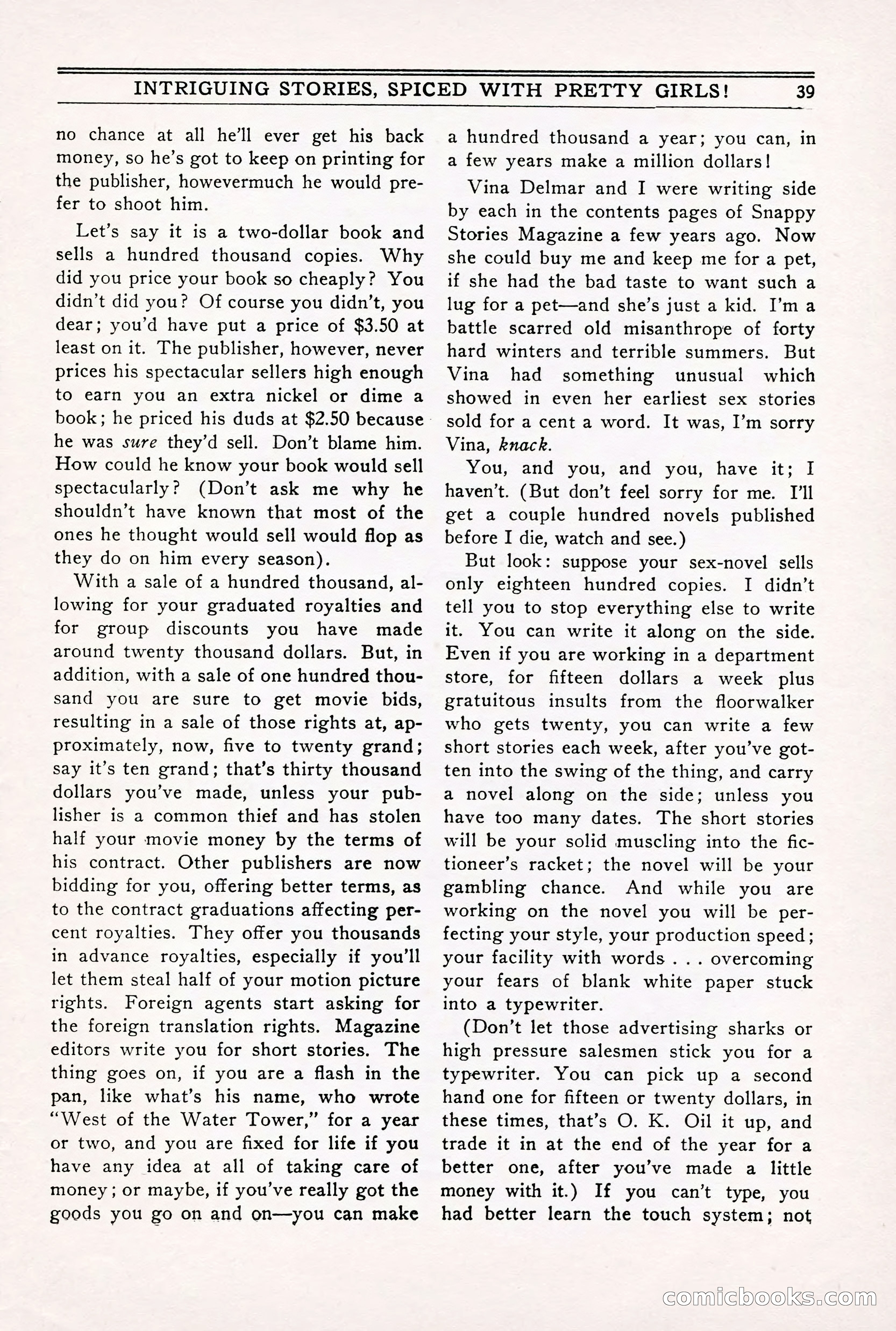
A restored page from Pulp Fiction, 1938. Page through the whole issue in the reader above.
📄 Transcribed text from this page (OCR, searchable)
Machine-transcribed from the original scan — historical spelling and the odd misread are preserved.
INTRIGUING STORIES, SPICED WITH PRETTY GIRLS! 39 a A ee no chance at all he'll ever get his back money, so he’s got to keep on printing for the publisher, howevermuch he would pre- fer to shoot him. Let’s say it is a two-dollar book and sells a hundred thousand copies. Why did you price your book so cheaply? You didn’t did you? Of course you didn’t, you dear; you'd have put a price of $3.50 at least on it. The publisher, however, never prices his spectacular sellers high enough to earn you an extra nickel or dime a book; he priced his duds at $2.50 because » he was sure they’d sell. Don’t blame him. How could he know your book would sell spectacularly? (Don’t ask me why he shouldn’t have known that most of the ones he thought would sell would flop as they do on him every season). With a sale of a hundred thousand, al- lowing for your graduated royalties and for group discounts you have made around twenty thousand dollars. But, in addition, with a sale of one hundred thou- sand you are sure to get movie bids, resulting in a sale of those rights at, ap- proximately, now, five to twenty grand; say it’s ten grand; that’s thirty thousand dollars you’ve made, unless your pub- lisher is a common thief and has stolen half your movie money by the terms of his contract. Other publishers are now bidding for you, offering better terms, as to the contract graduations affecting per- cent royalties. They offer you thousands in advance royalties, especially if you'll let them steal half of your motion picture rights. Foreign agents start asking for the foreign translation rights. Magazine editors write you for short stories. The thing goes on, if you are a flash in the pan, like what’s his name, who wrote “West of the Water Tower,” for a year or two, and you are fixed for life if you have any idea at all of taking care of money ; or maybe, if you’ve really got the goods you go on and on—you can make a hundred thousand a year; you can, in a few years make a million dollars! Vina Delmar and I were writing side by each in the contents pages of Snappy Stories Magazine a few years ago. Now she could buy me and keep me for a pet, if she had the bad taste to want such a lug for a pet—and she’s just a kid. I’ma battle scarred old misanthrope of forty hard winters and terrible summers. But Vina had something unusual which showed in even her earliest sex stories sold for a cent a word. It was, I’m sorry Vina, knack. You, and you, and you, have it; I haven’t. (But don’t feel sorry for me. I'll get a couple hundred novels published before I die, watch and see.) But look: suppose your sex-novel sells only eighteen hundred copies. I didn’t tell you to stop everything else to write it. You can write it along on the side. Even if you are working in a department store, for fifteen dollars a week plus gratuitous insults from the floorwalker who gets twenty, you can write a few short stories each week, after you’ve got- ten into the swing of the thing, and carry a novel along on the side; unless you have too many dates. The short stories will be your solid muscling into the fic- tioneer’s racket; the novel will be your gambling chance. And while you are working on the novel you will be per- fecting your style, your production speed; your facility with words . .. overcoming your fears of blank white paper stuck into a typewriter. (Don’t let those advertising sharks or high pressure salesmen stick you for a typewriter. You can pick up a second hand one for fifteen or twenty dollars, in these times, that’s O. K. Oil it up, and trade it in at the end of the year for a better one, after you’ve made a little money with it.) If you can’t type, you had better learn the touch system; not comiclsoo C@