
Pulp Fiction, 1938 · page 31 of 64
10 Story Book, August 1938 — page 31: what you’re looking at
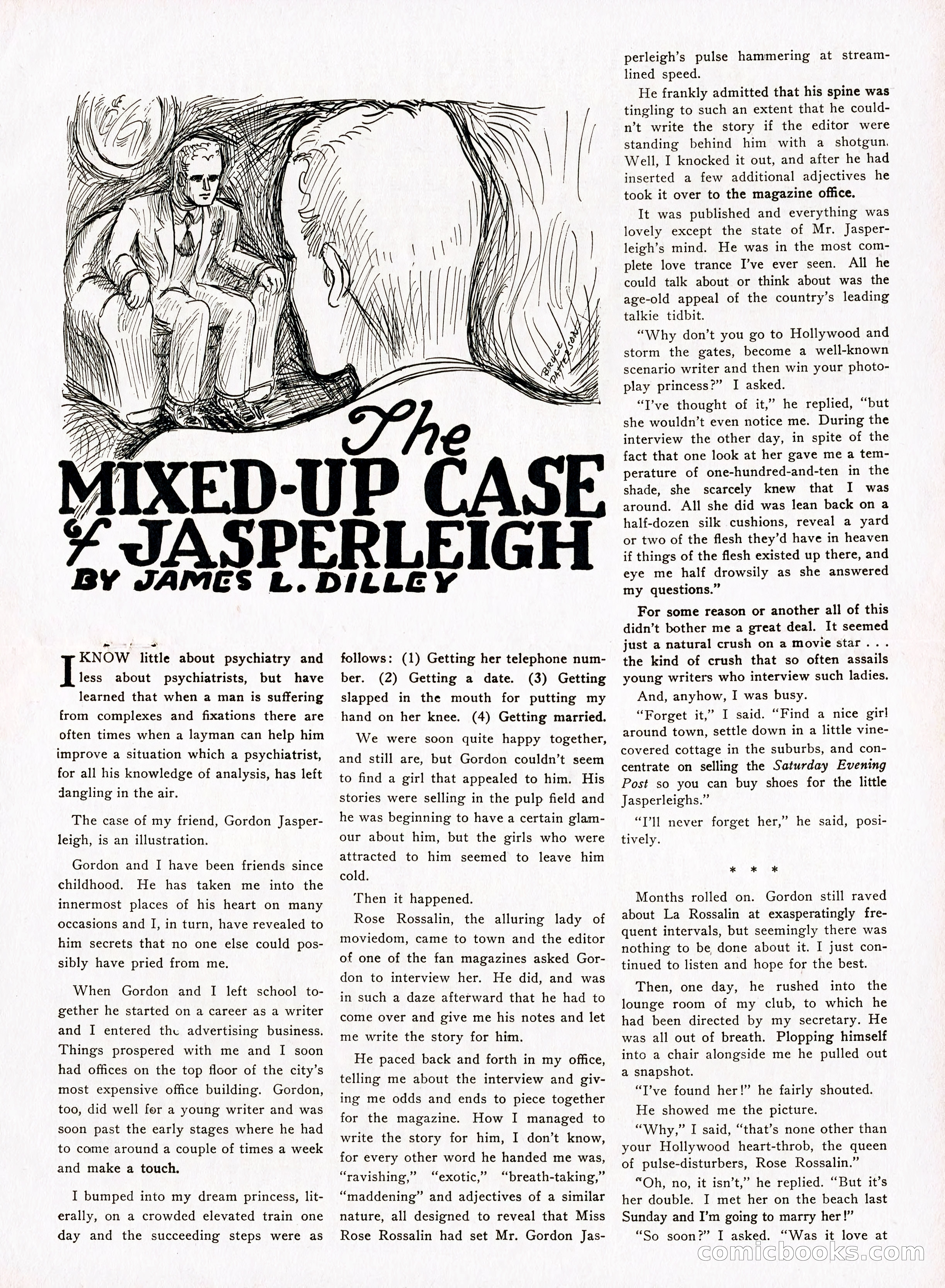
A restored page from Pulp Fiction, 1938. Page through the whole issue in the reader above.
📄 Transcribed text from this page (OCR, searchable)
Machine-transcribed from the original scan — historical spelling and the odd misread are preserved.
\ 22 = ———— — ——— ———_—< / Nn ee Wf | Ss ———_ a a TM YEA I / ) f but have learned that when a man is suffering less about psychiatrists, Tis OW little about psychiatry and from complexes and fixations there are often times when a layman can help him improve a situation which a psychiatrist, for all his knowledge of analysis, has left dangling in the air. The case of my friend, Gordon Jasper- leigh, is an illustration. Gordon and I have been friends since childhood. He has taken me into the innermost places of his heart on many occasions and I, in turn, have revealed to him secrets that no one else could pos- sibly have pried from me. When Gordon and I left school to- gether he started on a career as a writer and I entered the advertising business. Things prospered with me and I soon had offices on the top floor of the city’s most expensive office building. Gordon, too, did well fer a young writer and was soon past the early stages where he had to come around a couple of times a week and make a touch. I bumped into my dream princess, lit- erally, on a crowded elevated train one day and the succeeding steps were as follows: (1) Getting her telephone num- (2) Getting a date. (3) Getting slapped in the mouth for putting my hand on her knee. (4) Getting married. ber. We were soon quite happy together, and still are, but Gordon couldn’t seem to find a girl that appealed to him. His stories were selling in the pulp field and he was beginning to have a certain glam- our about him, but the girls who were attracted to him seemed to leave him cold. Then it happened. Rose Rossalin, the alluring lady of moviedom, came to town and the editor of one of the fan magazines asked Gor- don to interview her. He did, and was in such a daze afterward that he had to come over and give me his notes and let me write the story for him. He paced back and forth in my office, telling me about the interview and giv- ing me odds and ends to piece together for the magazine. How I managed to write the story for him, I don’t know, for every other word he handed me was, “breath-taking,” “maddening” and adjectives of a similar “ravishing,” “exotic,” nature, all designed to reveal that Miss Rose Rossalin had set Mr. Gordon Jas- perleigh’s pulse hammering at stream- lined speed. He frankly admitted that his spine was tingling to such an extent that he could- n’t write the story if the editor were standing behind him with a shotgun. Well, I knocked it out, and after he had inserted a few additional adjectives he took it over to the magazine office. It was published and everything was lovely except the state of Mr. Jasper- leigh’s mind. He was in the most com- plete love trance I’ve ever seen. All he could talk about or think about was the age-old appeal of the country’s leading talkie tidbit. “Why don’t you go to Hollywood and storm the gates, become a well-known scenario writer and then win your photo- play princess?” I asked. “T’ve thought of it,” he replied, “but she wouldn’t even notice me. During the interview the other day, in spite of the fact that one look at her gave me a tem- perature of one-hundred-and-ten in the shade, she scarcely knew that I was around. All she did was lean back on a half-dozen silk cushions, reveal a yard or two of the flesh they’d have in heaven if things of the flesh existed up there, and eye me half drowsily as she answered my questions.” For some reason or another all of this didn’t bother me a great deal. It seemed just a natural crush on a movie star... the kind of crush that so often assails young writers who interview such ladies. And, anyhow, I was busy. “Forget it,” I said. “Find a nice girl around town, settle down in a little vine- covered cottage in the suburbs, and con- centrate on selling the Saturday Evening Post so you can buy shoes for the little Jasperleighs.” “T’ll never forget her,” he said, posi- tively. * * x Months rolled on. Gordon still raved about La Rossalin at exasperatingly fre- quent intervals, but seemingly there was nothing to be done about it. I just con- tinued to listen and hope for the best. Then, one day, he rushed into the lounge room of my club, to which he had been directed by my secretary. He was all out of breath. Plopping himself into a chair alongside me he pulled out a snapshot. “T’ve found her!” he fairly shouted. He showed me the picture. “Why,” I said, “that’s none other than your Hollywood heart-throb, the queen of pulse-disturbers, Rose Rossalin.” “Oh, no, it isn’t,” he replied. “But it’s her double. I met her on the beach last Sunday and I’m going to marry her!” “So soon?’ I asked. “Was it love at CoOMnniclooolkxs (C(O)