
Pulp Fiction, 1938 · page 41 of 64
10 Story Book, August 1938 — page 41: what you’re looking at
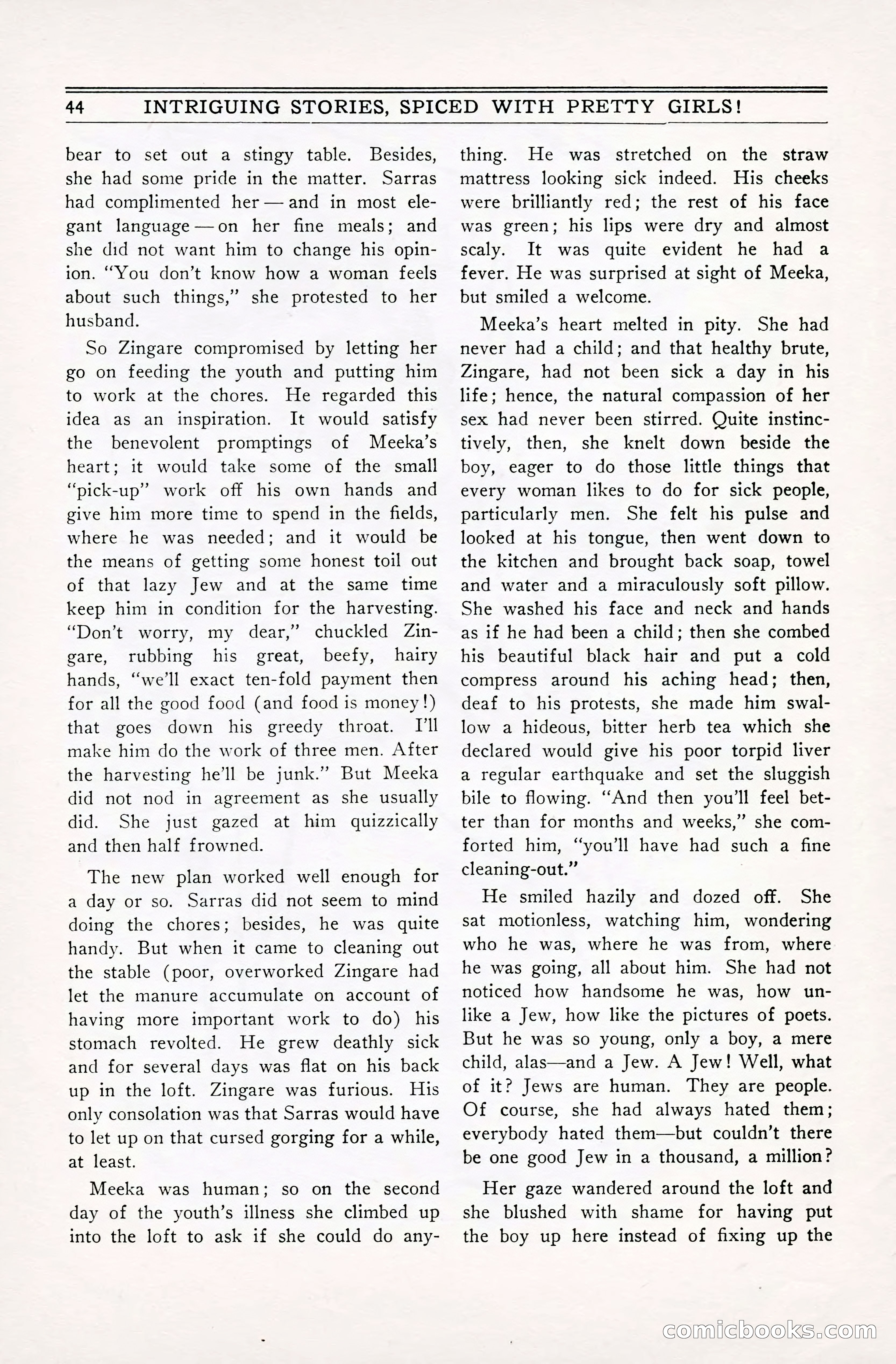
A restored page from Pulp Fiction, 1938. Page through the whole issue in the reader above.
📄 Transcribed text from this page (OCR, searchable)
Machine-transcribed from the original scan — historical spelling and the odd misread are preserved.
44 INTRIGUING STORIES, SPICED WITH PRETTY GIRLS! bear to set out a stingy table. Besides, she had some pride in the matter. Sarras had complimented her—and in most ele- gant language—on her fine meals; and she did not want him to change his opin- ion. “You don’t know how a woman feels about such things,” she protested to her husband. So Zingare compromised by letting her go on feeding the youth and putting him to work at the chores. He regarded this idea as an inspiration. It would satisfy the benevolent promptings of Meeka’s heart; it would take some of the small “pick-up” work off his own hands and give him more time to spend in the fields, where he was needed; and it would be the means of getting some honest toil out of that lazy Jew and at the same time keep him in condition for the harvesting. “Don’t worry, my dear,” chuckled Zin- gare, rubbing his great, beefy, hairy hands, “we'll exact ten-fold payment then for all the good food (and food is money !) that goes down his greedy throat. ll make him do the work of three men. After the harvesting he’ll be junk.” But Meeka did not nod in agreement as she usually did. She just gazed at him quizzically and then half frowned. The new plan worked well enough for a day or so. Sarras did not seem to mind doing the chores; besides, he was quite handy. But when it came to cleaning out the stable (poor, overworked Zingare had let the manure accumulate on account of having more important work to do) his stomach revolted. He grew deathly sick and for several days was flat on his back up in the loft. Zingare was furious. His only consolation was that Sarras would have to let up on that cursed gorging for a while, at least. Meeka was human; so on the second day of the youth’s illness she climbed up into the loft to ask if she could do any- thing. He was stretched on the straw mattress looking sick indeed. His cheeks were brilliantly red; the rest of his face was green; his lips were dry and almost scaly. It was quite evident he had a fever. He was surprised at sight of Meeka, but smiled a welcome. Meeka’s heart melted in pity. She had never had a child; and that healthy brute, Zingare, had not been sick a day in his life; hence, the natural compassion of her sex had never been stirred. Quite instinc- tively, then, she knelt down beside the boy, eager to do those little things that every woman likes to do for sick people, particularly men. She felt his pulse and looked at his tongue, then went down to the kitchen and brought back soap, towel and water and a miraculously soft pillow. She washed his face and neck and hands as if he had been a child; then she combed his beautiful black hair and put a cold compress around his aching head; then, deaf to his protests, she made him swal- low a hideous, bitter herb tea which she declared would give his poor torpid liver a regular earthquake and set the sluggish bile to flowing. “And then you'll feel bet- ter than for months and weeks,” she com- forted him, “you'll have had such a fine cleaning-out.” He smiled hazily and dozed off. She sat motionless, watching him, wondering who he was, where he was from, where he was going, all about him. She had not noticed how handsome he was, how un- like a Jew, how like the pictures of poets. But he was so young, only a boy, a mere child, alas—and a Jew. A Jew! Well, what of it? Jews are human. They are people. Of course, she had always hated them; everybody hated them—but couldn’t there be one good Jew in a thousand, a million? Her gaze wandered around the loft and she blushed with shame for having put the boy up here instead of fixing up the ComicbOoks.c©