
A complete issue · 18 pages · 1879
Puck — December 17, 1879
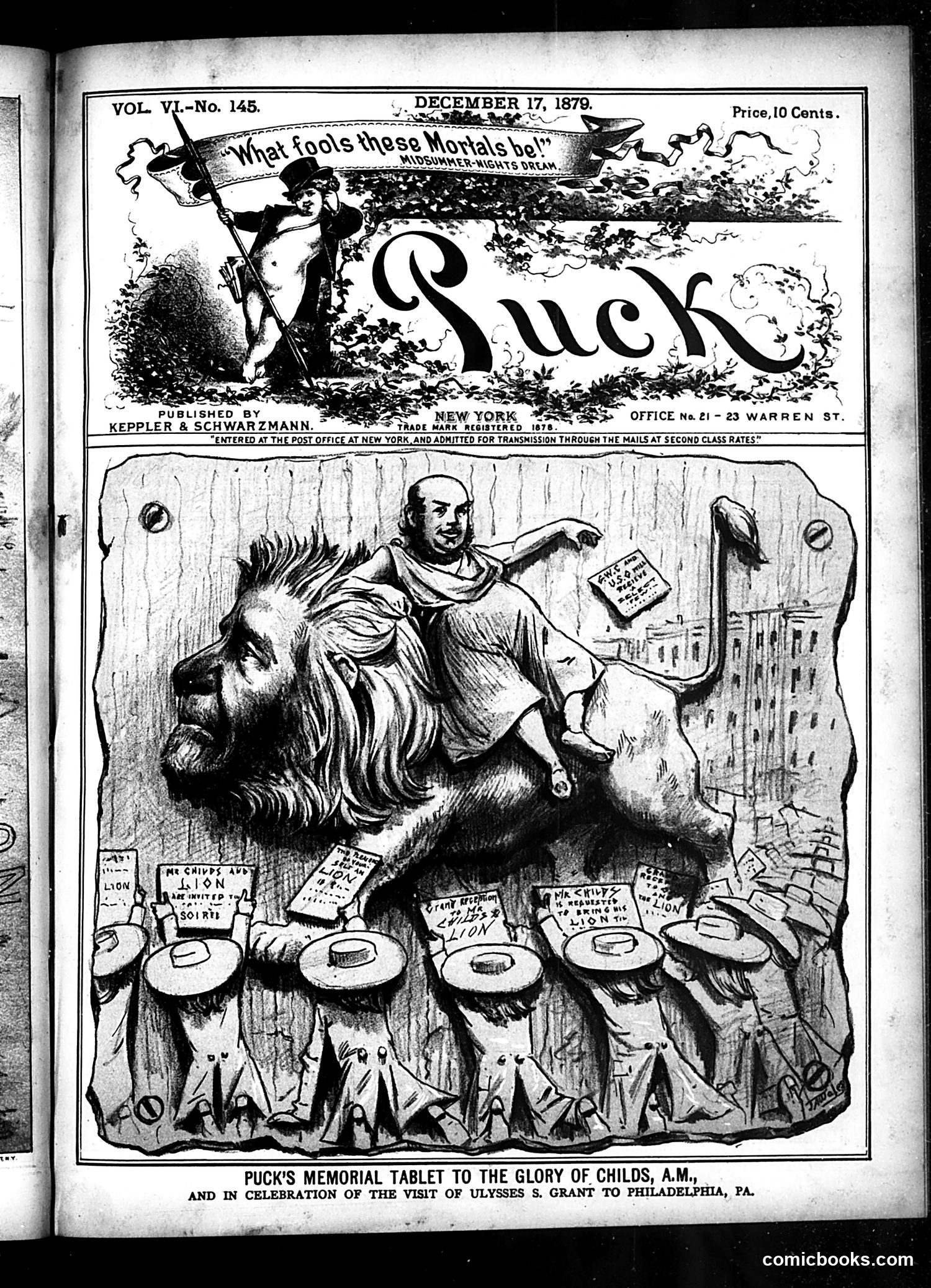
This satirical cartoon depicts a bearded lion carrying a small figure on its back, surrounded by what appear to be children's heads wearing various labeled caps or bonnets. The caption references "Puck's Memorial Tablet to the Glory of Childs, A.M., and in Celebration of the Visit of Ulysses S. Grant to Philadelphia, Pa." The lion likely represents a powerful political or social force, while the small figure riding it suggests someone wielding influence. The surrounding children's heads with labeled caps remain unclear without reading their individual inscriptions, though they appear to represent different groups or constituencies. The cartoon celebrates Grant's Philadelphia visit, though the specific satirical point—whether praising or criticizing Grant, Childs, or another figure—is difficult to determine from the image alone without clearer label legibility.
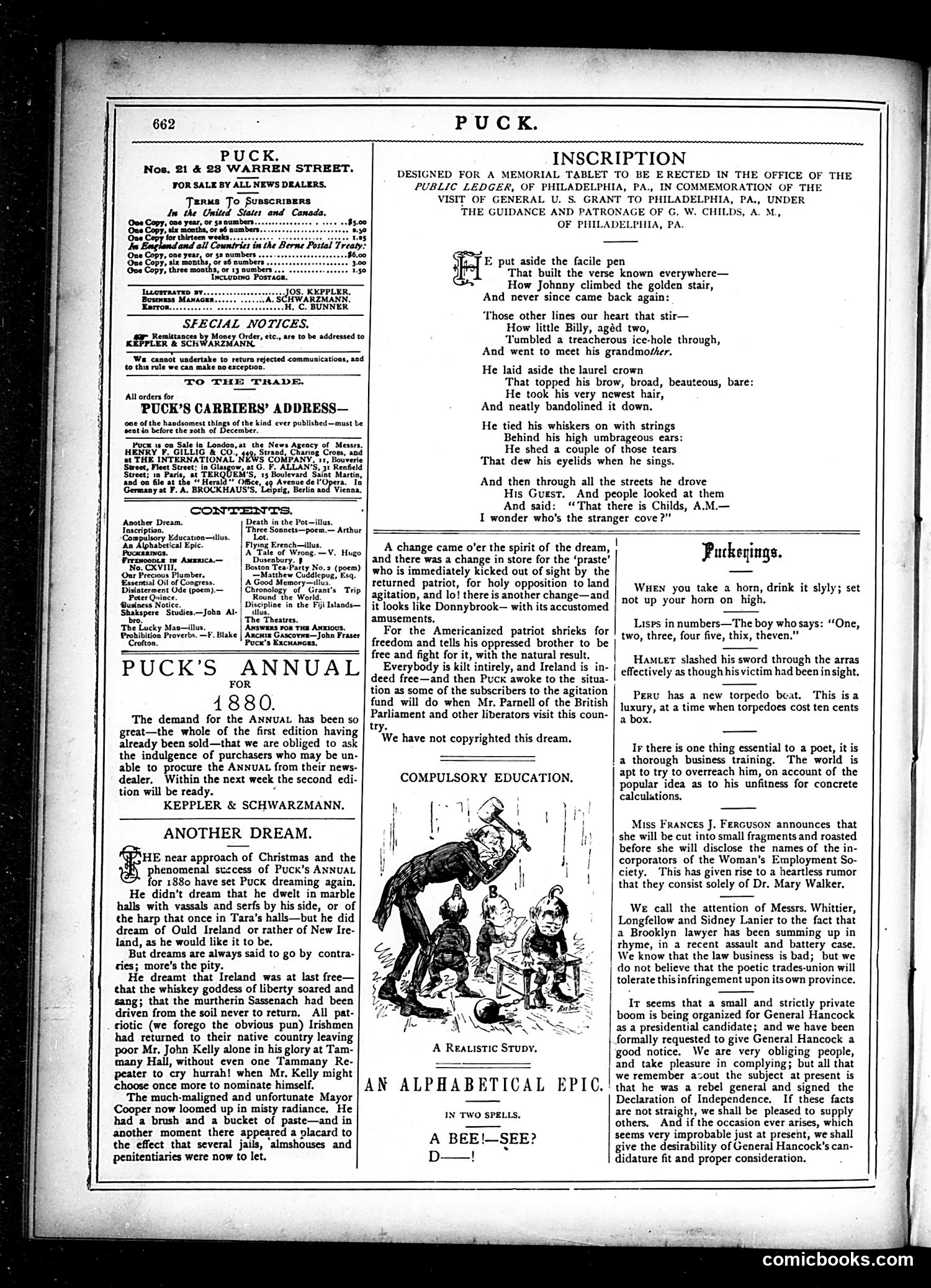
This page contains primarily **text content and advertisements** rather than a major political cartoon. The main illustrated piece is titled "A Realistic Study," showing what appears to be a **caricatured figure in heavy winter clothing interacting with children** — likely satirizing some contemporary social or political figure, though the specific identity is unclear from the image alone. The page features advertisements for Puck's 1880 Annual and discusses **"Compulsory Education,"** suggesting the illustrated study may relate to education policy debates of the period. Without clearer identification of the caricatured figure, the precise satirical target remains uncertain, though it appears to mock attitudes toward education or children's welfare. The artistic style is typical of Puck's heavy-handed caricature approach.
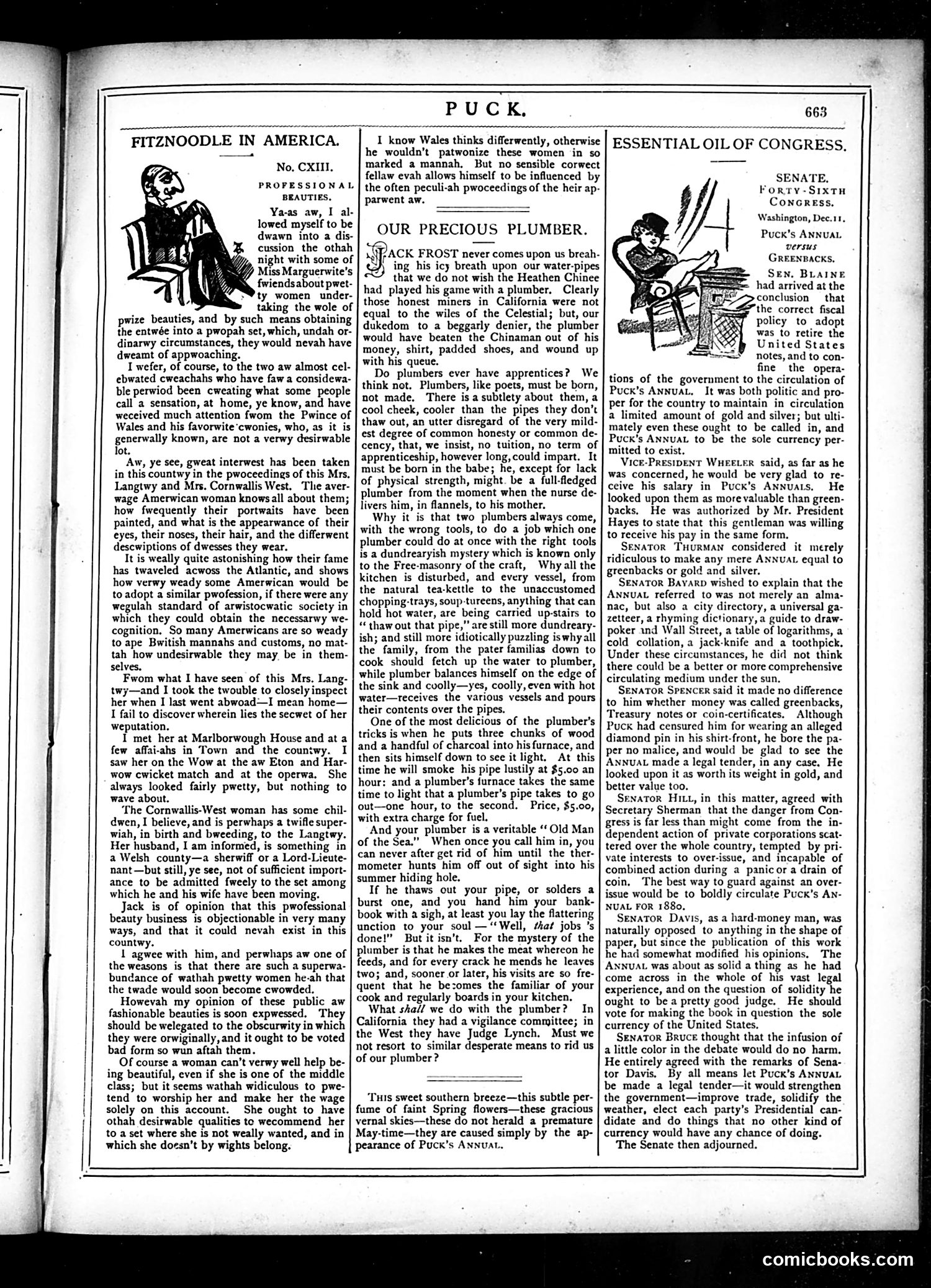
This page contains three distinct articles. **"Fitznoodle in America"** (left) is a satirical piece mocking American women's adoption of British fashions and mannerisms, particularly among the wealthy. It critiques the slavish imitation of British society while questioning whether American women should abandon their own identity. **"Our Precious Plumber"** (center) humorously elevates plumbers as essential professionals, comparing them favorably to poets and suggesting they deserve apprenticeship systems and respect comparable to other trades. It's social satire defending working-class dignity. **"Essential Oil of Congress"** (right) appears to be political commentary on Senate proceedings, though the specific context is unclear from the visible text. The accompanying illustration shows a figure at a desk, likely depicting a congressman or senator.
This page is primarily **advertising and editorial content** rather than political satire. It contains: 1. **"Disinterment Ode"** - A humorous funeral poem by Peter Quince mocking obituary poetry conventions 2. **Business notices** - Multiple advertisements from Puck's publishers and various merchants selling items like patent medicines, paintings, and circus tickets 3. **"Shakespere Studies" section** - Literary commentary on *Hamlet* Act III, analyzing textual ambiguities and character motivations 4. **"He Has Us There"** - A brief humor piece about spelling instruction, with a joke about proper pronunciation 5. **"Another Specimen of British Humor"** - A short anecdote about piano-playing The page reflects Puck's typical mix of satire, advertising revenue, and literary content. No significant political cartoons are visible—this appears to be an interior advertising/content page.
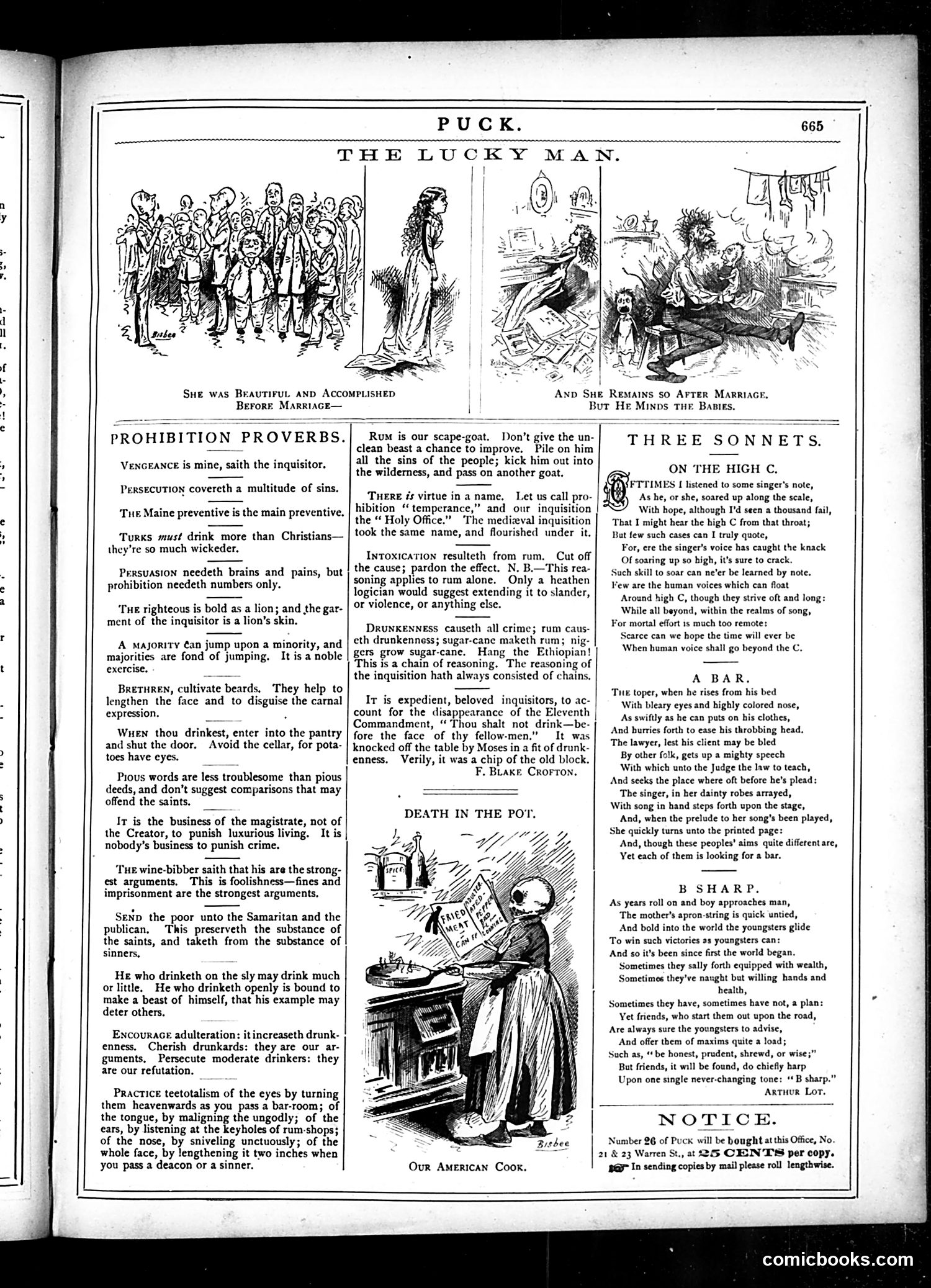
This page contains three main satirical pieces. "The Lucky Man" (top) shows a contrasting narrative: a woman depicted as "beautiful and accomplished" before marriage, then shown afterward as exhausted and neglectful of her home, suggesting marriage diminishes women's vitality and accomplishments—a commentary on domestic expectations. "Prohibition Proverbs" (left column) satirizes temperance advocates through inverted moral statements, mocking their absolutist rhetoric about alcohol consumption and punishment. "Death in the Pot" (center illustration) depicts a skeletal death figure emerging from a cooking pot, likely critiquing unsafe food preparation or poor cooking—possibly referencing the social problems of tenement living or working-class domestic conditions. The sonnets and other poetry on the right appear incidental to the primary satirical content.
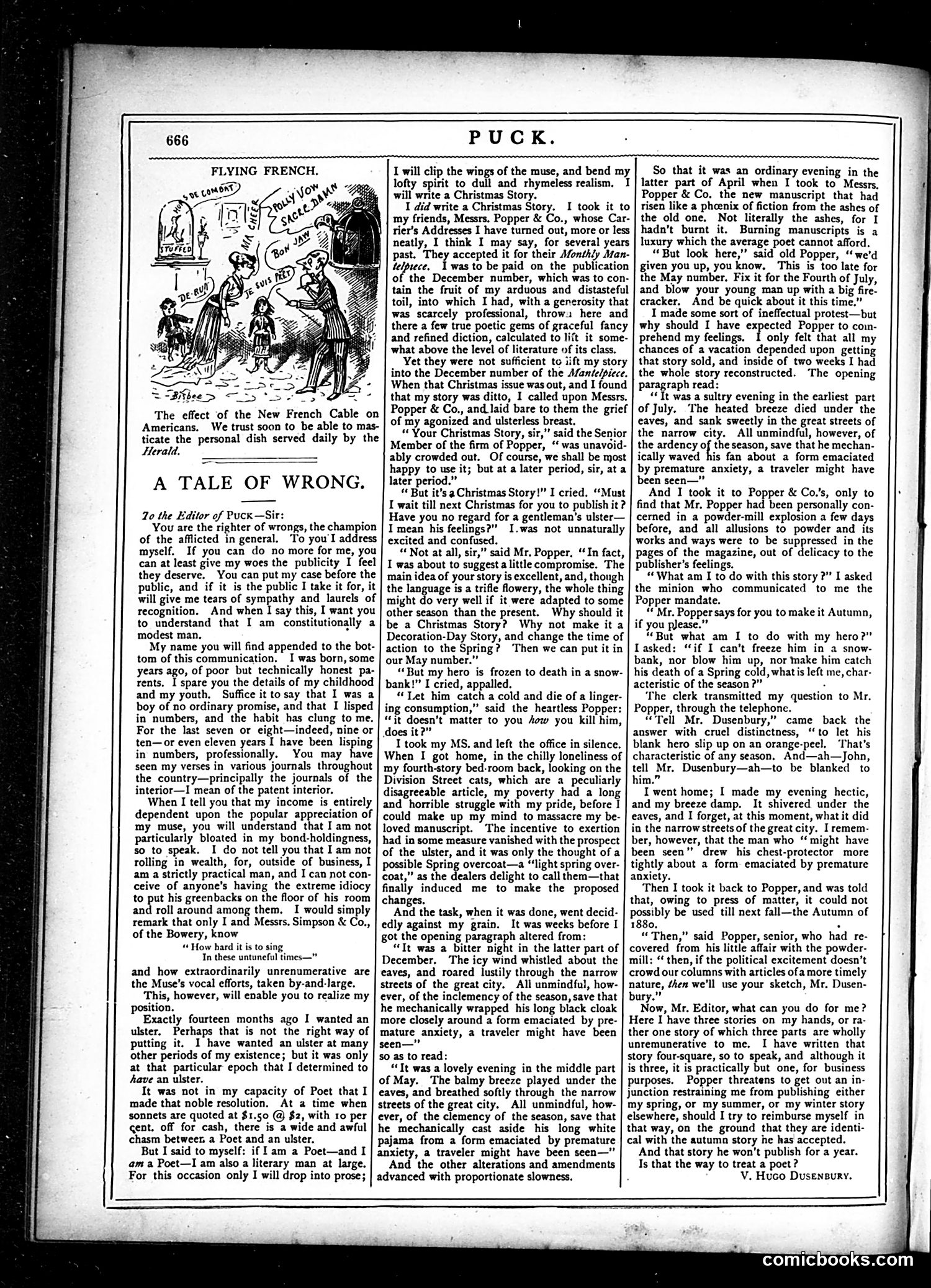
This page contains two distinct sections: **"Flying French"** (top left): A cartoon satirizing French cable technology and its American reception. The illustration appears to mock French engineering or communication methods as unnecessarily complicated or unreliable, playing on American skepticism toward French innovations. **"A Tale of Wrong"** (main text): A lengthy letter to Puck's editor from a writer disputing editorial rejection of his Christmas story. The author claims his manuscript was rejected, then allegedly plagiarized by the publisher Popper & Co. He demands explanation for why his work appears in their *Manifesto* magazine without credit. The page primarily showcases Puck's tradition of publishing reader complaints and disputes—likely exaggerated for comedic effect. The combination of the French cable joke and publishing industry grievance reflects Puck's satirical focus on contemporary American business and cultural affairs.
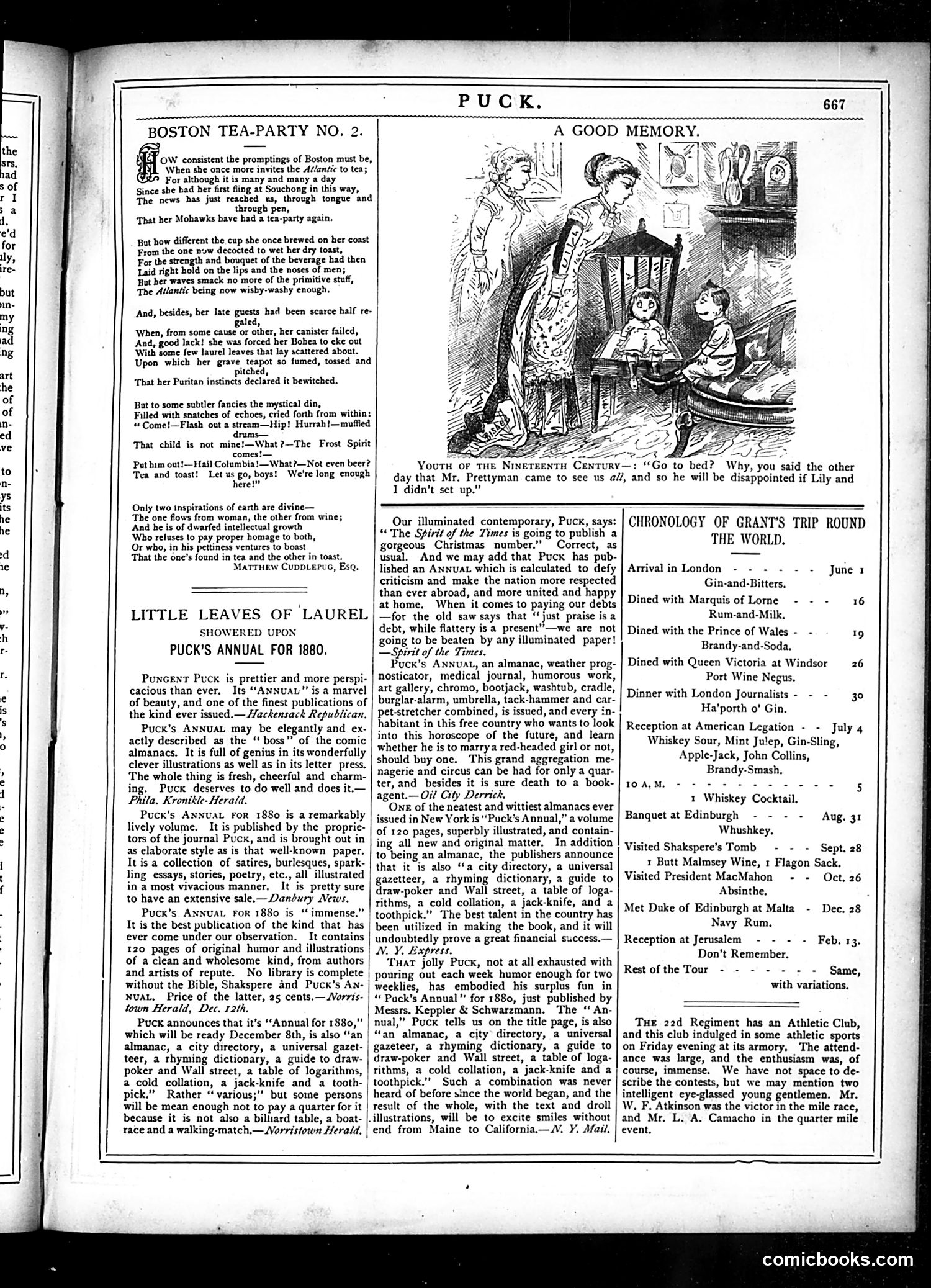
This cartoon depicts a Victorian-era domestic scene where a woman addresses a man seated in a chair, with the caption "Youth of the Nineteenth Century: 'Go to bed? Why, you said the other day that Mr. Preityman came to see us all; and so he will be disappointed if Lily and I didn't sit up.'" The satire targets young women's social expectations and courtship customs of the 1880s. The cartoon mocks how Victorian youth—particularly women—used social visiting as cover for romantic encounters. The "good memory" referenced in the title sardonically notes how the young woman conveniently remembers the gentleman caller's visit to keep herself available and visible to him, defying parental authority to retire early. It satirizes both youthful romantic scheming and the pretense of propriety governing Victorian courtship.
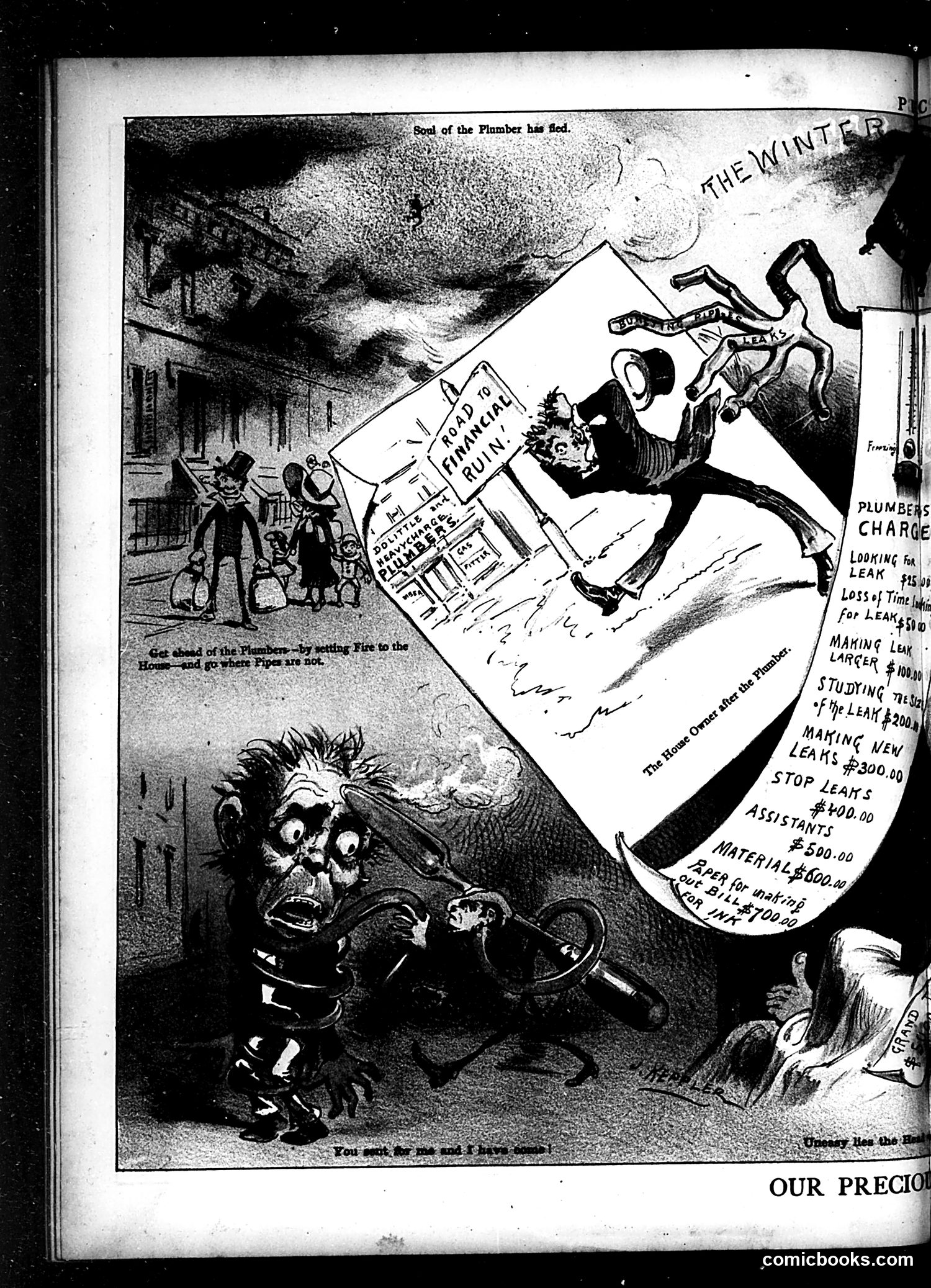
This satirical cartoon criticizes exorbitant plumbing repair costs during winter. The central figure—a grotesque, distorted homeowner with an anguished expression—confronts a smug plumber who presents an itemized bill listing absurd charges: "$200 for looking," "$300 for leaks," "$500 for assistance," "$400 for materials," etc. The upper left shows a family huddled in their cold home (captioned "Soul of the Plumber has fled"), while the plumber charges away during winter conditions. The satire mocks how plumbers exploit homeowners' desperation during cold weather when pipe repairs are urgent and unavoidable. The grotesque facial expressions emphasize the emotional distress of unexpected, inflated bills—a timeless consumer complaint about service industry pricing practices.
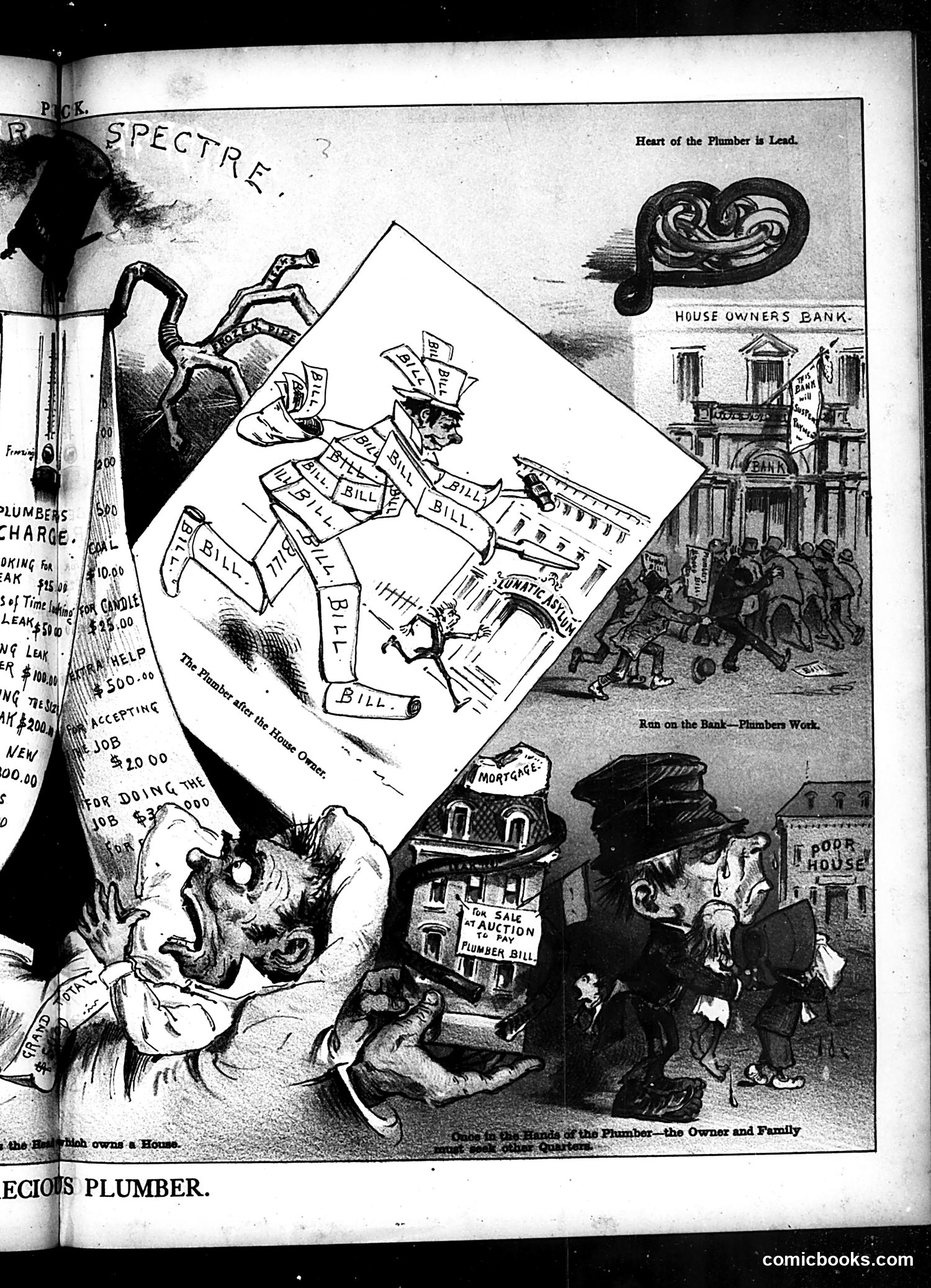
This Puck cartoon satirizes the high cost of plumbing repairs. The central image depicts a skeletal specter labeled "The Plumber" haunting a homeowner, surrounded by bills and charges for various plumbing work—each labeled "BILL." The accompanying scenes show: - A "House Owners Bank" being stormed by people - A property "Run on the Bank—Plumbers Work" - Homeowners and families in financial distress over plumbing costs The satire targets how plumbers' exorbitant fees drain homeowners' finances and cause widespread economic anxiety. The "spectre" imagery suggests plumbers are phantom threats to household budgets. This reflects genuine public frustration with skilled tradesmen's pricing during this era, presented as a widespread social problem affecting many families simultaneously.
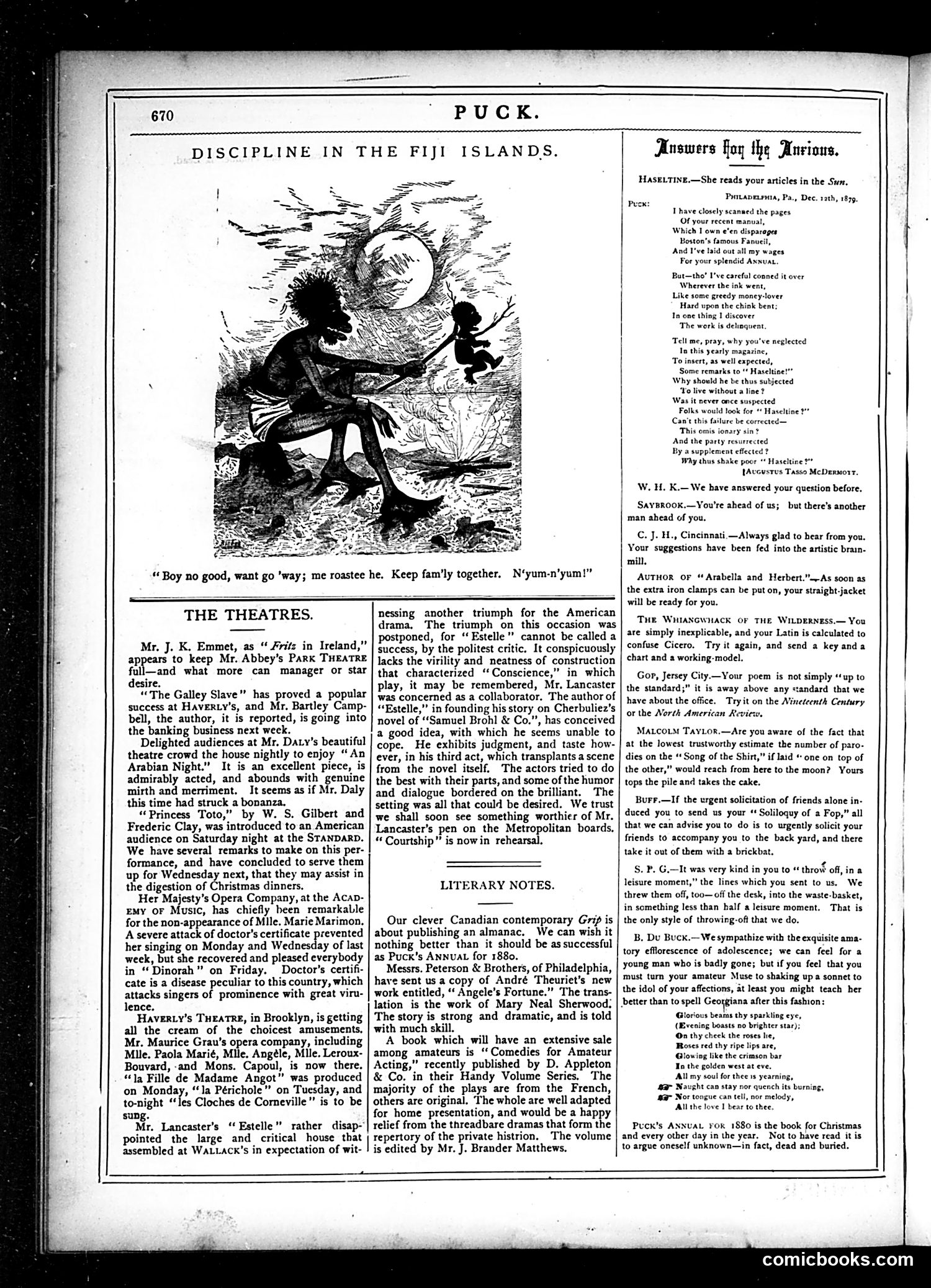
This cartoon satirizes colonial discipline in the Fiji Islands. The image shows a European colonial administrator wielding a cane against Indigenous Fijian people, depicted in a grotesquely caricatured style common to the era. The caption—"Boy no good, want go 'way; me roastee he. Keep fam'ly together. N'yum-n'yum!"—presents the administrator's violence as crude "discipline" while mocking both his broken English and the implied cannibalism fears Europeans projected onto Pacific Islanders. The satire critiques European colonial brutality disguised as civilizing authority. By exaggerating the administrator's violence and ridiculous dialect, Puck ridicules the justifications offered for imperial control and physical punishment of colonized peoples.
This page contains serialized fiction rather than political satire or cartoons. "Archie Gascoyne: A Romance of Skye" is a romantic story written by John Fraser, published in Puck magazine. The narrative follows Archie and his friend Ronald MacDonald as they discover a fortune (gold, diamonds, and precious stones worth over £600,000) hidden in a Highland cottage. The plot involves their decision to keep the discovery secret, with Archie becoming reluctant to marry Alice Jakes due to fears the fortune might be lost or that she'd marry him for money. This is serialized fiction entertainment rather than political commentary or satirical cartooning—typical content Puck published alongside its humor sections.
This page is primarily **advertising and serialized fiction** rather than political satire. The left column continues "Chapter XX" of what appears to be a serialized story in Puck magazine, featuring characters named Archie, Ronald, Alice, and Sir Alexander. The narrative discusses their travels and social interactions in New York. The right side contains **period advertisements** for winter goods (1879), including notices for Jones department store locations, Weber pianos, Docuta bitters (a patent medicine), Angostura bitters, and housefurnishing goods. There is no visible political cartoon on this page. The content reflects typical late-19th-century magazine formatting: serialized entertainment mixed with commercial advertising targeting the magazine's readership.
This page is primarily **advertising and notices** rather than political satire. The dominant content includes: - Multiple ads for **Prang's Christmas products** (cards, decorations, novelties) - Advertisements for **piano manufacturers** (Steinway), **champagne** (G.H. Mumm), and **holiday gifts** - A notice for **Puck's Annual for 1880** (25 cents) - Various merchant advertisements The only illustrated content is a **G.H. Mumm champagne bottle** with decorative branding. **No political cartoon or satirical commentary** appears on this particular page. It represents a typical late-19th-century magazine layout mixing editorial content with seasonal advertisements, likely from a December 1879 or early 1880 issue given the Christmas product focus and the 1880 annual announcement.
This page is primarily **advertisements and notices** rather than political cartoons or satirical content. It consists of various commercial ads for 1880 New York businesses, including: - H. O'Neill & Co.'s department store (fall/winter goods sale) - Jacob Blank's beer saloon and restaurant - Peter Doelger's beer - Trapphagen & Co.'s boot and shoe store The only substantive editorial content is a brief section titled "The Sun for 1880," which appears to be the newspaper's statement of principles, emphasizing political independence and commitment to covering important events. There is also a small "Holiday Novelties" section mentioning current gossip items (Keely's motor, new perfume named after a polo organizer, rumors about executions). No clear political cartoons or caricatures are visible on this page.
This page is primarily **advertising**, not political satire or editorial content. It contains numerous commercial advertisements for late 19th-century products and services: champagne, cigars, toy stores, candies, furniture, eyeglasses, pianos, billiard tables, steel pens, and other goods. The **central cartoon image** depicts a cherubic figure riding what appears to be a large cigar or similar object—this accompanies an advertisement for "Puck" brand cigars manufactured by the Metropolitan Cigar Manufactory in New York. The cartoon is promotional rather than satirical. The page demonstrates how Puck monetized its publication through advertisements while maintaining its branded visual identity in commercial space.
This appears to be primarily an **advertising page** rather than a satirical cartoon page. It contains numerous late 19th-century advertisements for luxury goods and services available in New York City, including: - Fine jewelry and watches (John H. Heller Jr.) - Champagne and wines (Werner & Co., A. Heller & Bro., A. Stoecklein) - Coffee pots and house furnishings (Edward D. Bassford) - Men's hats and clothing (Dunlap & Co., felt hats) - Furniture (Mathesius & Frey) - A brewery (Central Park Brewery) The page also advertises Volume V of Puck magazine itself, available bound or unbound at the Puck Office. There are no visible satirical cartoons or political commentary on this page—it functions as a revenue-generating advertisement section typical of period magazines.
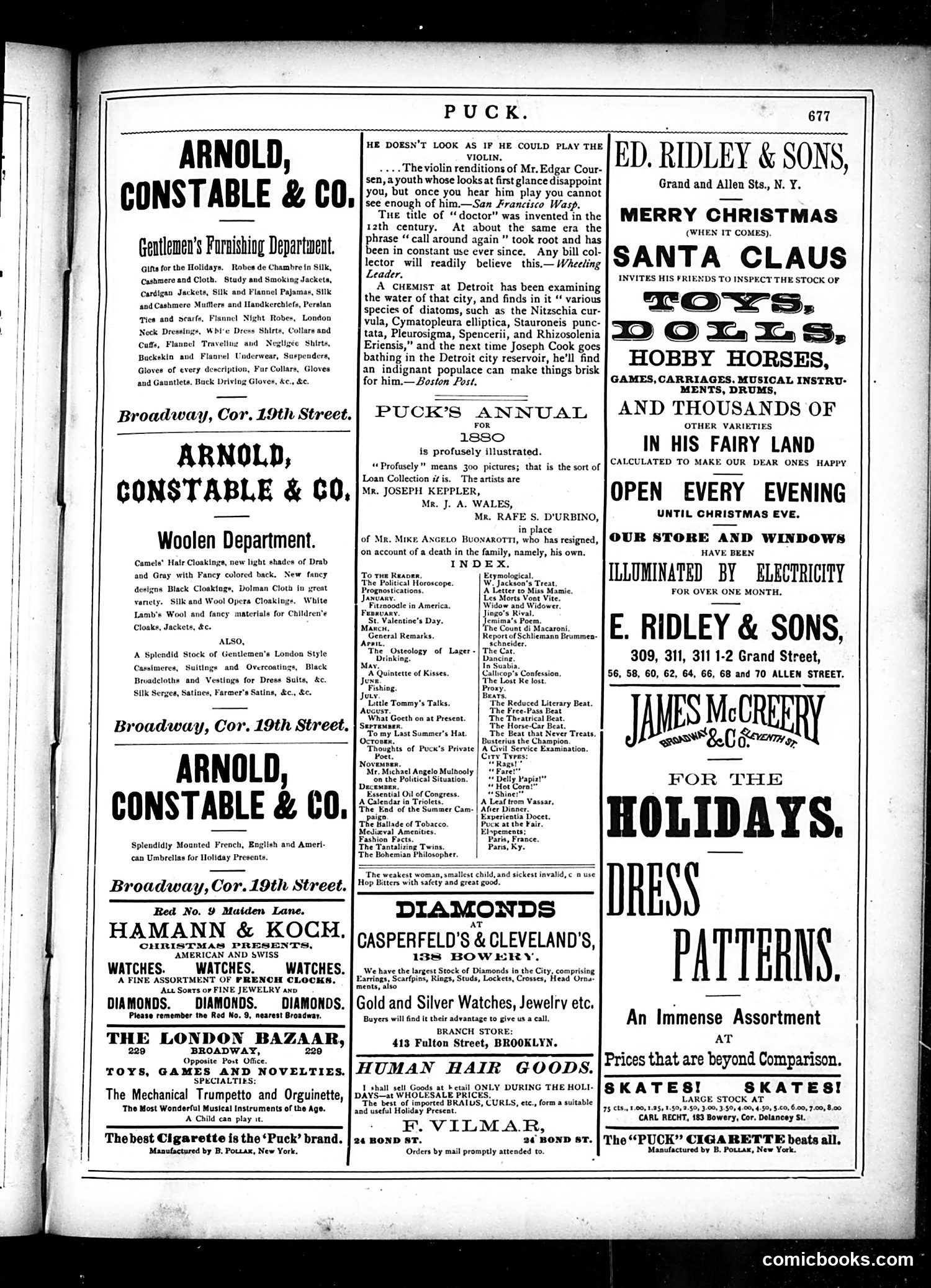
This page is **predominantly advertising**, not editorial cartoon content. The majority consists of holiday shopping advertisements from 1890, including: - Arnold, Constable & Co. (gentlemen's furnishings and woolens) - Ed. Ridley & Sons (toys and hobby horses) - James McCrory (dress patterns) - Hamann & Koch (watches and diamonds) - The London Bazaar (toys and novelties) The only editorial content visible is a brief satirical note about a Detroit chemist examining water samples, and a comment about violin playing—both minor humor pieces rather than political commentary. The page reflects Puck's business model: mixing light social satire with substantial advertising revenue to fund the publication.
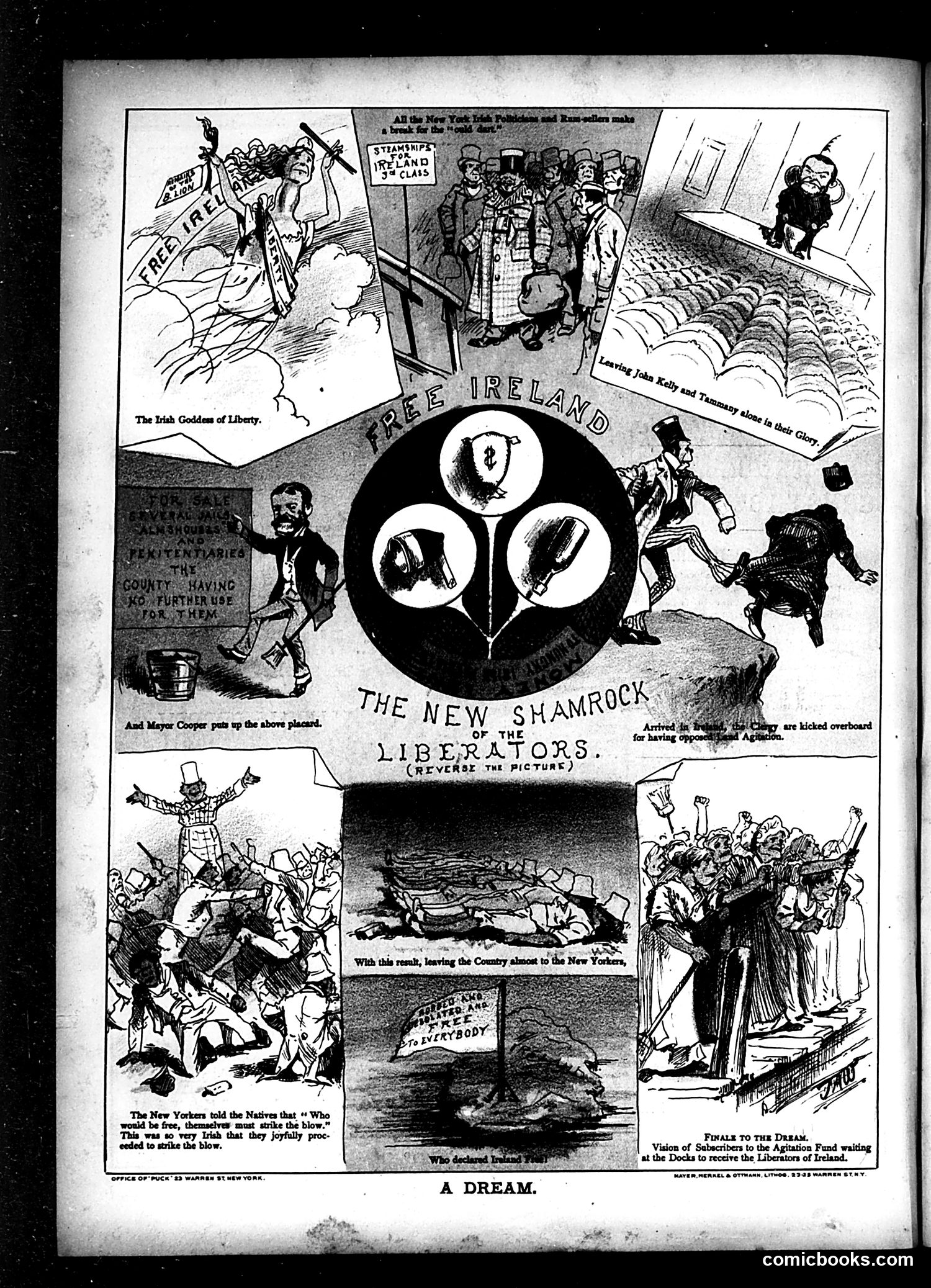
This Puck cartoon satirizes Irish-American political activism, likely from the early 20th century. The central shamrock contains three symbols representing Irish independence movements. The surrounding vignettes depict violent revolutionary scenarios—riots, armed conflict, and chaos in New York streets. The title "A Dream" suggests this is mocking Irish-American liberators' fantasies of violent insurrection. References include "The Irish Goddess of Liberty" (top left) and caricatured figures representing New York politicians and Irish activists. The cartoon criticizes what Puck saw as dangerous revolutionary rhetoric from Irish-Americans, depicting their dreams of Irish independence as destabilizing to American cities. The satire attacks both the feasibility and the violent methods of Irish nationalist movements.