
Puck, 1879-12-17 · page 10 of 18
Puck — December 17, 1879 — page 10: what you’re looking at
What you’re looking at
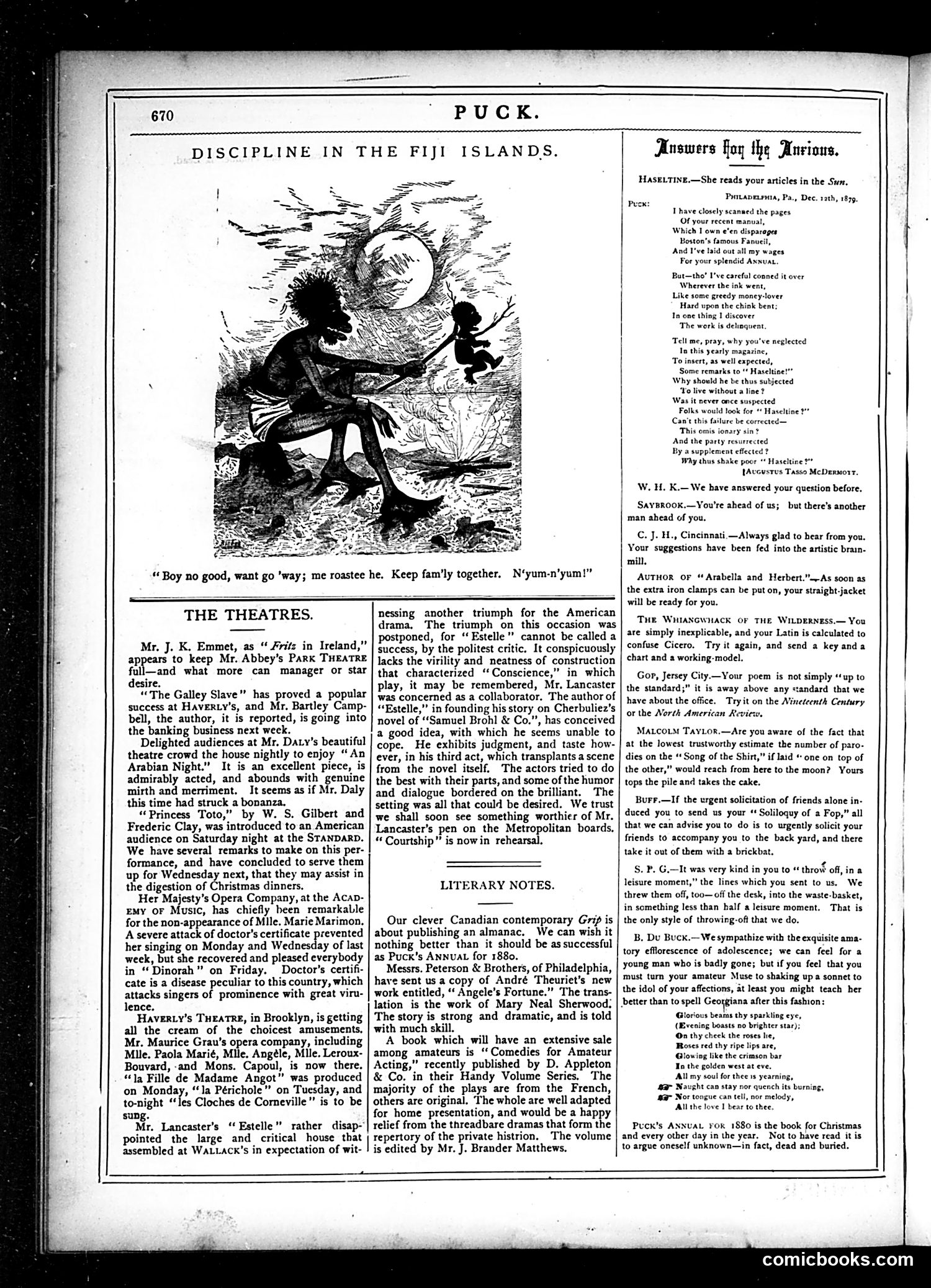
This cartoon satirizes colonial discipline in the Fiji Islands. The image shows a European colonial administrator wielding a cane against Indigenous Fijian people, depicted in a grotesquely caricatured style common to the era. The caption—"Boy no good, want go 'way; me roastee he. Keep fam'ly together. N'yum-n'yum!"—presents the administrator's violence as crude "discipline" while mocking both his broken English and the implied cannibalism fears Europeans projected onto Pacific Islanders. The satire critiques European colonial brutality disguised as civilizing authority. By exaggerating the administrator's violence and ridiculous dialect, Puck ridicules the justifications offered for imperial control and physical punishment of colonized peoples.
📄 Transcribed text from this page (OCR, searchable)
Machine-transcribed from the original scan — historical spelling and the odd misread are preserved.
PUCK. DISCIPLINE IN THE FIJI ISLANDS. “ Boy no good, want go ’way; me roastee he. Keep fam'ly together. N‘yum-n’yum!” THE THEATRES. Mr. J. K. Emmet, as “ Fritz in Ireland,” ap, to keep Mr. Abbey’s Park THEATRE full—and what more can manager or star desire. “The Galley Slave” has proved a popular success at HAVERLY’s, and Mr. Bartley Camp- bell, the author, it is reported, is going into the banking business next weck. Delighted audiences at Mr. Daty’s beautiful theatre crowd the house nightly to enjoy “An Arabian Night.” It is an excellent piece, is admirably acted, and abounds with genuine mirth and merriment. It seems as if Mr. Daly this time had struck a bonanza. “Princess Toto,” by W. S. Gilbert and Frederic Clay, was introduced to an American audience on Saturday night at the STANDARD. We have several remarks to make on this per- formance, and have concluded to serve them up for Wednesday next, that they may assist in the digestion of Christmas dinners. Her Majesty’s Opera Company, at the AcaD- remy OF Music, has chiefly been remarkable for the non-appearance of Mile. Marie Marimon. A severe attack of doctor's certificate prevented her singing on Monday and Wednesday of last week, but she recovered and pleased everybody in “Dinorah” on Friday. Doctor's certifi- cate is a disease peculiar to this country, which attacks singers of prominence with great viru- lence. Haverty's THEATRE, in Brooklyn, is getting all the cream of the choicest amusements, Mr. Maurice Grau’s opera company, including Mile. Paola Marié, Mlle. Angéle, Mile. Leroux- Bouvard, -and Mons. Capoul, is now there. “Ja Fille de Madame Angot” was produced on Monday, “la Périchole” on Tuesday, and to-night ‘les Cloches de Corneville” is to be sung. Mr. Lancaster's “Estelle” rather disap- pointed the large and critical house that assembled at WALLAcK’s in expectation of wit- nessing another triumph for the American drama, The triumph on this occasion was postponed, for “Estelle” cannot be called a success, by the politest critic. It conspicuously lacks the virility and neatness of construction that characterized ‘ Conscience,” in which play, it may be remembered, Mr. Lancaster was concerned as a collaborator. The author of “Estelle,” in founding his story on Cherbuliez's novel of ‘‘Samuel Brohl & Co.”, has conceived a good idea, with which he seems unable to cope. He exhibits judgment, and taste how- ever, in his third act, which transplants a scene from the novel itself. The actors tried to do the best with their parts, and some of the humor and dialogue bordered on the brilliant. The setting was all that could be desired. We trust we shall soon see something worthier of Mr. Lancaster’s pen on the Metropolitan boards. “Courtship” is nowin rehearsal, LITERARY NOTES. Our clever Canadian contemporary Grip is about publishing an almanac, We can wish it nothing better than it should be as successful as Puck's ANNUAL for 1880. Messrs. Peterson & Brothers, of Philadelphia, have sent us a copy of André Theuriet’s new work entitled, ‘‘ Angele’s Fortune.” The trans- lation is the work of Mary Neal Sherwood. The story is strong and dramatic, and is told with much skill. A book which will have an extensive sale among amateurs is “Comedies for Amateur Acting,” recently published by D. Appleton & Co. in their Handy Volume Series. The majority of the plays are from the French, others are original. ‘The whole are well adapted for home presentation, and would be a happy relief from the threadbare dramas that form the repertory of the private histrion, The volume is edited by Mr. J. Brander Matthews. Answers Hoy the Aneions, Hase.ting. She reads your articles in the Sun. Pratapeurma, Pa., Dec. 12th, 1879, I have closely scanned the pages Of your recent manual, Which I own e'en disparoger Boston's famous Fanueil, And I've laid out all my wages For your splendid Axnuat. But—tho' I've careful conned it over Wherever the ink went, Like some greedy money-lover Hard upon the chink bent; In one thing 1 discover The work is dehequent. Tell me, pray, why you've neglected Te this yearly magazine, To insert, as well expected, Some remarks to "* Haseltine Why should he be thus subjected ‘Yo live without a lin Was it never once suspected Folks would look for * Haseltine ?” Can't this failure be corrected — This omis ionary sin? And the party resurrected By a supplement effected ? Why thus shake poor ** Haseltin tAvoustus Tasso McDermory. W. H, K.— We have answered your question before. SavBROOK.—You're ahead of us; but there’s another man ahead of you. C. J. H., Cincinnati. — Always glad to hear from you. Your suggestions have been fed into the artistic brain- mill. AuTHOR oF “ Arabella and Herbert.”As soon as the extra iron clamps can be put on, your straight-jacket will be ready for you, Tue Witancwnack oF THE WILDERNESS.— You are simply inexplicable, and your Latin is calculated to confuse Cicero. Try it again, and send a key anda chart and a working-model. Gor, Jersey City—Your poem is not simply «up to the standard” it is away above any standard that we have about the office. Try it on the Nineteenth Century or the North American Review, MALCOLM TAYLOR.—Are you aware of the fact that at the lowest trustworthy estimate the number of paro- dies on the “ Song of the Shirt,” if laid «one on top of the other,” would reach from here to the moon? Yours tops the pile and takes the cake, BurF.—If the urgent solicitation of friends alone in- duced you to send us your “Soliloquy of a Fop,” all that we can advise you to do is to urgently solicit your friends to accompany you to the back yard, and there take it out of them with a brickbat, S. P. G.—It was very kind in you to “ throw off, in leisure moment,” the lines which you sent to us. We threw them off, too— off the desk, into the waste-basket, in something less than half a leisure moment. That is the only style of throwing-off that we do, B, Du Buck.—We sympathize with the exquisite ama- tory efflorescence of adolescence; we can feel for a young man who is badly gone; but if you feel that you must turn your amateur Muse to shaking up a sonnet to the idol of your affections, at least you might teach her better than to spell Georgiana after this fashion: Glorious beams thy sparkling eye, (Bveoing boasts no brighter star); @n thy cheek the roses he, Roses red thy ripe lips are, Glowing like the crimson bar Tn the golden west at eve, All my soul for thee 1s yearning, fear Nawght can stay nor quench its burning, a Nor tongue can tell, nor melody, All the love I bear to thee. PUcK’s ANNUAL FOR 1880 is the book for Christmas and every other day in the year. Not to have read it is, to argue oneself unknown—in fact, dead and buried. comicbooks.com