
Puck, 1879-12-17 · page 3 of 18
Puck — December 17, 1879 — page 3: what you’re looking at
What you’re looking at
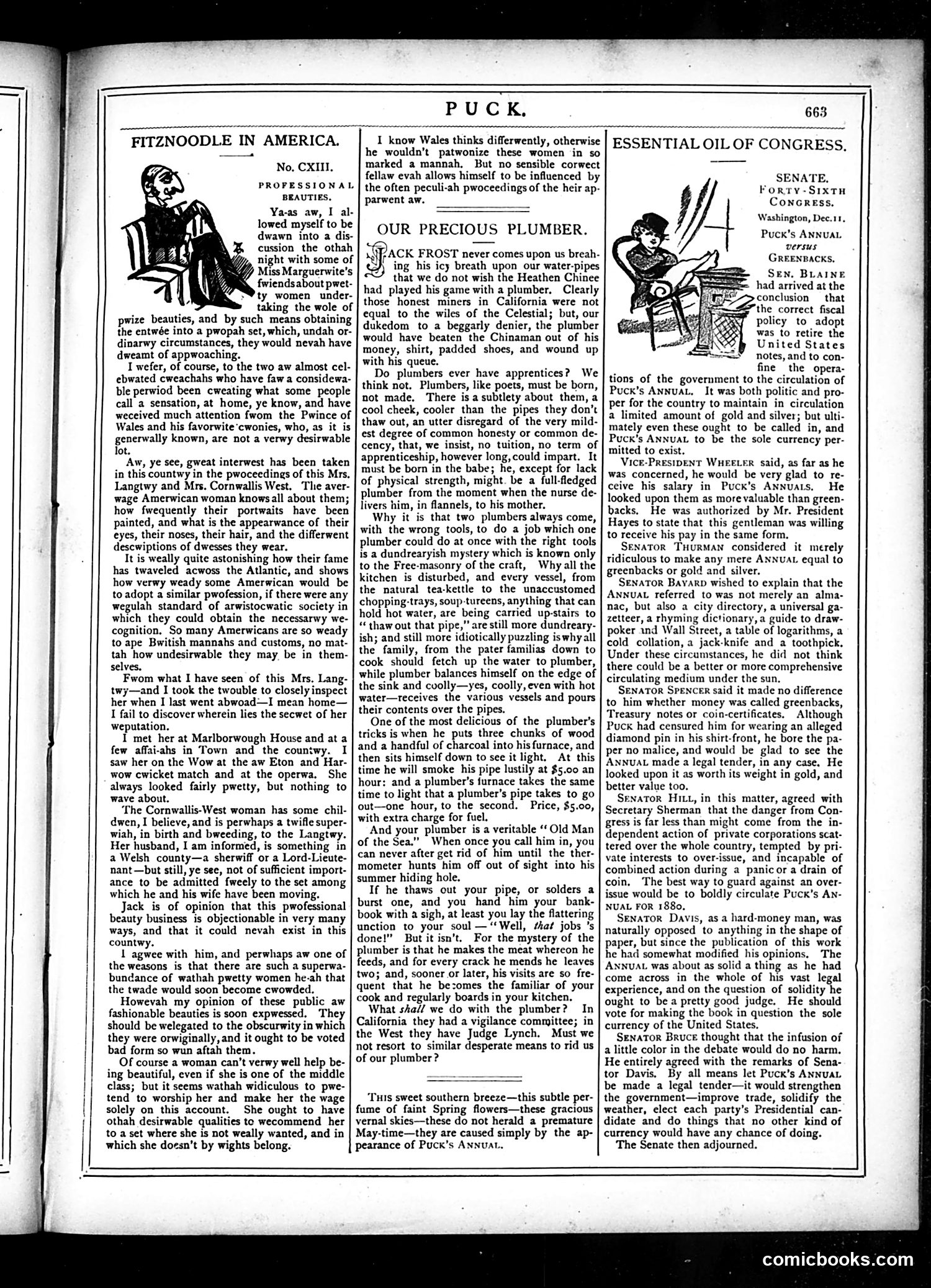
This page contains three distinct articles. **"Fitznoodle in America"** (left) is a satirical piece mocking American women's adoption of British fashions and mannerisms, particularly among the wealthy. It critiques the slavish imitation of British society while questioning whether American women should abandon their own identity. **"Our Precious Plumber"** (center) humorously elevates plumbers as essential professionals, comparing them favorably to poets and suggesting they deserve apprenticeship systems and respect comparable to other trades. It's social satire defending working-class dignity. **"Essential Oil of Congress"** (right) appears to be political commentary on Senate proceedings, though the specific context is unclear from the visible text. The accompanying illustration shows a figure at a desk, likely depicting a congressman or senator.
📄 Transcribed text from this page (OCR, searchable)
Machine-transcribed from the original scan — historical spelling and the odd misread are preserved.
FITZNOODLE IN AMERICA. No, CXIII. PROFESSIONAL BEAUTIES, Ya-as aw, I al- lowed myself to be dwawn into a dis- cussion the othah night with some of Miss Marguerwite’s fwiendsabout pwet- ty women under- taking the wole of pwize beauties, and by such means obtaining the entwée into a pwopah set, which, undah or- dinarwy circumstances, they would nevah have dweamt of appwoaching. I wefer, of course, to the two aw almost cel- ebwated cweachahs who have faw a considewa- ble perwiod been cweating what some people call a sensation, at home, ye know, and have weceived much attention fwom the Pwince of Wales and his favorwite‘cwonies, who, as it is generwally known, are not a verwy desirwable lot. Aw, ye see, gweat interwest has been taken in this countwy in the pwoceedings of this Mrs. Langtwy and Mrs. Cornwallis West. The av. wage Amerwican woman knowsall about them; how fwequently their portwaits have been painted, and what is the appearwance of their eyes, their noses, their hair, and the differwent descwiptions of dwesses they wear. It is weally quite astonishing how their fame has twaveled acwoss the Atlantic, and shows how verwy weady some Amerwican would be to adopt a similar pwofession, if there were any wegulah standard of arwistocwatic society in which they could obtain the necessarwy we- cognition. So many Amerwicans are so weady to ape Bwitish mannahs and customs, no mat- tah how undesirwable they may be in them- selves, Fwom what I have seen of this Mrs. Lang- twy—and I took the twouble to closely inspect her when I last went abwoad—I mean home— I fail to discover wherein lies the secwet of her weputation. I met her at Marlborwough House and at a few affai-ahs in Town and the countwy. I saw her on the Wow at the aw Eton and Har- wow cwicket match and at the operwa, She always looked fairly pwetty, but nothing to wave about. ‘The Cornwallis-West woman has some chil- dwen, I believe, and is perwhaps a twifle super- wiah, in birth and bweeding, to the Langtwy. Her husband, I am informed, is something in a Welsh county—a sherwiff or a Lord-Lieute- nant—but still, ye see, not of sufficient import- ance to be admitted fweely to the set among which he and his wife have been moving. Jack is of opinion that this pwofessional beauty business is objectionable in very many ways, and that it could nevah exist in this countwy. 1 agwee with him, and perwhaps aw one of the weasons is that there are such a superwa- bundance of wathah pwetty women he-ah that the twade would soon become cwowded. Howevah my opinion of these public aw fashionable beauties is soon expwessed, They should be welegated to the obscurwity in which they were orwiginally, and it ought to be voted bad form so wun aftah them. Of course a woman can’t verwy well help be- ing beautiful, even if she is one of the middle class; but it seems wathah widiculous to pwe- tend to worship her and make her the wage solely on this account. She ought to have othah desirwable qualities to wecommend her to a set where she is not weally wanted, and in which she doesn’t by wights belong. PUCK, 663 1 know Wales thinks differwently, otherwise he wouldn't patwonize these women in so marked a mannah, But no sensible corwect fellaw evah allows himself to be influenced by the often peculi-ah pwoceedings of the heir ap- parwent aw. OUR PRECIOUS PLUMBER. pack FROST never comes upon us breah- ing his icy breath upon our water-pipes that we do not wish the Heathen Chinee had played his game with a plumber. Clearly those honest miners in California were not equal to the wiles of the Celestial; but, our dukedom to a beggarly denier, the plumber would have beaten the Chinaman out of his money, shirt, padded shoes, and wound up with his queue. Do plumbers ever have apprentices? We think not. Plumbers, like poets, must be born, not made. There is a subtlety about them, a cool cheek, cooler than the pipes they don’t thaw out, an utter disregard of the very mild- est degree of common honesty or common de- cency, that, we insist, no tuition, no term of apprenticeship, however long, could impart. It must be born in the babe; he, except for lack of physical strength, might. be a full-fledged plumber from the moment when the nurse de- livers him, in flannels, to his mother. Why it is that two plumbers always come, with the wrong tools, to do a job which one plumber could do at once with the right tools is a dundrearyish mystery which is known only to the Free-masonry of the craft, Why all the kitchen is disturbed, and every vessel, from the natural tea-kettle to the unaccustomed chopping-trays, soup-tureens, anything that can hold hot water, are being carried up-stairs to « thaw out that pipe,” are still more dundreary- ish; and still more idiotically puzzling iswhy all the family, from the pater familias down to cook should fetch up the water to plumber, while plumber balances himself on the edge of the sink and cvolly—yes, coolly, even with hot water—receives the various vessels and pours their contents over the pipes. One of the most delicious of the plumber’s tricks is when he puts three chunks of wood and a handful of charcoal into his furnace, and then sits himself down to see it light. At this time he will smoke his pipe lustily at $5.00 an hour: and a plumber’s furnace takes the same time to light that a plumber’s pipe takes to go out—one hour, to the second. Price, $5.00, with extra charge for fuel. And your plumber is a veritable ‘Old Man of the Sea.” When once you call him in, you can never after get rid of him until the ther- mometer hunts him off out of sight into his summer hiding hole. If he thaws out your pipe, or solders a burst one, and you hand him your bank- book with a sigh, at least you lay the flattering unction to your soul —‘Well, that jobs ’s done!” But it isn’t. For the mystery of the plumber is that he makes the meat whercon he feeds, and for every crack he mends he leaves two; and, sooner or later, his visits are so fre- quent that he bezomes the familiar of your cook and regularly boards in your kitchen. What sha// we do with the plumber? In California they had a vigilance committee; in the West they have Judge Lynch. Must we not resort to similar desperate means to rid us of our plumber? ‘THis sweet southern breeze—this subtle per- fume of faint Spring flowers—these gracious vernal skies—these do not herald a premature May-time—they are caused simply by the ap- pearance of Puck’s ANNUAL. ESSENTIAL OIL OF CONGRESS, SENATE, Fortry-Sixtu Conoress. Washington, Dec.11, Puck's ANNUAL versus GREENBACKS. Sen. BLAINE had arrived at the conclusion that ‘the correct fiscal policy to adopt was to retire the United States notes, and to con- fine the opera- tions of the government to the circulation of Puck's ANNUAL. It was both politic and pro- per for the country to maintain in circulation a limited amount of gold and silver; but ulti- mately even these ought to be called in, and Puck's ANNuAL to be the sole currency per- mitted to exist. Vice-PresipENT WHEELER said, as far as he was concerned, he would be very glad to re- ceive his salary in Puck's ANNuats, He looked upon them as more valuable than green- backs. He was authorized by Mr. President Hayes to state that this gentleman was willing to receive his pay in the same form, Senator Tuurman considered it merely ridiculous to make any mere ANNUAL equal to greenbacks or gold and silver. Senator Bayarp wished to explain that the ANNUAL referred to was not merely an alma- nac, but also a city directory, a universal ga- zetteer, a rhyming dictionary, a guide to draw- poker ind Wall Street, a table of logarithms, a cold collation, a jack-knife and a toothpick. Under these circumstances, he did not think there could be a better or more comprehensive. circulating medium under the sun, SENATOR SPENCER said it made no difference to him whether money was called greenbacks, Treasury notes or coin-certificates. Although Puck had censured him for wearing an alleged diamond pin in his shirt-front, he bore the pa- per no malice, and would be glad to see the ANNUAL made a legal tender, in any case, He looked upon it as worth its weight in gold, and better value too. Senator Hitt, in this matter, agreed with Secretary Sherman that the danger from Con- gress is far less than might come from the in- dependent action of private corporations scat- tered over the whole country, tempted by pri- vate interests to over-issue, and incapable of combined action during a panicor a drain of coin, The best way to guard against an over- issue would be to boldly circulate Puck’s AN- NUAL FOR 1880, Senator Davis, as a hard-money man, was naturally opposed to anything in the shape of paper, but since the publication of this work he had somewhat modified his opinions, The Annuat was about as solid a thing as he had come across in the whole of his vast legal experience, and on the question of solidity he ought to bea pretty good judge. He should vote for making the book in question the sole currency of the United States, SENATOR Bruce thought that the infusion of a little color in the debate would do no harm. He entirely agreed with the remarks of Sena- tor Davis. By all means let Puck’s ANNUAL be made a legal tender—it would strengthen the government—improve trade, solidify the weather, elect each party’s Presidential can- didate and do things that no other kind of currency would have any chance of doing. The Senate then adjourned. comicbooks.com