
Puck, 1879-12-17 · page 6 of 18
Puck — December 17, 1879 — page 6: what you’re looking at
What you’re looking at
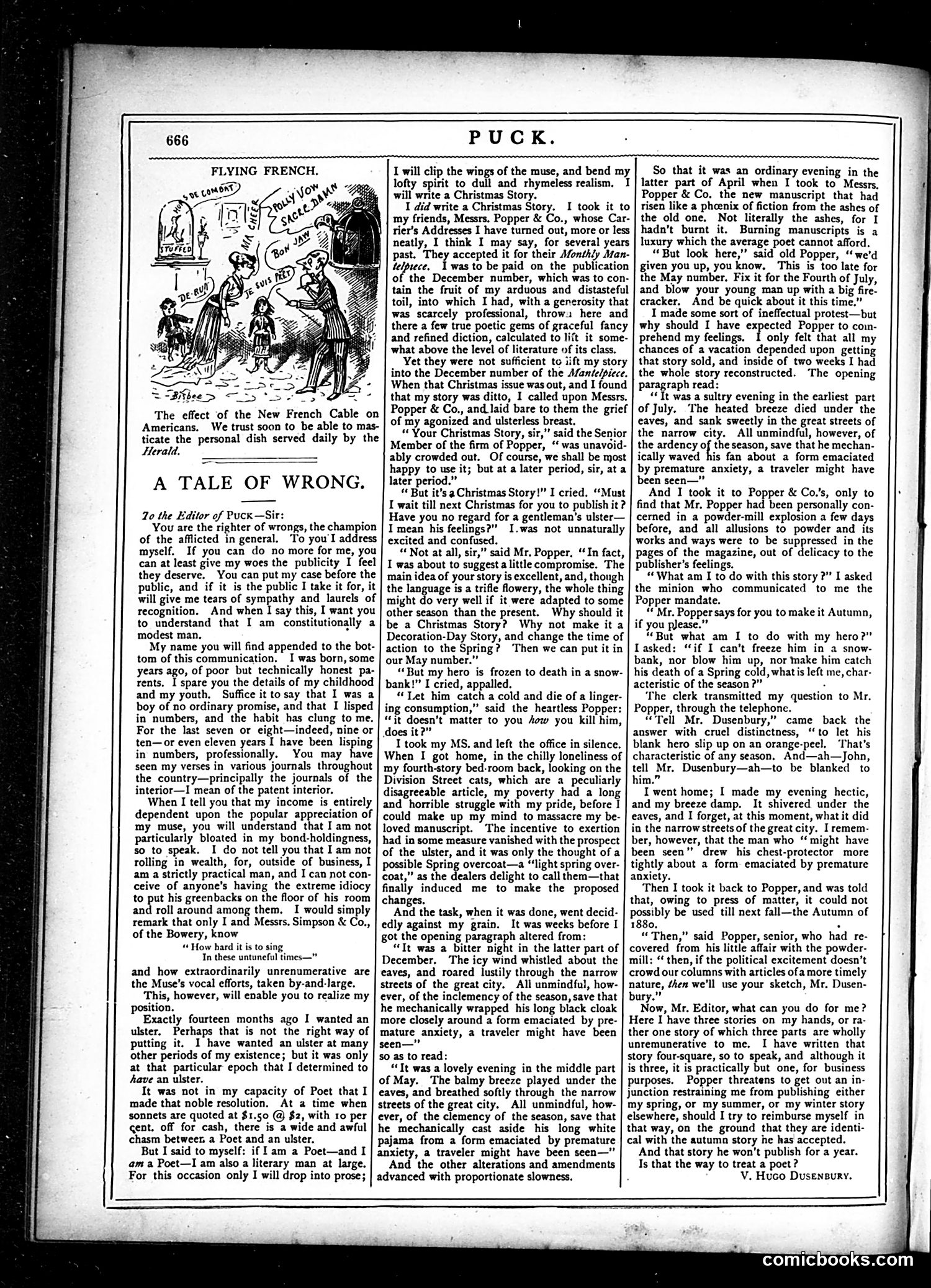
This page contains two distinct sections: **"Flying French"** (top left): A cartoon satirizing French cable technology and its American reception. The illustration appears to mock French engineering or communication methods as unnecessarily complicated or unreliable, playing on American skepticism toward French innovations. **"A Tale of Wrong"** (main text): A lengthy letter to Puck's editor from a writer disputing editorial rejection of his Christmas story. The author claims his manuscript was rejected, then allegedly plagiarized by the publisher Popper & Co. He demands explanation for why his work appears in their *Manifesto* magazine without credit. The page primarily showcases Puck's tradition of publishing reader complaints and disputes—likely exaggerated for comedic effect. The combination of the French cable joke and publishing industry grievance reflects Puck's satirical focus on contemporary American business and cultural affairs.
📄 Transcribed text from this page (OCR, searchable)
Machine-transcribed from the original scan — historical spelling and the odd misread are preserved.
PUCK. FLYING FRENCH. The effect of the New French Cable on Americans. We trust soon to be able to mas- ticate the personal dish served daily by the Herald. A TALE OF WRONG. Yo the Editor of Puck—Sir: You are the righter of wrongs, the champion of the afflicted in general. To you'l address myself. If you can do no more for me, you can at least give my woes the publicity I feel they deserve. You can put my case before the public, and if it is the public I take it for, it will give me tears of sympathy and laurels of recognition. And when I say this, I want you to understand that I am constitutionally a modest man, My name you will find appended to the bot- tom of this communication. I was born, some years ago, of poor but technically honest pa- rents, I spare you the details of my childhood and my youth, Suffice it to say that I was a boy of no ordinary promise, and that I lisped in numbers, and the habit has clung to me, For the last seven or eight—indeed, nine or ten—or even eleven years I have been lisping in numbers, professionally. You may have seen my verses in various journals throughout the country—principally the journals of the interior—I mean of the patent interior. When I tell you that my income is entirely dependent upon the popular appreciation of my muse, you will understand that I am not particularly bloated in my bond-holdingness, so to speak. I do not tell you that I am not rolling in wealth, for, outside of business, I am a strictly practical man, and I can not con- ceive of anyone’s having the extreme idiocy to put his greenbacks on the floor of his room and roll around among them. I would simply remark that only I and Messrs. Simpson & Co., of the Bowery, know « How hard it is to sing In these untuneful times—” and how extraordinarily unrenumerative are the Muse's vocal efforts, taken by-and-large. ‘This, however, will enable you to realize my ition. Exactly fourteen months ago I wanted an ulster. Perhaps that is not the right way of putting it. I have wanted an ulster at many other periods of my existence; but it was only at that particular epoch that I determined to Aave an ulster. It was not in my capacity of Poet that I made that noble resolution. At a time when sonnets are quoted at $1.50 @ $2, with ro per Gent. off for cash, there is a wide and awful chasm betweer, a Poet and an ulster. But I said to myself: if 1 am a Poet—and I am a Poet—I am also a literary man at large. I will clip the wings of the muse, and bend my lofty spirit to dull and rhymeless realism. will write a Christmas Story. I did write a Christmas Story. I took it to my friends, Messrs. Popper & Co., whose Car- rier’s Addresses I have turned out, more or less neatly, I think I may say, for several years past. They accepted it for their Afonthly Man- delprece. i was to be paid on the publication of the December number, which was to con- tain the fruit of my arduous and distasteful toil, into which I had, with a generosity that was scarcely professional, throw. here and there a few true poetic gems of graceful fancy and refined diction, calculated to lift it some- what above the level of literature of its class. Yet they were not sufficient to iift my story into the December number of the Afantelpiece. When that Christmas issue was out, and I found that my story was ditto, I called upon Messrs. Popper & Co., and laid bare to them the grief of my agonized and ulsterless breast. “Your Christmas Story, sir,” said the Senior Member of the firm of Popper, “was unavoid- ably crowded out, Of course, we shall be most happy to use it; but at a later period, sir, at a later period.” “ But it’s aChristmas Story!” I cried. ‘Must I wait till next Christmas for you to publish it ? Have you no regard for a gentleman's ulster— I mean his feelings?” I.was not unnaturally excited and confused. “Not at all, sir,” said Mr. Popper, “In fact, I was about to suggest a little compromise. The main idea of your story is excellent, and, though the language is a trifle flowery, the whole thing might do very well if it were adapted to some other season than the present. Why should it be a Christmas Story? Why not make it a Decoration-Day Story, and change the time of action to the Spring? ‘Then we can put it in our May number.” “But my hero is frozen to death in a snow- bank!” I cried, appalled, “Let him catch a cold and die of a linger- ing consumption,” said the heartless Popper: “it doesn’t matter to you fow you kill him, does it?” I took my MS. and left the office in silence, When I got home, in the chilly loneliness of my fourth-story bed-room back, looking on the Division Street cats, which are a peculiarly disagreeable article, my poverty had a long and horrible struggle with my pride, before I could make up my mind to massacre my be- loved manuscript. The incentive to exertion had in some measure vanished with the prospect of the ulster, and it was only the thought of a possible Spring overcoat—a “light spring over- coat,” as the dealers delight to call them—that finally induced me to make the proposed changes. And the task, when it was done, went decid- edly against my grain. It was weeks before I got the opening paragraph altered from: “Tt was a bitter Sight in the latter part of December. The icy wind whistled about the eaves, and roared lustily through the narrow streets of the great city. All unmindful, how- ever, of the inclemency of the season, save that he mechanically wrapped his long black cloak more closely around a form emaciated by pre- mature anxiety, a traveler might have been seen—" so as to read: “Tt was a lovely evening in the middle part of May. The balmy breeze played under the eaves, and breathed softly through the narrow streets of the great city. All unmindful, how- ever, of the clemency of the season, save that he mechanically cast aside his long white pajama from a form emaciated by premature anxiety, a traveler might have been seen—” And the other alterations and amendments For this occasion only I will drop into prose; advanced with proportionate slowness. So that it was an ordinary evening in the latter part of April when I took to Messrs, Popper & Co, the new manuscript that had risen like a phoenix of fiction from the ashes of the old one. Not literally the ashes, for I hadn’t burnt it. Burning manuscripts is a luxury which the average poet cannot afford. “But look here,” said old Popper, “we'd given you up, you know. This is too late for the May number. Fix it for the Fourth of July, and blow your young man up with a big fire. cracker, And be quick about it this time.” I made some sort of ineffectual protest—but why should I have expected Popper to comn- prehend my feelings. I only felt that all my chances of a vacation depended upon getting that story sold, and inside of two weeks I had the whole story reconstructed. The opening paragraph read: “Tt was a sultry evening in the earliest part of July. The heated breeze died under the eaves, and sank sweetly in the great streets of the narrow city. All unmindful, however, of the ardency of the season, save that he mechan- ically waved his fan about a form emaciated by premature anxiety, a traveler might have been seen—” And I took it to Popper & Co.'s, only to find that Mr. Popper had been personally con- cerned in a powder-mill explosion a few days before, and all allusions to powder and its works and ways were to be suppressed in the pages of the magazine, out of delicacy to the publisher's feelings. “What am I to do with this story ?” I asked the minion who communicated to me the Popper mandate, “Mr. Popper says for you to make it Autumn, if you pJease.”” “But what am I to do with my hero?” Lasked: “if I can't freeze him in a snow- bank, nor blow him up, nor make him catch his death of a Spring cold, whatis left me, char- acteristic of the season?” : ‘The clerk transmitted my question to Mr. Popper, through the telephone. “Tell Mr. Dusenbury,” came back the answer with cruel distinctness, ‘to let his blank hero slip up on an orange-peel, ‘That's characteristic of any season, And—ah—John, tell Mr. Dusenbury—ah—to be blanked to him.” I went home; I made my evening hectic, and my breeze damp. It shivered under the eaves, and I forget, at this moment, what it did in the narrow streets of the great city. I remem- ber, however, that the man who “might have been seen” drew his chest-protector more tightly about a form emaciated by premature anxiety. Then I took it back to Popper, and was told that, owing to press of matter, it could not possibly be used till next fall—the Autumn of 1880, . “Then,” said Popper, senior, who had re- covered from his little affair with the powder- mill: “ then, if the political excitement doesn’t crowd our columns with articles ofa more timely nature, then we'll use your sketch, Mr. Dusen- bury.” Now, Mr. Editor, what can you do for me? Here I have three stories on my hands, or ra- ther one story of which three parts are wholly unremunerative to me. I have written that story four-square, so to speak, and although it is three, it is practically but one, for business purposes. Popper threatens to get out an in- junction restraining me from publishing either my spring, or my summer, or my winter story elsewhere, should I try to reimburse myself in that way, on the ground that they are identi- cal with the autumn story he has accepted. ‘And that story he won't publish for a year. Is that the way to treat a poet? V. Huco Dusensury. comicbooks.com