
Puck, 1879-12-17 · page 11 of 18
Puck — December 17, 1879 — page 11: what you’re looking at
What you’re looking at
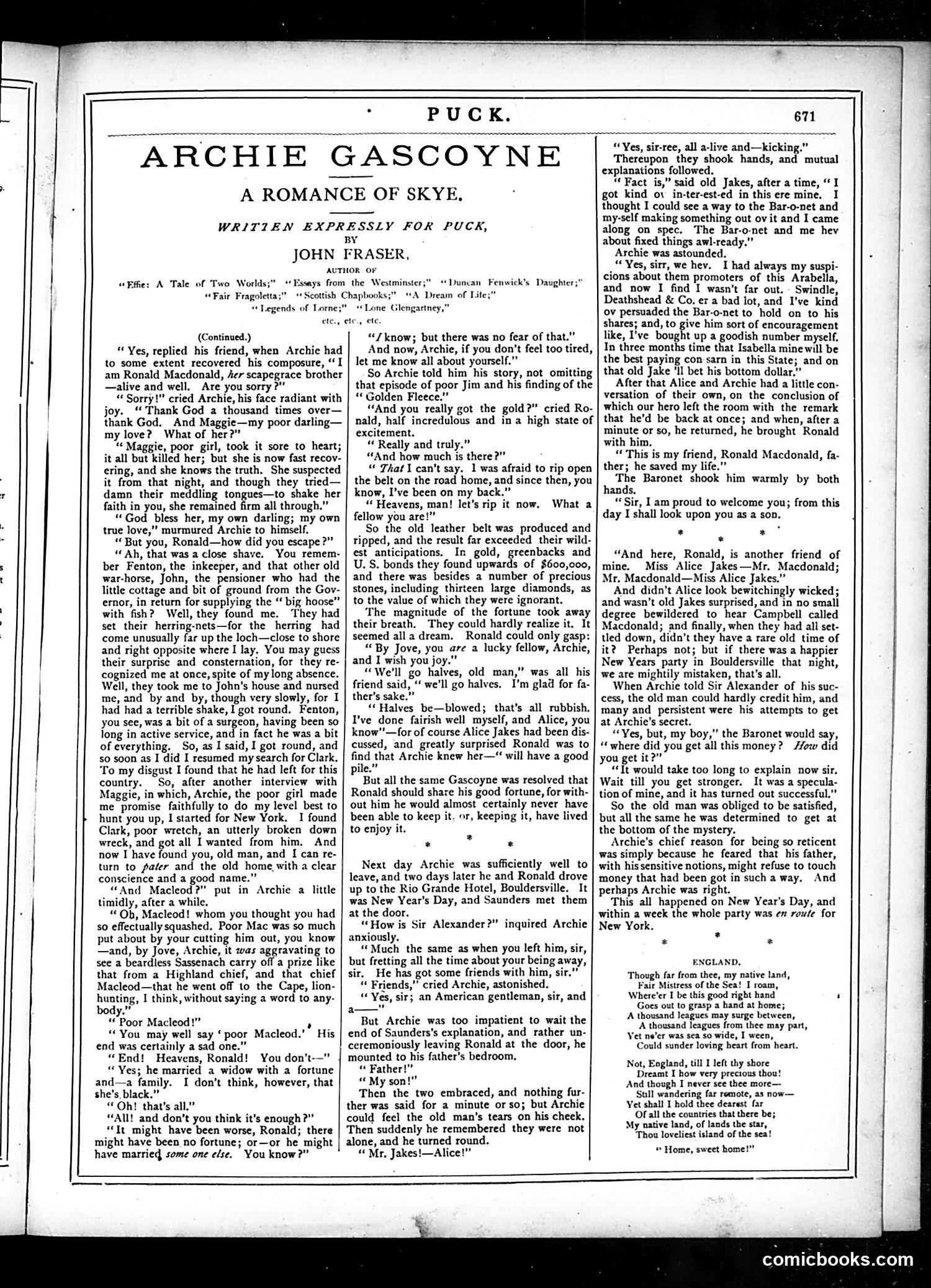
This page contains serialized fiction rather than political satire or cartoons. "Archie Gascoyne: A Romance of Skye" is a romantic story written by John Fraser, published in Puck magazine. The narrative follows Archie and his friend Ronald MacDonald as they discover a fortune (gold, diamonds, and precious stones worth over £600,000) hidden in a Highland cottage. The plot involves their decision to keep the discovery secret, with Archie becoming reluctant to marry Alice Jakes due to fears the fortune might be lost or that she'd marry him for money. This is serialized fiction entertainment rather than political commentary or satirical cartooning—typical content Puck published alongside its humor sections.
📄 Transcribed text from this page (OCR, searchable)
Machine-transcribed from the original scan — historical spelling and the odd misread are preserved.
“ARCHIE GASCOYNE . PUCK. A ROMANCE OF SKYE, WRITTEN EXPRESSLY FOR PUCK, BY JOHN FRASER, AUTHOR OF «Ffie: A Tale of Two Worlds” “Essays from the Westminster” “Duncan Fenwick’s: Daughter;” Fair Fragoletta;” «Scottish Chapbooks;” ‘A Dream of Lite;” ‘+ Legends of Lorne; Lone Glengartney,” ele., ete, ele. (Continued.) “ Yes, replied his friend, when Archie had to some extent recovered his composure, ‘I am Ronald Macdonald, Aer scapegrace brother —alive and well. Are you sorry ?”” “Sorry!” cried Archie, his face radiant with joy. “Thank God a thousand times over— thank God. And Maggie—my poor darling— my love? What of her?” “ Maggie, poor girl, took it sore to heart; it all but killed her; but she is now fast recov- ering, and she knows the truth. She suspected it from that night, and though they tried— damn their meddling tongues—to shake her faith in you, she remained firm all through.” “God bless her, my own darling; my own true love,” murmured Archie to himself. “But you, Ronald—how did you escape?” “Ah, that was a close shave. You remem- ber Fenton, the inkeeper, and that other old war-horse, John, the pensioner who had the little cottage and bit of ground from the Gov- ernor, in return for supplying the “ big hoose” with fish? Well, they found me. They had set their herring-nets—for the herring had come unusually far up the loch—close to shore and right opposite where I lay. You may guess their surprise and consternation, for they re- cognized me at once, spite of my long absence. Well, they took me to John’s house and nursed me, and by and by, though very slowly, for I had had a terrible shake, I got round, Fenton, you see, was a bit of a surgeon, having been so long in active service, and in fact he was a bit of everything. So, as I said, I got round, and so soon as I did I resumed my search for Clark. To my disgust I found that he had left for this country. So, after another interview with Maggie, in which, Archie, the poor girl made me promise faithfully to do my level best to hunt you up, I started for New York. I found Clark, poor wretch, an utterly broken down wreck, and got all I wanted from him. And now I have found you, old man, and I can re- turn to pater and the old home, with a clear conscience and a good name.” “And Macleod?” put in Archie a little timidly, after a while. “Ob, Macleod! whom you thought you had so effectually squashed. Poor Mac was so much put about by your cutting him out, you know —and, by Jove, Archie, it was aggravating to see a beardless Sassenach carry off a prize like that from a Highland chief, and that chief Macleod—that he went off to the Cape, lion- hunting, I think, without saying a word to any- “Poor Macleod!” > “You may well say ‘poor Macleod.’ His end was certainly a sad one.” “End! Heavens, Ronald! You don’t-—" “Yes; he married a widow with a fortune and—a family. I don’t think, however, that she’s. black.” “Oh! that’s all.” “All! and don't you think it's enough ?” “It might have been worse, Ronald; there might have been no fortune; or—or he might have married some one else. You know?” “7 know; but there was no fear of that.” And now, Archie, if you don't feel too tired, let me know all about yourself.” So Archie told him his story, not omitting that episode of poor Jim and his finding of the “ Golden Fleece.” “And you really got the gold?” cried Ro- nald, half incredulous and in a high state of excitement. “ Really and truly.” “And how much is there?” “ That \ can't say. 1 was afraid to rip open the belt on the road home, and since then, you know, I’ve been on my back.” “« Heavens, man! let’s rip it now. fellow you are!” So the old leather belt was produced and ripped, and the result far exceeded their wild- est anticipations. In gold, greenbacks and U. S. bonds they found upwards of $600,000, and there was besides a number of precious stones, including thirteen large diamonds, as to the value of which they were ignorant. The magnitude of the fortune took away their breath, They could hardly realize it. It seemed all a dream. Ronald could only gasp: “By Jove, you are a lucky fellow, Archie, and I wish you joy.” “We'll go halves, old man,” was all his friend said, ‘ we'll go halves. I'm glad for fa- ther’s sake.” “Halves be—blowed; that’s all rubbish. I've done fairish well myself, and Alice, you know"’—for of course Alice Jakes had been dis- cussed, and greatly surprised Ronald was to find that Archie knew her— will have a good ile.” e But all the same Gascoyne was resolved that Ronald should share his good fortune, for with- out him he would almost certainly never have been able to keep it. or, keeping it, have lived to enjoy it. What a * * * Next day Archie was sufficiently well to leave, and two days later he and Ronald drove up to the Rio Grande Hotel, Bouldersville. It was New Year's Day, and Saunders met them at the door. ‘How is Sir Alexander?” inquired Archie anxiously. “Much the same as when you left him, sir, but fretting all the time about your being away, sir, He has got some friends with him, sir.” “ Friends,” cried Archie, astonished. “Yes, sir; an American gentleman, sir, and Pa) But Archie was too impatient to wait the end of Saunders’s explanation, and rather un- ccremoniously leaving Ronald at the door, he mounted to his father’s bedroom. “ Father!” «© My son!” Then the two embraced, and nothing fur- ther was said for a minute or so; but Archie could feel the old man’s tears on his cheek, ‘Then suddenly he remembered they were not alone, and he turned round. “Mr, Jakes!—Alice!” Thereupon they shook hands, and mutual explanations followed. “Fact is,” said old Jakes, after a time, “I got kind ov in-ter-est-ed in this ere mine. I thought I could see a way to the Bar-o-net and my-self making something out ov it and I came along on spec. The Bar-o-net and me hev about fixed things awl-ready.” Archie was astounded. Yes, sirr, we hev. I had always my suspi- cions about them promoters of this Arabella, and now I find I wasn’t far out. Swindle, Deathshead & Co. er a bad lot, and I’ve kind ov persuaded the Bar-o-net to hold on to his shares; and, to give him sort of encouragement like, I've bought up a goodish number myself, In three months time that Isabella mine will be the best paying con sarn in this State; and on that old Jake 'Il bet his bottom dollar.” After that Alice and Archie had a little con- versation of their own, on the conclusion of which our hero left the room with the remark that he'd be back at once; and when, after a minute or so, he returned, he brought Ronald with him. “ This is my friend, Ronald Macdonald, fa- ther; he saved my life.” The Baronet shook him warmly by both hands. “Sir, 1am proud to welcome you; from this day I shall look upon you as a son. * 2 * “And here, Ronald, is another friend of mine. Miss Alice Jakes—Mr. Macdonald; Mr. Macdonald—Miss Alice Jakes,” And didn’t Alice look bewitchingly wicked; and wasn’t old Jakes surprised, and in no small degree bewildered to hear Campbell called Macdonald; and finally, when they had all set- tled down, didn’t they have a rare old time of it? Perhaps not; but if there was a happier New Years party in Bouldersville that night, we are mightily mistaken, that’s all. When Archie told Sir Alexander of his suc- cess, the old man could hardly credit him, and many and persistent were his attempts to get at Archie’s secret. “Yes, but, my boy,” the Baronet would say, “where did you get all this money? How did you get it?” “It would take too long to explain now sir. Wait till you get stronger. It was a specula- tion of mine, and it has turned out successful.” So the old man was obliged to be satisfied, but all the same he was determined to get at the bottom of the mystery. Archie’s chief reason for being so reticent was simply because he feared that his father, with his sensitive notions, might refuse to touch money that had been got in such a way. And perhaps Archie was right. This all happened on New Year's Day, and within a week the whole party was en route for New York, é * * ENGLAND, ‘Though far from thee, my native land, Fair Mistress of the Sea! I roam, Where’er I be this good right hand ‘ Goes out to grasp a hand at home; A thousand leagues may surge between, A thousand leagues from thee may part, Yet ne'er was sea so wide, I ween, Could sunder loving heart from’ heart. Not, England, till I left thy shore Dreamt I how very precious thou! ‘And though I never see thee more— Sull wandering far remote, as now— Yet shall I hold thee dearest far Ofall the countries that there be; My native land, of lands the star, “Thou loveliest island of the sea! « Home, sweet home!” comicbooks.com