
Puck, 1879-12-17 · page 4 of 18
Puck — December 17, 1879 — page 4: what you’re looking at
What you’re looking at
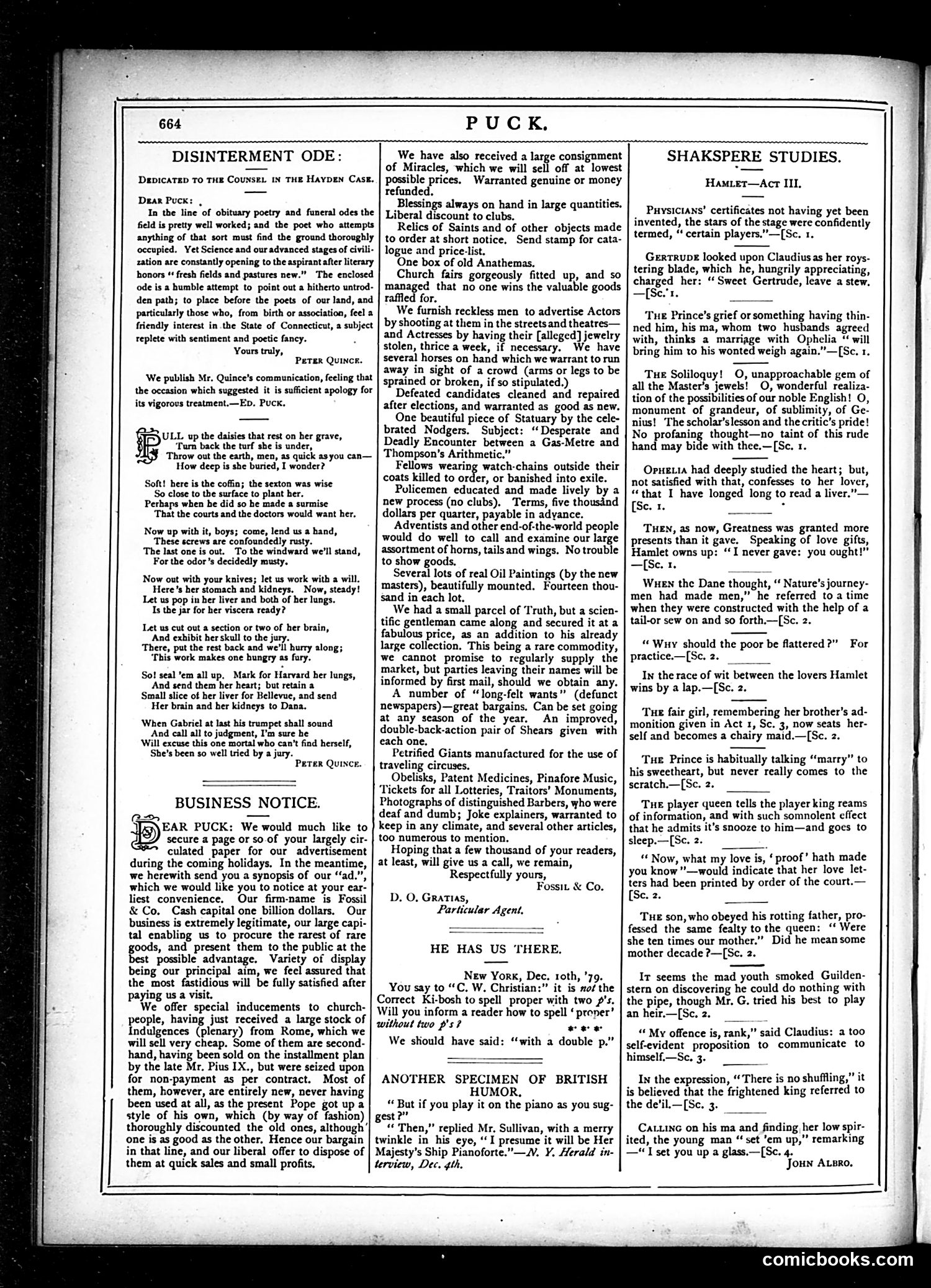
This page is primarily **advertising and editorial content** rather than political satire. It contains: 1. **"Disinterment Ode"** - A humorous funeral poem by Peter Quince mocking obituary poetry conventions 2. **Business notices** - Multiple advertisements from Puck's publishers and various merchants selling items like patent medicines, paintings, and circus tickets 3. **"Shakespere Studies" section** - Literary commentary on *Hamlet* Act III, analyzing textual ambiguities and character motivations 4. **"He Has Us There"** - A brief humor piece about spelling instruction, with a joke about proper pronunciation 5. **"Another Specimen of British Humor"** - A short anecdote about piano-playing The page reflects Puck's typical mix of satire, advertising revenue, and literary content. No significant political cartoons are visible—this appears to be an interior advertising/content page.
📄 Transcribed text from this page (OCR, searchable)
Machine-transcribed from the original scan — historical spelling and the odd misread are preserved.
PUCK. DISINTERMENT ODE: DEDICATED TO THE Counsen In THE HayDEN Case. Dear Puck: , In the line of obituary poetry and funeral odes the field is pretty well worked; and the poet who attempts anything of that sort must find the ground thoroughly occupied. Yet Science and our advanced stages of civili- zation are constantly opening to the aspirant after literary honors “fresh fields and pastures new.” The enclosed ode is a humble attempt to point out a hitherto untrod- den path; to place before the poets of our land, and particularly those who, from birth or association, feel a friendly interest in the State of Connecticut, a subject replete with sentiment and poetic fancy. Yours truly, Peter Quince. ‘We publish Mr. Quince’s communication, feeling that the occasion which suggested it is sufficient apology for its vigorovs treatment.—Eb. Puck. ULL up the daisies that rest on her grave, “Turn back the turf she is under, Throw out the earth, men, as quick as you can— How deep is she buried, I wonder? Soft! here is the coffin; the sexton was wise So close to the surface to plant her. Perhaps when he did so he made a surmise That the courts and the doctors would want her. Now up with it, boys; come, lend us a hand, These screws are confoundedly rusty. The last one is out. To the windward we'll stand, For the odor’s decidedly musty. Now out with your knives; let us work with a will. Here's her stomach and kidneys. Now, steady! Let us pop in her liver and both of her lungs. Is the jar for her viscera ready? Let us cut out a section or two of her brain, ‘And exhibit her skull to the jury. There, put the rest back and we'll hurry along; ‘This work makes one hungry as fury. So! seal em all up, Mark for Harvard her lungs, And send them her heart; but retain a ‘Small slice of her liver for Bellevue, and send Her brain and her kidneys to Dana. When Gabriel at last his trumpet shall sound ‘And call all to judgment, I'm sure he Will excuse this one mortal who can’t find herself, She's been so well tried by a jury. Peter Quince. BUSINESS NOTICE. 8) te PUCK: We would much like to lee) secure a page or so.of your largely cir- culated paper for our advertisement during the coming holidays. In the meantime, we herewith send you a synopsis of our ‘“ad.”, which we would like you to notice at your ear- liest convenience. Our firm-name is Fossil & Co, Cash capital one billion dollars. Our business is extremely legitimate, our large capi- tal enabling us to procure the rarest of rare goods, and present them to the public at the best possible advantage, Variety of display being our principal aim, we feel assured that the most fastidious will be fully satisfied after paying us a visit. We offer special inducements to church- people, having just received a large stock of Indulgences (plenary) from Rome, which we will sell very cheap. Some of them are second- hand, having been sold on the installment plan by the late Mr. Pius 1X., but were seized upon for non-payment as per contract. Most of them, however, are entirely new, never having been used at all, as the present Pope got up a style of his own, which (by way of fashion) thoroughly discounted the old ones, although’ one is as good as the other. Hence our bargain in that line, and our liberal offer to dispose of them at quick sales and small profits. We have also received a large consignment of Miracles, which we will sell off at lowest possible prices. Warranted genuine or money refunded. Blessings always on hand in large quantities. Liberal discount to clubs. Relics of Saints and of other objects made to order at short notice. Send stamp for cata- logue and price-list. One box of old Anathemas. Church fairs gorgeously fitted up, and so managed that no one wins the valuable goods raffled for. We furnish reckless men to advertise Actors by shooting at them in the streets and theatres— and Actresses by having their [alleged] jewelry stolen, thrice a week, if necessary. We have several horses on hand which we warrant to run away in sight of a crowd (arms or legs to be sprained or broken, if so stipulated.) Defeated candidates cleaned and repaired after elections, and warranted as good as new. One beautiful piece of Statuary by the cele- brated Nodgers. Subject: “Desperate and Deadly Encounter between a Gas-Metre and Thompson's Arithmetic.” Fellows wearing watch-chains outside their coats killed to order, or banished into exile. Policemen educated and made lively by a new process (no clubs). ‘Terms, five thousind dollars per quarter, payable in adyance. Adventists and other end-of-the-world people would do well to call and examine our large assortment of horns, tails and wings. No trouble to show goods, Several lots of real Oil Paintings (by the new masters), beautifully mounted. Fourteen thou- sand in each lot. We had a small parcel of ‘Truth, but a scien- tific gentleman came along and secured it at a fabulous price, as an addition to his already large collection. This being a rare commodity, we cannot promise to regularly supply the market, but parties leaving their names will be informed by first mail, should we obtain any. A number of “long-felt wants” (defunct newspapers)—great bargains. Can be set going at any season of the year. An improved, double-back-action pair of Shears given with each one, Petrified Giants manufactured for the use of traveling circuses. Obelisks, Patent Medicines, Pinafore Music, Tickets for all Lotteries, Traitors’ Monuments, Photographs of distinguished Barbers, who were deaf and dumb; Joke explainers, warranted to keep in any climate, and several other articles, too numerous to mention. Hoping that a few thousand of your readers, at least, will give us a call, we remain, Respectfully yours, Fossit & Co. D. O. Gratias, Particular Agent, HE HAS US THERE. New York, Dec. roth, ’79. You say to “C, W. Christian:” it is nofthe Correct Ki-bosh to spell proper with two 9's. Will you inform a reader how to spell ‘ proper’ without two p's? eee We should have said: “with a double p.” ANOTHER SPECIMEN OF BRITISH HUMOR, “ But if you play it on the piano as you sug- gest 2" “Then,” replied Mr, Sullivan, with a merry twinkle in his eye, “I presume it will be Her Majesty’s Ship Pianoforte."—W. Y, Herald in- ferview, Dec. 4th, SHAKSPERE STUDIES. Hamiet—Act Ill. Puysicians’ certificates not having yet been invented, the stars of the stage were confidently termed, “certain players.”—[Sc. 1. Gertrupe looked upon Claudius as her roys- tering blade, which he, hungrily appreciating, charged her: “ Sweet Gertrude, leave a stew. —[Se.’r. ‘Tue Prince’s grief or something having thin- ned him, his ma, whom two husbands agreed with, thinks a marriage with Ophelia “ will bring him to his wonted weigh again.”"—[Sc. 1. Tue Soliloquy! O, unapproachable gem of all the Master’s jewels! O, wonderful realiza- tion of the possibilities of our noble English! O, monument of grandeur, of sublimity, of Ge- nius! ‘The scholar’slesson and the critic's pride! No profaning thought—no taint of this rude hand may bide with thee.—[Sc. 1. Opuetia had deeply studied the heart; but, not satisfied with that, confesses to her lover, “that I have longed long to read a liver.”— [Sc. 1. . THEN, as now, Greatness was granted more presents than it gave. Speaking of love gifts, Hamlet owns up: ‘‘I never gave: you ought!” —[Sce. 1. Wuen the Dane thought, “ Nature’s journey- men had made men,” he referred to a time when they were constructed with the help of a tail-or sew on and so forth.—[Sc. 2. “Wuy should the poor be flattered?” For practice.—[Sc. 2. In the race of wit between the lovers Hamlet wins by a lap.—[Sc. 2. ‘Tue fair girl, remembering her brother's ad- monition given in Act 1, Sc. 3, now seats her- self and becomes a chairy maid.—[Sc. 2. ‘Tur Prince is habitually talking “marry” to his sweetheart, but never really comes to the scratch.—[Sc. 2. Tue player queen tells the player king reams of information, and with such somnolent effect that he admits it’s snooze to him—and goes to sleep.—[Sc. 2. “Now, what my love is, ‘ proof’ hath made you know ”—would indicate that her love let- ters had been printed by order of the court.— [Sc. 2. __ Tue son, who obeyed his rotting father, pro- fessed the same fealty to the queen: ‘‘ Were she ten times our mother.” Did he mean some mother decade ?—[Sc. 2. Ir seems the mad youth smoked Guilden- stern on discovering he could do nothing with the pipe, though Mr. G. tried his best to play an heir.—[Sc, 2. “ My offence is, rank,” said Claudius: a too self-evident proposition to communicate to himself—Sc. 3. In the expression, “There is no shuffling,” it is believed that the frightened king referred to the de'il.—[Sc. 3. Catuinc on his ma and finding her low spir- ited, the young man “set ‘em up,” remarking —TT set you up a glass.—[Sc. 4. Joun ALsRo. comicbooks.com