
A complete issue · 18 pages · 1879
Puck — November 12, 1879
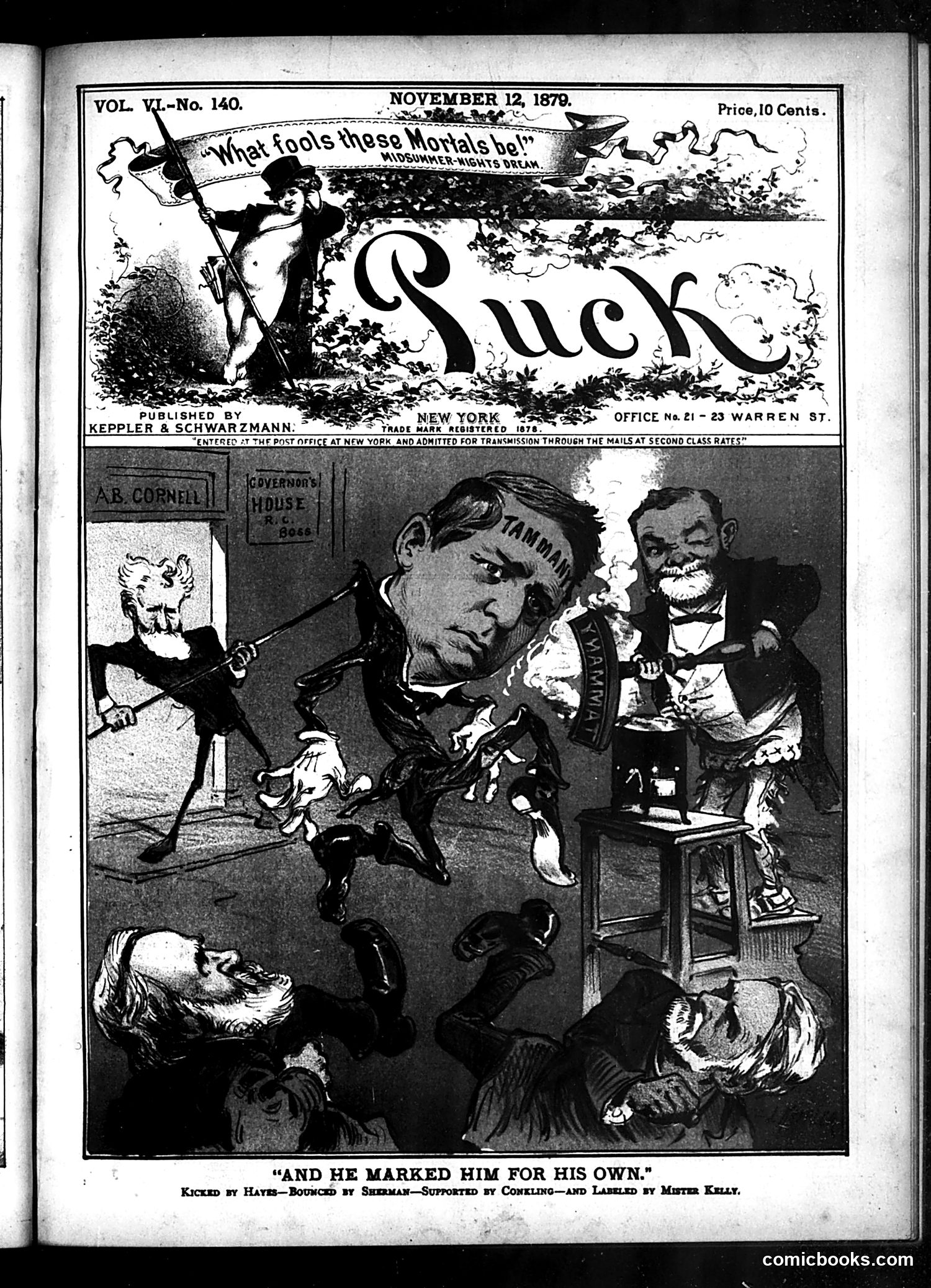
This political cartoon satirizes what appears to be a power struggle involving Republican political figures of the 1879 era. The caption reads "And He Marked Him for His Own," attributed to figures named Hayes, Sherman, Conkling, and Kelly. The central caricatured figure with a prominent nose appears to be the target of manipulation by surrounding politicians. The "Governor's House" sign and "A.B. Cornell" reference suggest this involves New York state politics and possibly Cornell's governorship. The satire depicts backroom political maneuvering—one figure is literally "marked" or claimed by more powerful politicians through corrupt dealing. The goblin-like creatures and theatrical poses emphasize the underhanded nature of the political patronage system being ridiculed.
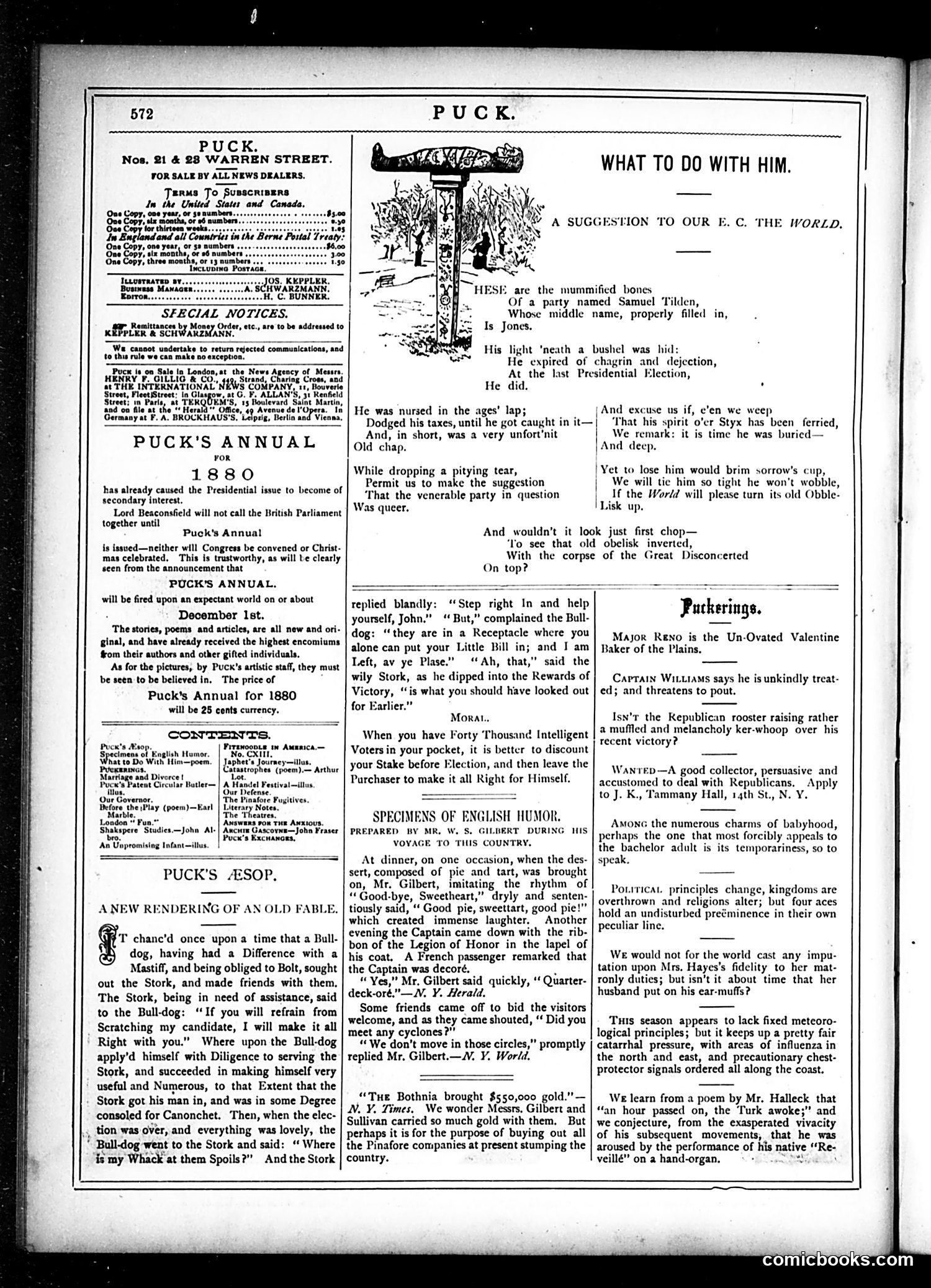
The main cartoon "What to Do with Him" presents a satirical poem about Samuel Tilden, the Democratic presidential candidate in 1880. The illustration shows a gallows with Tilden's bones hanging from it. The poem mocks Tilden's political failures and suggests he's politically "dead" — his candidacy rejected, his influence finished. References to "dodging his taxes" and "caught in it" allude to scandals surrounding him. The satire suggests Republicans should abandon him entirely rather than attempt political revival. The accompanying text and "Moral" advise Republicans to protect their electoral advantage before the election rather than leaving victory to chance. This reflects the intense partisan rhetoric of the 1880 campaign period.
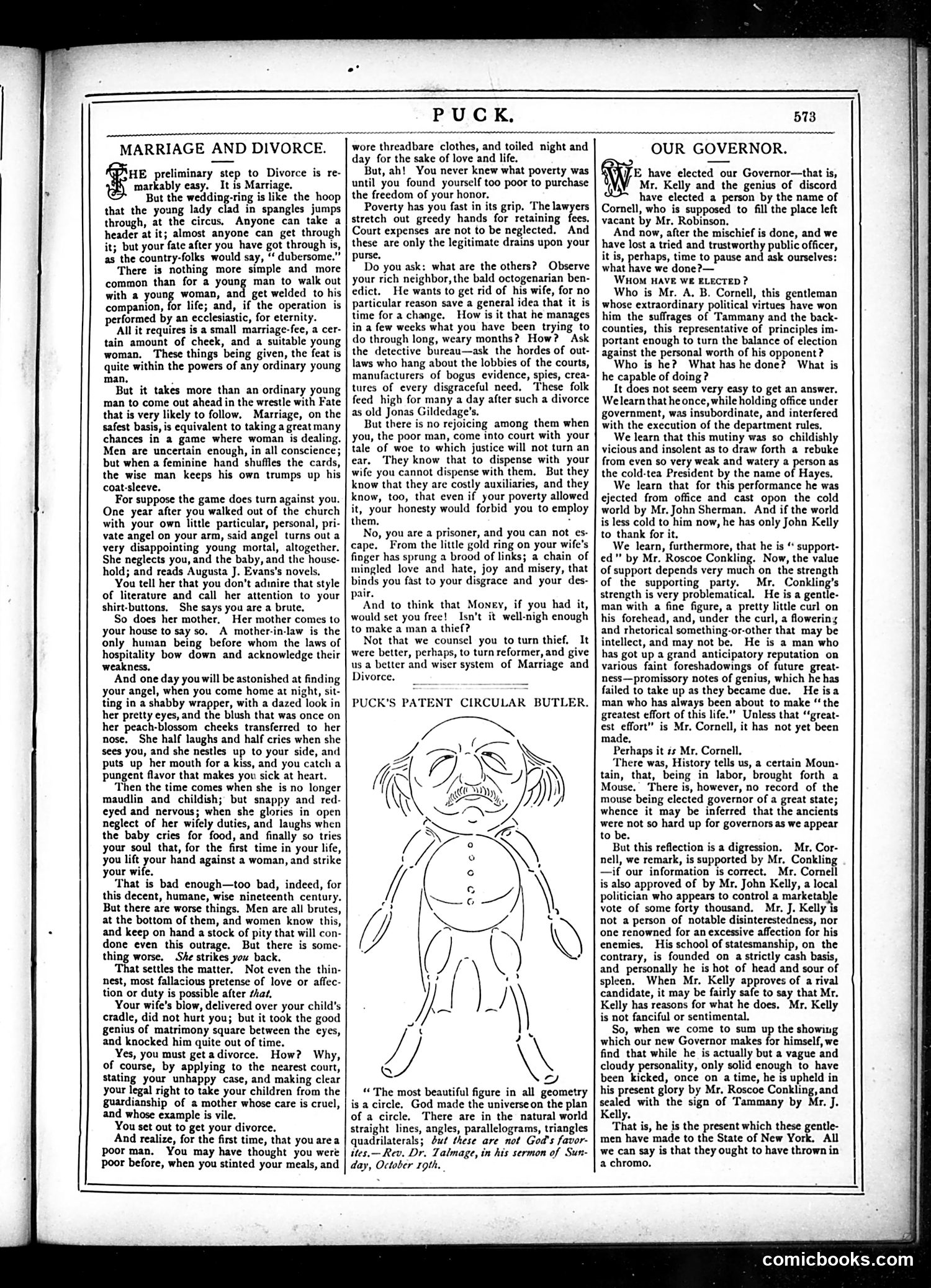
The right column satirizes the election of a new New York governor, likely Alonzo B. Cornell. The text attacks Cornell's character, claiming he's supported by political operative John Kelly and politician John Sherman. The satire mocks Cornell's reputation for: - Making "the greatest effort of his life" appear effortless - Building an "anticipatory reputation on various fanciful foreclosures of future greatness" - Operating on a "strictly cash basis" focused on patronage rather than principle The accompanying crude caricature—labeled "Puck's Patent Circular Butler"—visually reinforces the mockery. The satirist questions whether such a man, built on political calculation rather merit, deserves the governorship. The piece exemplifies Puck's role exposing political corruption and machine politics in Gilded Age New York.
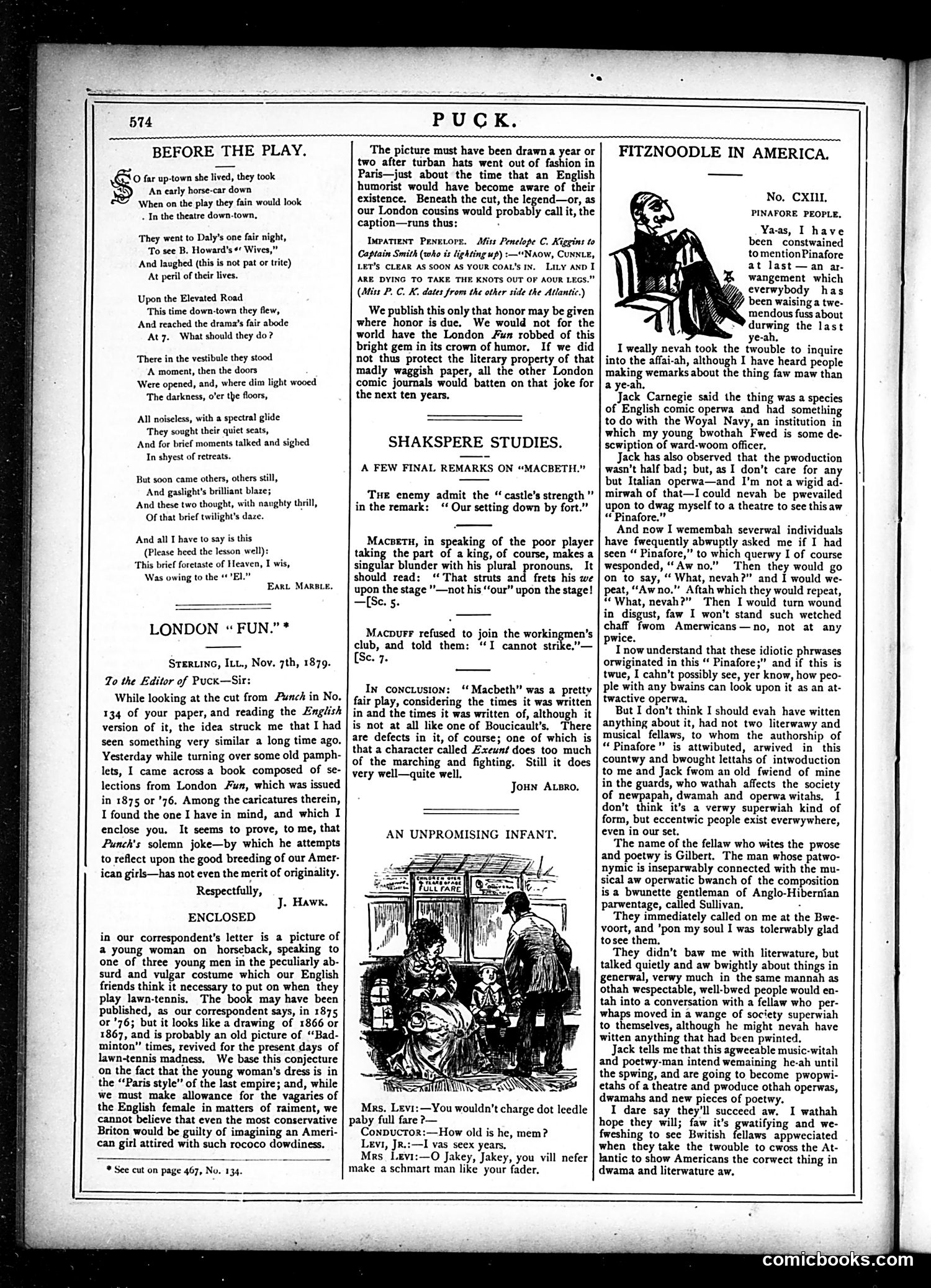
This page contains primarily **literary and theater criticism** rather than political satire. The main content includes: 1. **"Fitznoodle in America"** (No. CXIII): A humorous column where the author recounts encounters with pretentious people discussing opera, literature, and theater. The satire targets American social climbers and pseudo-intellectuals who adopt affected opinions about high culture. 2. **"Shakespeare Studies"**: Commentary on Macbeth's theatrical merits and defects. 3. **"London 'Fun'"**: A reader's letter discussing Puck's humor and comparative American/British comedy styles. 4. **"An Unpromising Infant"**: A small illustrated dialogue joke (image shows figures in conversation). The page's humor focuses on **cultural pretension and social affectation** rather than political commentary—mocking Americans' attempts to appear cultured while lacking genuine understanding.
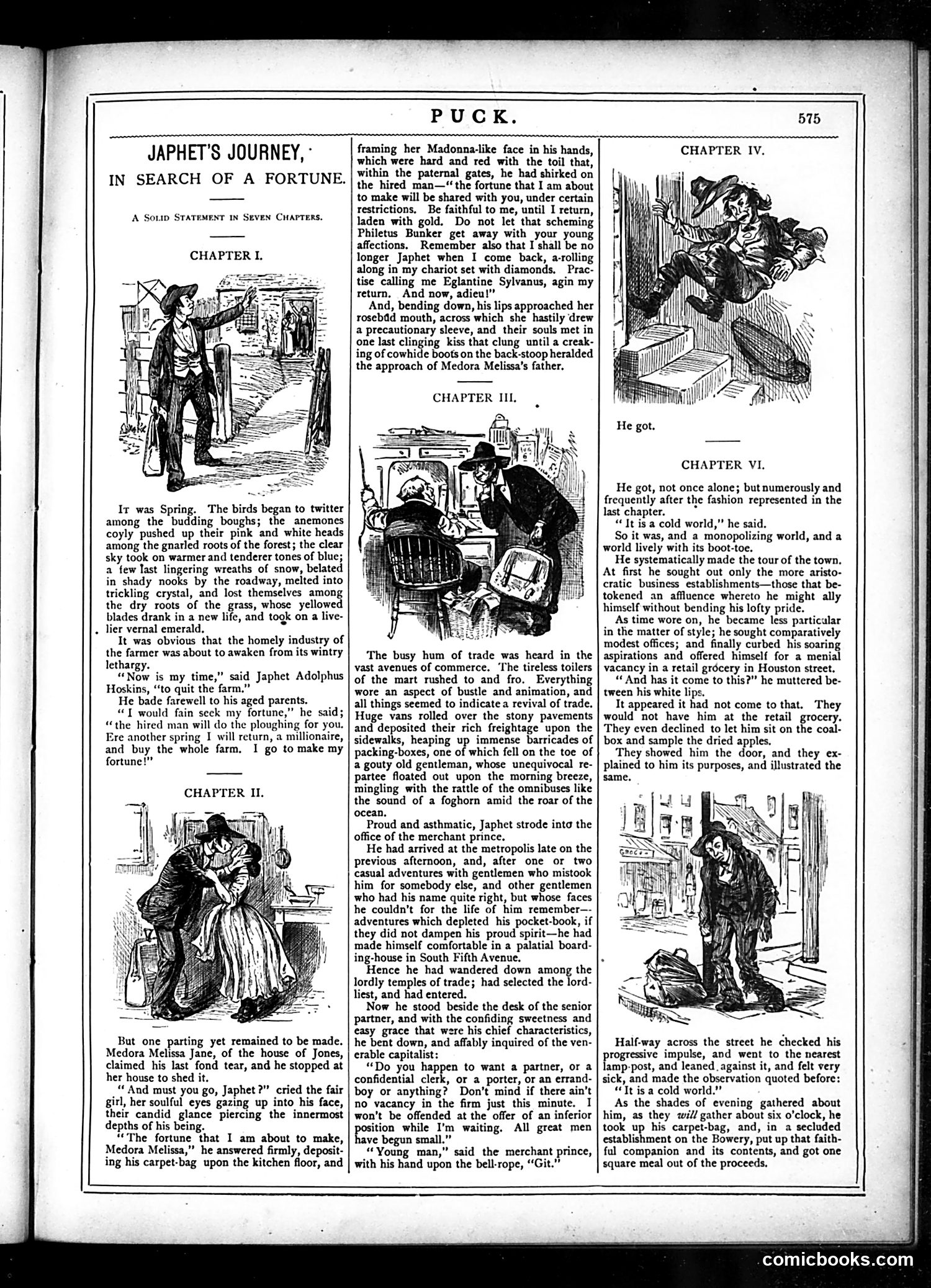
This appears to be a serialized fiction story rather than political satire. The narrative follows a character named Japhet Adolphus Hockins, a young man seeking his fortune in New York City during spring. The illustrations show: a man in period dress, a domestic farewell scene, urban commerce, and street scenes. The story depicts Japhet's arrival in the city, his attempts to find employment and business opportunities, and his encounters with various merchants and characters. This is literary entertainment rather than political commentary—a serialized adventure tale aimed at Puck's readers, featuring stock characters of urban fortune-seeking common in 19th-century American popular fiction. The satirical edge, if any, targets social pretension and the competitive nature of city business rather than specific political figures.
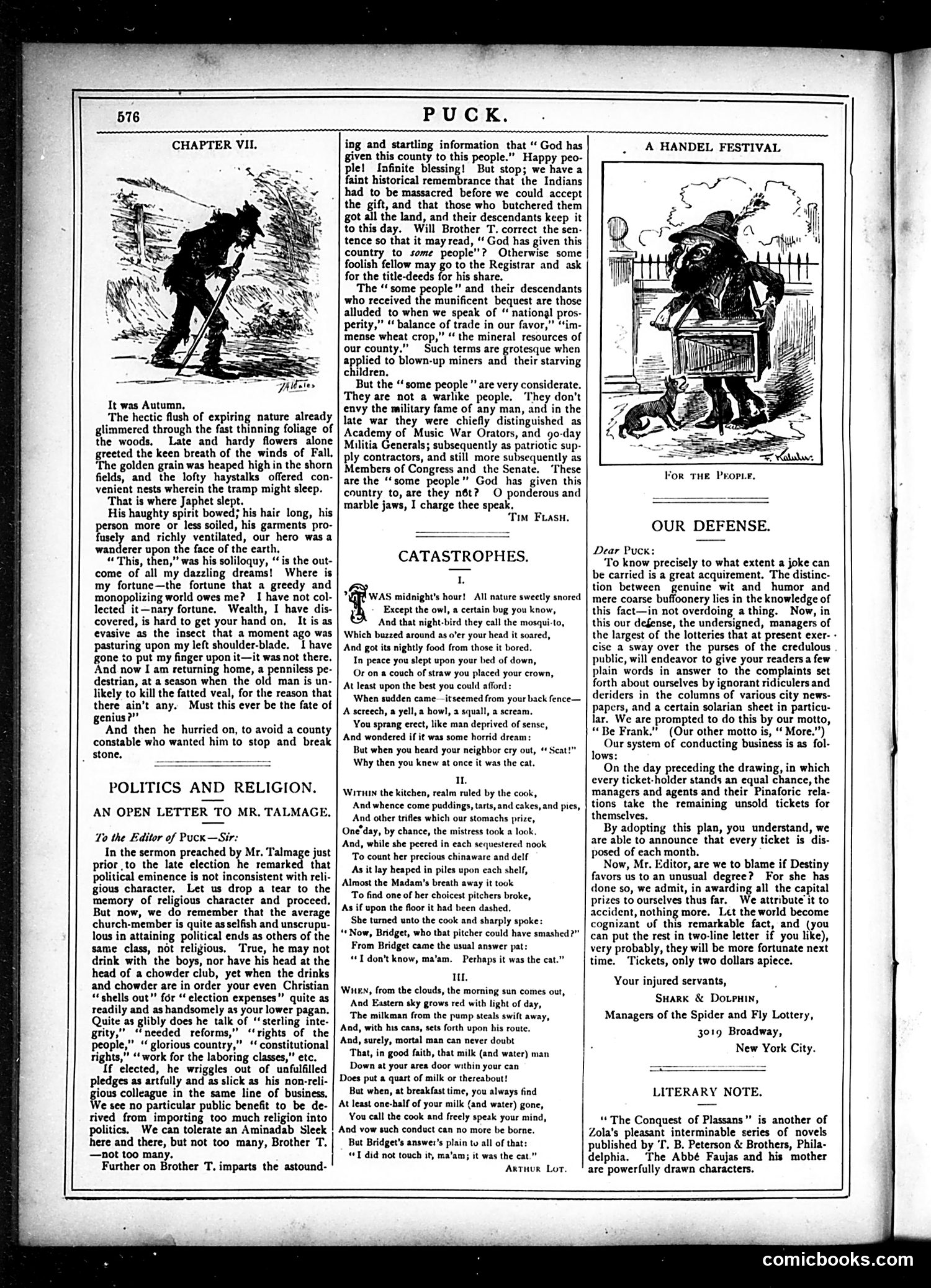
This page contains three separate satirical sections: **"A Handel Festival"** (right illustration): Shows a rotund figure conducting, likely satirizing some contemporary musical event or conductor, though specific identification is unclear from the image alone. **"Catastrophes"** (center): A humorous poem about domestic mishaps—midnight noise, a bug, sleeping on hay, broken items, and a cat causing mischief. This appears to be light verse rather than political satire. **"Politics and Religion"** (left): An open letter criticizing an unnamed Mr. Talmage for mixing religious preaching with political advocacy. The writer argues against clergymen endorsing political candidates or parties, defending separation of church and state while tolerating diverse political views among the populace. The page emphasizes Puck's satirical approach to American social and political issues of its era.
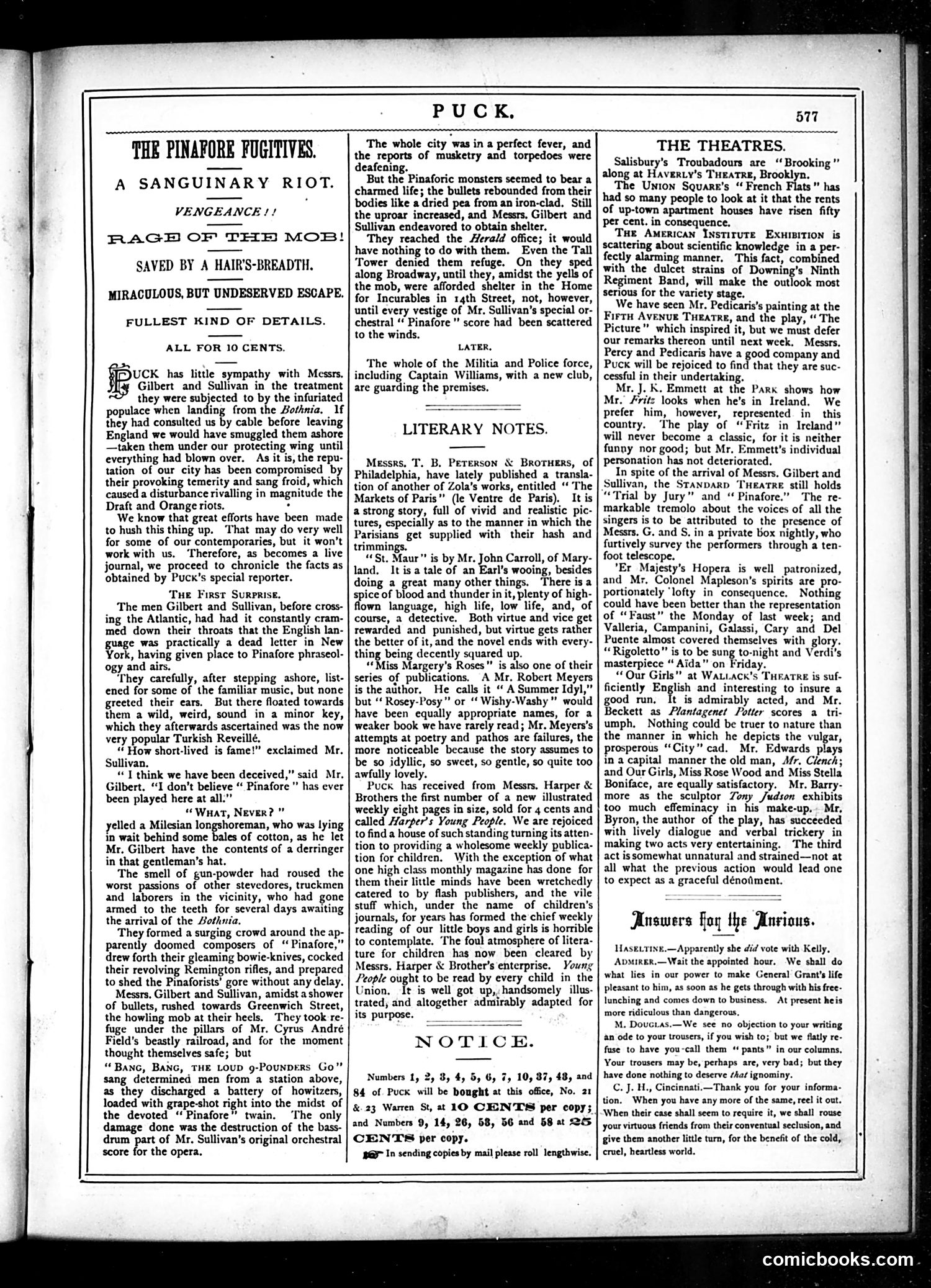
This page contains no political cartoon. Instead, it features three main sections: 1. **"The Pinafore Fugitives"** — A satirical article about a riot involving the Gilbert and Sullivan opera *H.M.S. Pinafore*. The piece humorously describes how performers and audience members fled a theater during a performance, with the chaos humorously attributed to the opera's plot confusion. 2. **"The Theatres"** — Theater reviews and notices covering multiple New York venues and productions. 3. **"Literary Notes"** and **"Answers for the Anxious"** — Brief commentary on new publications and a reader advice column. The page is primarily text-based editorial content rather than visual satire. No identifiable political figures or caricatures appear in the visible content.
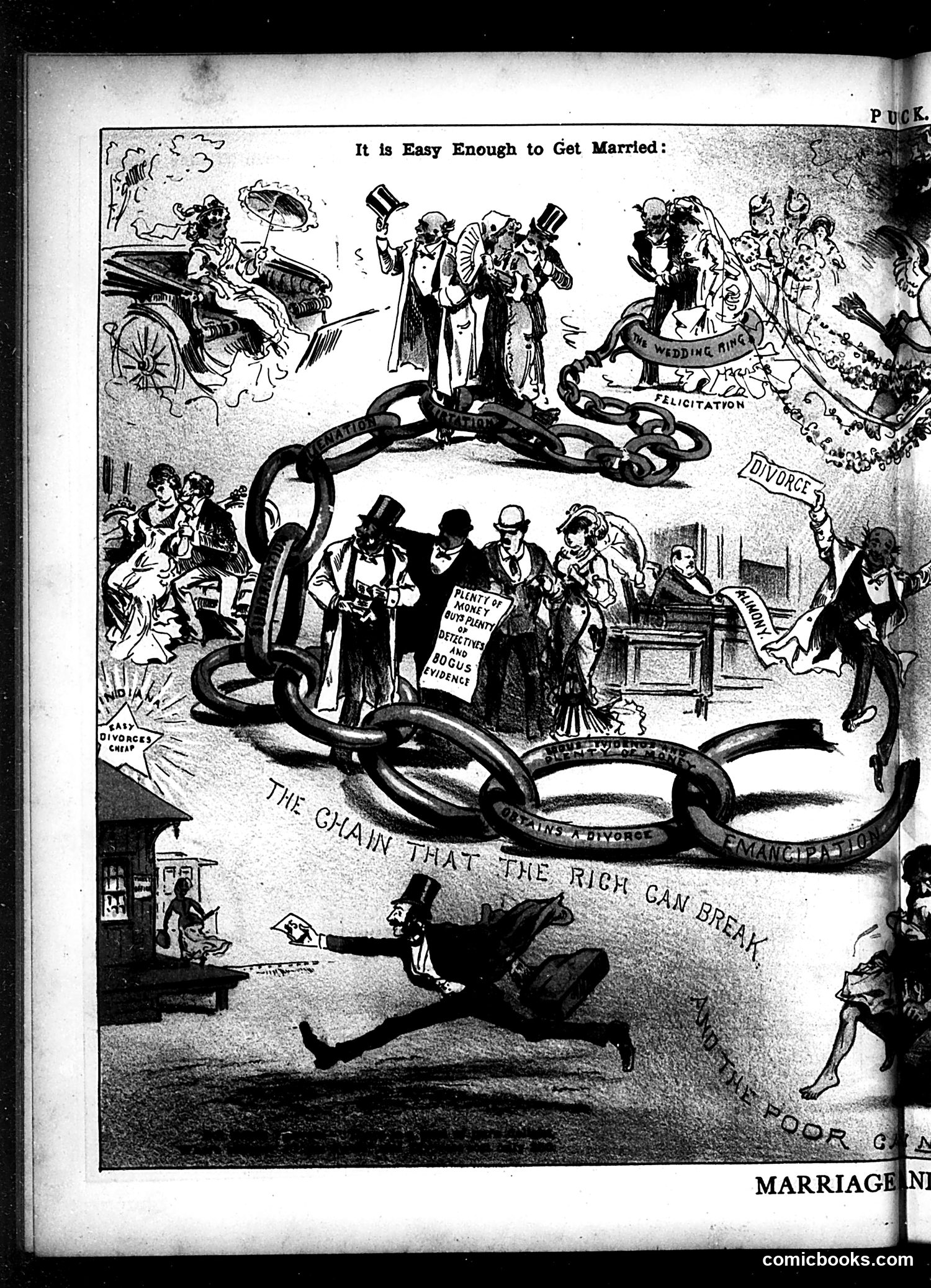
This Puck cartoon satirizes marriage and divorce through a chain-link metaphor. The central image shows an enormous chain labeled "THE CHAIN THAT THE RICH CAN BREAK," depicting marriage as an inescapable bond—except for the wealthy. The illustration depicts the journey from courtship (top left, with carriages and celebrations) through "Wedding Rings" and "Felicitation," then downward to "Divorce" proceedings where wealthy figures easily escape the marital bonds. A man at bottom appears to be freed from the chain, "breaking" it effortlessly. The satire critiques class inequality: while ordinary people remain trapped by marriage vows, the rich exploit legal systems to obtain divorces unavailable to the poor. The chain symbolizes how marriage law operated differently based on social class and wealth in this era.
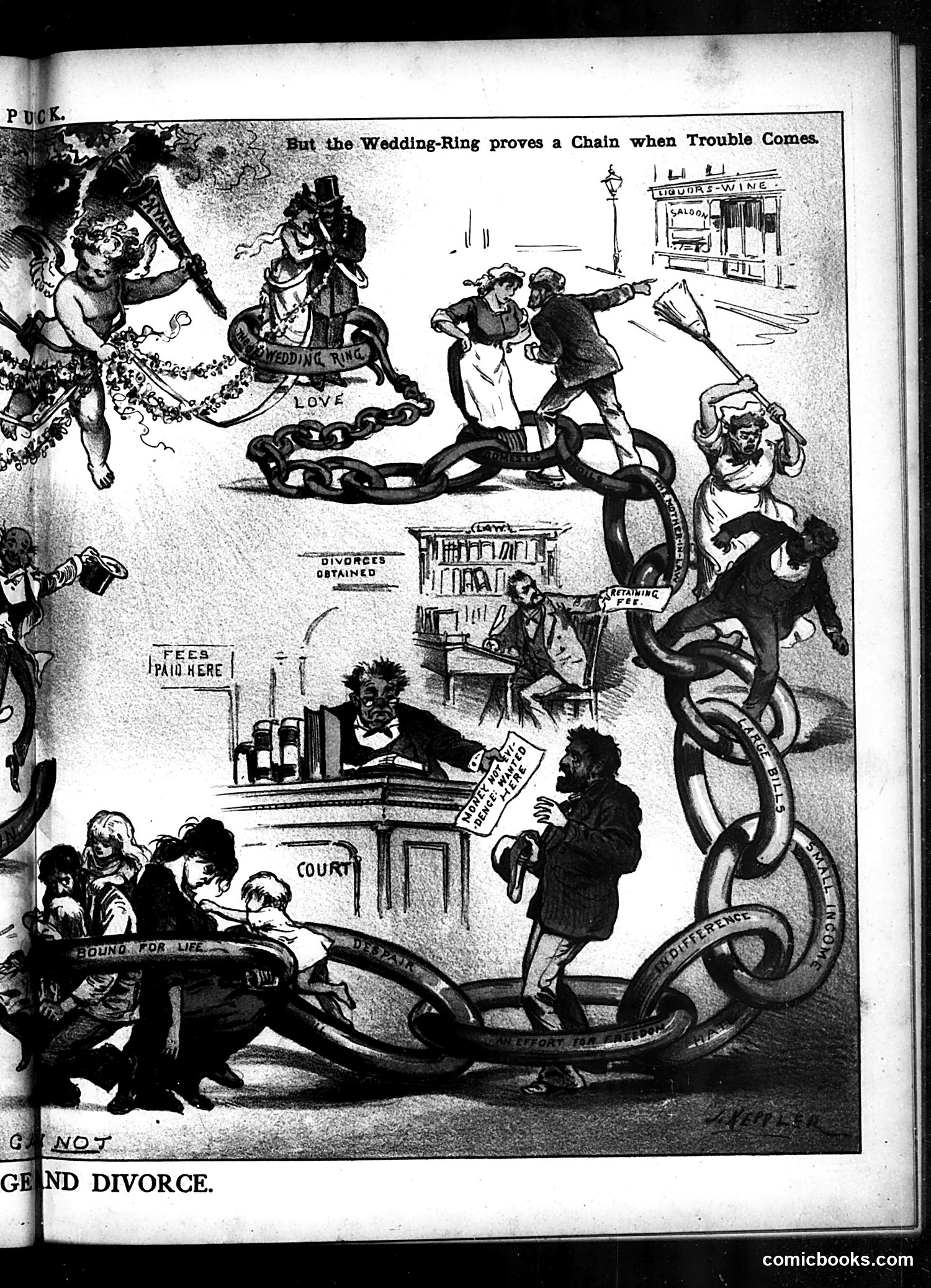
This Puck cartoon satirizes divorce as a tragic consequence of marriage. The central image shows a large chain labeled with divorce-related terms ("EFFORT," "MOTHER-IN-LAW," "DISCORD") binding together various figures representing different aspects of marital dissolution. The chain connects multiple vignettes: at top, cupids represent romantic "LOVE"; in the middle, a couple argues while a lawyer obtains "DIVORCES"; at bottom, a courthouse scene shows "FEES PAID HERE" and distressed figures labeled "BOUND FOR LIFE" and "BOUND FOR RUIN." The satirical point: marriage begins with romantic idealism but becomes an inescapable chain of conflict, legal fees, and social ruin when troubles arise. The wedding ring transforms from symbol of love into a literal chain binding people to misery and financial hardship.
This page contains **serialized fiction, not political satire or cartoons**. It's a continuation of "Archie Gascoyne: A Romance of Skye" by John Fraser, published in Puck magazine. The page presents a romantic narrative featuring characters including Archie, Alice Jakes, and various Scottish settings. The text discusses themes of love, marriage prospects, and social class—typical concerns of Victorian/Edwardian romance literature. **No political cartoons or satirical commentary appear on this page.** This is a literary installment rather than the satirical or humorous visual content Puck was typically known for. The page demonstrates that Puck, while primarily a satirical magazine, also serialized romantic fiction to appeal to broader readership.
This page is primarily **text content**, not a political cartoon. It contains a serialized story titled "The Story of Dark-Devil Jim" alongside a section labeled "Mark Twain on Sabbatarian Hawley." The Twain section appears to be commentary on a figure named Hawley (likely a public figure of the era) whom Twain characterizes as hypocritical—someone who presents himself as morally upstanding in public but whose private character contradicts this image. Twain critiques Hawley's politics and public positions with his characteristic sardonic wit. The page layout mixes fiction with opinion/commentary, typical of Puck's format blending entertainment with social satire. Without clearer visual elements or more specific historical context in the visible text, the precise identity of "Sabbatarian Hawley" and the exact nature of Twain's critique remain unclear from this page alone.
This page consists primarily of **short humorous anecdotes and jokes** rather than political cartoons. The content includes: - A small illustration at top showing a comical figure, labeled "Puck's Jestings" - Multiple brief jokes and witty observations on various topics (Toronto residents, oyster bets, political figures, war matters, etc.) - References to contemporary figures like **Bismarck, Pope Leo XIII, and Grant** in political commentary - Social humor about juries, Indian policies, and bureaucratic absurdities - An advertisement for **Boker's Bitters** (stomach remedy) and announcement for **Volume V of Puck** magazine The page functions as filler content—typical of Puck's mixed format combining satirical commentary with light entertainment. Most jokes target general social follies rather than specific political events, making them broadly accessible to contemporary readers.
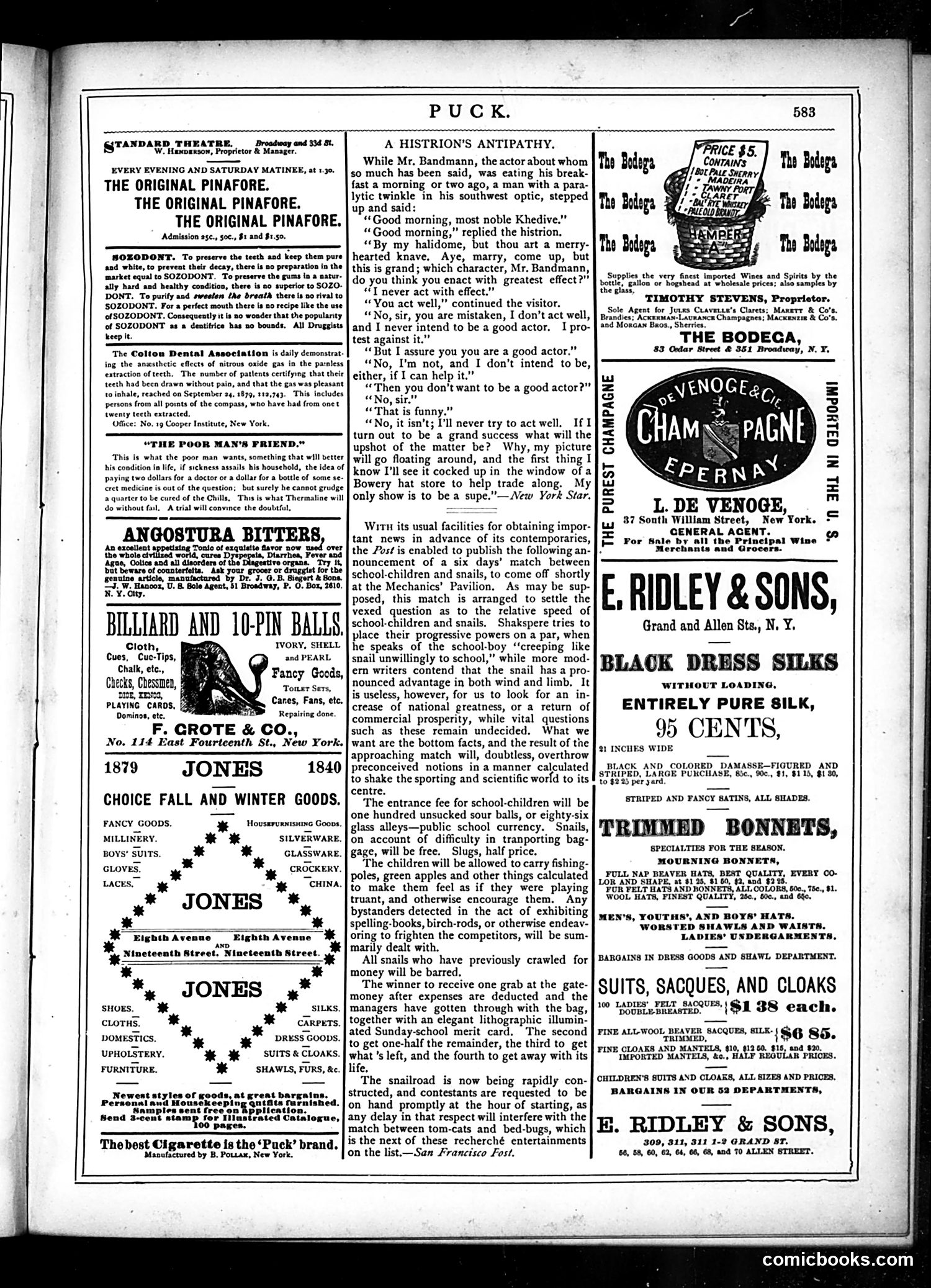
This page is primarily **advertising**, not satirical content. The left side contains ads for theaters, bitters, billiard equipment, and Jones department store (repeated multiple times with decorative borders). The right side features commercial advertisements for The Bodega wine merchant, L. de Venoge champagne, E. Ridley & Sons (offering black dress silks, trimmed bonnets, and clothing), and other retailers. The only editorial content is "A Histrion's Antipathy" (top left)—a brief humorous anecdote about actor Bandmann dismissing acting as a profession, claiming he'd rather be a barkeeper. The joke plays on the actor's low regard for his own craft. This appears to be from a magazine issue used primarily for revenue-generating advertisements rather than satire.
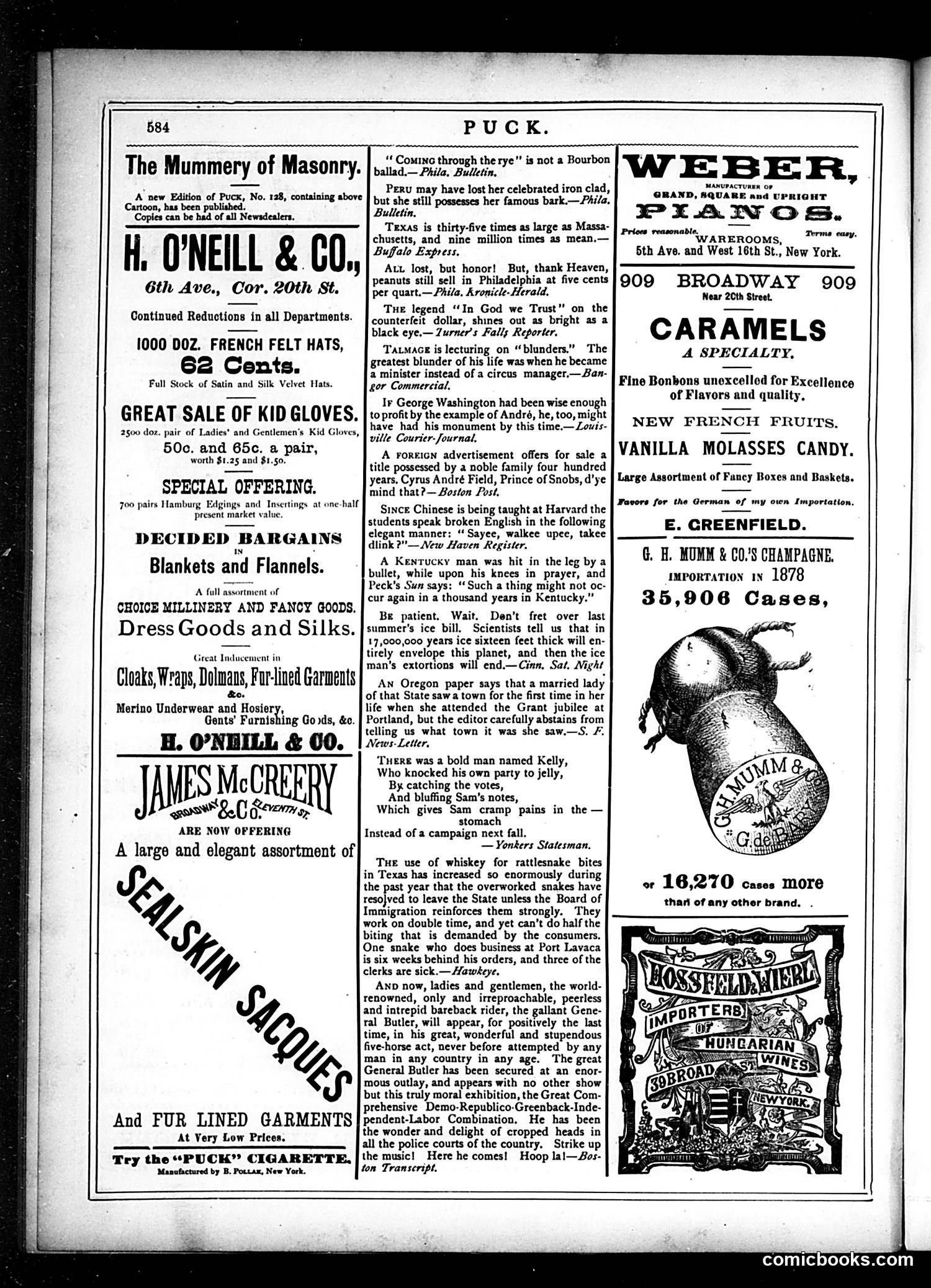
This page is primarily **advertising and miscellaneous content** rather than a political cartoon. It contains multiple ads for stores (H. O'Neill & Co., James McCreery), products (French felt hats, kid gloves, selskin shoes), and consumer goods typical of late 19th-century retail. The center column includes various **humor snippets and anecdotes**—brief, disconnected jokes about topics like Chinese students at Harvard, a Kentucky man's prayer, and General Butler appearing in shows. These are light social observations rather than sharp political satire. The right side features **product advertisements** including Weber pianos, caramels, and G.H. Mumm champagne, with an illustration of grapes. Overall, this represents a typical Puck page mixing advertising revenue with filler humor—not focused political or social commentary.
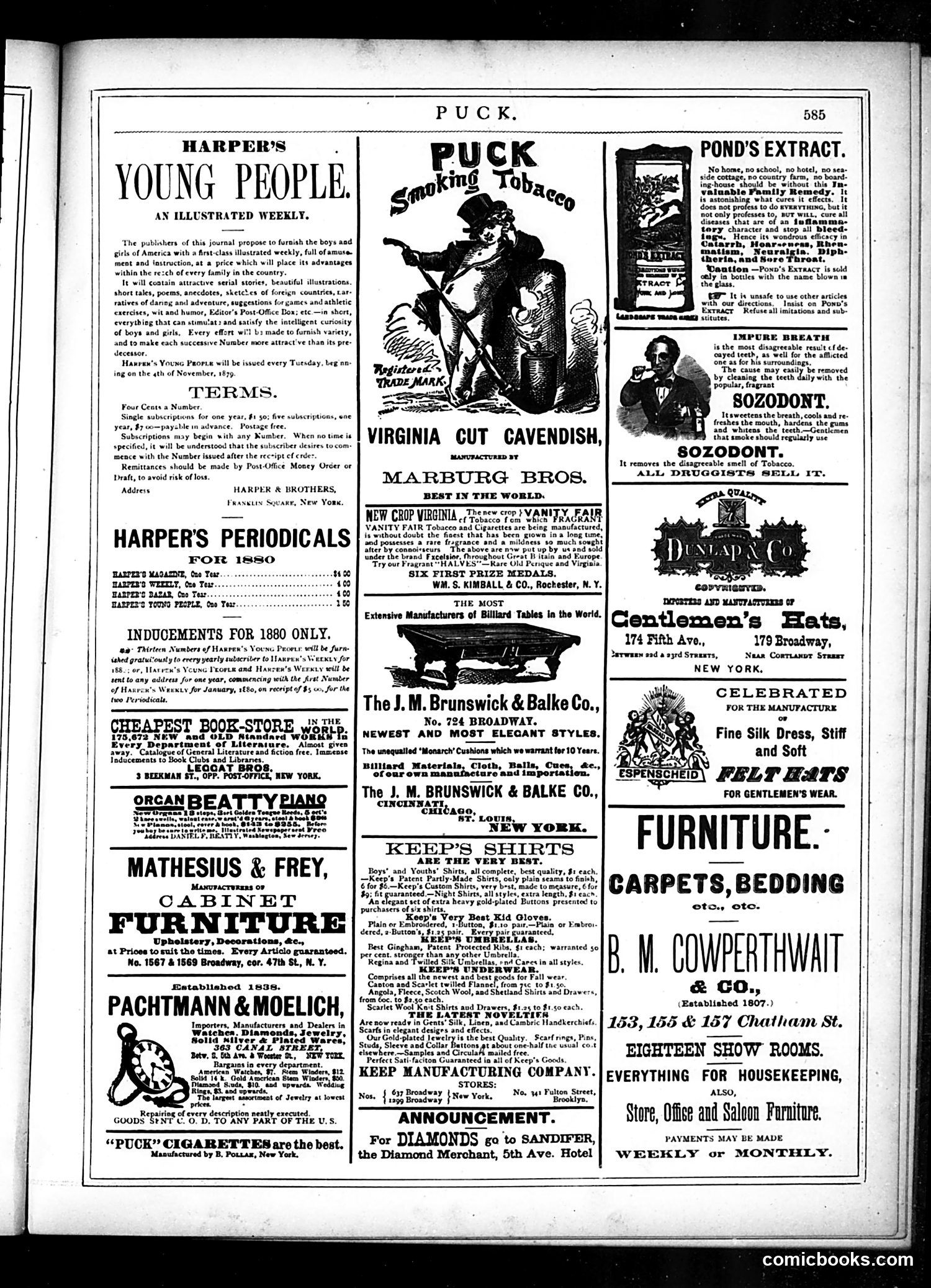
This page is primarily **advertising and announcements** for Puck magazine's 1880 offerings, with no significant political cartoons visible in the main content area. The central image shows a classical cherub or putto figure associated with **tobacco advertising** (Virginia Cut Cavendish by Marburg Bros.), not political satire. The page features standard commercial advertisements for the era: furniture, clothing, billiard tables, jewelry, and other goods—typical of 19th-century magazine back matter. **Harper's Young People** section promotes a competing illustrated weekly for youth. Without identifying specific political figures or satirical commentary in the visible cartoons/illustrations, this appears to be a standard advertising page rather than content requiring political-historical interpretation for modern readers.
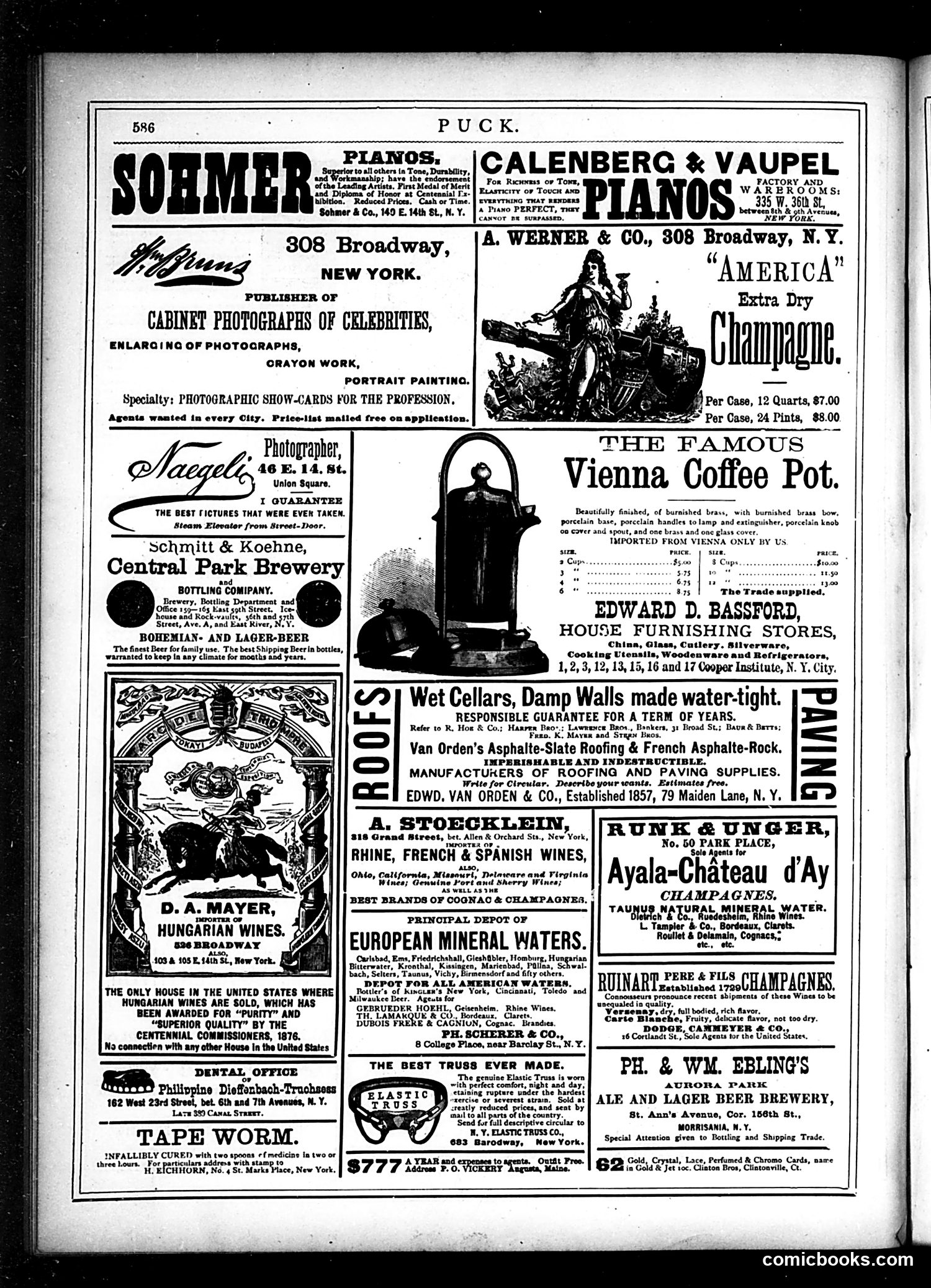
This page is **primarily advertising**, not satirical content. It contains late 19th-century product advertisements for: - Musical instruments (Sohmer pianos, Calenberg & Vaupel pianos) - Beverages (champagne, Vienna coffee pots, wines, mineral waters, beer) - Home goods and services (roofing, house furnishings, dental work) - Patent medicines (tapeworm cure, elastic truss) The largest visual element is an ornate **D.A. Mayer wines advertisement** featuring a decorative crest with a figure, promoting Hungarian, Rhine, French, and Spanish wines. There is **no political cartoon visible** on this page—it appears to be a standard classified/display advertisement section from *Puck* magazine, typical of late 1800s publishing revenue models where satirical content shared pages with extensive paid advertising.
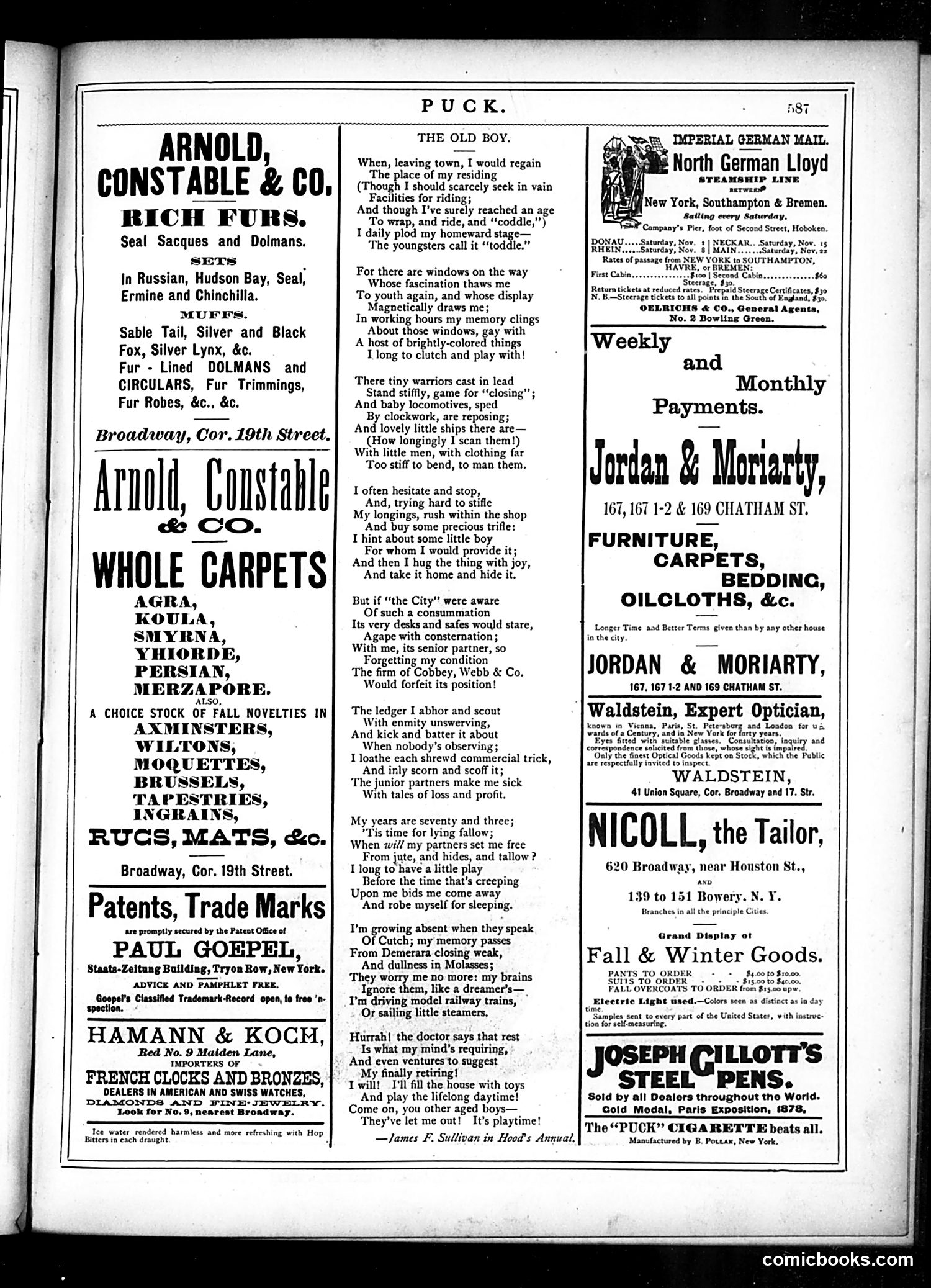
This page is **primarily advertising**, not a political cartoon. The dominant content consists of commercial advertisements for late 19th-century businesses: Arnold, Constable & Co. (rich furs), Jordan & Moriarty (furniture and carpets), Nicoll the Tailor, Joseph Gillott's Steel Pens, and others. The only editorial content is a poem titled "THE OLD BOY" by James F. Sullivan, which nostalgically recalls childhood toys and games—tin soldiers, toy trains, ships, and dolls. The poem expresses sentimental longing for youth and simpler times. This appears to be a back page of *Puck* magazine, where advertising revenue supported the publication. The poem's theme of nostalgia would have resonated with the magazine's adult readership.
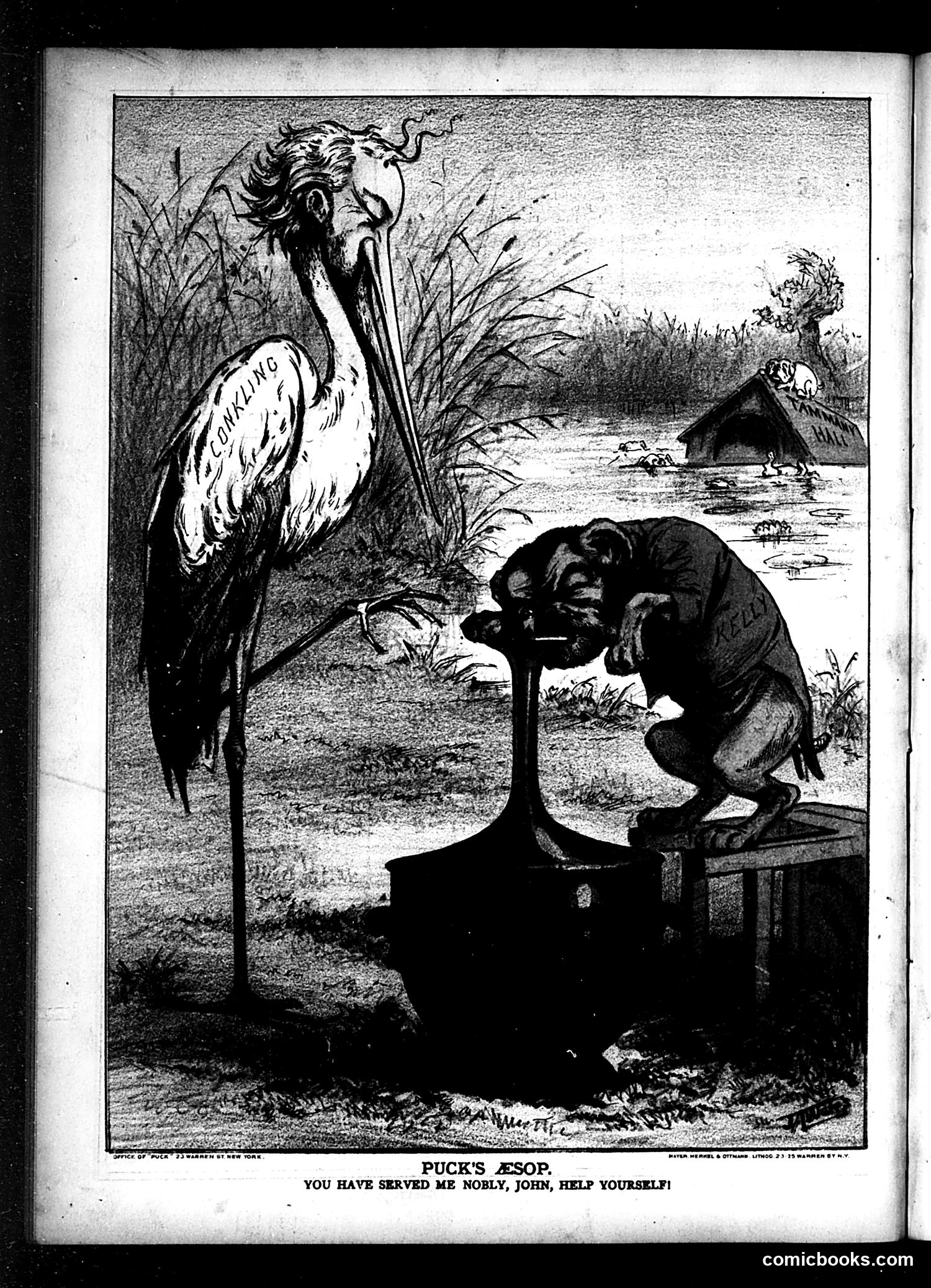
This cartoon depicts a scene from Aesop's Fables featuring a stork and a fox. The stork has caught fish in a pot, and the fox—appearing to be anthropomorphized—is being invited to help itself to the meal. The satire appears to reference political reciprocity or patronage: the caption suggests a powerful figure ("the stork") rewarding a loyal servant ("John") for faithful service. The tableau likely comments on political favors, corrupt bargains, or quid pro quo arrangements common in Gilded Age politics. The specific historical context—which politician or scandal this targets—is unclear without additional publication details. However, the Aesop's Fables framework was commonly used in Puck to critique moral failures in political relationships.