
Puck, 1879-11-12 · page 4 of 18
Puck — November 12, 1879 — page 4: what you’re looking at
What you’re looking at
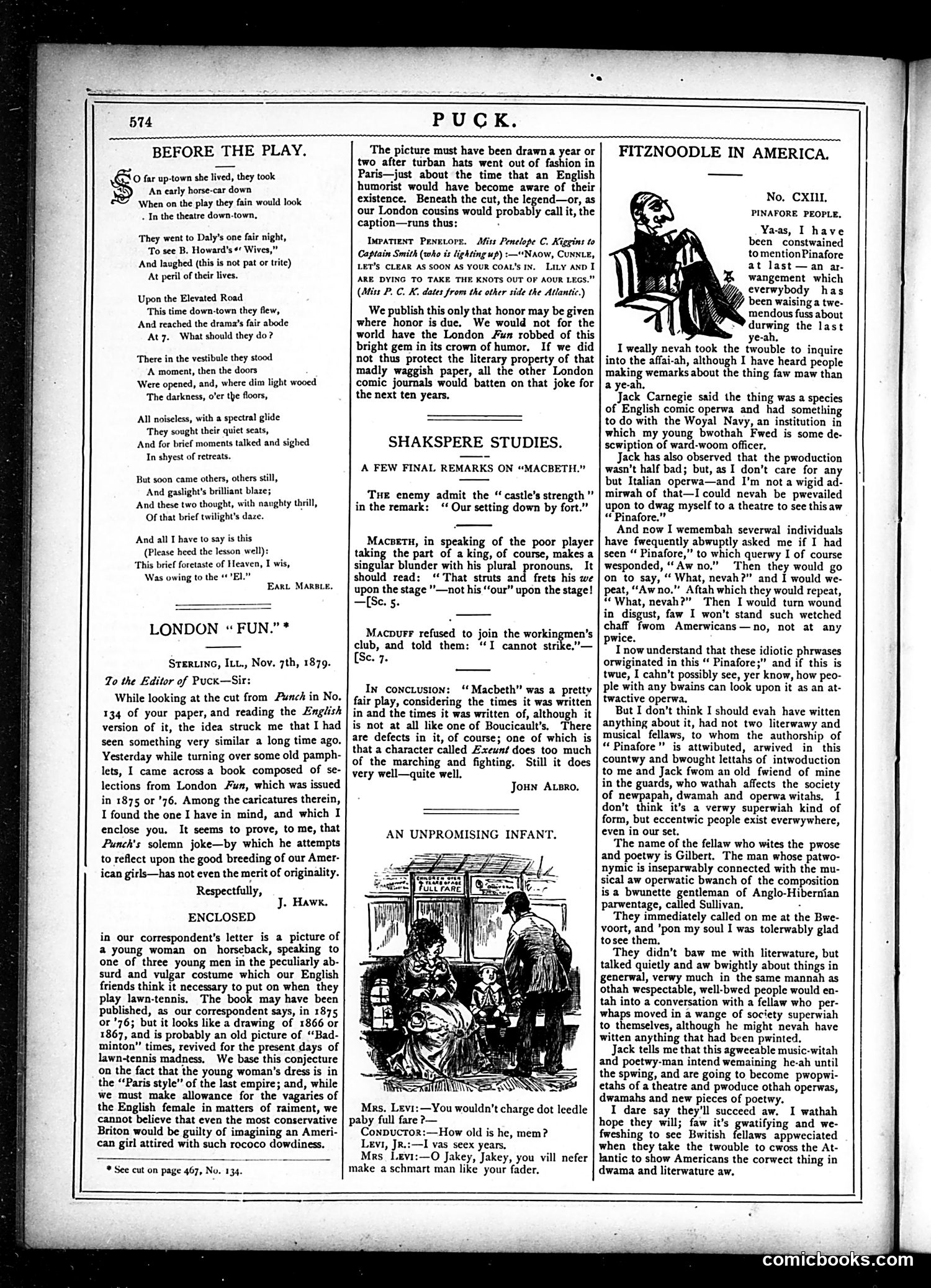
This page contains primarily **literary and theater criticism** rather than political satire. The main content includes: 1. **"Fitznoodle in America"** (No. CXIII): A humorous column where the author recounts encounters with pretentious people discussing opera, literature, and theater. The satire targets American social climbers and pseudo-intellectuals who adopt affected opinions about high culture. 2. **"Shakespeare Studies"**: Commentary on Macbeth's theatrical merits and defects. 3. **"London 'Fun'"**: A reader's letter discussing Puck's humor and comparative American/British comedy styles. 4. **"An Unpromising Infant"**: A small illustrated dialogue joke (image shows figures in conversation). The page's humor focuses on **cultural pretension and social affectation** rather than political commentary—mocking Americans' attempts to appear cultured while lacking genuine understanding.
📄 Transcribed text from this page (OCR, searchable)
Machine-transcribed from the original scan — historical spelling and the odd misread are preserved.
574 PUCK. BEFORE THE PLAY. S far up-town she lived, they took ‘An early horse-car down When on the play they fain would look . In the theatre down-town, ‘They went to Daly’s one fair night, To see B. Howard’s # Wives,” ‘And laughed (this is not pat or trite) At peril of their lives. Upon the Elevated Road ‘This time down-town they flew, And reached the drama’s fair abode At 7. What should they do? ‘There in the vestibule they stood ‘A moment, then the doors Were opened, and, where dim light wooed ‘The darkness, o'er the floors, All noiseless, with a spectral glide ‘They sought their quiet seats, And for brief moments talked and sighed In shyest of retreats. But soon came others, others still, And gaslight’s brilliant blaze; And these two thought, with nanghty thrill, Of that brief twilight’s daze. And all [have to say is this (Please heed the lesson well): ‘This brief foretaste of Heaven, I wis, Was owing to the El.” , ae EARL MARBLE. LONDON « FUN.” * Sreruine, Itt, Nov. 7th, 1879. Io the Editor of Puck—Sir: While looking at the cut from Punch in No. 134 of your paper, and reading the English version of it, the idea struck me that I had seen something very similar a long time ago. Yesterday while turning over some old pamph- lets, I came across a book composed of se- lections from London Fun, which was issued in 1875 or ’76, Among the caricatures therein, I found the one I have in mind, and which I enclose you. It seems to prove, to me, that Punch's solemn joke—by which he attempts to reflect upon the good breeding of our Amer- ican girls—has not even the merit of originality. full ccna J. Hawk. ENCLOSED in our correspondent’s letter is a picture of @ young woman on horseback, speaking to one of three young men in the peculiarly ab- surd and vulgar costume which our English friends think it necessary to put on when they play lawn-tennis. The book may have been published, as our correspondent says, in 1875 or '76; but it looks like a drawing of 1866 or 1867, and is probably an old picture of “Bad- minton” times, revived for the present days of lawn-tennis madness, We base this conjecture on the fact that the young woman's dress is in the “Paris style’’ of the last empire; and, while we must make allowance for the vagaries of the English female in matters of raiment, we cannot believe that even the most conservative Briton would be guilty of imagining an Ameri- can girl attired with such rococo dowdiness. * See cut on page 467, No. 134. The picture must have been drawn a year or two after turban hats went out of fashion in Paris—just about the time that an English humorist would have become aware of their existence. Beneath the cut, the legend—or, as our London cousins would probably call it, the caption—runs thus: . Impatient Penevore. Afiss Penelope C. Kiggins to Captain Smith (who is lighting up) :—“Naow, CUNNLE, LET'S CLEAR AS SOON AS YOUR COAL'S IN. LILY AND I ARE DYING TO TAKE THE KNOTS OUT OF AOUR LEGS.” (Aiss P. C. K. dates frome the other side the Atlantic.) We publish this only that honor may be given where honor is due. We would not for the world have the London Fun robbed of this bright gem in its crown of humor. If we did not thus protect the literary property of that madly waggish paper, all the other London comic journals would batten on that joke for the next ten years. SHAKSPERE STUDIES. A FEW FINAL REMARKS ON “MACBETH.” Tue enemy admit the “ castle’s strength” in the remark: “‘ Our setting down by fort.” Macsetu, in speaking of the poor player taking the part of aking, of course, makes a singular blunder with his plural pronouns, It should read: ‘That struts and frets his we upon the stage —not his ‘‘our” upon the stage! —{[Se. 5. MacourF refused to join the workii club, and told them: “I cannot st [Sc. 7. In conciusion: ‘ Macbeth” was a pretty fair play, considering the times it was written in and the times it was written of, although it is not at all like one of Boucicault’s, There are defects in it, of course; one of which is that a character called Exeunt does too much of the marching and fighting. Still it does very well—quite well. Joun Atsro, AN UNPROMISING INFANT. = Mrs. Levi:—You wouldn't charge dot leedle paby full fare ?— Conpuctor:—How old is he, mem? Levi, JR.:—I vas seex years, Mrs Levi:—O Jakey, Jakey, you vill nefer make a schmart man like your fader. No, CXIIL. PINAFORE PEOPLE, Ya-as, I have been constwained tomentionPinafore at last —an ar- wangement which everwybody has been waising a twe- mendous fuss about durwing the last ye-ah, I weally nevah took the twouble to inquire into the affai-ah, although I have heard people making wemarks about the thing faw maw than aye-ah, Jack Carnegie said the thing was a species of English comic operwa and had something to do with the Woyal Navy, an institution in which my young bwothah Fwed is some de- sewiption of ward-woom officer. Jack has also observed that the pwoduction wasn’t half bad; but, as I don’t care for any but Italian operwa—and I'm not a wigid ad- mirwah of that—I could nevah be pwevailed upon to dwag myself to a theatre to see thisaw “Pinafore.” And row I wemembah severwal individuals have fwequently abwuptly asked me if I had seen “ Pinafore,” to which querwy I of course wesponded, “Aw no.” ‘Then they would go on to say, “ What, nevah?” and I would we- peat, “Awno.” Aftah which they would repeat, “What, nevah?” Then I would turn wound in disgust, faw I won't stand such wetched chaff fwom Amerwicans—no, not at any pwice. I now understand that these idiotic phrwases orwiginated in this “ Pinafore;” and if this is twue, I cahn’t possibly see, yer know, how peo- ple with any bwains can look upon it as an at- twactive operwa, But I don’t think I should evah have witten anything about it, had not two literwawy and musical fellaws, to whom the authorship of “ Pinafore” is attwibuted, arwived in this countwy and bwought lettahs of intwoduction to me and Jack fwom an old fwiend of mine in the guards, who wathah affects the society of newpapah, dwamah and operwa witahs, I don’t think it’s a verwy superwiah kind of form, but eccentwic people exist everwywhere, even in our set. The name of the fellaw who wites the pwose and poetwy is Gilbert. The man whose patwo- nymic is inseparwably connected with the mu- sical aw operwatic bwanch of the composition is a bwunette gentleman of Anglo-Hibernian parwentage, called Sullivan, : They immediately called on me at the Bwe- voort, and ‘pon my soul I was tolerwably glad tosee them. They didn’t baw me with literwature, but talked quietly and aw bwightly about things in generwal, verwy much in the same mannah as othah wespectable, well-bwed people would en- tah into a conversation with a fellaw who per- whaps moved in a wange of society superwiah to themselves, although he might nevah have witten anything that had been pwinted. Jack tells me that this agweeable music-witah and poetwy-man intend wemaining he-ah until the spwing, and are going to become pwopwi- etahs of a theatre and pwoduce othah operwas, dwamahs and new pieces of poetwy. I dare say they'll succeed aw. I wathah hope they will; faw it’s gwatifying and we- fweshing to see Bwitish fellaws appweciated when they take the twouble to cwoss the At- lantic to show Americans the corwect thing in dwama and literwature aw. comicbooks.com