
Puck, 1879-11-12 · page 5 of 18
Puck — November 12, 1879 — page 5: what you’re looking at
What you’re looking at
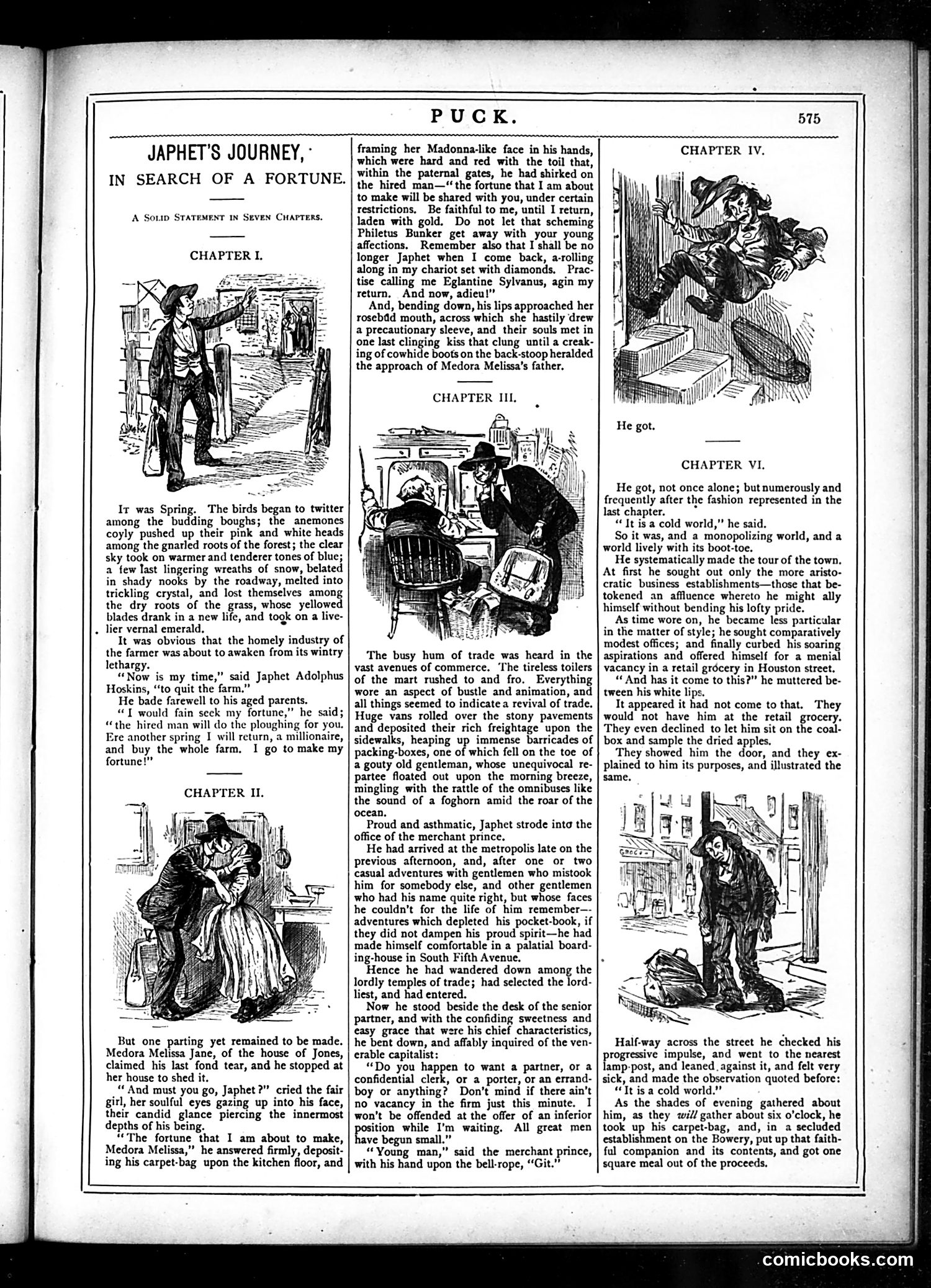
This appears to be a serialized fiction story rather than political satire. The narrative follows a character named Japhet Adolphus Hockins, a young man seeking his fortune in New York City during spring. The illustrations show: a man in period dress, a domestic farewell scene, urban commerce, and street scenes. The story depicts Japhet's arrival in the city, his attempts to find employment and business opportunities, and his encounters with various merchants and characters. This is literary entertainment rather than political commentary—a serialized adventure tale aimed at Puck's readers, featuring stock characters of urban fortune-seeking common in 19th-century American popular fiction. The satirical edge, if any, targets social pretension and the competitive nature of city business rather than specific political figures.
📄 Transcribed text from this page (OCR, searchable)
Machine-transcribed from the original scan — historical spelling and the odd misread are preserved.
PUCK. JAPHET'S JOURNEY, ° IN SEARCH OF A FORTUNE. A Solty STATEMENT IN SEVEN CHAPTERS. CHAPTER I. Ir was Spring. The birds began to twitter among the budding boughs; the anemones coyly pushed up their pink and white heads among the gnarled roots of the forest; the clear sky took on warmer and tenderer tones of blue; a few last lingering wreaths of snow, belated in shady nooks by the roadway, melted into trickling crystal, and lost themselves among the dry roots of the grass, whose yellowed blades drank in a new life, and togk on a live- . lier vernal emerald. It was obvious that the homely industry of the farmer was about to awaken from its wintry lethargy. “Now is my time,” said Japhet Adolphus Hoskins, “to quit the farm.” He bade farewell to his aged parents. “T would fain seck my fortune,” he said; “the hired man will do the ploughing for you. Ere another spring I will return, a millionaire, and buy the whole farm. I go to make my fortune!” CHAPTER II. But one parting yet remained to be made. Medora Melissa Jane, of the house of Jones, claimed his last fond tear, and he stopped at her house to shed it. “And must you go, Japhet?” cried the fair girl, her soulful eyes gazing up into his face, their candid glance piercing the innermost depths of his being. “The fortune that I am about to make, Medora Melissa,” he answered firmly, deposit: ing his carpet-bag upon the kitchen floor, and framing her Madonna-like face in his hands, which were hard and red with the toil that, within the paternal gates, he had shirked on the hired man—‘“ the fortune that I am about to make will be shared with you, under certain restrictions. Be faithful to me, until I return, laden with gold. Do not let that scheming Philetus Bunker get away with your young affections. Remember also that I shall be no longer Japhet when I come back, a-rolling along in my chariot set with diamonds. Prac- tise calling me Eglantine Sylvanus, agin my return, And now, adieu!” And, bending down, his lips approached her rosebad mouth, across which she hastily drew a precautionary sleeve, and their souls met in one last clinging kiss that clung until a creak- ing of cowhide boots on the back-stoop heralded the approach of Medora Melissa’s father. CHAPTER IIL. The busy hum of trade was heard in the vast avenues of commerce. ‘The tireless toilers of the mart rushed to and fro. Everything wore an aspect of bustle and animation, and all things seemed to indicate a revival of trade. Huge vans rolled over the stony pavements and deposited their rich freightage upon the sidewalks, heaping up immense barricades of packing-boxes, one of which fell on the toe of a gouty old gentleman, whose unequivocal re- partee floated out upon the morning breeze, mingling with the rattle of the omnibuses like the sound of a foghorn amid the roar of the ocean, Proud and asthmatic, Japhet strode into the office of the merchant prince, He had arrived at the metropolis late on the previous afternoon, and, after one or two casual adventures with gentlemen who mistook him for somebody else, and other gentlemen who had his name quite right, but whose faces he couldn’t for the life of him remember—- adventures which depleted his pocket-book, if they did not dampen his proud spirit—he had made himself comfortable in a palatial board- ing-house in South Fifth Avenue, Hence he had wandered down among the lordly temples of trade; had selected the lord- liest, and had entered. Now he stood beside the desk of the senior partner, and with the confiding sweetness and easy grace that were his chief characteristics, he bent down, and affably inquired of the ven- erable capitalist: “Do you happen to want a partner, or a confidential clerk, or a porter, or an errand- boy or anything? Don’t mind if there ain’t no vacancy in the firm just this minute. I won't be offended at the offer of an inferior ition while I’m waiting. All great men ve begun small.” “Young man,” said the merchant prince, with his hand upon the bell-rope, “Git.” CHAPTER IV. CHAPTER VI. He got, not once alone; but numerously and frequently after the fashion represented in the last chapter. “It is a cold world,” he said. So it was, and a monopolizing world, and a world lively with its boot-toe. He systematically made the tour of the town, At first he sought out only the more aristo- cratic business establishments—those that be- tokened an affluence whereto he might ally himself without bending his lofty pride. As time wore on, he became less particular in the matter of style; he sought comparatively modest offices; and finally curbed his soaring aspirations and offered himself for a menial vacancy in a retail grécery in Houston street. ‘And has it come to this?” he muttered be- tween his white lips. It appeared it had not come to that. They would not have him at the retail grocery. They even declined to let him sit on the coal- box and sample the dried apples. They showed him the door, and they ex- plained to him its purposes, and illustrated the Half-way across the street he checked his rogressive impulse, and went to the nearest lamp-post, and leaned against it, and felt very sick, and made the observation quoted before: “Tt is a cold world.” As the shades of evening gathered about him, as they wid/ gather about six o'clock, he took up his carpet-bag, and, in a secluded establishment on the Bowery, put up that faith- ful companion and its contents, and got one square meal out of the proceeds, comicbooks.co