
Puck, 1879-11-12 · page 10 of 18
Puck — November 12, 1879 — page 10: what you’re looking at
What you’re looking at
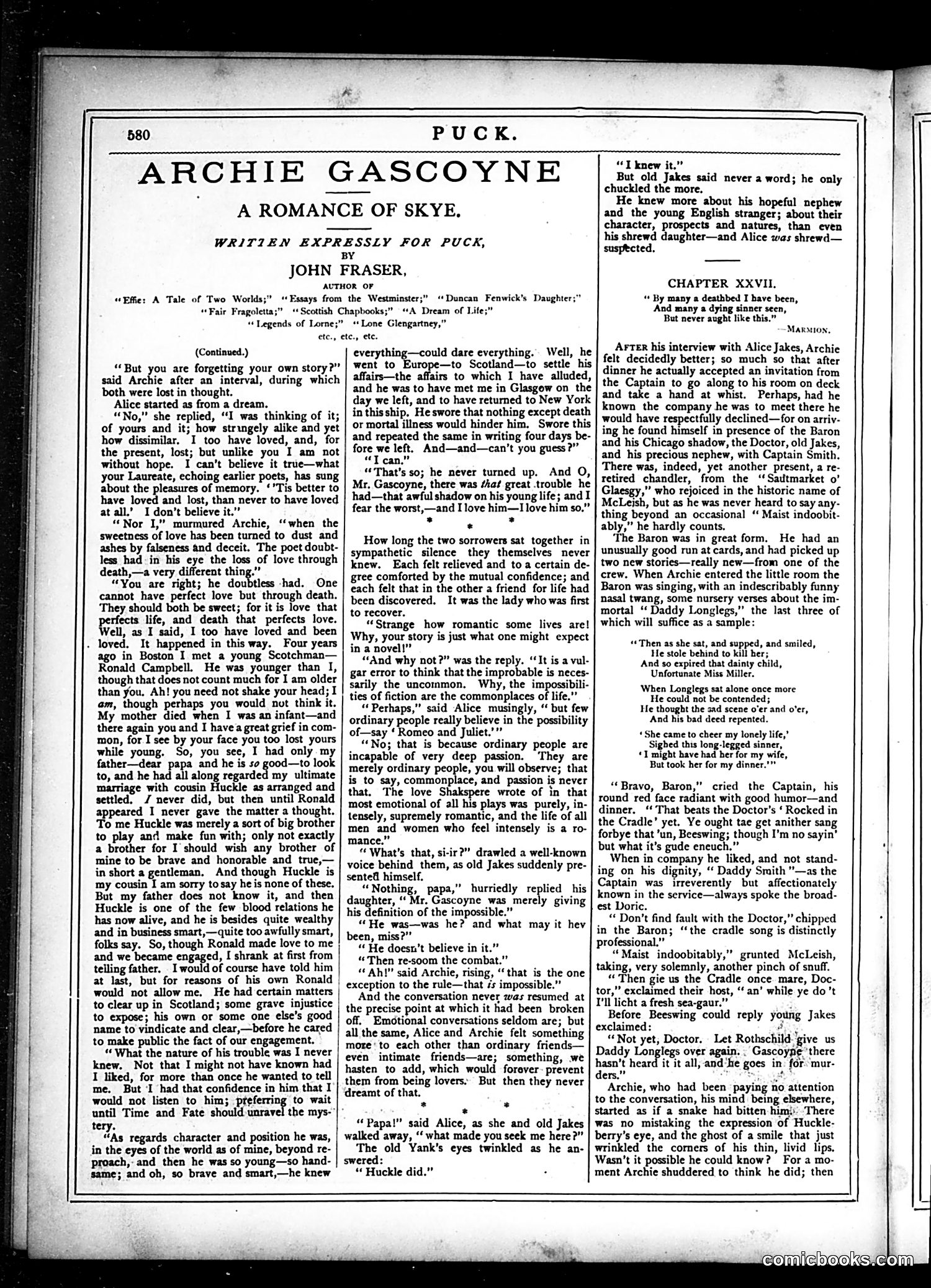
This page contains **serialized fiction, not political satire or cartoons**. It's a continuation of "Archie Gascoyne: A Romance of Skye" by John Fraser, published in Puck magazine. The page presents a romantic narrative featuring characters including Archie, Alice Jakes, and various Scottish settings. The text discusses themes of love, marriage prospects, and social class—typical concerns of Victorian/Edwardian romance literature. **No political cartoons or satirical commentary appear on this page.** This is a literary installment rather than the satirical or humorous visual content Puck was typically known for. The page demonstrates that Puck, while primarily a satirical magazine, also serialized romantic fiction to appeal to broader readership.
📄 Transcribed text from this page (OCR, searchable)
Machine-transcribed from the original scan — historical spelling and the odd misread are preserved.
. loved. PUCK. ARCHIE GASCOYNE A ROMANCE OF SKYE. WRITIEN EXPRESSLY FOR PUCK, BY JOHN FRASER, AUTHOR OF “Effie: A Tale of Two Worlds;” ‘Essays from the Westminster; Duncan Fenwick’s Daughter; “Fair Fragoletta;” “Scottish Chapbooks;” “A Dream of Lite;” “Legends of Lorne;” “Lone Glengartney,” ete., ete., ete. (Continued.) “But you are forgetting your own story?” said Archie after an interval, during which both were lost in thought. Alice started as from a dream. "No," she replied, “I was thinking of it; of yours and it; how stringely alike and yet how dissimilar. I too have loved, and, for the present, lost; but unlike you I am not without hope. I can’t believe it true—what your Laureate, echoing earlier poets, has sung about the pleasures of memory. ‘'Tis better to have loved and lost, than never to have loved at all.’ I don’t believe it.” “Nor I,” murmured Archie, ‘when the sweetness of love has been turned to dust and ashes by falseness and deceit. The poet doubt- less had-in his eye the loss of love through death,—a very different thing.” “You are right; he doubtless -had. One cannot have perfect love but through death. They should both be sweet; for it is love that Pesiects life, and death that perfects love. ell, as I said, I too have loved and been It happened in this way. Four years in Boston I met a young Scotchman— Ronald Campbell. He was younger than I, though that does not count much for I am older than you. Ah! you need not shake your head; I am, though perhaps you would not think it. My mother died when I was an infant—and there again you and I havea great grief in com- mon, for I see by your face you too lost yours while young. So, you see, I had only my father—dear papa and he is so good—to look to, and he had all along regarded my ultimate marriage with cousin Huckle as arranged and settled, / never did, but then until Ronald appeared I never gave the matter a thought. To me Huckle was merely a sort of big brother to play and make fun with; only not exactly a brother for I should wish any brother of mine to be brave and honorable and true,— in short a gentleman. And though Huckle is my cousin I am sorry to say he is none of these. But my father does not know it, and then Huckle is one of the few blood relations he has now alive, and he is besides quite wealthy and in business smart,—quite too awfully smart, folks say. So, though Ronald made love to me and we became engaged, I shrank at first from telling father. I would of course have told him at last, but for reasons of his own Ronald would not allow me. He had certain matters to clear up in Scotland; some grave injustice to expose; his own or some one else’s good name to vindicate and clear,—before he cared to make public the fact of our engagement. «‘ What the nature of his trouble was I never knew. Not that I might not have known had I liked, for more than once he wanted to tell me. But ‘I had that confidence in him that I would not listen to him; preferring to wait until Time and Fate should unravel the mys- tery. “As regards character and position he was, in the eyes of the world as of mine, beyond re- proach,- and then he was so young—so hand- same; and oh, so brave and smart,—he knew everything—could dare everything. Well, he went to ‘Europe—to Scotland—to settle his affairs—the affairs to which I have alluded, and he was to have met me in Glasgow on the day we left, and to have returned to New York in this ship. He swore that nothing except death or mortal illness would hinder him. Swore this and repeated the same in writing four days be- fore we left. And—and—can’t you guess?” “YT can.” “That's so; he never turned up. And O, ‘Mr, Gascoyne, there was that great trouble he had—that awful shadow on his young life; and I fear the worst,—and I love him—I love him so.”” * * * How long the two sorrowers sat together in sympathetic silence they themselves never knew. Each felt relieved and to a certain de- gree comforted by the mutual confidence; and each felt that in the other a friend for life had been discovered. It was the lady who was first to recover. “Strange how romantic some lives are! Why, your story is just what one might expect in a novel!” “And why not?” was the reply. “It is a vul- gar error to think that the improbable is neces- sarily the uncommon. Why, the impossibili- ties of fiction are the commonplaces of life.” “Perhaps,” said Alice musingly, “ but few ordinary people really believe in the possibility of—say ‘Romeo and Juliet.’” “No; that is because ordinary people are incapable of very deep passion. ‘They are merely ordinary people, you will observe; that is to say, commonplace, and passion is never that. The love Shakspere wrote of in that most emotional of all his plays was purely, in- tensely, supremely romantic, and the life of all men and women who feel intensely is a ro- mance.” ‘What's that, si-ir?” drawled a well-known voice behind them, as old Jakes suddenly pre- sented himself. “Nothing, papa,” hurriedly replied his daughter, “Mr. Gascoyne was merely giving his definition of the impossible.” “He was—was he? and what may it hev been, miss?” “ He doesn’t believe in it.” “Then re-soom the combat.” “Ah!” said Archie, rising, ‘that is the one exception to the rule—that /s impossible.” And the conversation never was resumed at the precise point at which it had been broken off, Emdtional conversations seldom are; but all the same, Alice and Archie felt something more’ to each other than ordinary friends— even intimate friends—are; something, we hasten to add, which would forever: prevent them from being lovers. But then they never dreamt of that. * * * “Papal” said Alice, as she and old Jakes walked away, ‘‘ what made you seek me here?” The old Yank's eyes twinkled as he an- swered: “Huckle did.” . “I knew it.” But old Jakes said never a word; he only chuckled the more. He knew more about his hopeful nephew and the young English stranger; about their character, prospects and natures, than even his shrewd daughter—and Alice was shrewd— suspected, CHAPTER XXVII. « By many a deathbed I have been, ‘And many a dying sinner seen, But never aught like this.” Marion, Arter his interview with Alice Jakes, Archie felt decidedly better; so much so that after dinner he actually accepted an invitation from the Captain to go along to his room on deck and take a hand at whist. Perhaps, had he known the company he was to meet there he would have respectfully declined—for on arriv- ing he found himself in presence of the Baron and his Chicago shadow, the Doctor, old Jakes, and his precious nephew, with Captain Smith. There was, indeed, yet another present, a re- retired chandler, from the ‘‘Sautmarket o’ Glaesgy,” who rejoiced in the historic name of McLeish, but as he was never heard to say any- thing beyond an occasional “ Maist indoobit- ably,” he hardly counts. ‘The Baron was in great form. He had an unusually good run at cards, and had picked up two new stories—really new—from one of the crew. When Archie entered the little room the Baron was singing, with an indescribably funny nasal twang, some nursery verses about the im- mortal ‘“ Daddy Longlegs,” the last three of which will suffice as a sample: “Then as she sat, and supped, and smiled, He stole behind to kill her; And so expired that dainty child, Unfortunate Miss Miller. ‘When Longlegs sat alone once more He could not be contended; He thought the sad scene o'er and o'er, ‘And his bad deed repented. “She came to cheer my lonely life,’ Sighed this long-legged sinner, “Tmight have had her for my wife, But took her for my dinner." “Bravo, Baron,” cried the Captain, his round red face radiant with good humor—and dinner. ‘ That beats the Doctor's ‘ Rocked in the Cradle’ yet. Ye ought tae get anither sang forbye that ‘un, Beeswing; though I'm no sayin’ but what it’s gude eneuch. When in company he liked, and not stand- ing on his dignity, “‘ Daddy Smith "—as the Captain was irreverently but affectionately known in the service—always spoke the broad- est Doric. “ Don’t find fault with the Doctor,” chipped in the Baron; “the cradle song is distinctly professional.” “Maist indoobitably,” grunted McLeish, taking, very solemnly, another pinch of snuff. “ Then gie us the Cradle once. mare, Doc- tor,” exclaimed their host, ‘an’ while ye do’t I'll licht a fresh sea-gaur.” ; Before Beeswing could reply young Jakes exclaimed: aes “Not yet, Doctor. Let Rothschild. ‘give us Daddy Longlegs over again. | Gascoype:"there hasn't heard it it all, and‘he goes in: for. mur- ders.” eat Archie, who had been paying no attention to the conversation, his mind being elsewhere, started as if a snake had bitten him: ‘There was no mistaking the expression of Huckle- berry’s eye, and the ghost of a smile that just wrinkled the corners of his thin, livid lips. Wasn't it possible he could know? For a mo- ment Archie shuddered to think he did; then