
Puck, 1879-11-12 · page 11 of 18
Puck — November 12, 1879 — page 11: what you’re looking at
What you’re looking at
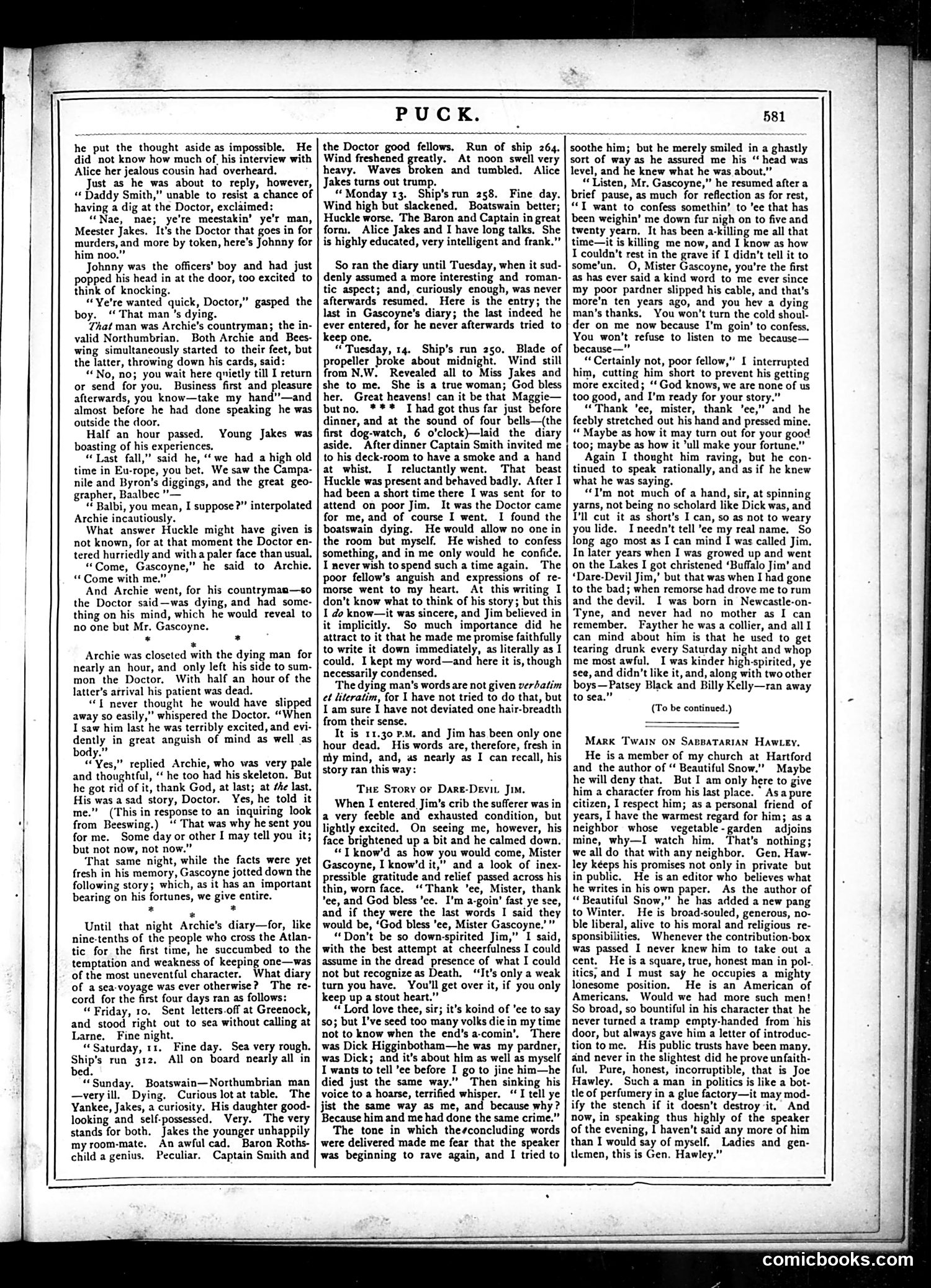
This page is primarily **text content**, not a political cartoon. It contains a serialized story titled "The Story of Dark-Devil Jim" alongside a section labeled "Mark Twain on Sabbatarian Hawley." The Twain section appears to be commentary on a figure named Hawley (likely a public figure of the era) whom Twain characterizes as hypocritical—someone who presents himself as morally upstanding in public but whose private character contradicts this image. Twain critiques Hawley's politics and public positions with his characteristic sardonic wit. The page layout mixes fiction with opinion/commentary, typical of Puck's format blending entertainment with social satire. Without clearer visual elements or more specific historical context in the visible text, the precise identity of "Sabbatarian Hawley" and the exact nature of Twain's critique remain unclear from this page alone.
📄 Transcribed text from this page (OCR, searchable)
Machine-transcribed from the original scan — historical spelling and the odd misread are preserved.
PUCK. he put the thought aside as impossible. He did not know how much of his interview with Alice her jealous cousin had overheard. ust as he was about to reply, however, « Daddy Smith,” unable to resist a chance of having a dig at the Doctor, exclaimed: “Nae, nae; ye're meestakin’ ye'r man, Meester Jakes. It’s the Doctor that goes in for murders, and more by token, here’s Johnny for him noo.” Johnny was the officers’ boy and had just popped his head in at the door, too excited to think of knocking. “Ye're wanted quick, Doctor,” gasped the boy. “That man ’s dying. That man was Archie's countryman; the in- valid Northumbrian. Both Archie and Bees- wing simultaneously started to their feet, but the latter, throwing down his cards, said: “No, no; you wait here quietly till I return or send for you. Business first and pleasure afterwards, you know—take my hand"—and almost before he had done speaking he was outside the door. Half an hour passed. boasting of his experiences. “Last fall,” said he, “we had a high old time in Eu-rope, you bet. We saw the Campa- nile and Byron’s diggings, and the great geo- grapher, Baalbec "— “ Balbi, you mean, I suppose?” interpolated Archie incautiously. What answer Huckle might have given is not known, for at that moment the Doctor en- tered hurriedly and witha paler face than usual, “Come, Gascoyne,” he said to Archie. “© Come with me.” And Archie went, for his countrymas—so the Doctor said—was dying, and had some- thing on his mind, which he would reveal to no one but Mr. Gascoyne. * Young Jakes was * * Archie was closeted with the dying man for nearly an hour, and only left his side to sum- mon the Doctor. With half an hour of the latter’s arrival his patient was dead. “E never thought he would have slipped away so easily,” whispered the Doctor. “When I saw him last he was terribly excited, and evi- dently in great anguish of mind as well as body.” “Yes,” replied Archie, who was very pale and thoughtful, ‘‘ he too had his skeleton. But he got rid of it, thank God, at last; at she last. His was asad story, Doctor. Yes, he told it me.” (This in response to an inquiring look from Beeswing.) ‘That was why he sent you for me. Some day or other I may tell you it; but not now, not now.” That same night, while the facts were yet fresh in his memory, Gascoyne jotted down the following story; which, as it has an important bearing on his fortunes, we give entire. * * Until that night Archie's diary—for, like nine-tenths of the people who cross the Atlan- tic for the first time, he succumbed to the temptation and weakness of keeping one—was of the most uneventful character. What diary of a sea-voyage was ever otherwise? The re- cord for the first four days ran as follows: “Friday, 10, Sent letters.off at Greenock, and stood right out to sea without calling at Larne. Fine night. “Saturday, 11. Fine day. Sea very rough. Ship's run 312, All on board nearly all in bed. “Sunday. Boatswain—Northumbrian man —very ill, Dying. Curious lot at table. The Yankee, Jakes, a curiosity. His daughter good- looking and self-possessed. Very. The very stands for both. Jakes the younger unhappily my room-mate. An awful cad. Baron Roths- child a genius. Peculiar. Captain Smith and the Doctor good fellows. Run of ship 264. Wind freshened greatly. At noon swell very heavy. Waves Broken and tumbled. Alice Jakes turns out trump. “Monday 13. Ship's run 258. Fine day. Wind high but slackened. Boatswain better; Huckle worse. The Baron and Captain in great form. Alice Jakes and I have long talks. She is highly educated, very intelligent and frank.” So ran the diary until Tuesday, when it sud- denly assumed a more interesting and roman- tic aspect; and, curiously enough, was never afterwards resumed. Here is the entry; the last in Gascoyne's diary; the last indeed he ever entered, for he never afterwards tried to keep one. “Tuesday, 14. Ship’s run 250, Blade of propeller broke about midnight. Wind still from N.W. Revealed all to Miss Jakes and she to me. She is a true woman; God bless her. Great heavens! can it be that Maggie— butno, *** [had got thus far just before dinner, and at the sound of four bells—(the first dog-watch, 6 o'clock)—laid the diary aside. After dinner Captain Smith invited me to his deck-room to have a smoke and a hand at whist. I reluctantly went. That beast Huckle was present and behaved badly, After I had been a short time there I was sent for to attend on poor Jim. It was the Doctor came for me, and of course I went. I found the boatswain dying. He would allow no one in the room but myself. He wished to confess something, and in me only would he confice. I never wish to spend such a time again. The poor fellow’s anguish and expressions of re- morse went to my heart. At this writing I don’t know what to think of his story; but this 1 do know—it was sincere, and Jim believed in it implicitly. So much importance did he attract to it that he made me promise faithfully to write it down immediately, as literally as I could. I kept my word—and here it is, though necessarily condensed. ‘The dying man’s words are not given verbatim et literatim, for I have not tried to do that, but I am sure I have not deviated one hair-breadth from their sense. It is 11.30 p.m. and Jim has been only one hour dead. His words are, therefore, fresh in my mind, and, as nearly as I can recall, his story ran this way: Tue Story or Dare-Devit Jim. When I entered. Jim’s crib the sufferer was in a very feeble and exhausted condition, but lightly excited. On seeing me, however, his face brightened up a bit and he calmed down. “T know’d as how you would come, Mister Gascoyne, I know'd it,” and a look of inex- pressible gratitude and relief passed across his thin, worn face. ‘Thank 'ee, Mister, thank ‘ee, and God bless 'ce. I’m a-goin’ fast ye see, and if they were the last words I said they would be, ‘God bless ‘ee, Mister Gascoyne.’” “Don’t be so down-spirited Jim,” I said, with the best attempt at cheerfulness I could assume in the dread presence of what I could not but recognize as Death, “It’s only a weak turn you have. You'll get over it, if you only keep up a stout heart.” “ Lord love thee, sir; it's koind of 'ee to say so; but I’ve seed too many volks die in my time not to know when the end’s a-comin’, There was Dick Higginbotham—he was my pardner, was Dick; and it’s about him as well as myself I wants to tell ’ee before I go to jine him—he died just the same way.” Then sinking his voice to a hoarse, terrified whisper. ‘I tell ye jist the same way as me, and because why? Because him and me had done the same crime.” The tone in which thesconcluding words were delivered made me fear that the speaker was beginning to rave again, and I tried to 581 soothe him; but he merely smiled in a ghastly sort of way as he assured me his ‘head was level, and he knew what he was about.” “Listen, Mr, Gascoyne,” he resumed after a brief pause, as much for reflection as for rest, “I want to confess somethin’ to ’ee that has been weighin’ me down fur nigh on to five and twenty yearn. It has been a-killing me all that time—it is killing me now, and I know as how I couldn't rest in the grave if I didn’t tell it to some'un. O, Mister Gascoyne, you're the first as has ever said a kind word to me ever since my poor pardner slipped his cable, and that’s more'n ten years ago, and you hev a dying man’s thanks. You won't turn the cold shoul- der on me now because I’m goin’ to confess, You won't refuse to listen to me because— because—"” “Certainly not, poor fellow,” I interrupted him, cutting him short to prevent his getting more excited; ‘God knows, we are none of us too good, and I’m ready for your story.” “Thank 'ee, mister, thank ’ee,” and he feebly stretched out his hand and pressed mine, “ Maybe as how it may turn out for your good too; maybe as how it ‘ull make your fortune.” Again I thought him raving, but he con- tinued to speak rationally, and as if he knew what he was saying. “T'm not much of a hand, sir, at spinning yarns, not being no scholard like Dick was, and I'll cut it as short’s I can, so as not to weary you lide. Ineedn’t tell ’ee my real name. So long ago most as I can mind I was called Jim, In later years when I was growed up and went on the Lakes I got christened ‘Buffalo Jim’ and ‘Dare-Devil Jim,’ but that was when I had gone to the bad; when remorse had drove me to rum and the devil. I was born in Newcastle-on- Tyne, and never had no mother as I can remember. Fayther he was a collier, and all I can mind about him is that he used to get tearing drunk every Saturday night and whop me most awful, I was kinder high-spirited, ye see, and didn’t like it, and, along with two other boys—Patsey Black and Billy Kelly—ran away to sea.” (To be continued.) Mark Twarn on SappaTarian Haw_ey, He is a member of my church at Hartford and the author of “ Beautiful Snow.” Maybe he will deny that, But I am only here to give him a character from his last place. " Asa pure citizen, I respect him; as a personal friend of years, I have the warmest regard for him; as a neighbor whose vegetable-garden adjoins mine, why—I watch him, That's nothing; we all do that with any neighbor. Gen, Haw- ley kéeps his promises not only in private but in public. He is an editor who believes what he writes in his own paper. As the author of “ Beautiful Snow,” he has added a new pang to Winter, He is broad-souled, generous, no- ble liberal, alive to his moral and religious re- sponsibilities, Whenever the contribution-box was passed I never knew him to take out a cent. He is a square, true, honest man in pol-. itics; and I must say he occupies a mighty lonesome position, He is an American of Americans, Would we had more such men! So broad, so bountiful in his character that he never turned a tramp empty-handed from ‘his door, but always gave him a letter of introduc- tion tome. His public trusts have been many. and never in the slightest did he prove unfaith- ful. Pure, honest, incorruptible, that is Joe Hawley. Such a man in politics is like a bot- tle of perfumery in a glue factory—it may mod- ify the stench if it doesn’t destroy it. And now, in speaking thus highly of the speaker of the evening, I haven't said any more of him than I would say of myself. Ladies and gen- ucmen, this is Gen. Hawley.” comicbooks.com —