
Puck, 1879-11-12 · page 3 of 18
Puck — November 12, 1879 — page 3: what you’re looking at
What you’re looking at
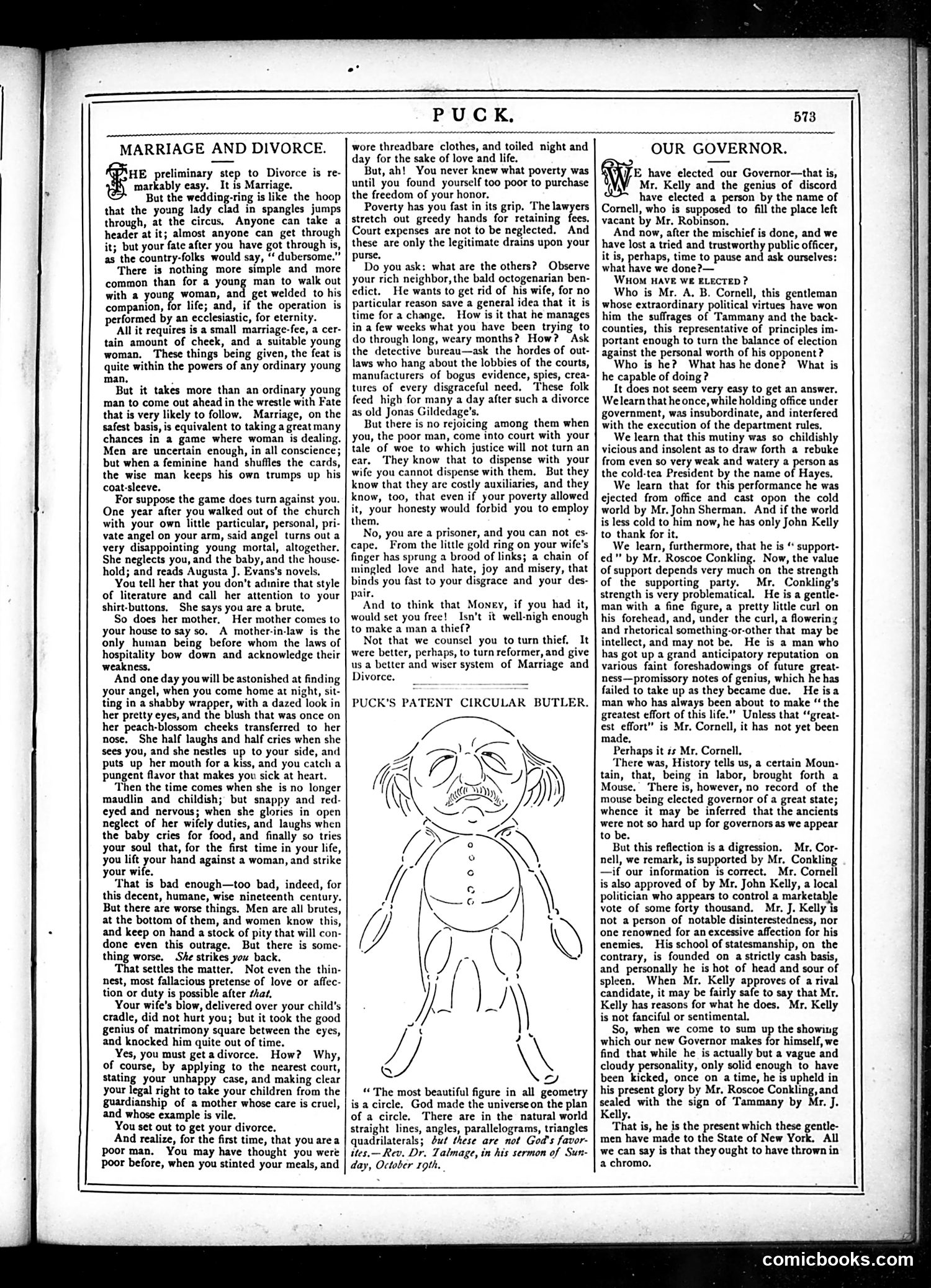
The right column satirizes the election of a new New York governor, likely Alonzo B. Cornell. The text attacks Cornell's character, claiming he's supported by political operative John Kelly and politician John Sherman. The satire mocks Cornell's reputation for: - Making "the greatest effort of his life" appear effortless - Building an "anticipatory reputation on various fanciful foreclosures of future greatness" - Operating on a "strictly cash basis" focused on patronage rather than principle The accompanying crude caricature—labeled "Puck's Patent Circular Butler"—visually reinforces the mockery. The satirist questions whether such a man, built on political calculation rather merit, deserves the governorship. The piece exemplifies Puck's role exposing political corruption and machine politics in Gilded Age New York.
📄 Transcribed text from this page (OCR, searchable)
Machine-transcribed from the original scan — historical spelling and the odd misread are preserved.
PUCK, 573 MARRIAGE AND DIVORCE. HE preliminary step to Divorce is re- markably easy. It is Marriage. But the wedding-ring is like the hoop that the young lady clad in spangles jumps through, at the circus, Anyone can take a header at it; almost anyone can get through it; but your fate after you have got through is, as the country-folks would say, ‘‘ dubersome.” There is nothing more simple and more common than for a young man to walk out with a young woman, and get welded to his companion, for life; and, if the operation is performed by an ecclesiastic, for eternity. All it requires is a small marriage-fee, a cer- tain amount of cheek, and a suitable young woman. These things being given, the feat is quite within the powers of any ordinary young man, . But it takes more than an ordinary young man to come out ahead in the wrestle with Fate that is very likely to follow. Marriage, on the safest basis, is equivalent to taking agreatmany chances in a game where woman is dealing. Men are uncertain enough, in all conscience; but when a feminine hand shuffles the cards, the wise man keeps his own trumps up his coat-sleeve. For suppose the game does turn against you. One year after you walked out of the church with your own little particular, personal, pri- vate angel on your arm, said angel turns out a very disappointing young mortal, altogether. She neglects you, and the baby, and the house- hold; and reads Augusta J. Evans's novels, You tell her that you don't adinire that style of literature and call her attention to your shirt-buttons. She says you are a brute. So does her mother, Her mother comes to your house to say so. A mother-in-law is the only human being before whom the laws of hospitality bow down and acknowledge their weakness, ‘And one day you will be astonished at finding your angel, when you come home at night, sit- ting in a shabby wrapper, with a dazed look in her pretty eyes, and the blush that was once on her peach-blossom cheeks transferred to her nose, She half laughs and half cries when she sees you, and she nestles up to your side, and puts up her mouth for a kiss, and you catch a pungent flavor that makes you sick at heart. Then the time comes when she is no longer maudlin and childish; but snappy and red- eyed and nervous; when she glories in open neglect of her wifely duties, and laughs when the baby cries for food, and finally so tries your soul that, for the first time in your life, you lift your hand against a woman, and strike your wife. That is bad enough—too bad, indeed, for this decent, humane, wise nineteenth century. But there are worse things. Men are all brutes, at the bottom of them, and women know this, and keep on hand a stock of pity that will con- done even this outrage. But there is some- thing worse. She strikes you back. That settles the matter. Not even the thin- nest, most fallacious pretense of love or affec- tion or duty is possible after that, Your wife's blow, delivered over your child's cradle, did not hurt you; but it took the good genius of matrimony square between the eyes, and knocked him quite out of time. Yes, you must get adivorce. How? Why, of course, by applying to the nearest court, Stating your unhappy case, and making clear your legal right to take your children from the guardianship of a mother whose care is cruel, and whose example is vile. You set out to get your divorce. And realize, for the first time, that you area Poor man. You may have thought you were Poor before, when you stinted your meals, and wore threadbare clothes, and toiled night and day for the sake of love and life. But, ah! You never knew what poverty was until you found yourself too poor to purchase the freedom of your honor. Poverty has you fast in its grip. ‘The lawyers stretch out greedy hands for retaining fees. Court expenses are not to be neglected. And these are only the legitimate drains upon your purse, Do you ask: what are the others? Observe your rich neighbor, the bald octogenarian ben- edict. He wants to get rid of his wife, for no particular reason save a general idea that it is time for a change. How is it that he manages in a few weeks what you have been trying to do through long, weary months? How? Ask the detective bureau—ask the hordes of out- laws who hang about the lobbies of the courts, manufacturers of bogus evidence, spies, crea- tures of every disgraceful need, These folk feed high for many a day after such a divorce as old Jonas Gildedage’s. But there is no rejoicing among them when you, the poor man, come into court with your tale of woe to which justice will not turn an ear. They know that to dispense with your wife you cannot dispense with them, But they know that they are costly auxiliaries, and they know, too, that even if your poverty allowed it, your honesty would forbid you to employ them. . No, you are a prisoner, and you can not ¢s- cape. From the little gold ring on your wife's finger has sprung a brood of links; a chain of mingled love and hate, joy and misery, that binds you fast to your disgrace and your des- pair. ' And to think that Money, if you had it, would set you free! Isn't it well-nigh enough to make a man a thief? Not that we counsel you to turn thief. It were better, perhaps, to turn reformer, and give us a better and wiser system of Marriage and Divorce. PUCK'S PATENT CIRCULAR BUTLER. HAF. fy~ ) (ZS . \ 6 “The most beautiful figure in all geometry is a circle. God made the universe on the plan of a circle, There are in the natural world straight lines, angles, parallelograms, triangles quadrilaterals; dut these are not God's favor- ttes.— Rev. Dr. Talmage, in his sermon of Sun- day, October 19th. OUR GOVERNOR. E have elected our Governor—that is, ( Mr. Kelly and the genius of discord have elected a person by the name of Cornell, who is supposed to fill the place left vacant by Mr. Robinson. And now, after the mischief is done, and we have lost a tried and trustworthy public officer, it is, perhaps, time to pause and ask ourelves: what have we done?— WHOM HAVE WE ELECTED? Who is Mr. A. B. Cornell, this gentleman whose extraordinary political virtues have won him the suffrages of Tammany and the back- counties, this representative of principles im- portant enough to turn the balance of election against the personal worth of his opponent? Who is he? What has he done? What is he capable of doing? It does not seem very easy to get an answer. Welearn that he once, while holding office under government, was insubordinate, and interfered with the execution of the department rules, We learn that this mutiny was so childishly vicious and insolent as to draw forth a rebuke from even so very weak and watery a person as the cold-tea President by the name of Hayes, We learn that for this performance he was ejected from office and cast opon the cold world by Mr. John Sherman. And if the world is less cold to him now, he has only John Kelly to thank for it. We learn, furthermore, that he is ‘ support- ed” by Mr. Roscoe Conkling. Now, the value of support depends very much on the strength of the supporting party. Mr. Conkling’s strength is very problematical. He is a gentle- man with a fine figure, a pretty little curl on his forehead, and, under the curl, a flowering and rhetorical something-or-other that may be intellect, and may not be. He is a man who has got up a grand anticipatory reputation on various faint foreshadowings of future great- ness—promissory notes of genius, which he has failed to take up as they became due. He isa man who has always been about to make “the greatest effort of this life.” Unless that ‘“great- est effort” is Mr. Cornell, it has not yet been made, Perhaps it ss Mr, Cornell. There was, History tells us, a certain Moun- tain, that, being in labor, brought forth a Mouse. There is, however, no record of the mouse being elected governor of a great state; whence it may be inferred that the ancients were not so hard up for governors as we appear to be. But this reflection is a digression. Mr. Cor- nell, we remark, is supported by Mr. Conkling —if our information is correct. Mr. Cornell is also approved of by Mr. John Kelly, a local politician who appears to control a marketable vote of some forty thousand. Mr. J. Kelly is not a person of notable disinterestedness, nor one renowned for an excessive affection for his enemies. His school of statesmanship, on the contrary, is founded on a strictly cash basis, and personally he is hot of head and sour of spleen, When Mr. Kelly approves of a rival candidate, it may be fairly safe to say that Mr. Kelly has reasons for what he does. Mr. Kelly is not fanciful or sentimental. So, when we come to sum up the showing which our new Governor makes for himself, we find that while he is actually but a vague and cloudy personality, only solid enough to have been kicked, once on a time, he is upheld in his present glory by Mr. Roscoe Conkling, and sealed with the sign of Tammany by Mr. J. Kelly. That is, he is the present which these gentle- men have made to the State of New York. All we can say is that they ought to have thrown in a chromo. comicbooks.com