
Puck, 1879-11-12 · page 6 of 18
Puck — November 12, 1879 — page 6: what you’re looking at
What you’re looking at
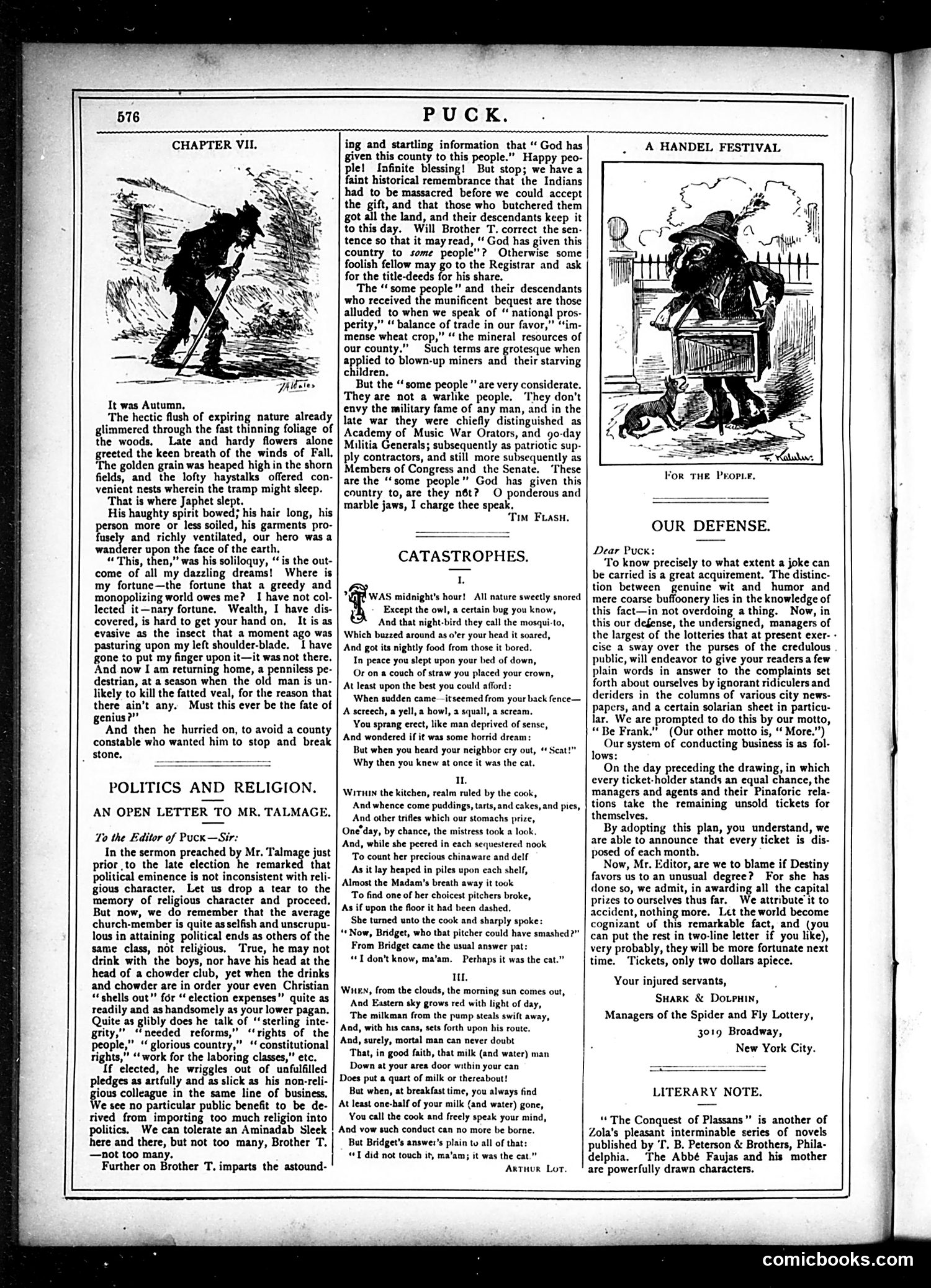
This page contains three separate satirical sections: **"A Handel Festival"** (right illustration): Shows a rotund figure conducting, likely satirizing some contemporary musical event or conductor, though specific identification is unclear from the image alone. **"Catastrophes"** (center): A humorous poem about domestic mishaps—midnight noise, a bug, sleeping on hay, broken items, and a cat causing mischief. This appears to be light verse rather than political satire. **"Politics and Religion"** (left): An open letter criticizing an unnamed Mr. Talmage for mixing religious preaching with political advocacy. The writer argues against clergymen endorsing political candidates or parties, defending separation of church and state while tolerating diverse political views among the populace. The page emphasizes Puck's satirical approach to American social and political issues of its era.
📄 Transcribed text from this page (OCR, searchable)
Machine-transcribed from the original scan — historical spelling and the odd misread are preserved.
PUCK. It was Autumn, The hectic flush of expiring nature already glimmered through the fast thinning foliage of the woods. Late and hardy flowers alone greeted the keen breath of the winds of Fall, ‘The golden grain was heaped high in the shorn fields, and the lofty haystalks offered con- venient nests wherein the tramp might sleep. That is where Japhet slept. His haughty spirit bowed; his hair long, his person more or less soiled, his garments pro- fusely and richly ventilated, our hero wasa wanderer upon the face of the earth, “ This, then,” was his soliloquy, ‘is the out- come of all my dazzling dreams! Where is my fortune—the fortune that a greedy and monopolizing world owes me? I have not col- lected it—nary fortune. Wealth, I have dis- covered, is hard to get your hand on, It is as evasive as the insect that a moment ago was pasturing upon my left shoulder-blade. 1 have gone to put my finger upon it—it was not there. And now I am returning home, a penniless pe- destrian, at a season when the old man is un- likely to kill the fatted veal, for the reason that there ain’t any. Must this ever be the fate of genius?” And then he hurried on, to avoid a county constable who wanted him to stop and break stone. POLITICS AND RELIGION. AN OPEN LETTER TO MR. TALMAGE. To the Editor of Pucx—Sir: In the sermon preached by Mr. Talmage just prior to the late election he remarked that political eminence is not inconsistent with reli- gious character, Let us drop a tear to the memory of religious character and proceed. But now, we do remember that the average church-member is quite as selfish and unscrupu- lous in attaining political ends as others of the same class, not religious, True, he may not drink with the boys, nor have his head at the head of a chowder club, yet when the drinks and chowder are in order your even Christian “shells out” for “ election expenses” quite as readily and as handsomely as your lower pagan. Quite as glibly does he talk of “sterling inte- grity,” “needed reforms,” ‘rights of the people,” ‘glorious country,” ‘constitutional rights,” “‘ work for the laboring classes," etc. If elected, he wriggles out of unfulfilled pledges as artfully and as slick as his non-reli- gious colleague in the same line of business, We see no particular public benefit to be de- rived from importing too much religion into politics, We can tolerate an Aminadab Sleek here and there, but not too many, Brother T. —not too many. Further on Brother T, imparts the astound- ing and startling information that “ God has given this county to this people.” Happy peo- ple! {finite blessing! But stop; we have a faint historical remembrance that the Indians had to be massacred before we could accept the gift, and that those who butchered them got all the land, and their descendants keep it to this day. Will Brother T. correct the sen- tence so that it may read, “ God has given this country to some people’? Otherwise some foolish fellow may go to the Registrar and ask for the title-deeds fr his share, The ‘some people" and their descendants who received the munificent bequest are those alluded to when we speak of ‘ nationgl pros- perity,” ‘ balance of trade in our favor,” “im- mense wheat crop,” ‘ the mineral resources of our county.” Such terms are grotesque when applied to blown-up miners and their starving children, But the ‘some people" are very considerate. They are not a warlike people. ‘They don't envy the military fame of any man, and in the late war they were chiefly distinguished as Academy of Music War Orators, and go-day Militia Generals; subsequently as patriotic sup- ply contractors, and still more subsequently as Members of Congress and the Senate. ‘These are the “some people” God has given this country to, are they n6t? O ponderous and marble jaws, I charge thee speak. Tim Frasu. CATASTROPHES. GRA WAS midnight’s hour! All nature sweetly snored Except the owl, a certain bug you know, And that night-bird they call the mosqui-to, Which buzzed around as o'er your head it soared, And got its nightly food from those it bored. In peace you slept upon your bed of down, Or on @ couch of straw you placed your crown, At least upon the best you could afford: When sudden came-—itseemed from your back fence— A screech, a yell, a howl, a squall, a scream, You sprang erect, like man deprived of sense, ‘And wondered if it was some horrid dream: But when you heard your neighbor cry out, Why then you knew at once it was the cat. IL Wiriun the kitchen, realm ruled by the cook, And whence come puddings, tarts, and cakes, and pies, And other trifles which our stomachs prize, One*day, by chance, the mistress took a look. And, while she peered in each sequestered nook To count her precious chinaware and delf As it lay heaped in piles upon each shelf, Almost the Madam’s breath away it took To find one of her choicest pitchers broke, As if upon the floor it had been dashed. She turned unto the cook and sharply spoke: “Now, Bridget, who that pitcher could have smashed?” From Bridget came the usual answer pat: “I don't know, ma'am. Perhaps it was the cat.” ML. Wut, from the clouds, the morning sun comes out, And Eastern sky grows red with light of day, The milkman from the pump steals swift away, And, with his cans, sets forth upon his route. And, surely, mortal man can never doubt That, in good faith, that milk (and water) man Down at your area door within your can Does put a quart of milk or thereabout! But when, at breakfast time, you always find At least one-half of your milk (and water) gone, You call the cook and freely speak your mind, And vow such conduct can no more be borne. But Bridget’s answer's plain to all of that: “I did not touch it, ma’am; it was the cat.” Arruur Lot. A HANDEL FESTIVAL ‘OR THE PEOPLE, OUR DEFENSE. Dear Puck: To know precisely to what extent a joke can be carried is a great acquirement. The distinc- tion between genuine wit and humor and mere coarse buffoonery lies in the knowledge of this fact—in not overdoing a thing. Now, in this our defense, the undersigned, managers of the largest of the lotteries that at present exer- - cise a sway over the purses of the credulous public, will endeavor to give your readers a few plain words in answer to the complaints set forth about ourselves by ignorant ridiculers and deriders in the columns of various city news- papers, and a certain solarian sheet in particu- lar. We are prompted to do this by our motto, “Be Frank.” (Our other motto is, ‘ More.””) Our system of conducting business is as fol- lows: On the day preceding the drawing, in which every ticket-holder stands an equal chance, the managers and agents and their Pinaforic rela- tions take the remaining unsold tickets for themselves. By adopting this plan, you understand, we are able to announce that every ticket is dis- posed of each month. Now, Mr. Editor, are we to blame if Destiny favors us to an unusual degree? For she has done so, we admit, in awarding all the capital prizes to ourselves thus far. We attribute’ it to accident, nothing more. Let the world become cognizant of this remarkable fact, and (you can put the rest in two-line letter if you like), very probably, they will be more fortunate next time. Tickets, only two dollars apiece. Your injured servants, Suark & Dotpuin, Managers of the Spider and Fly Lottery, 3019 Broadway, New York City. LITERARY NOTE, “The Conquest of Plassans” is another of Zola’s pleasant interminable series of novels published by ‘I. B. Peterson & Brothers, Phila- delphia. The Abbé Faujas and his mother are powerfully drawn characters. comicbooks.com