
A complete issue · 18 pages · 1879
Puck — November 5, 1879
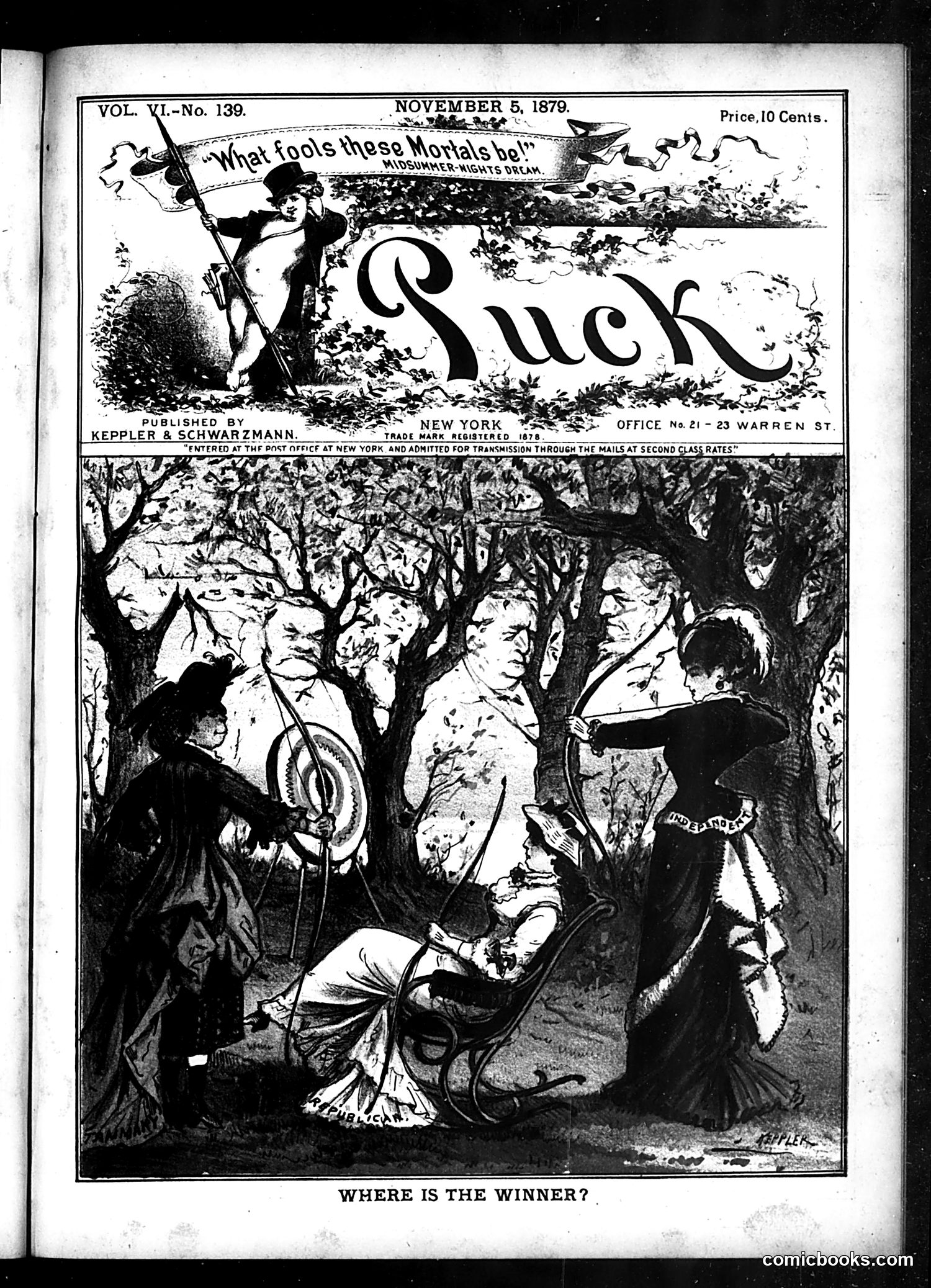
**"WHERE IS THE WINNER?"** This cartoon satirizes a disputed election outcome, likely the contested 1879 elections. The main image shows several grotesque male figures in a forest setting gathered around what appears to be a spinning wheel or voting mechanism, with one figure operating it. The title questions who legitimately won. The top banner reads "What fools these Mortals be!" (a Shakespeare reference), with a small devil-like figure holding an anarchist flag—suggesting the cartoon views radical politics as foolish trickery. The satire appears to mock election fraud, manipulation, or the chaotic uncertainty of determining an actual winner through potentially rigged voting processes. The grotesque caricatures emphasize the cartoon's contempt for the political figures involved in the disputed contest.
This page is primarily **text-based editorial and advertising content** rather than illustrated cartoons. The main articles discuss **Policeman Williams**, who appears to have been involved in a significant incident—the text references complaints against him, his dismissal by police commissioners, and debate over whether he should be reinstated. The editorial advocates for his reinstatement, arguing he was treated unjustly. A secondary piece titled "Justice" discusses **two Bulgarians (Pinaforés)** visiting the country, sarcastically noting Americans will judge them fairly. The page includes **subscription information and business notices** for Puck at the top. Without identifying specific illustrated figures, the satirical tone targets police department corruption and administrative injustice regarding Officer Williams's case—a contemporary New York scandal.
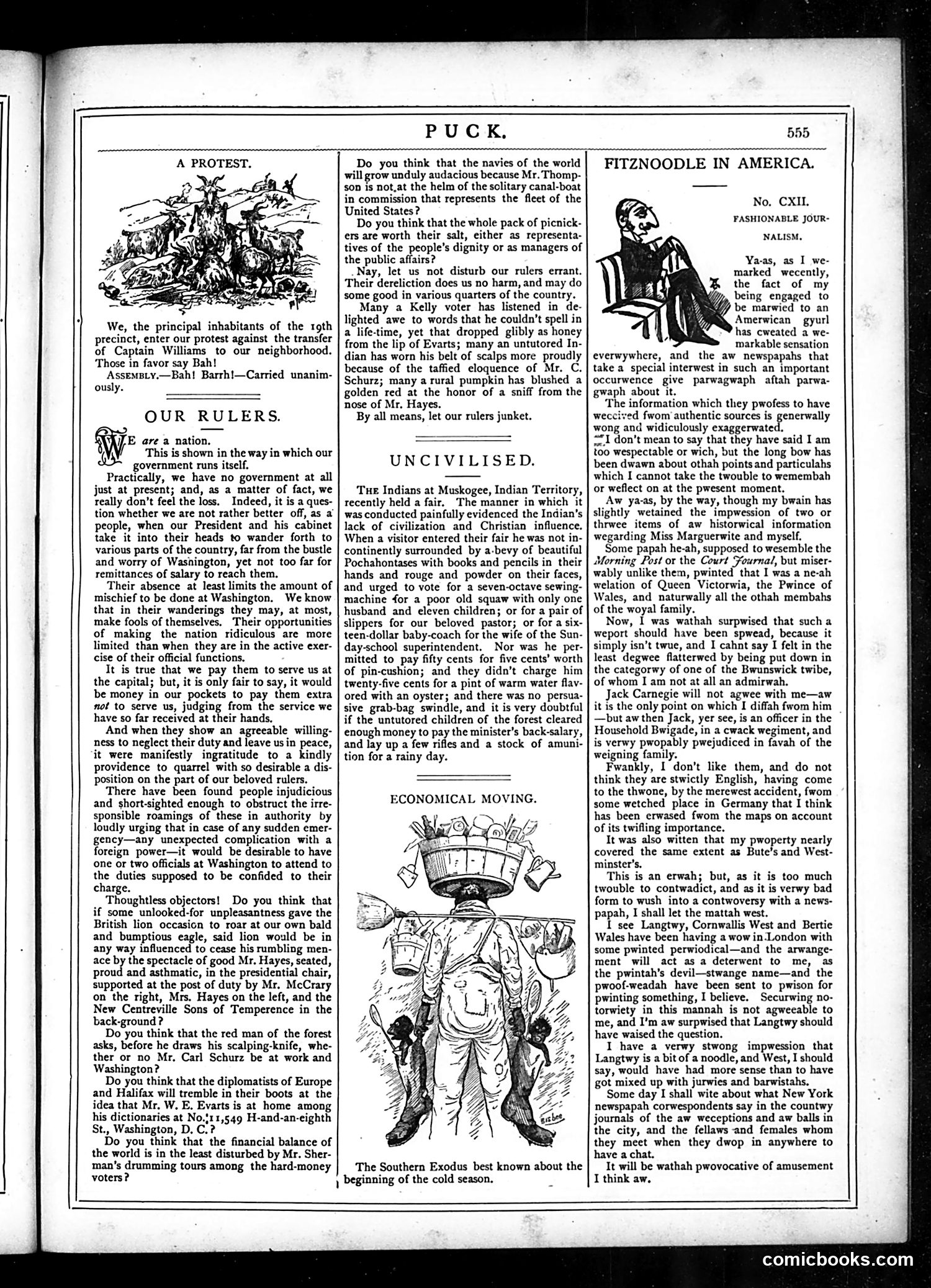
This page contains three satirical sections: **"A Protest"** (top left): Residents of Washington D.C.'s 19th precinct protest Captain Williams's neighborhood transfer, fearing his departure will harm the area. **"Our Rulers"** (left column): A critique of American government ineffectiveness. The piece argues that while the nation has a president and cabinet, actual governance is limited and often misguided. It sarcastically suggests that Washington politicians frequently make poor decisions and that their opportunities for productive action are restricted compared to other nations' critical functions. **"Fitznoodle in America"** (right): A fashionable tourist's satirical account of observing American life and manners, criticizing various aspects of American society and culture through a foreigner's supposedly superior perspective—a common Puck device for domestic social criticism. The cartoon illustrations support these written commentaries.
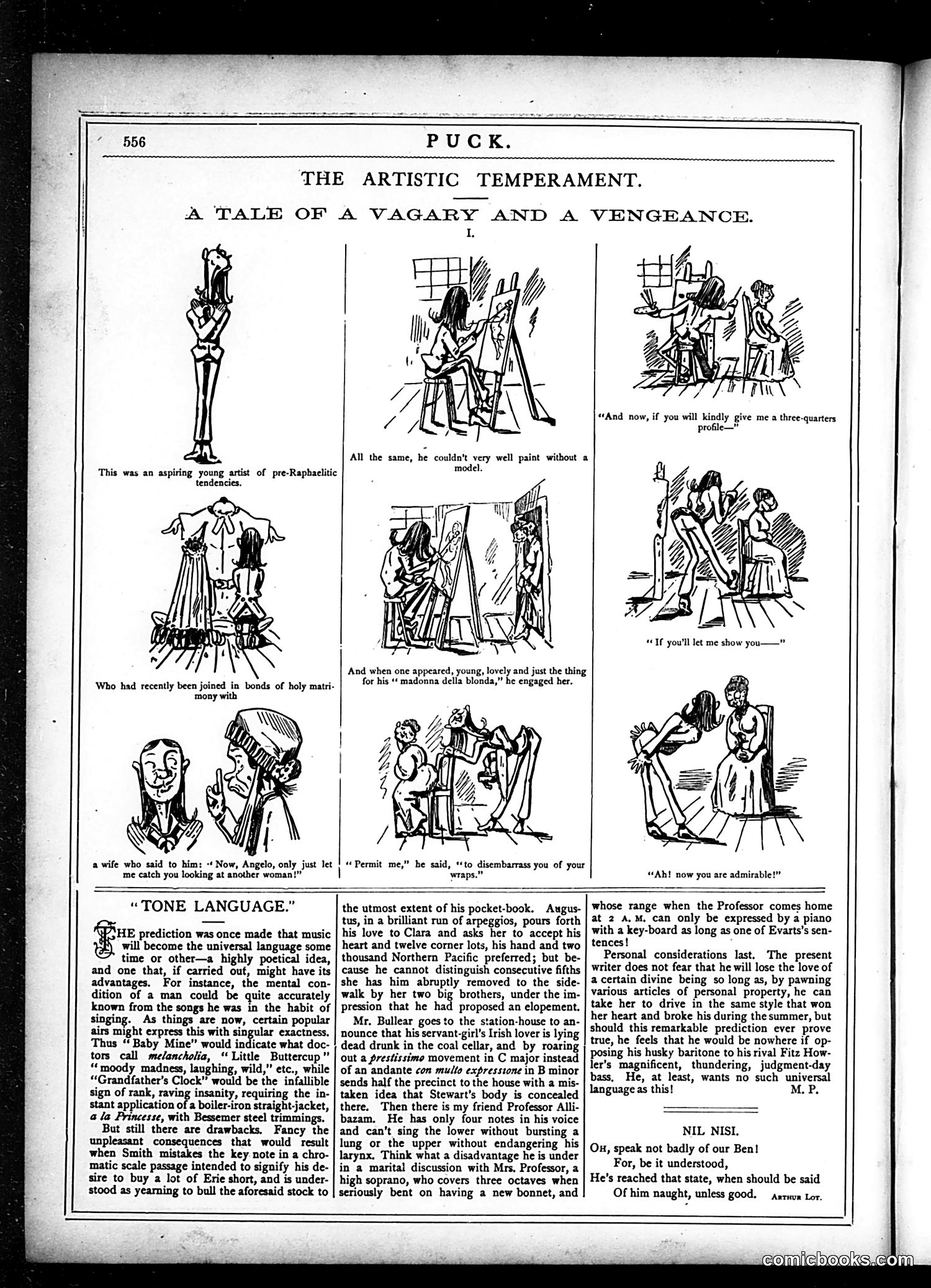
This satirical story mocks an aspiring pre-Raphaelite artist of "tendencies" (suggesting affected pretension). The narrative follows his romantic entanglements: he cannot paint without an attractive female model, becomes infatuated with a "young, lovely" model, and proposes elopement. When rejected, he drowns himself in a coal cellar. His widow then seeks revenge by posing as a model and striking him with her parasol during a painting session, concluding "Ah! now you are admirable!" The satire targets bohemian artistic affectation and volatile male temperament in the art world, while depicting female agency through the wife's practical vengeance. The pre-Raphaelite movement was known for elaborate romanticism and melodrama.
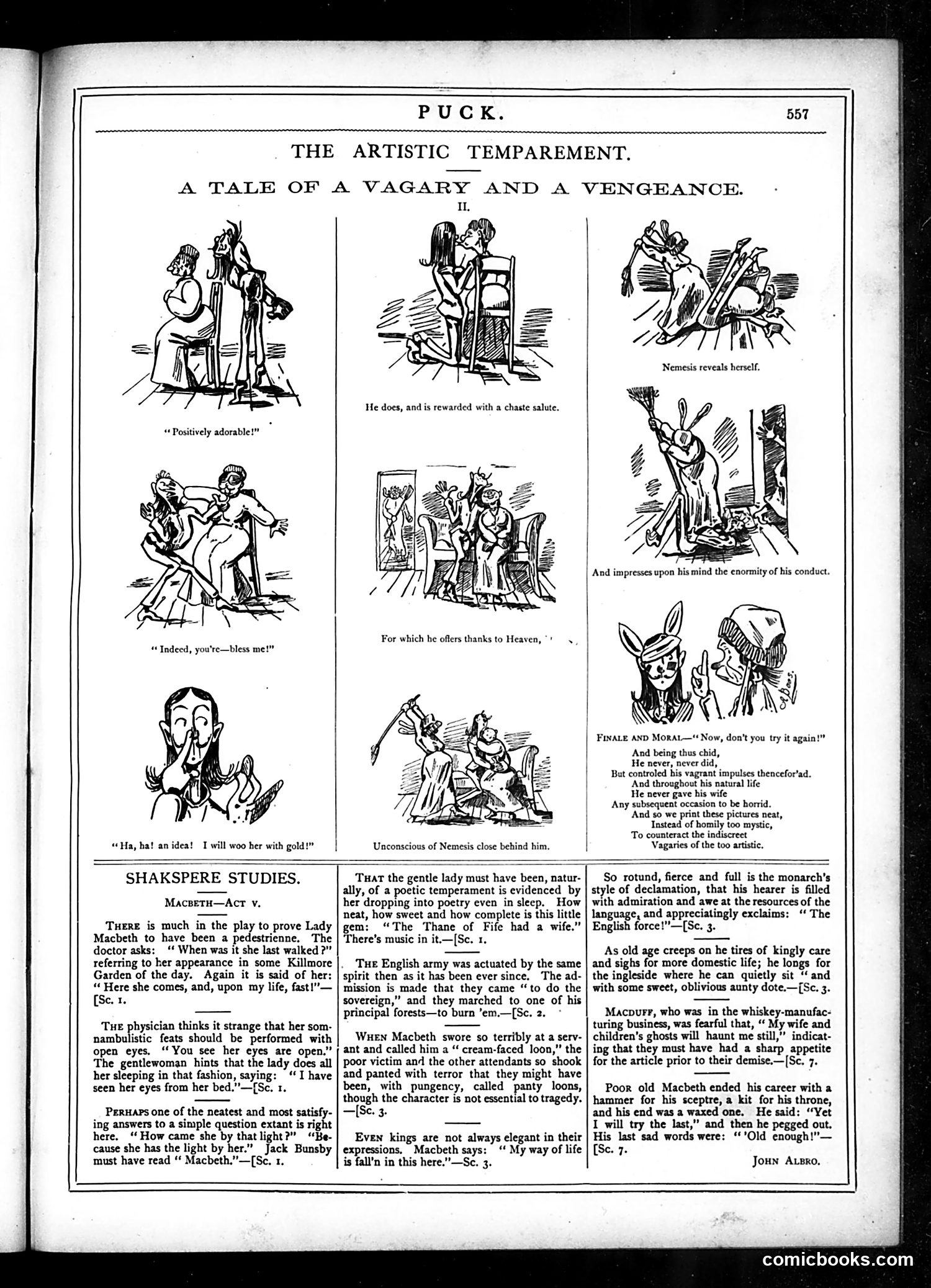
This page contains two distinct sections: **Upper Section: "The Artistic Temperament"** - A satirical comic strip about a vagabond artist and revenge. The narrative follows a poorly-dressed artist who receives praise ("Positively adorable!"), then romantic advances, and ultimately revenge from a goddess figure (Nemesis) who "reveals herself" and impresses upon him "the enormity of his conduct." The moral finale warns against artistic vagrancy and domestic irresponsibility. **Lower Section: "Shakspere Studies"** - Literary commentary analyzing Lady Macbeth from Shakespeare's *Macbeth* (Act V), discussing her poetic temperament and the historical context of English military campaigns referenced in the play. The upper cartoon satirizes bohemian artist culture and sexual impropriety through divine punishment, while the lower section provides serious dramatic criticism—typical of Puck's mixed content of humor and cultural commentary.
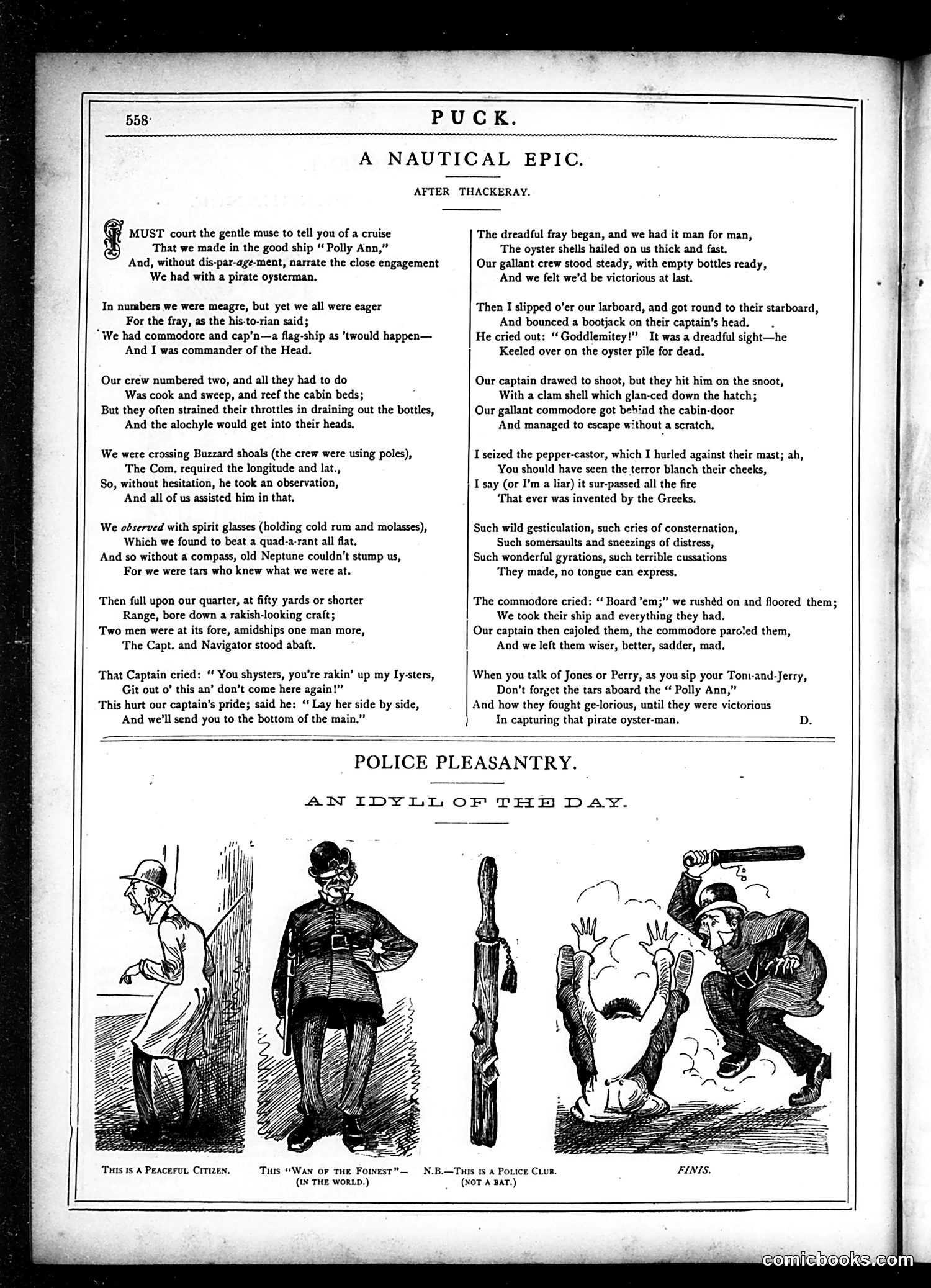
This is a satirical comic strip mocking police conduct. The four panels depict increasingly absurd scenarios labeled: 1. "A Peaceful Citizen" — a man cowering against a wall 2. "A Man of the Finest" (in the world) — a pompous police officer 3. "This is a Police Club" (not a bat) — shows a club 4. "Finis" — the citizen being beaten by police with clubs and a telescope The satire targets police brutality and abuse of authority. The ironic title "Police Pleasantry" and the mock-innocent labeling of the police club (emphasizing it's "not a bat") mock police violence as entertainment or sport. The progression shows a defenseless citizen brutalized by officers, critiquing either actual police practices or proposed measures that Puck's editors found troubling.
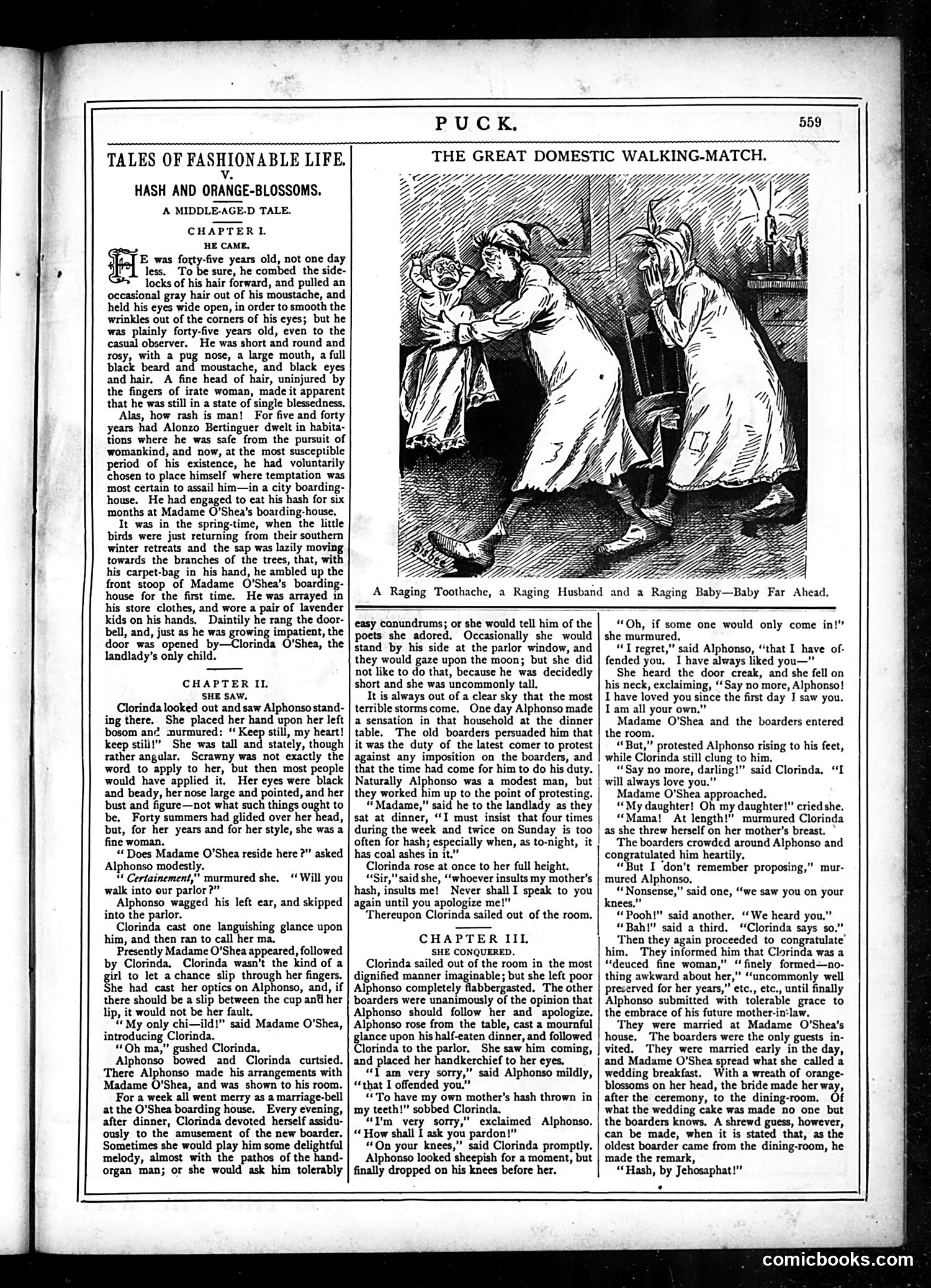
This page contains a serialized short story titled "Hash and Orange-Blossoms: A Middle-Aged Tale," not a political cartoon. The illustration titled "The Great Domestic Walking-Match" depicts a domestic conflict: a man (Alphonso) appears to be fleeing while a woman (Clorinda) chases him, with a baby involved—the caption reads "A Raging Toothache, a Raging Husband and a Raging Baby—Baby Far Ahead." The satire targets middle-class domestic life. The "walking-match" joke plays on the Victorian-era competitive walking races that were popular public spectacles. Here, the humor transposes that sporting concept onto marital discord, suggesting that domestic quarrels—triggered by toothaches and babies—drive couples to physical confrontation. This mocks the pretensions of "fashionable life" by revealing the messy, undignified reality beneath respectable appearances.
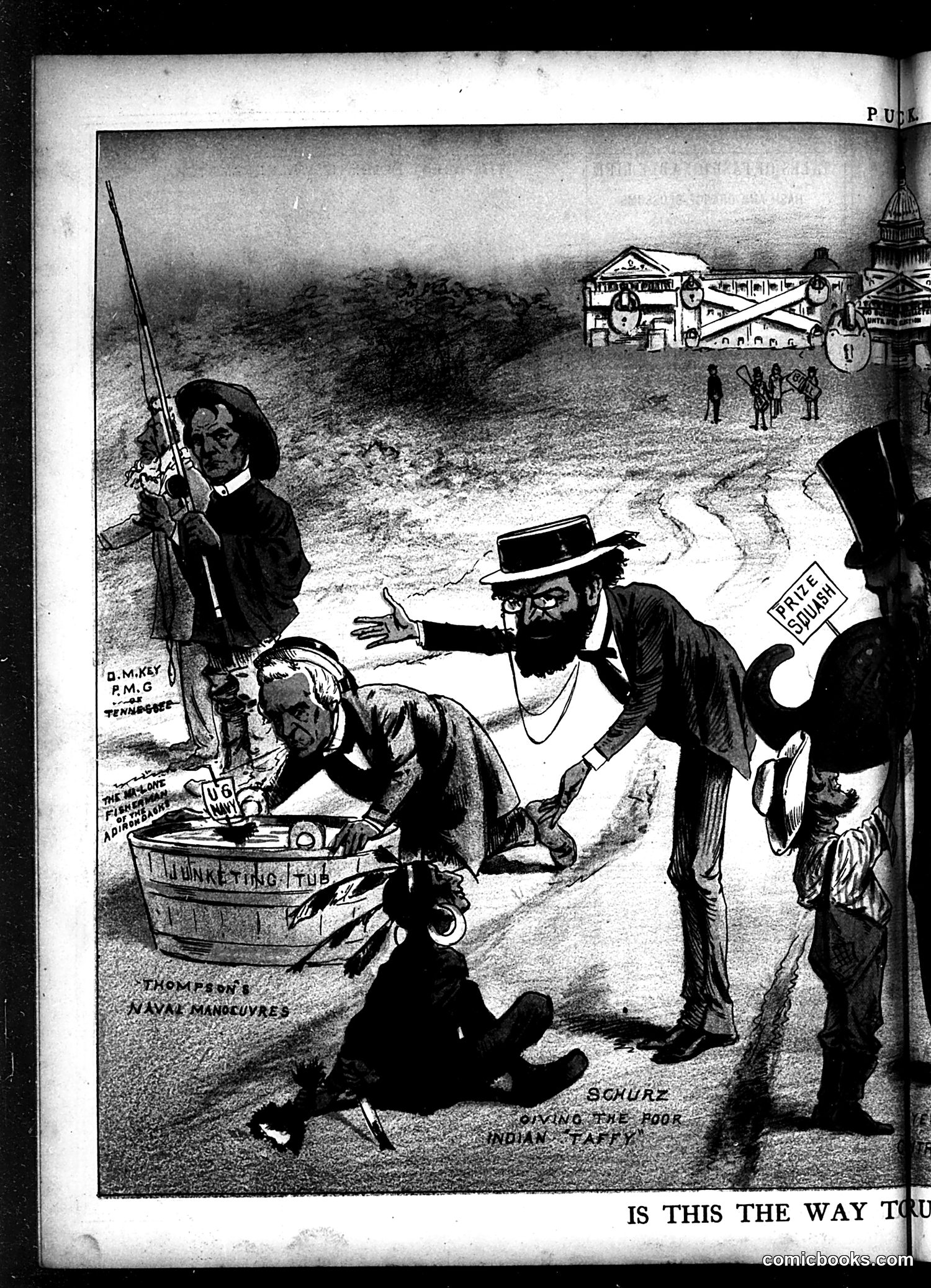
This Puck cartoon satirizes American imperialism and foreign policy in what appears to be an early 20th-century context. The central figure labeled "Schurz" (likely Carl Schurz, a prominent anti-imperialist) gestures toward a barrel labeled "Monkey Tub" containing grotesque caricatures. The figure with the rifle represents American military intervention, while the well-dressed gentleman appears to represent American business or political interests. The scene depicts imperial powers engaged in colonial exploitation—the "monkey tub" label suggests dehumanizing treatment of colonized peoples. The Capitol building visible in the background indicates American responsibility. The cartoon's title, partially visible ("IS THIS THE WAY TO..."), critiques whether such interventionist policies represent American values, positioning anti-imperialists like Schurz as moral objectors to these practices.
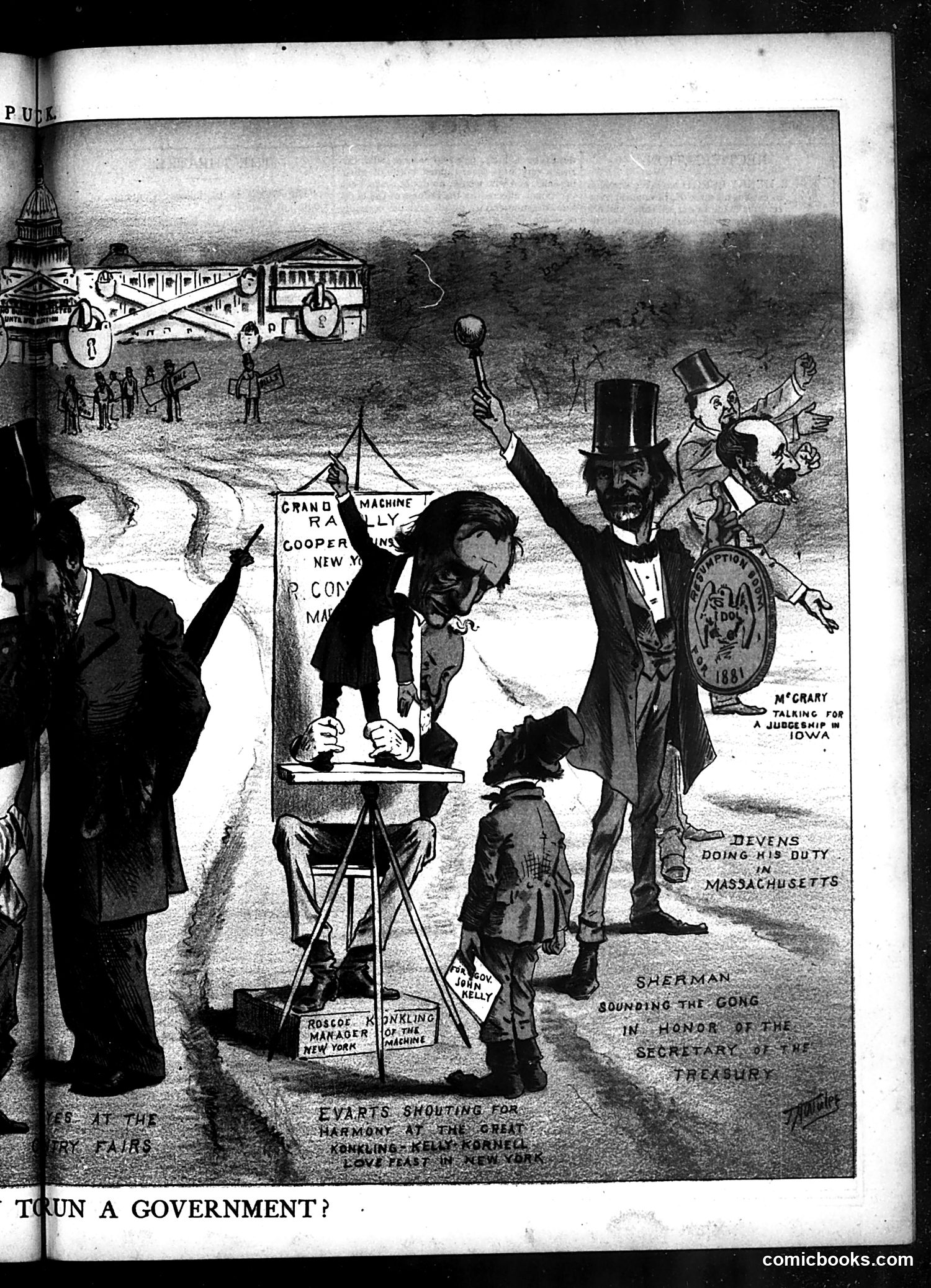
This Puck cartoon satirizes American political corruption through a carnival/fair setting. The central figure appears to be a political operative or carnival barker displaying a grotesque caricature labeled as representing government mismanagement. The visible text references include "Grand Machine" (likely a political machine), locations like "New York" and "Iowa," and figures identified as "Devens" (Massachusetts), "Sherman" (Secretary of Treasury), and "McCrary" (Iowa). These appear to be government officials implicated in scandals. The cartoon's title asks "To Run a Government?" — suggesting the entire governmental apparatus is a dishonest carnival show. The exaggerated caricatures and carnival setting emphasize how politicians treat governance as a theatrical con game rather than serious administration. This reflects late 19th-century corruption scandals in American politics.
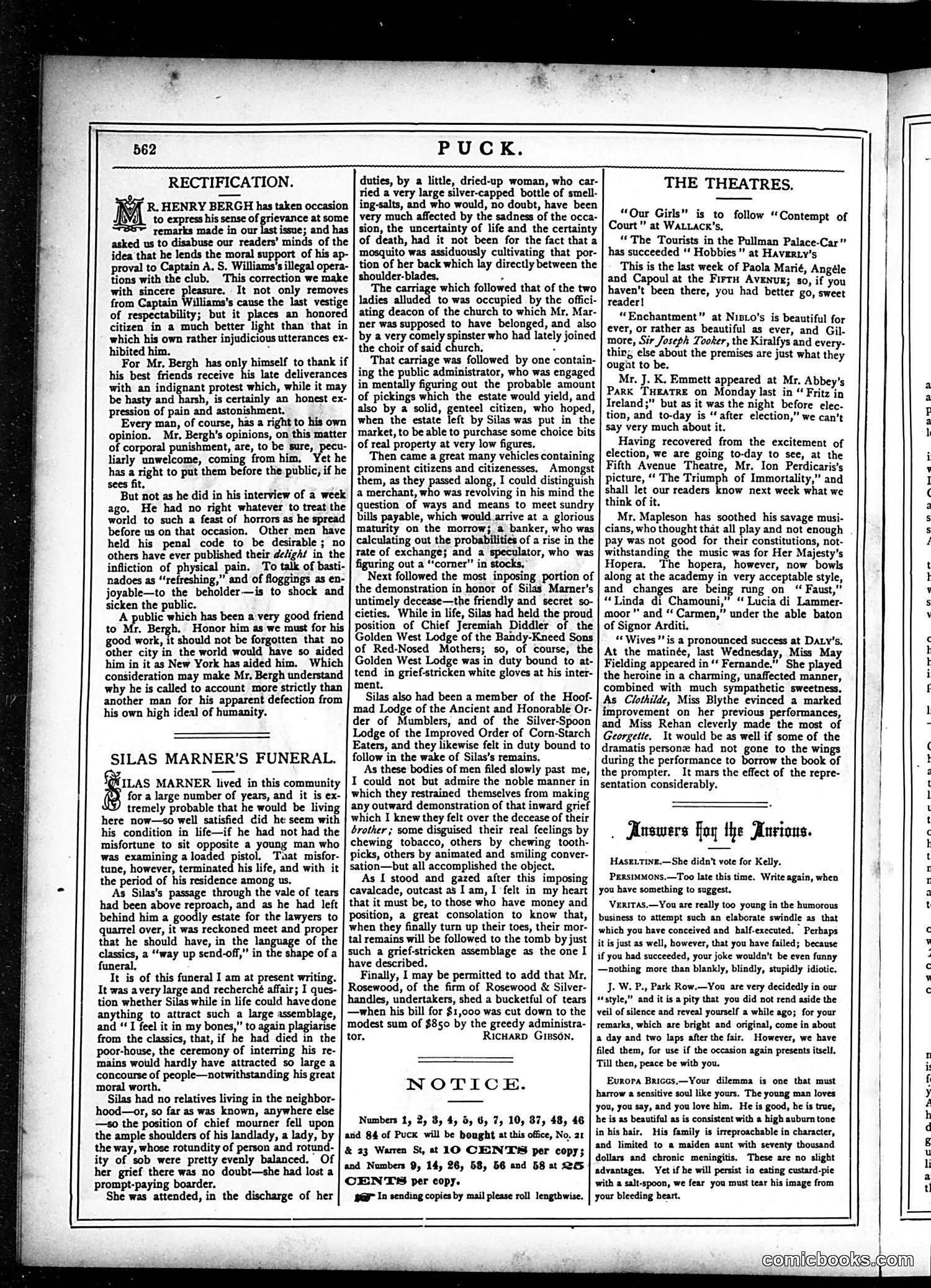
This page contains three distinct sections: a satirical essay titled "Rectification" by Mr. Henry Bergh; an obituary-style piece on "Silas Marner's Funeral"; and a "Notices" section with readers' responses. The "Rectification" piece appears to defend Bergh's character against recent criticisms, suggesting he faced public accusations of being harsh or moralistic. The Silas Marner section uses the fictional character's death as a satirical vehicle to comment on social hypocrisy—specifically how people perform grief publicly while privately harboring indifference. The page primarily contains **text-based satire rather than visual cartoons**. It reflects Puck's tradition of social commentary through editorial writing rather than illustrations. Without visible cartoon images, the satire relies entirely on ironic tone and literary critique of contemporary social behavior.
This page from *Puck* magazine contains **serialized fiction rather than political cartoons**. The piece is "Archie Gascoyne: A Romance of Skye," written expressly for *Puck* by John Fraser. The text consists of a romantic narrative set in Scotland, featuring characters like Archie, Alice, Robert Macdonald, and others. The story involves dialogue about courtship, travel, and social class—typical Victorian romance fiction themes. There are references to American versus English social conventions and manners. **There are no political cartoons or satirical illustrations visible on this page.** This appears to be a regular fiction installment, not the satirical/political content *Puck* was primarily known for. The page functions as serialized entertainment rather than social commentary.
This illustrated feature shows a cluster of small islands with anthropomorphized figures. Based on the text and imagery, it appears to satirize contemporary social types or character archetypes of the era. The accompanying prose commentary identifies various "islands" representing different professions and social classes—including references to circuses, detectives, and other occupational groups. The satire seems to mock affectations and pretensions of different segments of American society, using the archipelago metaphor to segregate distinct social "types" for mockery. However, without clearer legible captions identifying specific figures, I cannot definitively name which islands represent which groups. The piece exemplifies Puck's typical approach: using visual allegory and character-based humor to critique social pretension and professional absurdities of Gilded Age America.
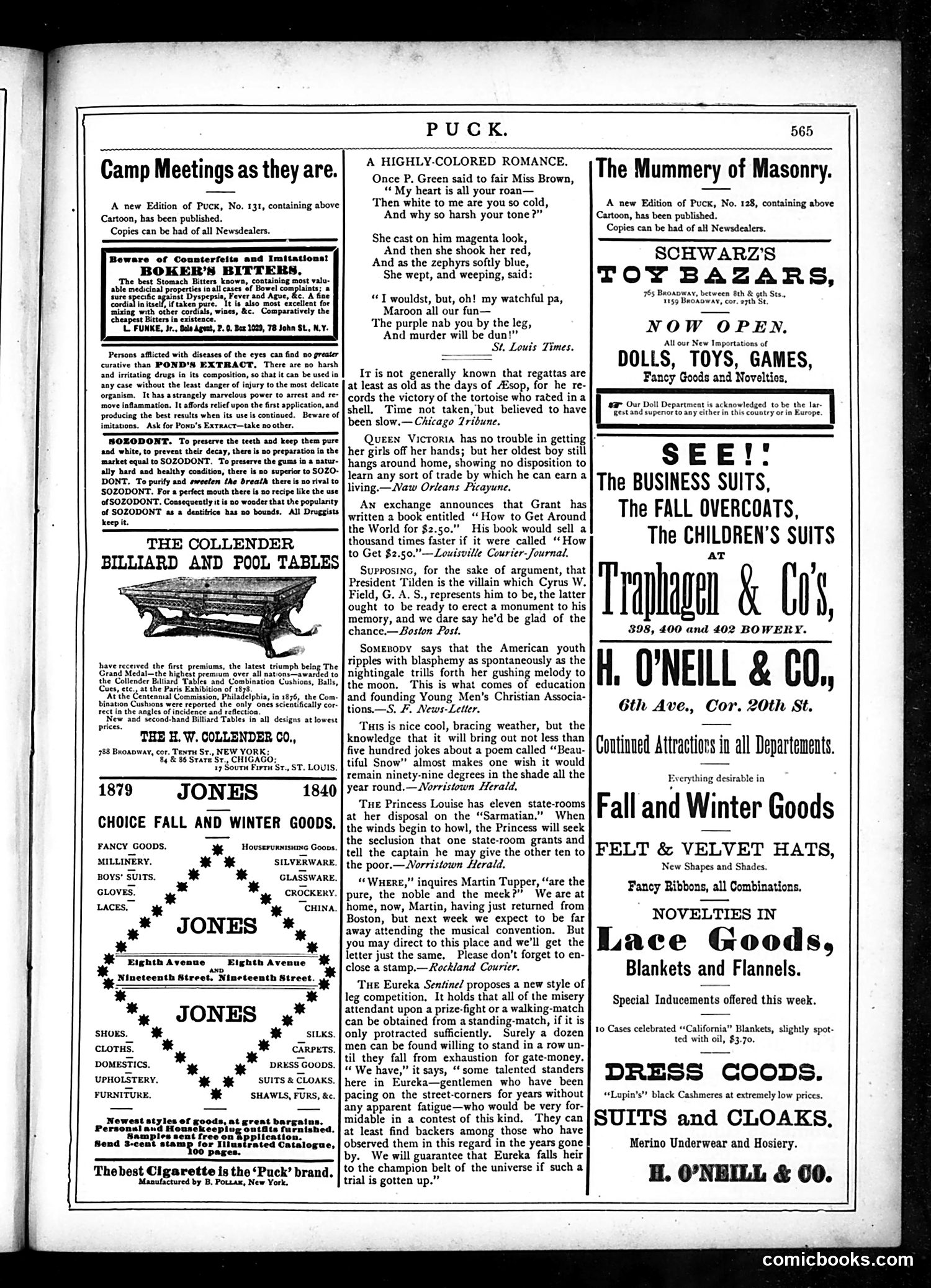
This page is primarily **advertising and miscellaneous content** rather than political cartoons. The visible elements include: - **"Camp Meetings as they are"** — a brief satirical piece mocking revival camp meetings as commercialized spectacles - **"A Highly-Colored Romance"** — humorous romantic dialogue poking fun at sentimental literature - **"The Mummery of Masonry"** — appears to satirize Freemasonry, though details are unclear from this excerpt - **Multiple advertisements** for retail stores (Trephagen & Co., H. O'Neill & Co., Jones), billiard tables, and various goods The magazine's satirical commentary targets **popular religious enthusiasm, sentimental literature, and fraternal organizations**, but no specific political figures or major events are identifiable on this page. It's a typical mixed-content issue combining light social satire with substantial commercial advertising.
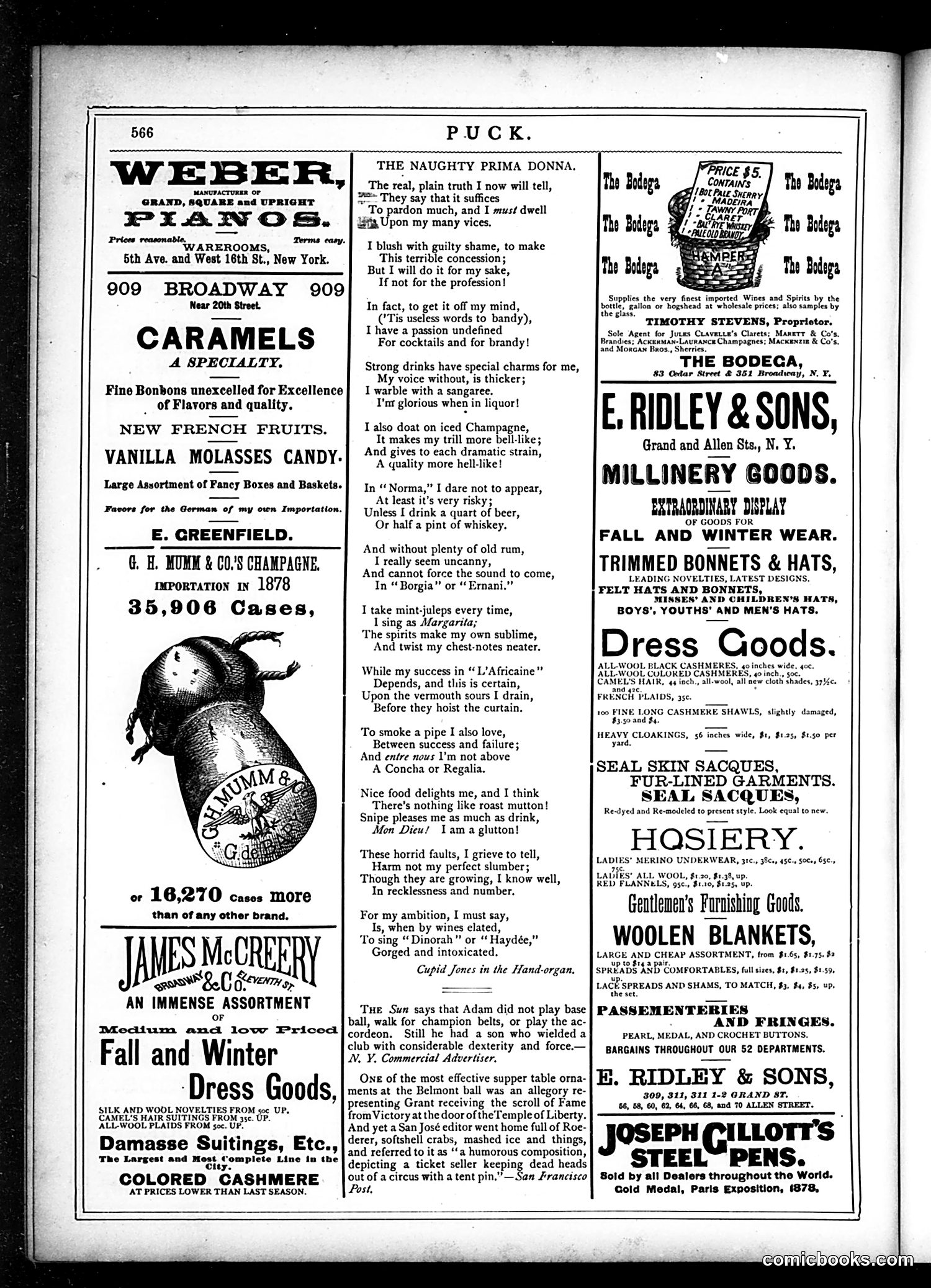
This page is primarily advertising, not a satirical cartoon. It features Victorian-era commercial advertisements for luxury goods—caramels, champagne, millinery, dress goods, blankets, and steel pens—placed by New York merchants like Weber, E. Ridley & Sons, and James McCreevy & Co. The only satirical content is "The Naughty Prima Donna," a poem in the upper center mocking an operatic diva's vices and pretensions. The verse humorously catalogs her excessive drinking (champagne, brandy, beer, whiskey, rum) and pipe-smoking while she claims artistic dedication. It's gentle social satire on theatrical excess and hypocrisy—a stock Puck theme—rather than political commentary. The illustration shows a pear-shaped bottle, likely champagne, reinforcing the drinking theme.
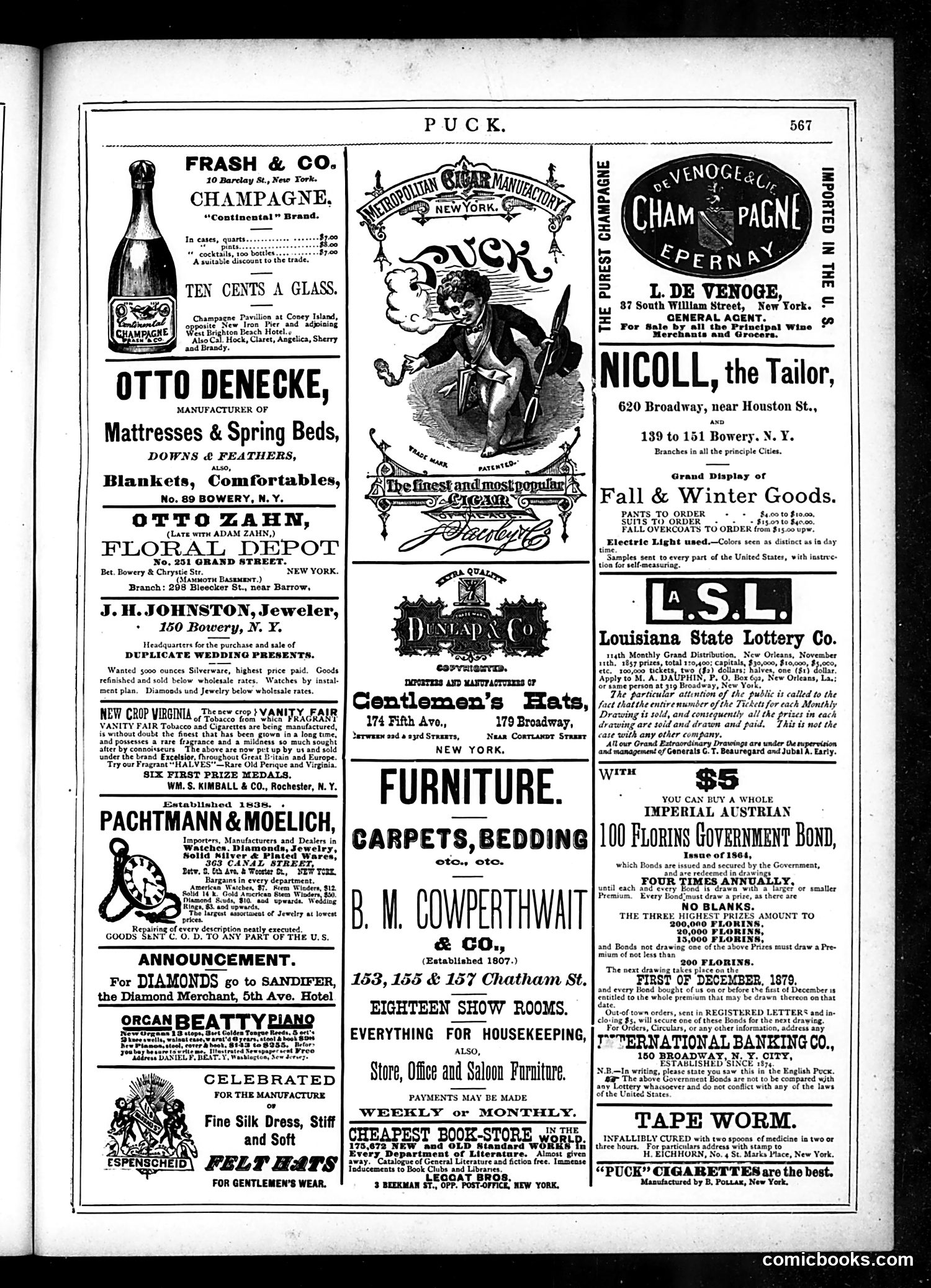
This page is predominantly **advertising** rather than editorial content or political cartoons. The main illustrated element is a Puck brand logo/masthead featuring a mischievous character (Puck, the traditional sprite figure) with the text "The finest and most popular" cigar brand. The page contains various product advertisements including champagne, mattresses, jewelry, furniture, lottery tickets, and pianos. There is no significant political cartoon or satirical content visible. The one notable feature is the **Gentlemen's Hats advertisement** by Dunlap & Co., positioned centrally, but this is straightforward commercial promotion rather than satire. This appears to be a typical late 19th-century magazine page mixing editorial space with paid advertisements.
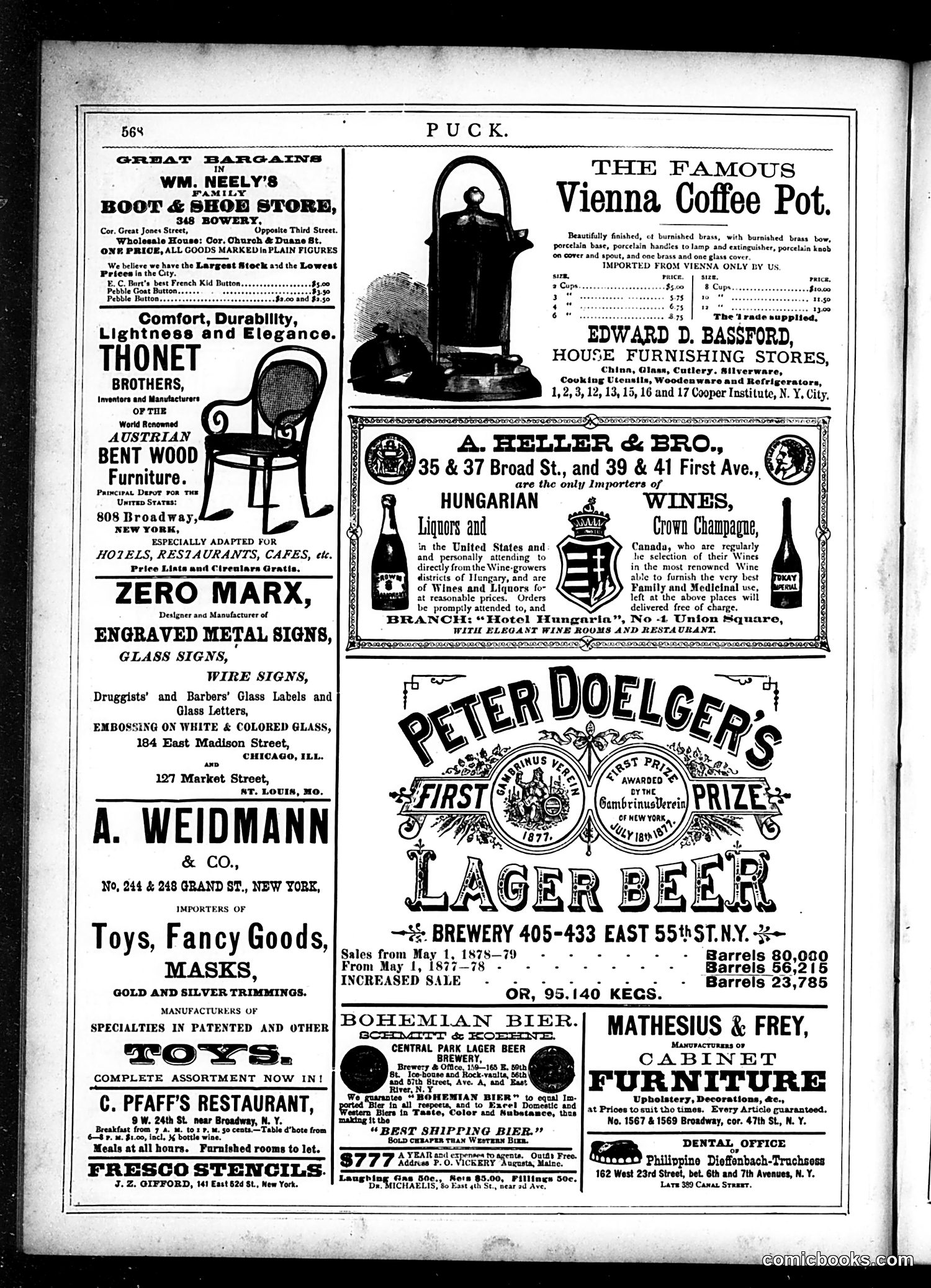
This page is primarily **advertising**, not editorial content or political satire. It contains numerous commercial advertisements for businesses including: - Boot and shoe stores - Furniture manufacturers (bent wood furniture) - Metal sign engravers - Toy and fancy goods importers - Restaurants - Beer breweries (Peter Doelger's Lager Beer, Bohemian Beer) - House furnishing stores - Coffee pots and kitchen goods The only visual element beyond text is an illustration of a **Vienna Coffee Pot** (decorative teapot) and a simple chair image advertising bent wood furniture. There are no political cartoons, caricatures, or satirical content visible on this page—it functions as a standard late-19th-century advertising section of the magazine.
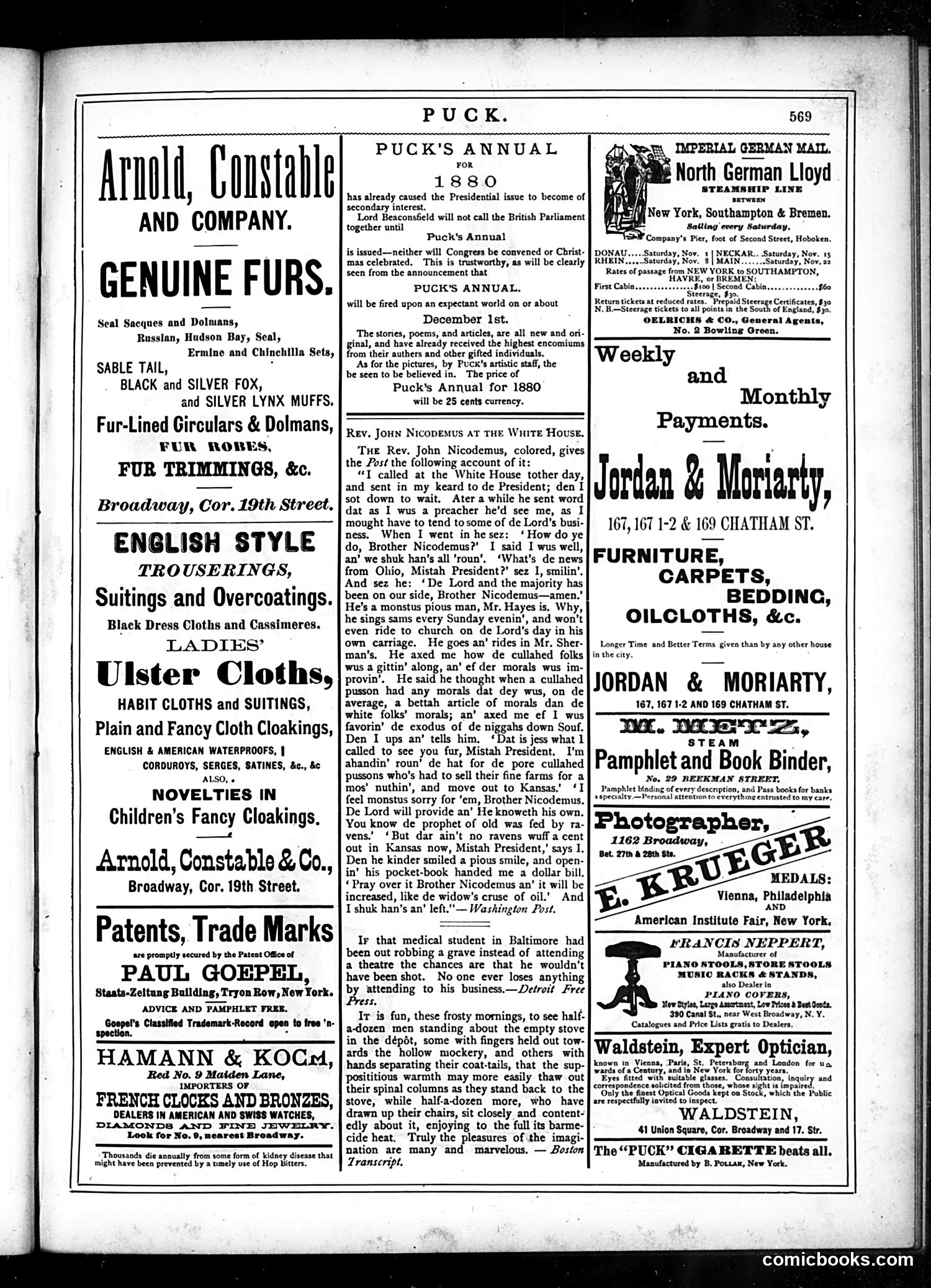
This page is primarily **advertising**, not satirical content. It features commercial notices from 1880 for: - **Arnold, Constable and Company**: A fur and clothing merchant advertising genuine furs, sable, seal products, and English-style garments - **Jordan & Moriarty**: Furniture, carpets, bedding, and oilcloths - **P. Krueger**: Photographer services - **Francis Neppert**: Piano stools and music stands - **Waldstein, Expert Optician**: Eyeglasses The page also includes brief humorous anecdotes (a reverend's account, medical student story, and depot observations), but these are fillers rather than political satire. The overall content reflects typical 1880s Puck magazine format: mixing advertisements with light humor rather than sharp political commentary.
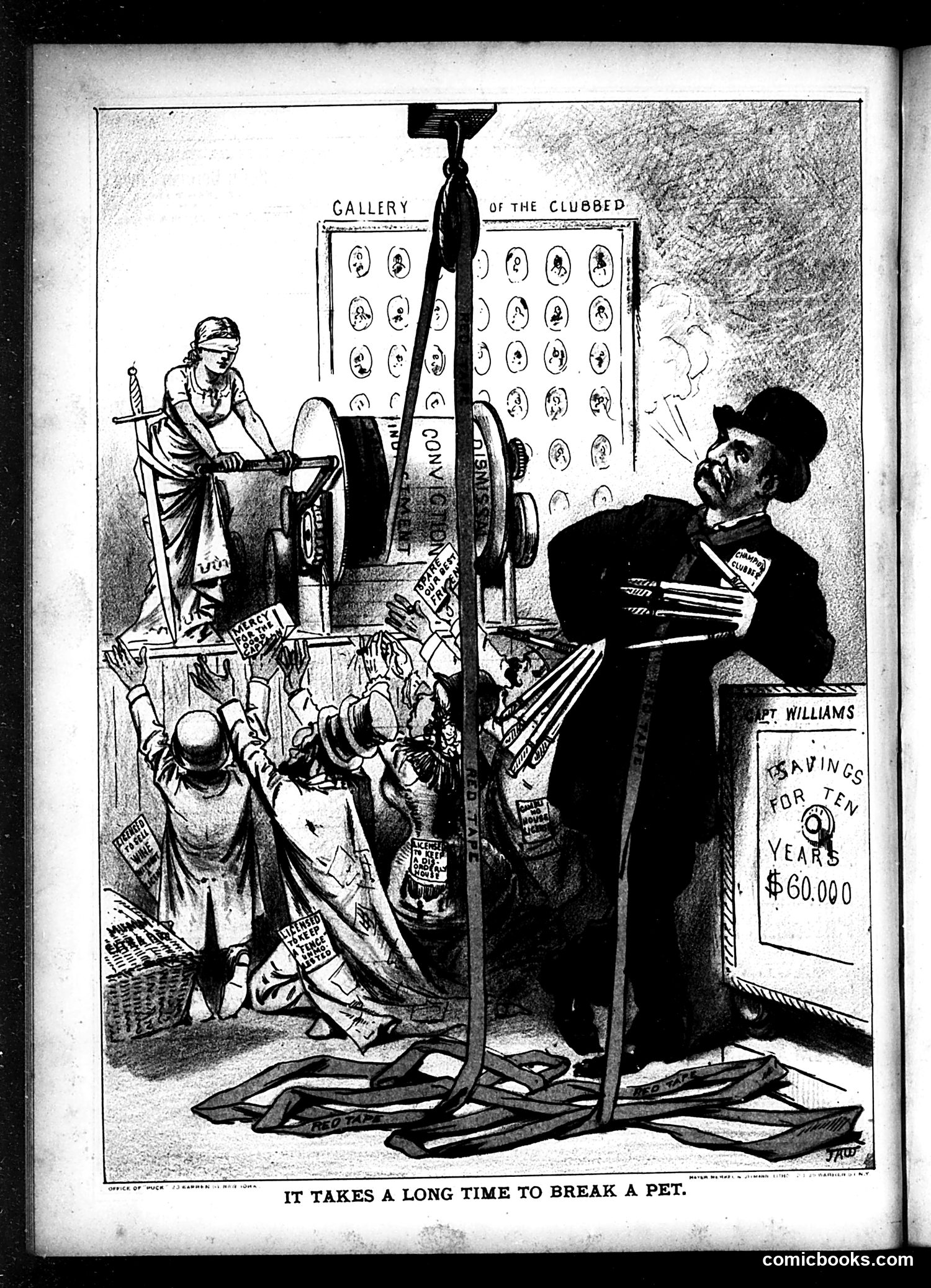
This Puck cartoon satirizes the difficulty of breaking corrupt political habits, titled "It Takes a Long Time to Break a Pet." The central figure appears to be a politician (wearing a hat, likely representing a specific public figure, though unclear which one) being subjected to punishment via a large club or mallet labeled "COMMON SENSE." Below, citizens/voters are shown kneeling, seemingly pleading or protesting. In the background, a "Gallery of the Clubbed" displays portraits, suggesting this is a repeated practice against multiple politicians. A sign references "Capt. Williams" and "$60,000" in "Savings for Ten Years"—likely referencing a specific financial scandal or embezzlement case. The satire suggests that despite public outcry and attempts at reform, corrupt politicians prove difficult to reform or remove from power.