
Puck, 1879-11-05 · page 5 of 18
Puck — November 5, 1879 — page 5: what you’re looking at
What you’re looking at
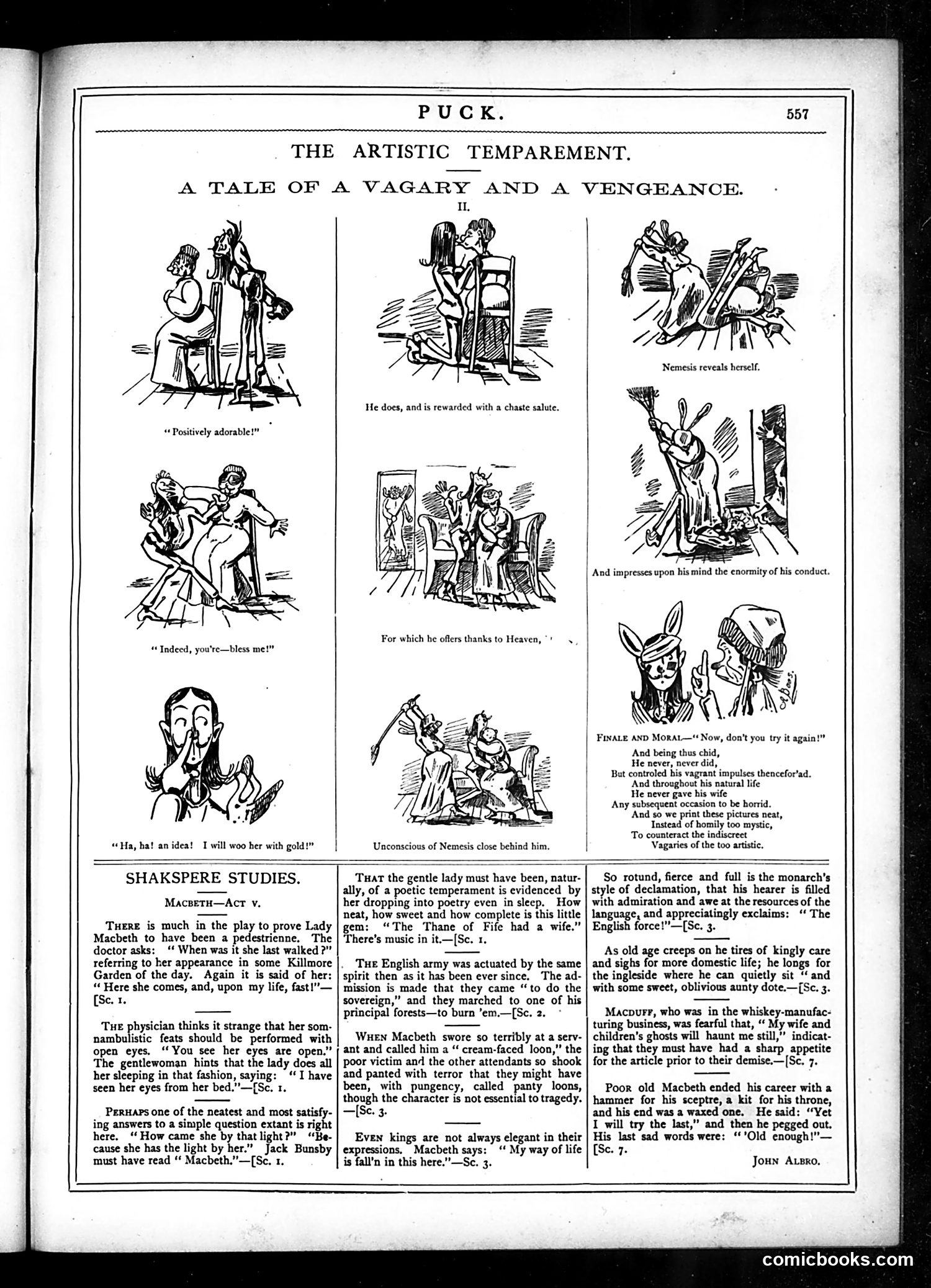
This page contains two distinct sections: **Upper Section: "The Artistic Temperament"** - A satirical comic strip about a vagabond artist and revenge. The narrative follows a poorly-dressed artist who receives praise ("Positively adorable!"), then romantic advances, and ultimately revenge from a goddess figure (Nemesis) who "reveals herself" and impresses upon him "the enormity of his conduct." The moral finale warns against artistic vagrancy and domestic irresponsibility. **Lower Section: "Shakspere Studies"** - Literary commentary analyzing Lady Macbeth from Shakespeare's *Macbeth* (Act V), discussing her poetic temperament and the historical context of English military campaigns referenced in the play. The upper cartoon satirizes bohemian artist culture and sexual impropriety through divine punishment, while the lower section provides serious dramatic criticism—typical of Puck's mixed content of humor and cultural commentary.
📄 Transcribed text from this page (OCR, searchable)
Machine-transcribed from the original scan — historical spelling and the odd misread are preserved.
PUCK. THE ARTISTIC TEMPAREMENT. A TALE OF A VAGARY AND A VENGEANCE. “Indeed, you're—bless me!” “Ha, ha! an idea! I will woo her with gold!” Unconscious of Nemesis close behind him. FINALE AND Morat— Now, don't you try it again!” And being thus chid, He never, never did, But controled his vagrant impulses thencefor’ad. ‘And throughout his natural life He never gave his wife Any subsequent occasion to be horrid. And so we print these pictures neat, Instead of homily too mystic, To counteract the indiscreet Vagaries of the too artistic, SHAKSPERE STUDIES. MacsetH—ACT v. Tuere is much in the play to prove Lady Macbeth to have been a pedestrienne. The doctor asks: ‘* When was it she last walked ?” referring to her appearance in some Killmore Garden of the day. Again it is said of her: [ Here she comes, and, upon my life, fast!”— Sc, 1. Tue physician thinks it strange that her som- nambulistic feats should be performed with open eyes. “You see her eyes are open.” The gentlewoman hints that the lady does all her sleeping in that fashion, saying: ‘I have seen her eyes from her bed.”—{Sc. 1. Peruaps one of the neatest and most satisfy- ing answers to a simple question extant is right here. ‘“ How came she by that light?” “Be- cause she has the light by her.” Jack Bunsby must have read “‘ Macbeth.”—[Sc. 1. Tuat the gentle lady must have been, natur- ally, of a poetic temperament is evidenced by her dropping into poetry even in sleep. How neat, how sweet and how complete is this little gem: “The Thane of Fife had a wife.” There's music in it—{Sc. 1. Tue English army was actuated by the same spirit then as it has been ever since. The ad- mission is made that they came “to do the sovereign,” and they marched to one of his principal forests—to burn ’em.—[Sc. 2. * WueEn Macbeth swore so terribly at a serv- ant and called him a “ cream-faced loon,” the poor victim and the other attendants so shook and panted with terror that they might have been, with pungency, called panty loons, bart the character is not essential to tragedy. —{[Se. 3. Even kings are not always elegant in their expressions, Macbeth says: ‘‘ My way of life is fall’n in this here.”—Sc. 3. So rotund, fierce and full is the monarch’s style of declamation, that his hearer is filled with admiration and awe at the resources of the language, and appreciatingly exclaims: ‘‘ The English force!”—[Sc. 3. As old age creeps on he tires of kingly care and sighs for more domestic life; he longs for the ingleside where he can quietly sit ‘and with some sweet, oblivious aunty dote.—(Sc. 3. Macourr, who was in the whiskey-manufac- turing business, was fearful that, “ My wife and children’s ghosts will haunt me still,” indicat- ing that they must have had a sharp appetite for the article prior to their demise.—[Sc. 7. Poor old Macbeth ended his career with a hammer for his sceptre, a kit for his throne, and his end was a waxed one. He said: “Yet I will try the last,” and then he pegged out. His last sad words were: ‘’Old enough!"”— [Sc. 7. Joun ALBKO, ee comicbooks.com