
Puck, 1879-11-05 · page 7 of 18
Puck — November 5, 1879 — page 7: what you’re looking at
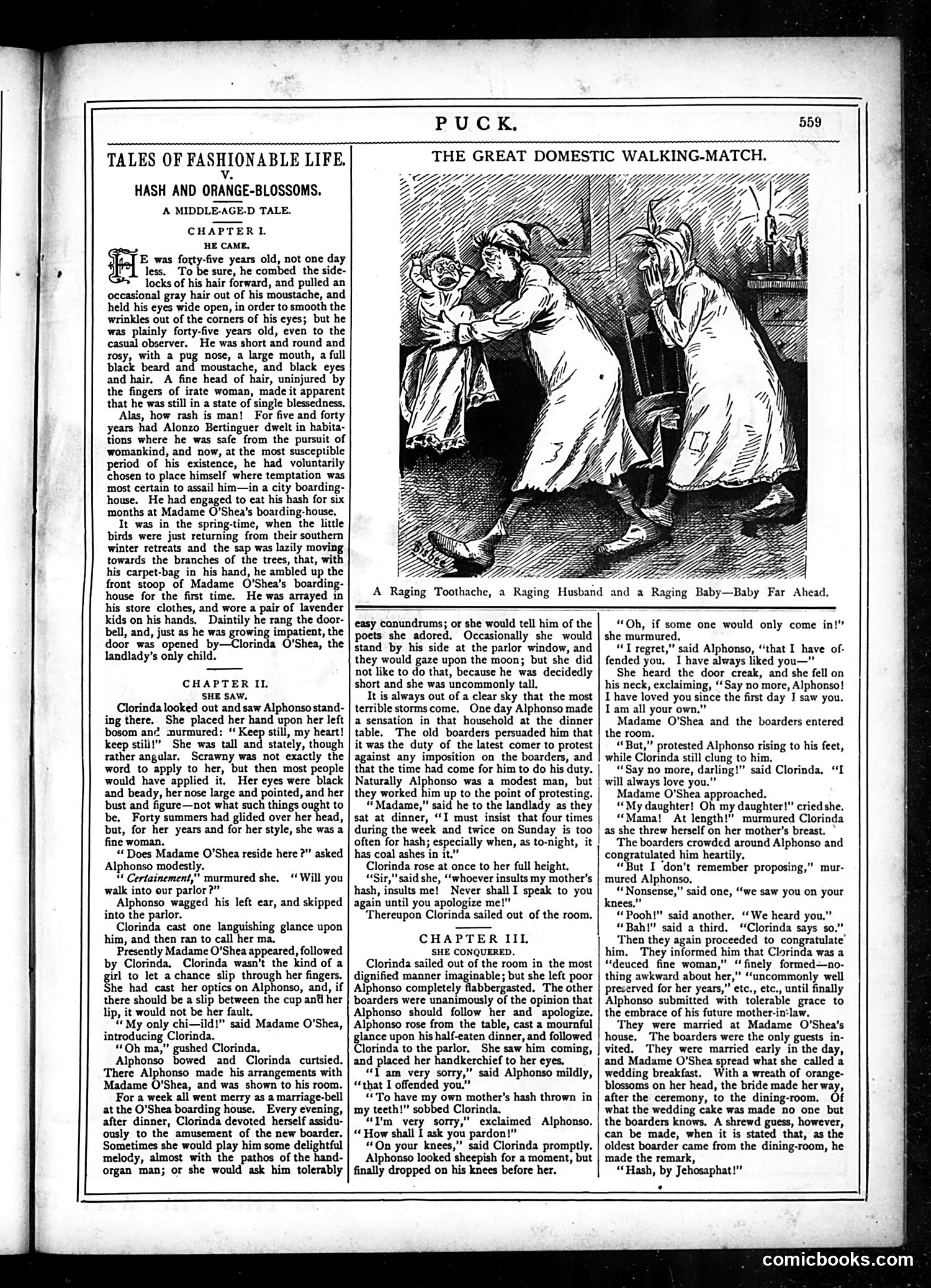
What you’re looking at
This page contains a serialized short story titled "Hash and Orange-Blossoms: A Middle-Aged Tale," not a political cartoon. The illustration titled "The Great Domestic Walking-Match" depicts a domestic conflict: a man (Alphonso) appears to be fleeing while a woman (Clorinda) chases him, with a baby involved—the caption reads "A Raging Toothache, a Raging Husband and a Raging Baby—Baby Far Ahead." The satire targets middle-class domestic life. The "walking-match" joke plays on the Victorian-era competitive walking races that were popular public spectacles. Here, the humor transposes that sporting concept onto marital discord, suggesting that domestic quarrels—triggered by toothaches and babies—drive couples to physical confrontation. This mocks the pretensions of "fashionable life" by revealing the messy, undignified reality beneath respectable appearances.
📄 Transcribed text from this page (OCR, searchable)
Machine-transcribed from the original scan — historical spelling and the odd misread are preserved.
PUCK. TALES OF FASHIONABLE LIFE. HASH AND ORANGE-BLOSSOMS, A MIDDLE-AGE-D TALE. CHAPTERL HE CAME, E was forty-five years old, not one day less. To be sure, he combed the side- locks of his hair forward, and pulled an occasional gray hair out of his moustache, and held his eyes wide open, in order to smooth the wrinkles out of the corners of his eyes; but he was plainly forty-five years old, even to the casual observer. He was short and round and rosy, with a pug nose, a large mouth, a full black beard and moustache, and black eyes and hair, A fine head of hair, uninjured by the fingers of irate woman, made it apparent that he was still in a state of single blessedness. Alas, how rash is man! For five and forty years had Alonzo Bertinguer dwelt in habita- tions where he was safe from the pursuit of womankind, and now, at the most susceptible period of his existence, he had voluntarily chosen to place himself where temptation was most certain to assail him—in a city boarding- house. He had engaged to eat his hash for six months at Madame O’Shea’s boarding-house. It was in the spring-time, when the little birds were just returning from their southern winter retreats and the sap was lazily moving towards the branches of the trees, that, with his carpet-bag in his hand, he ambled up the front stoop of Madame O’Shea’s boarding- house for the first time. He was arrayed in his store clothes, and wore a pair of lavender kids on his hands. Daintily he rang the door- bell, and, just as he was growing impatient, the door was opened by—Clorinda O'Shea, the landlady’s only child. CHAPTER IL SHE SAW. Clorinda looked out and saw Alphonso stand- ing there. She placed her hand upon her left bosom ané murmured: “ Keep still, my heart! keep still!” She was tall and stately, though rather angular. Scrawny was not exactly the word to apply to her, but then most people would have applied it. Her eyes were black and beady, her nose large and pointed, and her bust and figure—not what such things ought to be. Forty summers had glided over her head, but, for her years and for her style, she was a fine woman. “Does Madame O'Shea reside here ?” asked Alphonso modestly. “ Certainement,” murmured she. walk into our parlor?” Alphonso wagged his left ear, and skipped into the parlor. Clorinda cast one languishing glance upon him, and then ran to call her ma. Presently Madame O'Shea appeared, followed by Clorinda. Clorinda wasn’t the kind of a ‘irl to let a chance slip through her fingers. he had cast her optics on Alphonso, and, if there should be a slip between the cup antl her lip, it would not be her fault, “My only chi—ild!” said Madame O'Shea, introducing Clorinda. “Oh ma,” gushed Clorinda. Alphonso bowed and Clorinda curtsied. There Alphonso made his arrangements with Madame O'Shea, and was shown to his room. For a week all went merry as a marriage-bell at the O'Shea boarding house. Every evening, after dinner, Clorinda devoted herself assidu- ously to the amusement of the new boarder. Sometimes she would play him some delightful melody, almost with the pathos of the \d- organ man; or she would ask him tolerably “Will you THE GREAT DOMESTIC WALKING-MATCH. ty ya Y Yi ppp Wy A Raging Toothache, a Raging Husband and a Raging Baby—Baby Far Ahead. easy canundrums; or she would tell him of the poets she adored. Occasionally she would stand by his side at the parlor window, and they would gaze upon the moon; but she did not like to do that, because he was decidedly short and she was uncommonly tall. It is always out of a clear sky that the most terrible storms come. One day Alphonso made a sensation in that household at the dinner table. The old boarders persuaded him that it was the duty of the latest comer to protest against any imposition on the boarders, and that the time had come for him to do his duty. Naturally Alphonso was a modest man, but they worked him up to the point of protesting. “Madame,” said he to the landlady as they sat at dinner, “I must insist that four times | | as she threw herself on her mother’s breast. during the week and twice on Sunday is too often for hash; especially when, as to-night, it has coal ashes in it.” Clorinda rose at once to her full height. “Sir,"’said she, ‘whoever insults my mother’s hash, insults me! Never shall I speak to you again until you apologize me!” Thereupon Clorinda sailed out of the room. CHAPTER IIL SHE CONQUERED. Clorinda sailed out of the room in the most dignified manner imaginable; but she left poor Alphonso completely flabbergasted. The other boarders were unanimously of the opinion that Alphonso should follow her and apologize. Alphonso rose from the table, cast a mournful lance upon his half-eaten dinner, and followed Clorindas to the parlor. She saw him coming, and placed her handkerchief to her eyes, “1 am very sorry,” said Alphonso mildly, “that I offended you.” “To have my own mother’s hash thrown in my teeth!” sobbed Clorinda. “I’m very sorry,” exclaimed Alphonso. “How shall I ask you pardon!” “On your knees,” said Clorinda promptly. Alphonso looked sheepish for a moment, but finally dropped on his knees before her. “Oh, if some one would only come in!” she murmured, “7 regret,” said Alphonso, “that I have of- fended you. I have always liked you—” She heard the door creak, and she fell on his neck, exclaiming, ‘Say no more, Alphonso! I have loved you since the first day J saw you. I am all your own,” Madame O'Shea and the boarders entered the room. “But,” protested Alphonso rising to his feet, while Clorinda still clung to him. “Say no more, darling!” said Clorinda, ‘I | will always love you.” Madame O'Shea approached. “My daughter! Oh my daughter!” cried she. “Mama! At length!” murmured Clorinda The boarders crowded around Alphonso and congratulated him heartily. “But I ‘don’t remember proposing,” mur- mured Alphonso. “Nonsense,” said one, “we saw you on your knees.” “Pooh!” said another. ‘We heard you.” “Bah!” said a third. ‘Clorinda says so.” Then they again proceeded to congratulate’ him. They informed him that Clorinda was a “deuced fine woman,” “finely formed—no- thing awkward about her,” ‘uncommonly well preserved for her years,” etc., etc., until finally Alphonso submitted with tolerable grace to the embrace of his future mother-in-law. They were married at Madame O’Shea’s house. The boarders were the only guests in- vited. They were married early in the day, and Madame O'Shea spread what she called a wedding breakfast. With a wreath of orange- blossoms on her head, the bride made her way, after the ceremony, to the dining-room. Of what the wedding cake was made no one but the boarders knows, A shrewd guess, however, can be made, when it is stated that, as the oldest boarder came from the dining-room, he made the remark, “Hash, by Jehosaphat!” comicbooks.com