
Puck, 1879-11-05 · page 10 of 18
Puck — November 5, 1879 — page 10: what you’re looking at
What you’re looking at
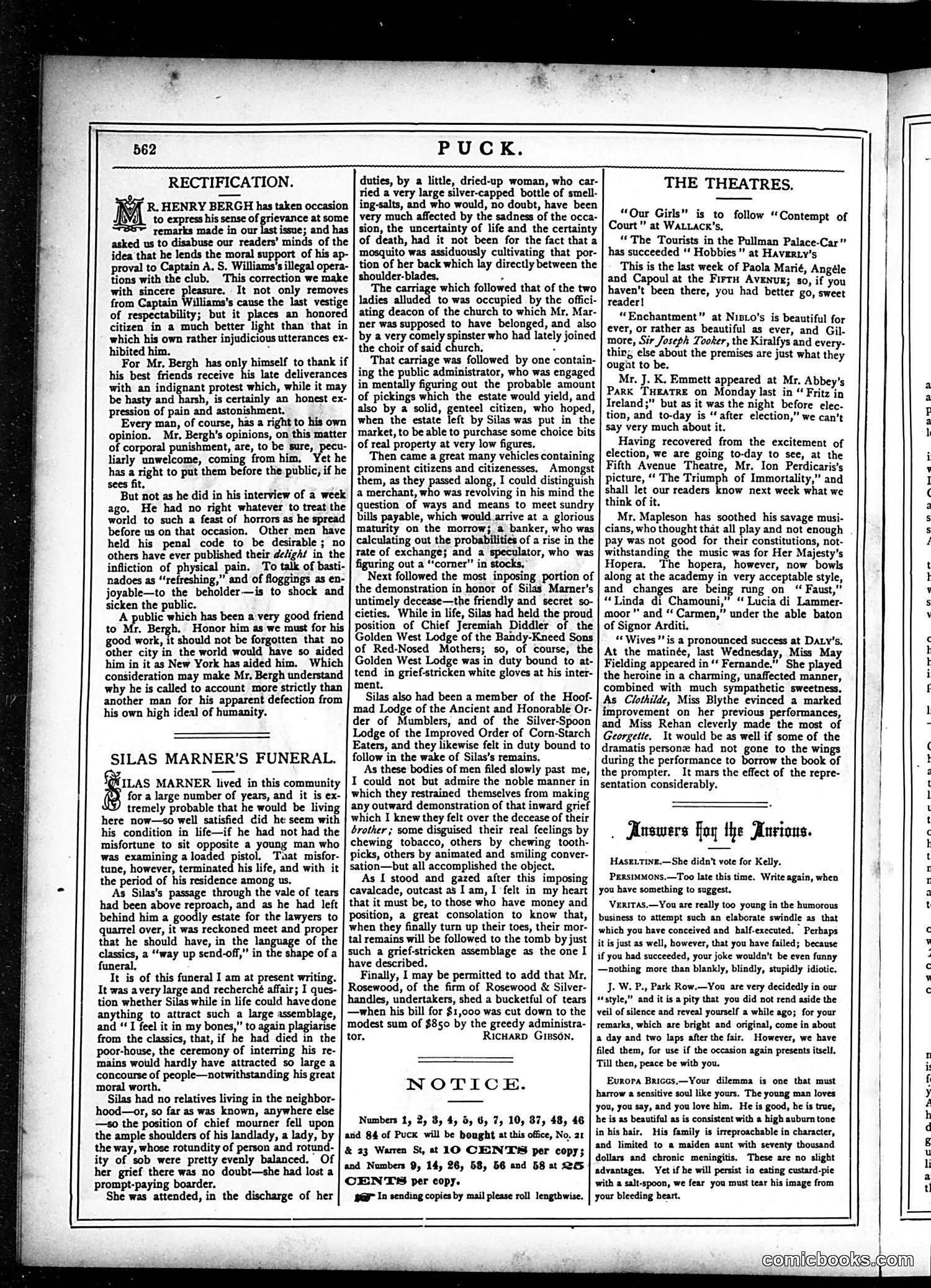
This page contains three distinct sections: a satirical essay titled "Rectification" by Mr. Henry Bergh; an obituary-style piece on "Silas Marner's Funeral"; and a "Notices" section with readers' responses. The "Rectification" piece appears to defend Bergh's character against recent criticisms, suggesting he faced public accusations of being harsh or moralistic. The Silas Marner section uses the fictional character's death as a satirical vehicle to comment on social hypocrisy—specifically how people perform grief publicly while privately harboring indifference. The page primarily contains **text-based satire rather than visual cartoons**. It reflects Puck's tradition of social commentary through editorial writing rather than illustrations. Without visible cartoon images, the satire relies entirely on ironic tone and literary critique of contemporary social behavior.
📄 Transcribed text from this page (OCR, searchable)
Machine-transcribed from the original scan — historical spelling and the odd misread are preserved.
PUCK. RECTIFICATION. R. HENRY BERGH has taken occasion to express his sense of grievance at some remarks made in our last issue; and has asked us to disabuse our readers’ minds of the idea that he lends the moral support of his ap- proval to Captain A. S. Williams's illegal opera- tions with the club. This correction we make with sincere pleasure. It not only removes from Captain Williams’s cause the last vestige of respectability; but it places an honored citizen in a much better light than that in which his own rather injudicious utterances ex- hibited him, ; : For Mr. Bergh has only himself to thank if his best friends receive his late deliverances with an indignant protest which, while it may be hasty and harsh, is certainly an honest ex- pression of pain and astonishment. Every man, of course, has a right to his own opinion. Mr. Bergh’s opinions, on this matter of corporal punishment, are, to be sure, pecu- liarly unwelcome, coming from him. Yet he has a right to put them before the public, if he sees fit. But not as he did in his interview of a week ago. He had no right whatever to treat the world to such a feast of horrors as he before us on that occasion. Other men have held his penal code to be desirable ; no others have ever published their de/ight in the infliction of physical pain. To talk of basti- | figu nadoes as “‘refreshing,” and of floggings as en- joyable—to the beholder—is to shock and sicken the public. 2 A public which has been a very good friend to Mr. Bergh. Honor him as we must for his good work, it should not be forgotten that no other city in the world would have so aided him in it as New York has aided him. Which consideration may make Mr, Bergh understand why he is called to account more strictly than another man for his apparent defection from his own high ideal of humanity. SILAS MARNER’S FUNERAL. ILAS MARNER lived in this community for a large number of years, and it is ex- tremely probable that he would be living here now—so well satisfied did he seem with his condition in life—if he had not had the misfortune to sit opposite a young man who was examining a loaded pistol. Taat misfor- tune, however, terminated his life, and with it the period of his residence among us. As Silas’s passage through the vale of tears had been above reproach, and as he had left behind him a goodly estate for the lawyers to quarrel over, it was reckoned meet and proper that he should have, in the Janguage of the classics, a “way up send-off,” in the shape of a funeral, It is of this funeral I am at present writing. It was avery large and recherché affair; I ques- tion whether Silas while in life could havedone anything to attract such a large assemblage, and “I feel it in my bones,” to again plagiarise duties, by a little, dried-up woman, who car- ried a very large silver-capped bottle of smell- ing-salts, and who would, no doubt, have been very much affected by the sadness of the occa- sion, the uncertainty of life and the certainty of death, had it not been for the fact that a mosquito was assiduously cultivating that por- tion of her back which lay directly between the shoulder-blades, . The carriage which followed that of the two ladies alluded to was occupied by the offici- ating deacon of the church to which Mr, Mar- ner was supposed to have belonged, and also by a very cone spinster who had lately joined the choir of said church, . That carriage was followed by one contain- ing the public administrator, who was engaged in mentally figuring out the probable amount of pickings which the estate would yield, and also by a solid, genteel citizen, who hoped, when the estate left by Silas was put in the market, to be able to purchase some choice bits of real property at very low figures, Then came a great many vehicles containing prominent citizens and citizenesses. Amongst them, as they passed along, I could distinguish a merchant, who was revolving in his mind the question of ways and means to meet sundry bills payable, which would.arrive at a glorious maturity on the morrow; a banker, who was calculating out the probabilities of a rise in the rate of exchange; and a speculator, who was ring out a “corner” in stocks, Next followed the most inposing portion of the demonstration in honor of Silas Marner's untimely decease—the friendly and secret so- cieties. While in life, Silas had held the proud position of Chief Jeremiah Diddler of the Golden West Lodge of the Bandy-Kneed Sons of Red-Nosed Mothers; so, of course, the Golden West Lodge was in duty bound to at- tend in grief-stricken white gloves at his inter- ment. Silas also had been a member of the Hoof- mad Lodge of the Ancient and Honorable Or- der of Mumblers, and of the Silver-Spoon Lodge of the Improved Order of Corn-Starch Eaters, and they likewise felt in duty bound to follow in the wake of Silas’s remains, As these bodies of men filed slowly past me, I could not but admire the noble manner in which they restrained themselves from making any outward demonstration of that inward grief which I knew they felt over the decease of their brother ; some disguised their real feelings by chewing tobacco, others by chewing tooth- picks, others by animated and smiling conver- sation—but all accomplished the object. ‘As I stood and gazed after this imposing cavalcade, outcast a8 I am, I felt in my heart that it must be, to those who have money and position, a great consolation to know that, when they finally turn up their toes, their mor- tal remains will be followed to the tomb by just such a grief-stricken assemblage as the one I have described. Finally, I may be permitted to add that Mr, Rosewood, of the firm of Rosewood & Silver- handles, undertakers, shed a bucketful of tears —when his bill for $1,000 was cut down to the modest sum of $850 by the greedy administra- tor. Ricuarp Gipson. from the classics, that, if he had died in the poor-house, the ceremony of interring his re- mains would hardly have attracted so large a concourse of people—notwithstanding his great moral worth, Silas had no relatives living in the neighbor- hood—or, so far as was known, anywhere else —so the position of chief mourner fell upon the ample shoulders of his landlady, a lady, by the way, whose rotundity of person and rotund- ity of sob were pretty evenly balanced. Of her grief there was no doubt—she had lost a prompt-paying boarder, She was attended, in the discharge of her NOTICE. Numbers 1, 2, By 4, 5, Uy 7, 10, 87, 48, 46 arid 84 of Puck will be bought at this office, No. 21 & 23 Warren St, at LO CENTS per copy; and Numbers 9, 14, 26, 58, 56 and 58 at 25 CENTS per copy. @F In sending copies by mail please roll lengthwise. THE THEATRES. “Our Girls” is to follow “Contem, Court ” at WALLACK’s, FS of “The Tourists in the Pullman Palace-Car” has succeeded “* Hobbies” at Haverty's This is the last week of Paola Marié, Angéle and Capoul at the Firru AvENug; 50, if you haven't been there, you had better gO, sweet reader! “Enchantment” at Nipto’s is beautiful for ever, or rather as beautiful as ever, and Gil- more, Sir Joseph Tooker, the Kiralfys and every- thing else about the premises are just what they ought to be, Mr. J. K. Emmett appeared at Mr. Abbey's Park THEATRE on Monday last in “ Fritz in Ireland ;" but as it was the night before elec- tion, and to-day is “after election,” we can’t say very much about it. Having recovered from the excitement of election, we are going to-day to see, at the Fifth Avenue Theatre, Mr. Ion Perdicaris’s picture, “ The Triumph of Immortality,” and shall let our readers know next week what we think of it. Mr. Mapleson has soothed his savage musi- cians, who thought that all play and not enough Pay was not good for their constitutions, not- withstanding the music was for Her Majesty’s Hopera, The hopera, however, now bowls along at the academy in very acceptable style, and changes are being rung on “ Faust,” “Linda di Chamouni,” “ Lucia di Lammer- moor" and “ Carmen,” under the able baton of Signor Arditi. “ Wives" is a pronounced success at DaLy’s, At the matinée, last Wednesday, Miss May Fielding appeared in “ Fernande.”” She played the heroine in a charming, unaffected manner, combined with much sympathetic sweetness, As Clothilde, Miss Blythe evinced a marked improvement on her previous performances, and Miss Rehan cleverly made the most of Georgette. It would be as well if some of the dramatis persone had not gone to the wings during the performance to borrow the book of the prompter. It mars the effect of the repre- sentation considerably. . Answers Foy the Anions. Haseitive.—She didn’t vote for Kelly. PERSIMMONS.—Too late this time. Write again, when you have something to suggest. VeRiTAs.—You are really too young in the humorous business to attempt such an elaborate swindle as that which you have conceived and half-executed. _ Perhaps it is just as well, however, that you have failed; because if you had succeeded, your joke wouldn't be even funny —nothing more than blankly, blindly, stupidly idiotic, J. W. P., Park Row.—You are very decidedly in our “style,” and it is a pity that you did not rend aside the veil of silence and reveal yourself a while ago; for your remarks, which are bright and original, come in about a day and two laps after the fair. However, we have filed them, for use if the occasion again presents itself. Till then, peace be with you, Europa Briccs.—Your dilemma is one that must harrow a sensitive soul like yours. The young man loves you, you say, and you love him. He is good, he is true, he is as beautiful as is consistent with a high auburn tone in his hair. His family is irreproachable in character, and limited to a maiden sunt with seventy thousand dollars and chronic meningitis, These are no slight advantages. Yet if he will persist in eating custard-pie with a salt-spoon, we fear you must tear his image from your bleeding heart. comichooks.com aa aa ae as ci a a ea Si a ee Pan en er az c ¥ c ¥ c