
Puck, 1879-11-05 · page 11 of 18
Puck — November 5, 1879 — page 11: what you’re looking at
What you’re looking at
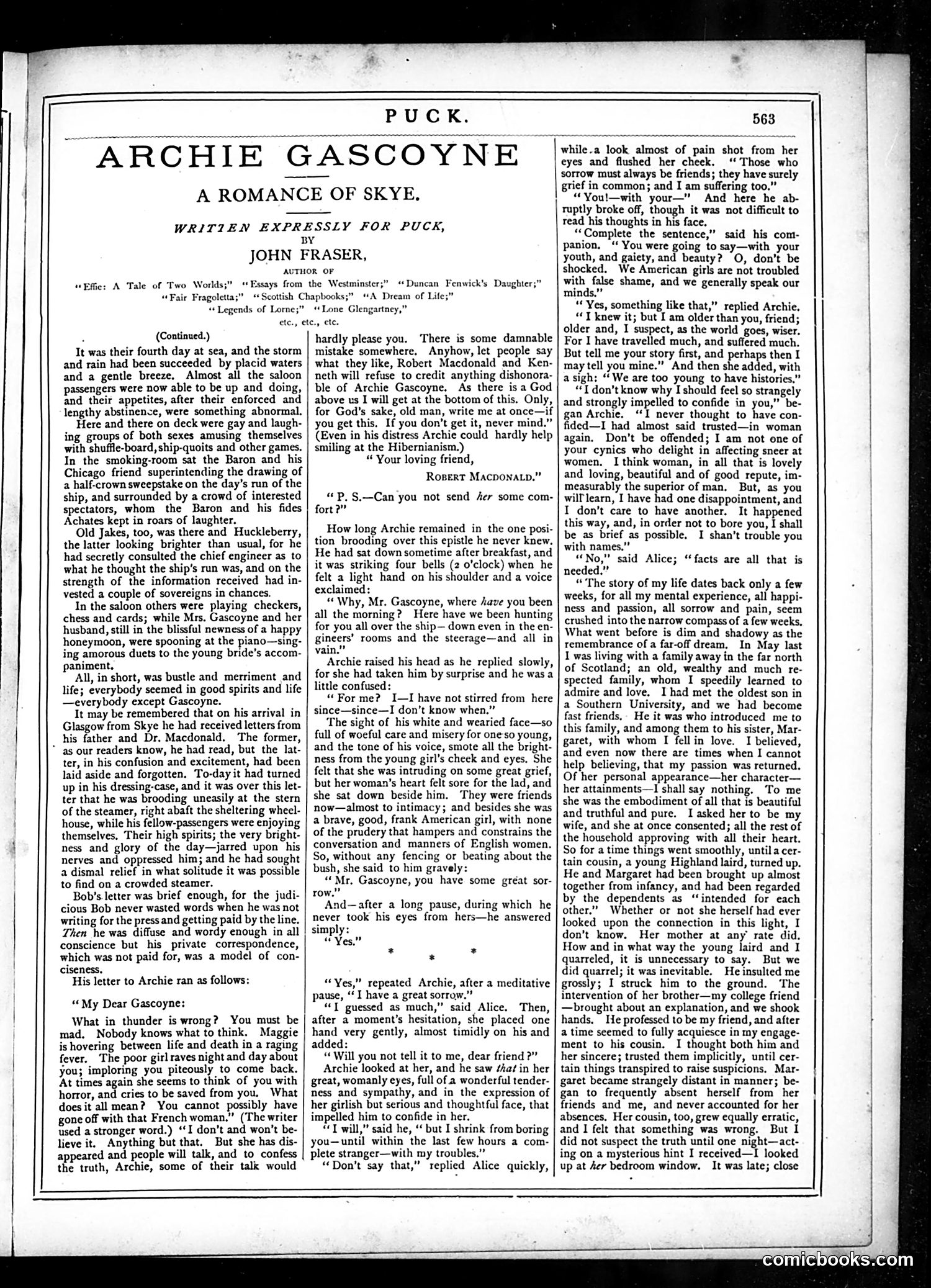
This page from *Puck* magazine contains **serialized fiction rather than political cartoons**. The piece is "Archie Gascoyne: A Romance of Skye," written expressly for *Puck* by John Fraser. The text consists of a romantic narrative set in Scotland, featuring characters like Archie, Alice, Robert Macdonald, and others. The story involves dialogue about courtship, travel, and social class—typical Victorian romance fiction themes. There are references to American versus English social conventions and manners. **There are no political cartoons or satirical illustrations visible on this page.** This appears to be a regular fiction installment, not the satirical/political content *Puck* was primarily known for. The page functions as serialized entertainment rather than social commentary.
📄 Transcribed text from this page (OCR, searchable)
Machine-transcribed from the original scan — historical spelling and the odd misread are preserved.
PUCK. ARCHIE GASCOYNE A ROMANCE OF SKYE. WRITITEN EXPRESSLY FOR PUCK, BY JOHN FRASER, AUTHOR OF “Effie: A Tale of Two Worlds; «Essays from the Westminster;” “Duncan Fenwick's Daughter;” “Fair Fragoletta;” ‘Scottish Chapbooks;” “A Dream of Life;” “+ Legends of Lorne; “Lone Glengartney,” ete., ete, ete. (Continued.) It was their fourth day at sea, and the storm and rain had been succeeded by placid waters and a gentle breeze. Almost all the saloon passengers were now able to be up and doing, and their appetites, after their enforced and lengthy abstinence, were something abnormal. Here and there on deck were gay and laugh- ing groups of both sexes amusing themselves with shufile-board, ship-quoits and other games. In the smoking-room sat the Baron and his Chicago friend superintending the drawing of a half-crown sweepstake on the day’s run of the ship, and surrounded by a crowd of interested spectators, whom the Baron and his fides Achates kept in roars of laughter. Old Jakes, too, was there and Huckleberry, the latter looking brighter than usual, for he had secretly consulted the chief engineer as to what he thought the ship’s run was, and on the strength of the information received had in- vested a couple of sovereigns in chances. In the saloon others were playing checkers, chess and cards; while Mrs. Gascoyne and her husband, still in the blissful newness of a happy honeymoon, were spooning at the piano—sing- ing amorous duets to the young bride’s accom- paniment. All, in short, was bustle and merriment and life; everybody seemed in good spirits and life —everybody except Gascoyne. It may be remembered that on his arrival in Glasgow from Skye he had received letters from his father and Dr. Macdonald. The former, * as our readers know, he had read, but the lat- ter, in his confusion and excitement, had been laid aside and forgotten. To-day it had turned up in his dressing-case, and it was over this let- ter that he was brooding uneasily at the stern of the steamer, right abaft the sheltering wheel- house, while his fellow-passengers were enjoying themselves, Their high spirits; the very bright- ness and glory of the day—jarred upon his nerves and oppressed him; and he had sought a dismal relief in what solitude it was possible to find on a crowded steamer. Bob's letter was brief enough, for the judi- cious Bob never wasted words when he was not writing for the press and getting paid by the line. Then he was diffuse and wordy enough in all conscience but his private correspondence, which was not paid for, was a model of con- ciseness. His letter to Archie ran as follows: “My Dear Gascoyne: What in thunder is wrong? You must be mad. Nobody knows what to think. Maggie is hovering between life and death in a raging fever. The poor girl raves night and day about you; imploring you piteously to come back. At times again she seems to think of you with horror, and cries to be saved from you. What does it all mean? You cannot possibly have gone off with that French woman.” (The writer used a stronger word.) ‘I don't and won't be- lieve it. Anything but that. But she has dis- appeared and people will talk, and to confess the truth, Archie, some of their talk would hardly please you. There is some damnable mistake somewhere. Anyhow, let people say what they like, Robert Macdonald and Ken- neth will refuse to credit anything dishonora- ble of Archie Gascoyne. As there is a God above us I will get at the bottom of this. Only, for God's sake, old man, write me at once—if you get this. If you don’t get it, never mind.” (Even in his distress Archie could hardly help smiling at the Hibernianism.) “Your loving friend, Rosert Macponatp.” “ P, S.—Can you not send Aer some com- fort?” How long Archie remained in the one posi- tion brooding over this epistle he never knew. He had sat down sometime after breakfast, and it was striking four bells (2 o'clock) when he felt a light hand on his shoulder and a voice exclaimed: “Why, Mr. Gascoyne, where ave you been all the morning? Here have we been hunting for you all over the ship— down even in the en- gineers’ rooms and the steerage—and all in vain.” Archie raised his head as he replied slowly, for she had taken him by surprise and he was a little confused: “For me? I—I have not stirred from here since—since—I don’t know when.” The sight of his white and wearied face—so full of woeful care and misery for one'so young, and the tone of his voice, smote all the bright- ness from the young girl’s cheek and eyes. She felt that she was intruding on some great grief, but her woman’s heart felt sore for the lad, and she sat down beside him. They were friends now—almost to intimacy; and besides she was a brave, good, frank American girl, with none of the prudery that hampers and constrains the conversation and manners of English women. So, without any fencing or beating about the bush, she said to him gravely: “Mr, Gascoyne, you have some gréat sor- row.” And—after a long pause, during which he never took his eyes from hers—he answered simply: Yes,” * “Yes,” repeated Archie, after a meditative pause, ‘I have a great sorrow.” “I guessed as much,” said Alice. Then, after a moment's hesitation, she placed one hand very gently, almost timidly on his and added: “Will you not tell it to me, dear friend ?” Archie looked at her, and he saw ¢hat in her great, womanly eyes, full of a wonderful tender- ness and sympathy, and in the expression of her girlish but serious and thoughtful face, that impelled him to confide in her. “T will,” said he, ‘¢ but I shrink from boring you—until within the last few hours a com- plete stranger—with my troubles.” “Don't say that,” replied Alice quickly, 563 while.a look almost of pain shot from her eyes and flushed her cheek. ‘Those who sorrow must always be friends; they have surely grief in common; and I am suffering too.” “You!—with your—” And here he ab- tuptly broke off, though it was not difficult to read his thoughts in his face. “Complete the sentence,” said his com- panion, “ You were going to say—with your youth, and gaiety, and beauty? O, don’t be shocked. We American girls are not troubled with false shame, and we generally speak our minds.” “Yes, something like that,” replied Archie, “I knew it; but I am older than you, friend; older and, I suspect, as the world goes, wiser. For I have travelled much, and suffered much. But tell me your story first, and perhaps then I may tell you mine.” And then she added, with asigh: “We are too young to have histories.” “I don't know why I should feel so strangely and strongly impelled to confide in you," be- gan Archie. “I never thought to have con- fided—I had almost said trusted—in woman again. Don't be offended; I am not one of your cynics who delight in affecting sneer at women, I think woman, in all that is lovely and loving, beautiful and of good repute, im- measurably the superior of man. But, as you will learn, I have had one disappointment, and I don’t care to have another. It happened this way, and, in order not to bore you, I shall be as brief as possible, I shan’t trouble you with names,” “‘No,” said Alice; ‘facts are all that is needed,” “ The story of my life dates back only a few weeks, for all my mental experience, all happi- ness and passion, all sorrow and pain, seem crushed into the narrow compass of a few weeks, What went before is dim and shadowy as the remembrance of a far-off dream, In May last I was living with a family away in the far north of Scotland; an old, wealthy and much re- spected family, whom I speedily learned to admire and love, I had met the oldest son in a Southern University, and we had become fast friends, He it was who introduced me to this family, and among them to his sister, Mar- garet, with whom I fell in love. I believed, and even now there are times when I cannot help believing, that my passion was returned. Of her personal appearance—her character— her attainments—I shall say nothing. To me she was the embodiment of all that is beautiful and truthful and pure. I asked her to be my wife, and she at once consented; all the rest of the household approving with all their heart. So for a time things went smoothly, until a cer- tain cousin, a young Highland laird, turned up. He and Margaret had been brought up almost together from infancy, and had been regarded by the dependents as ‘intended for each other.” Whether or not she herself had ever looked upon the connection in this light, I don’t know. Her mother at any’ rate did. How and in what way the young laird and I quarreled, it is unnecessary to say. But we did quarrel; it was inevitable. He insulted me grossly; I struck him to the ground. The intervention of her brother—my college friend —brought about an explanation, and we shook hands, He professed to be my friend, and after a time seemed to fully acquiesce in my engage- ment to his cousin. I thought both him and her sincere; trusted them implicitly, until cer- tain things transpired to raise suspicions. Mar- garet became strangely distant in manner; be- gan to frequently absent herself from her friends and me, and never accounted for her absences. Her cousin, too, grew equally erratic, and I felt that something was wrong. But I did not suspect the truth until one night—act- ing on a mysterious hint I received—I looked up at Aer bedroom window. It was late; close