
Puck, 1879-11-05 · page 6 of 18
Puck — November 5, 1879 — page 6: what you’re looking at
What you’re looking at
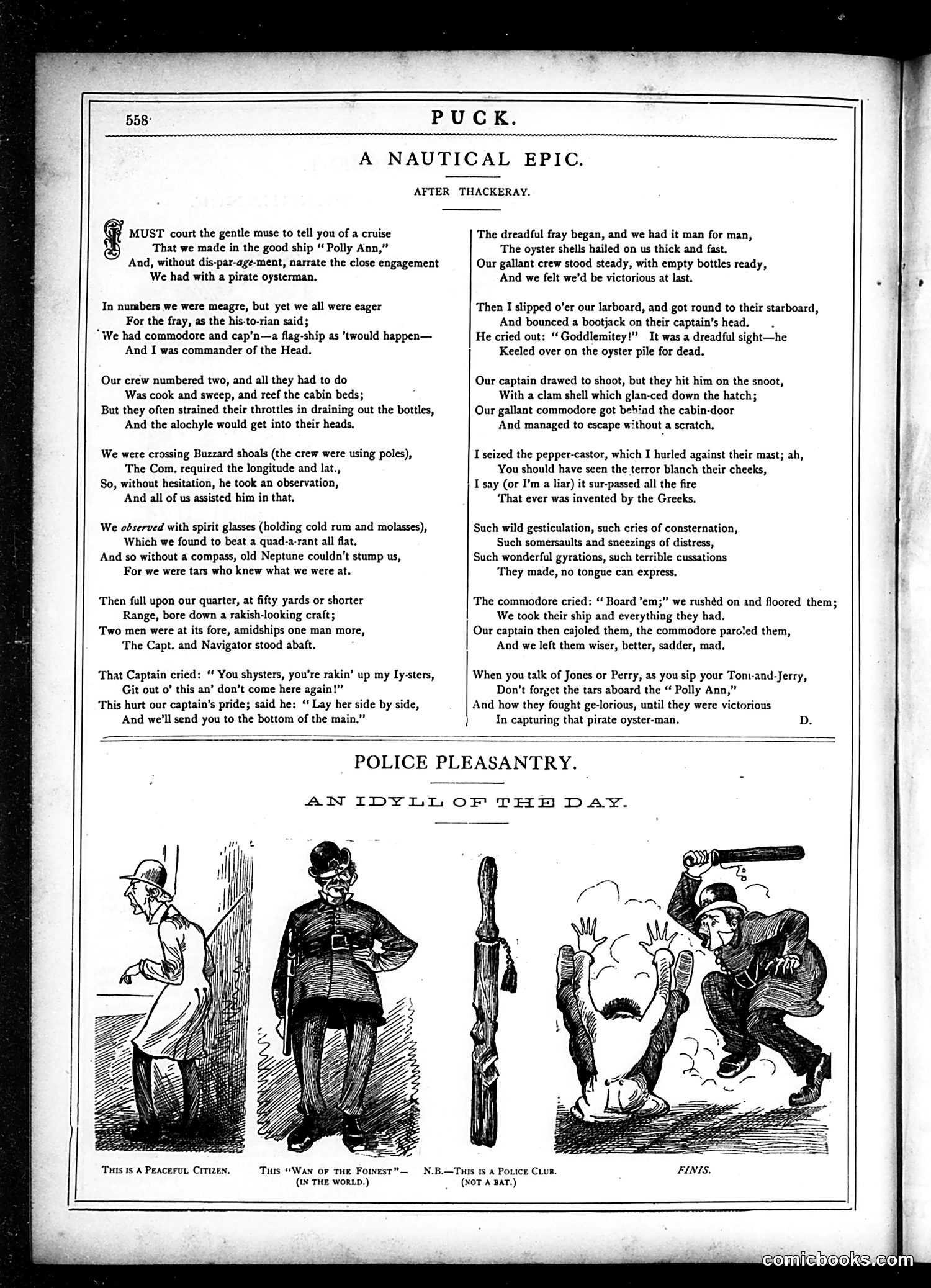
This is a satirical comic strip mocking police conduct. The four panels depict increasingly absurd scenarios labeled: 1. "A Peaceful Citizen" — a man cowering against a wall 2. "A Man of the Finest" (in the world) — a pompous police officer 3. "This is a Police Club" (not a bat) — shows a club 4. "Finis" — the citizen being beaten by police with clubs and a telescope The satire targets police brutality and abuse of authority. The ironic title "Police Pleasantry" and the mock-innocent labeling of the police club (emphasizing it's "not a bat") mock police violence as entertainment or sport. The progression shows a defenseless citizen brutalized by officers, critiquing either actual police practices or proposed measures that Puck's editors found troubling.
📄 Transcribed text from this page (OCR, searchable)
Machine-transcribed from the original scan — historical spelling and the odd misread are preserved.
PUCK. A NAUTICAL EPIC. AFTER THACKERAY. MUST court the gentle muse to tell you of a cruise That we made in the good ship “ Polly Ann,” And, without dis-par-age-ment, narrate the close engagement We had with a pirate oysterman. f In numbers we were meagre, but yet we all were eager For the fray, as the his-to-rian said; “We had commodore and cap’n—a flag-ship as 'twould happen— And I was commander of the Head. Our crew numbered two, and all they had to do Was cook and sweep, and reef the cabin beds; But they often strained their throttles in draining out the bottles, And the alochyle would get into their heads, We were crossing Buzzard shoals (the crew were using poles), The Com. required the longitude and lat., So, without hesitation, he took an observation, And all of us assisted him in that. We observed with spirit glasses (holding cold rum and molasses), Which we found to beat a quad-a-rant all flat. And so without a compass, old Neptune couldn’t stump us, For we were tars who knew what we were at. Then full upon our quarter, at fifty yards or shorter Range, bore down a rakish-looking craft; Two men were at its fore, amidships one man more, The Capt. and Navigator stood abaft. That Captain cried: ‘ You shysters, you're rakin’ up my Iy-sters, Git out o’ this an’ don’t come here agai ‘This hurt our captain's pride; said he: ‘‘ Lay her side by side, And we'll send you to the bottom of the main.” The dreadful fray began, and we had it man for man, The oyster shells hailed on us thick and fast. Our gallant crew stood steady, with empty bottles ready, And we felt we'd be victorious at last. Then I slipped o’er our larboard, and got round to their starboard, And bounced a bootjack on their captain’s head. He cried out: “Goddlemitey!” It was a dreadful sight—he Keeled over on the oyster pile for dead. Our captain drawed to shoot, but they hit him on the snoot, With a clam shell which glan-ced down the hatch; Our gallant commodore got behind the cabin-door And managed to escape without a scratch, I seized the pepper-castor, which I hurled against their mast; ah, You should have seen the terror blanch their cheeks, I say (or I’m a liar) it sur-passed all the fire ‘That ever was invented by the Greeks. Such wild gesticulation, such cries of consternation, Such somersaults and sneezings of distress, Such wonderful gyrations, such terrible cussations ‘They made, no tongue can express, The commodore cried: ‘ Board 'em;” we rushéd on and floored them; We took their ship and everything they had. Our captain then cajoled them, the commodore paro'ed them, And we left them wiser, better, sadder, mad. When you talk of Jones or Perry, as you sip your Tom-and-Jerry, Don’t forget the tars aboard the “ Polly Ann,” And how they fought ge-lorious, until they were victorious In capturing that pirate oyster-man, t POLICE PLEASANTRY. AN IDYLL OF THE Day. Tuts “Wan oF THE Forest”— (us THE WoRLD.) ‘Thus 1s A Peacerut Crrizen. N. .B.—Tuis 1 A Pouice CLUB. (Nor A BAT.)