
Puck, 1879-11-05 · page 4 of 18
Puck — November 5, 1879 — page 4: what you’re looking at
What you’re looking at
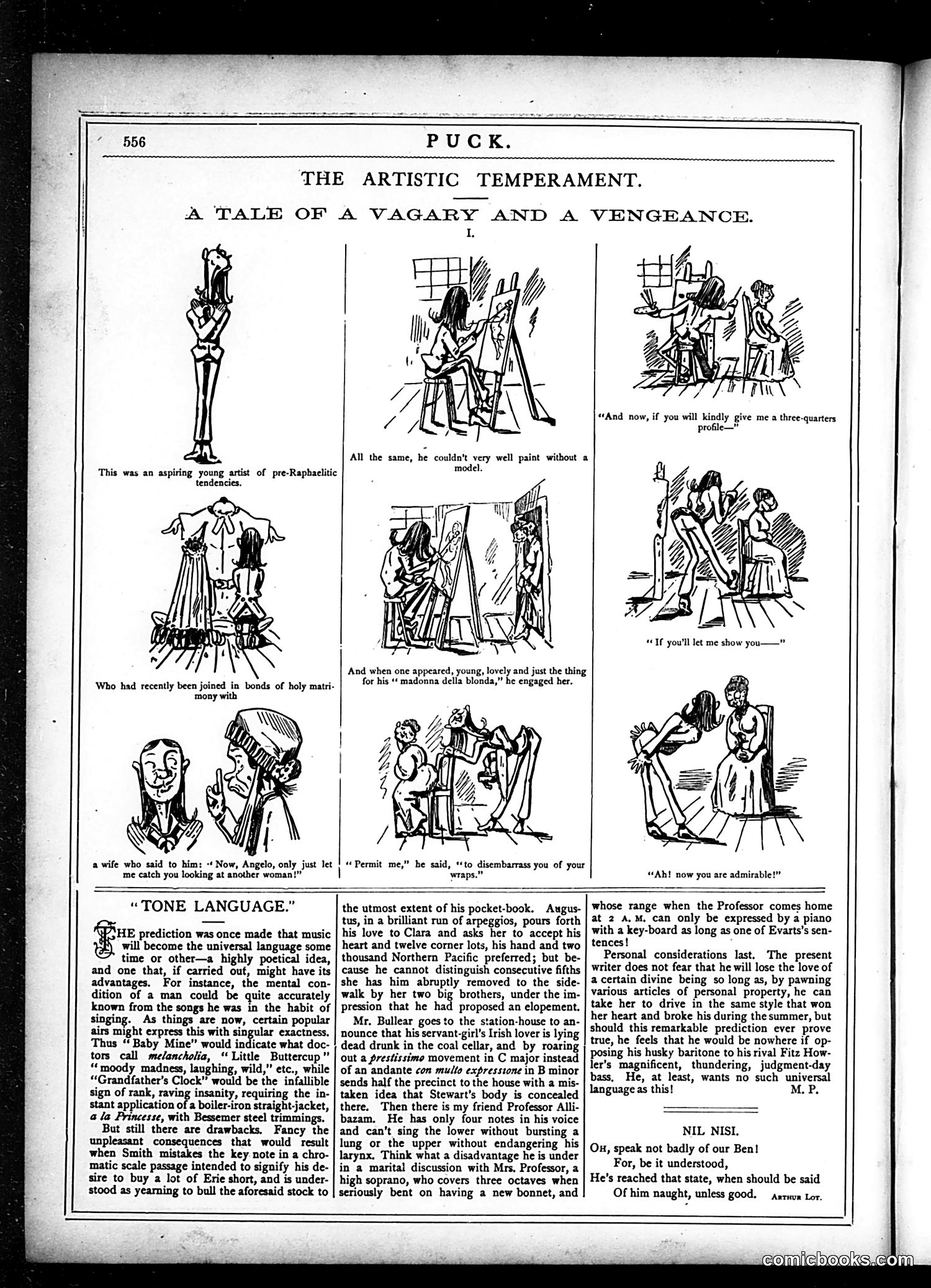
This satirical story mocks an aspiring pre-Raphaelite artist of "tendencies" (suggesting affected pretension). The narrative follows his romantic entanglements: he cannot paint without an attractive female model, becomes infatuated with a "young, lovely" model, and proposes elopement. When rejected, he drowns himself in a coal cellar. His widow then seeks revenge by posing as a model and striking him with her parasol during a painting session, concluding "Ah! now you are admirable!" The satire targets bohemian artistic affectation and volatile male temperament in the art world, while depicting female agency through the wife's practical vengeance. The pre-Raphaelite movement was known for elaborate romanticism and melodrama.
📄 Transcribed text from this page (OCR, searchable)
Machine-transcribed from the original scan — historical spelling and the odd misread are preserved.
PUCK. THE ARTISTIC TEMPERAMENT. A TALE OF A VAGARY AND A VENGEANCE. This was an aspiring young artist of pre-Raphaelitic tendencies. Who had recently been joined in bonds of holy matri- mony with a wife who said to him: ‘Now, Angelo, only just let me catch you looking at another woman!” and just the thing e engaged her. And when one appeared, young, lovely for his “ madonna della blonda,” “Permit me,” he said, ‘to disembarrass you of your wraps.” “And now, if you will kindly give me a three-quarters profile—" “Ah! now you are admirable!” “TONE LANGUAGE.” HE prediction was once made that music will become the universal language some time or other—a highly poetical idea, and one that, if carried out, might have its advantages. For instance, the mental con- dition of a man could be quite accurately known from the songs he was in the habit of singing. As things are now, certain popular airs might express this with singular exactness. Thus “Baby Mine” would indicate what doc- tors call melancholia, ‘Little Buttercup” ‘moody madness, laughing, wild,” etc., while “Grandfather's Clock” would be the infallible sign of rank, ering insanity, requiring the in- stant application of a boiler-iron straight-jacket, @ la Princesse, with Bessemer steel trimmings. But still there are drawbacks, Fancy the unpleasant consequences that would result when Smith mistakes the key note in a chro- matic scale passage intended to signify his de- sire to buy a lot of Erie short, and is under- stood as yearning to bull the aforesaid stock to the utmost extent of his pocket-book. Augus- tus, in a brilliant run of arpeggios, pours forth his love to Clara and asks her to accept his heart and twelve corner lots, his hand and two thousand Northern Pacific preferred; but be- cause he cannot distinguish consecutive fifths she has him abruptly removed to the side- walk by her two big brothers, under the im- pression that he had proposed an elopement. Mr. Bullear goes to the station-house to an- nounce that his servant-girl’s Irish lover is lying dead drunk in the coal cellar, and by roaring out a prestissime movement in C major instead of an andante con muito expresstone in B minor sends half the precinct to the house with a mis- taken idea that Stewart's body is concealed there, Then there is my friend Professor Alli- bazam. He has only four notes in his voice and can’t sing the lower without bursting a lung or the upper without endangering his larynx. Think what a disadvantage he is under in a marital discussion with Mrs. Professor, a high soprano, who covers three octaves when seriously bent on having a new bonnet, and whose range when the Professor comes home at 2 A.M, can only be expressed by a piano with a key-board as long as one of Evarts’s sen- tences! Personal considerations last. The present writer does not fear that he will lose the love of acertain divine being so long as, by pawning various articles of personal property, he can take her to drive in the same style that won her heart and broke his during the summer, but should this remarkable prediction ever prove true, he feels that he would be nowhere if op- posing his husky baritone to his rival Fitz How- ler’s magnificent, thundering, judgment-day bass, He, at least, wants no such universal language as this! M.P. NIL NISI. Ou, speak not badly of our Ben! For, be it understood, He's reached that state, when should be said Of him naught, unless good. Agruun Lor.