A complete issue · 16 pages · 1879
Puck — September 17, 1879
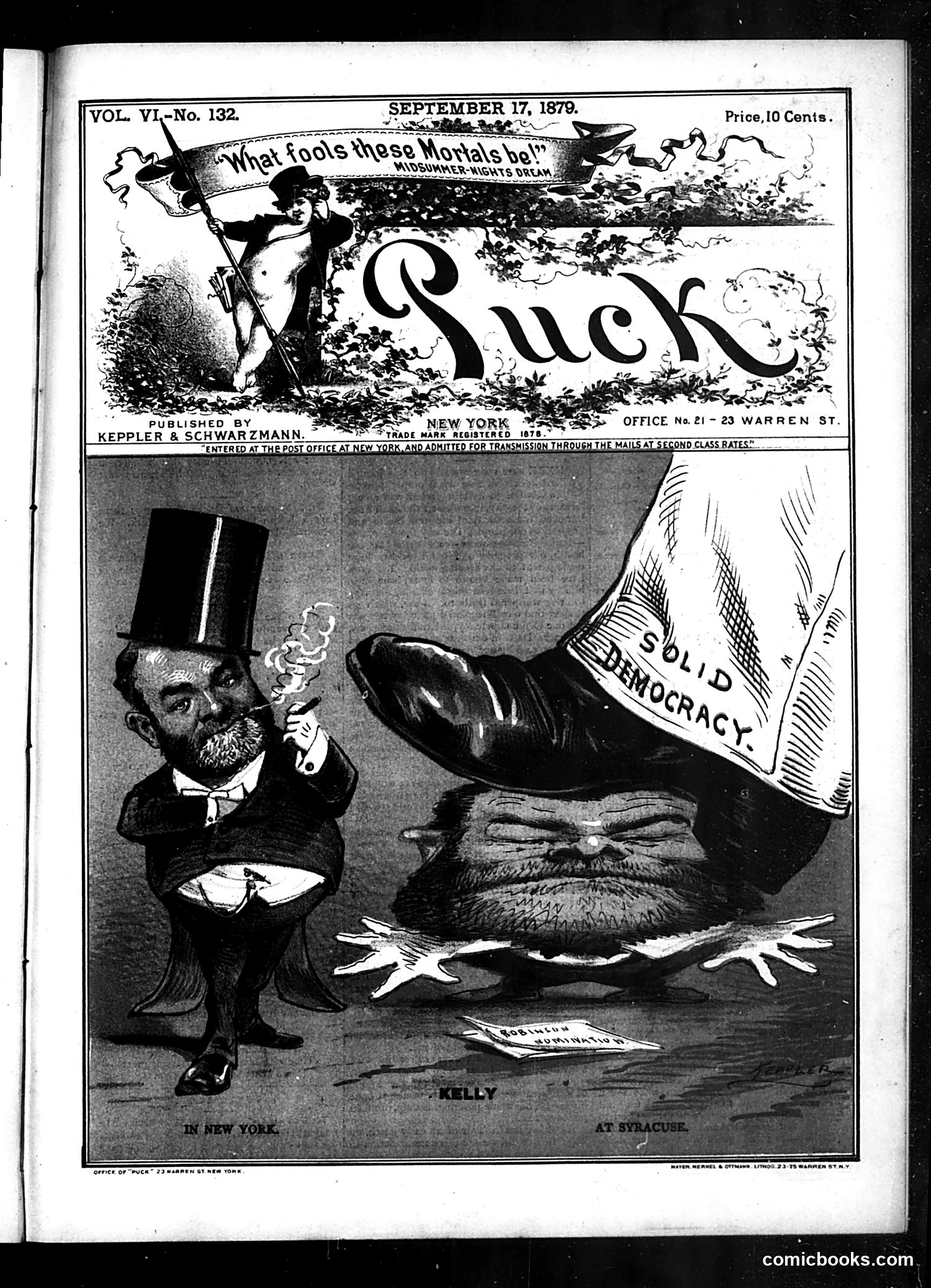
This cartoon satirizes political corruption during the Gilded Age. The small figure labeled "Kelly" (likely referring to a New York politician) stands in New York, while a massive boot labeled "Solid Democracy" crushes him at Syracuse. The boot's enormous size relative to Kelly emphasizes how Democratic political machinery overwhelmed individual politicians or reformers. The caption "What fools these Mortals be!" (from *A Midsummer Night's Dream*) mocks the naive belief that individuals could resist party power. The cartoonist criticizes how the Democratic Party's consolidated strength—its "solid" control—could eliminate political opposition or dissent through sheer institutional force. This reflects Reconstruction-era concerns about political monopolies and machine politics dominating American democracy.
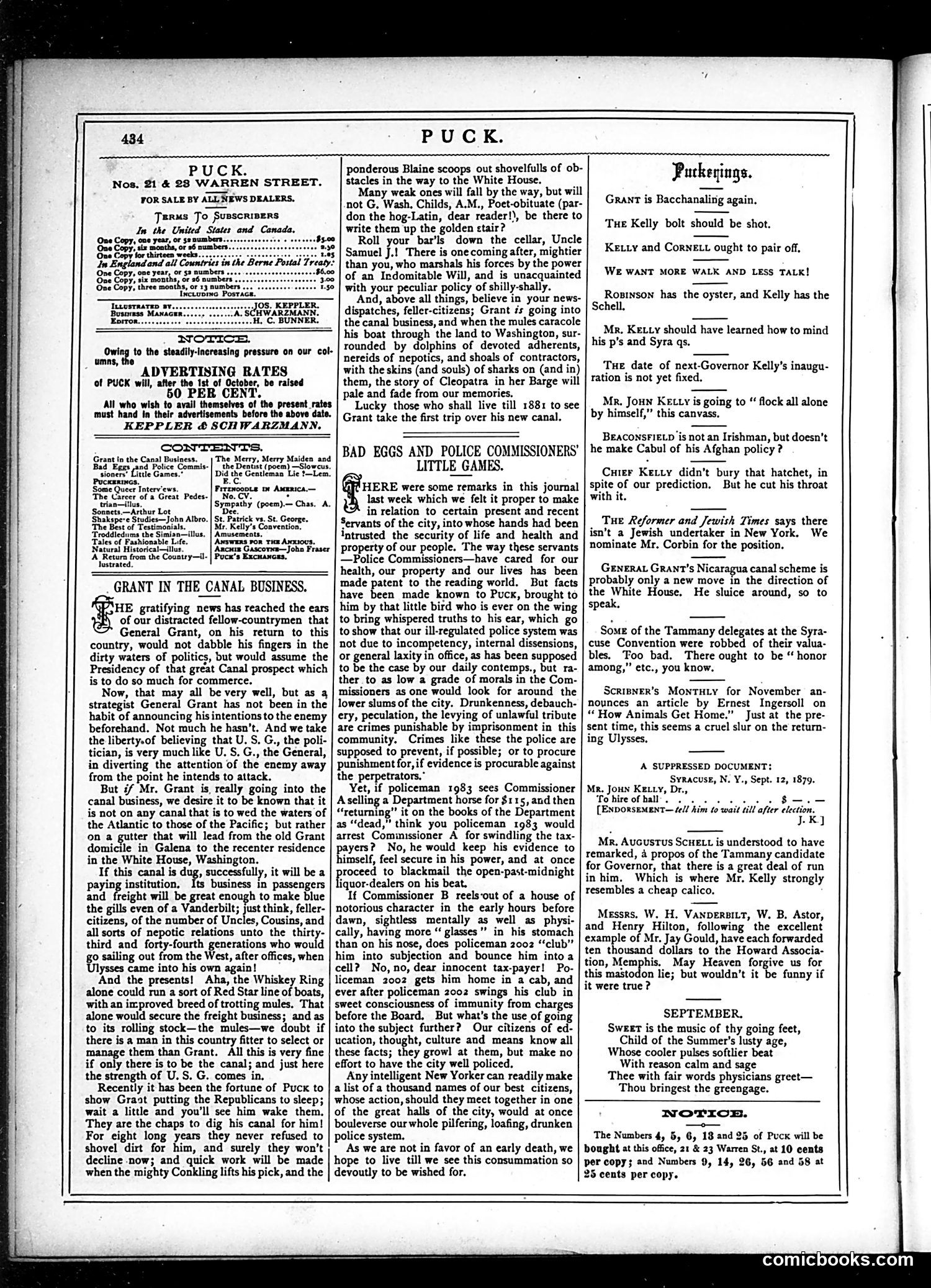
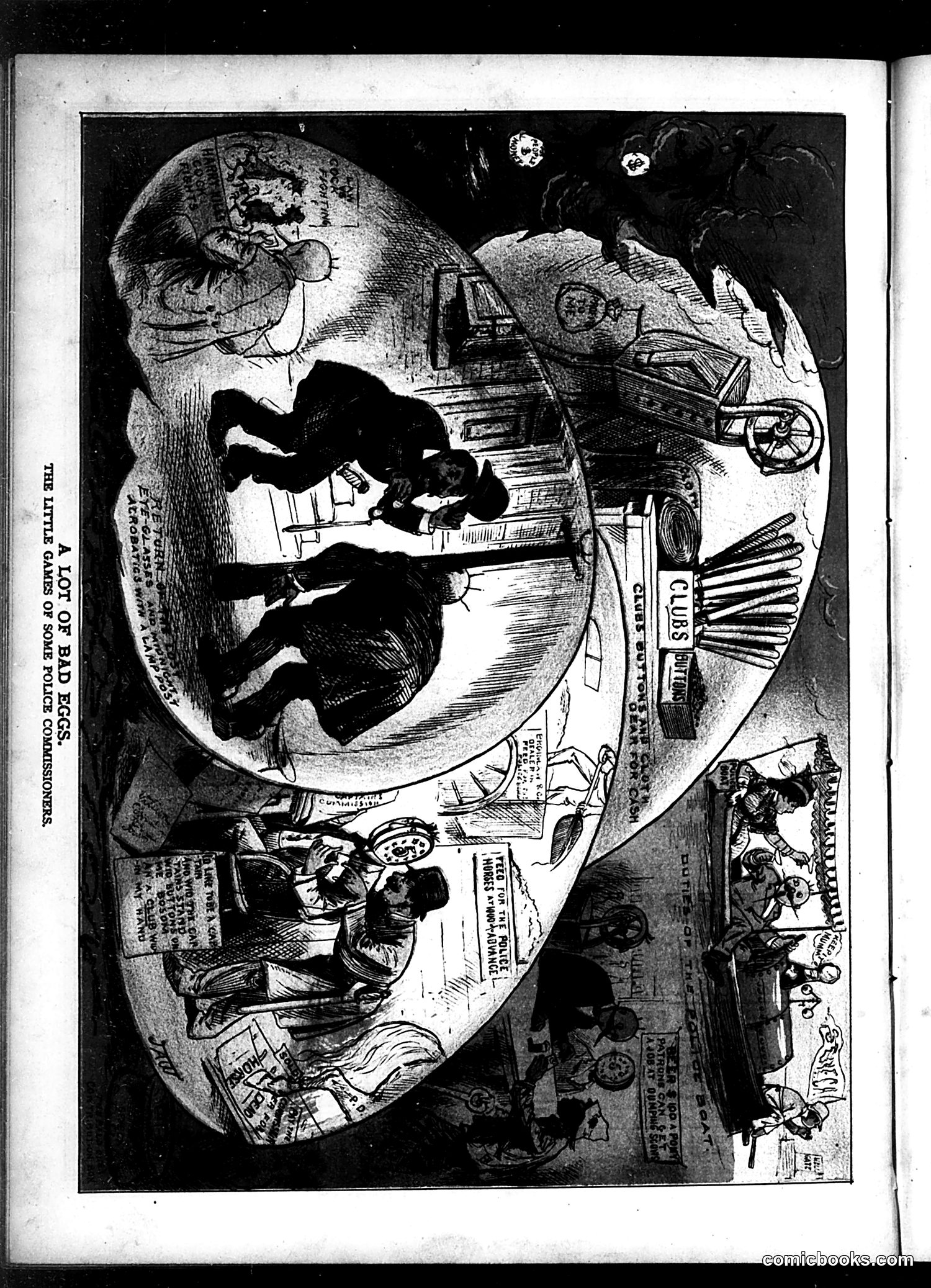
This page is primarily **text and advertisements** rather than political cartoons. The main editorial content is titled "GRANT IN THE CANAL BUSINESS," a satirical piece criticizing General Grant's proposed Nicaragua canal scheme. The satire argues that Grant, despite his military reputation, lacks the qualifications to oversee such a massive commercial project. The author suggests Grant's involvement would distract from proper governance and that his track record shows incompetence in non-military matters. The piece mocks both Grant's ambitions and those promoting the canal, using sharp rhetoric about incompetence, corruption, and mismanagement. The surrounding content includes brief "Puckerings" (humorous one-liners) about contemporary political figures and society gossip typical of the magazine's satirical approach.
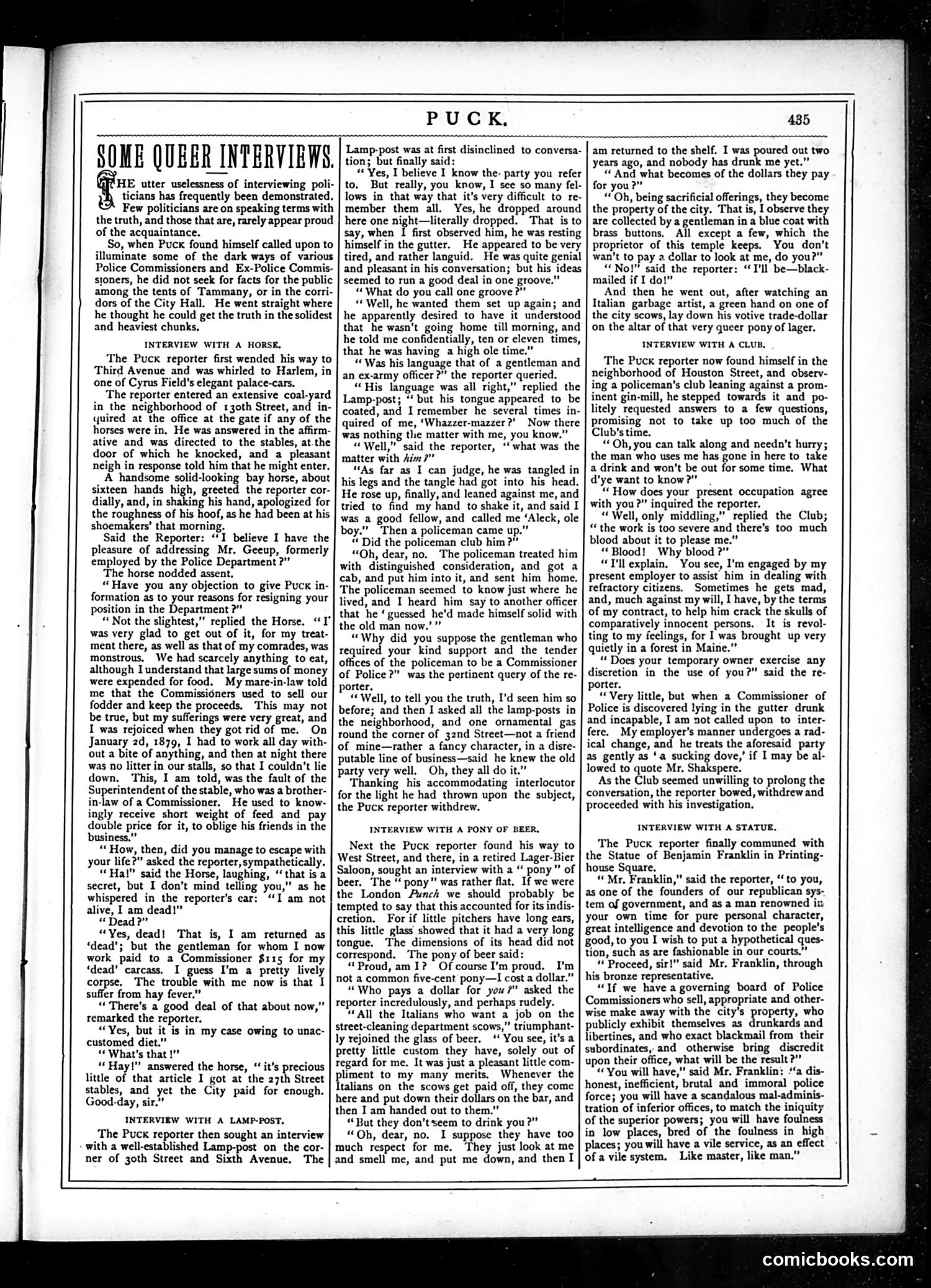
This page contains a series of humorous interviews titled "Some Queer Interviews," featuring satirical conversations between a Puck reporter and various New York City characters: a horse, a policeman's club, a pony of beer, a lamp-post, and a statue of Benjamin Franklin. The satire targets urban life and municipal governance through absurdist comedy. The interviews mock police practices, city infrastructure neglect, and political corruption—having inanimate objects voice complaints about how they're treated by the city and its citizens. The lamp-post, for instance, discusses being used by drunks; the beer pony comments on worker wages and patronage jobs. The humor relies on personification to critique contemporary civic problems indirectly, a common Puck technique for addressing sensitive social issues through whimsy rather than direct political attack.
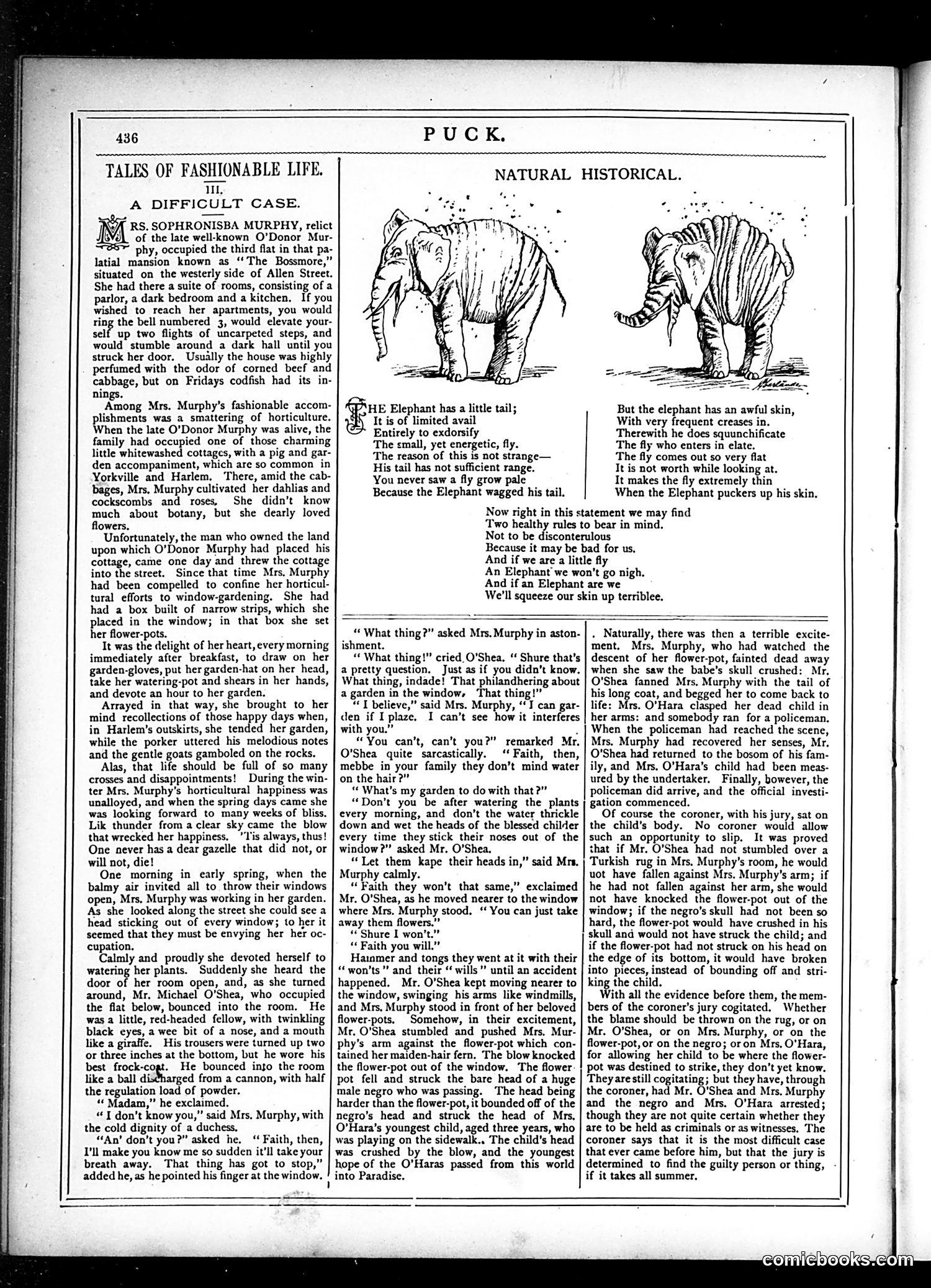
This page contains two distinct sections: **"Tales of Fashionable Life: A Difficult Case"** (left column) and **"Natural Historical"** (right column with elephant illustrations). The left column is a satirical narrative about Mrs. Sophronsba Murphy, a wealthy widow managing her fashionable Dublin residence. The humor centers on her conflict with Mr. O'Shea over window gardening—she waters plants daily; he claims the water damages his property below. The story escalates absurdly when a flower pot falls from her window, nearly killing his child. The right column is not political satire but rather a humorous "natural history" essay about elephants' physical characteristics, using whimsical logic to explain why elephants have wrinkled skin and limited tails. It's presented as pseudo-scientific commentary with light verse. Neither section appears to reference specific political figures or events—rather, they're general social satire aimed at Victorian bourgeois life and pretension.
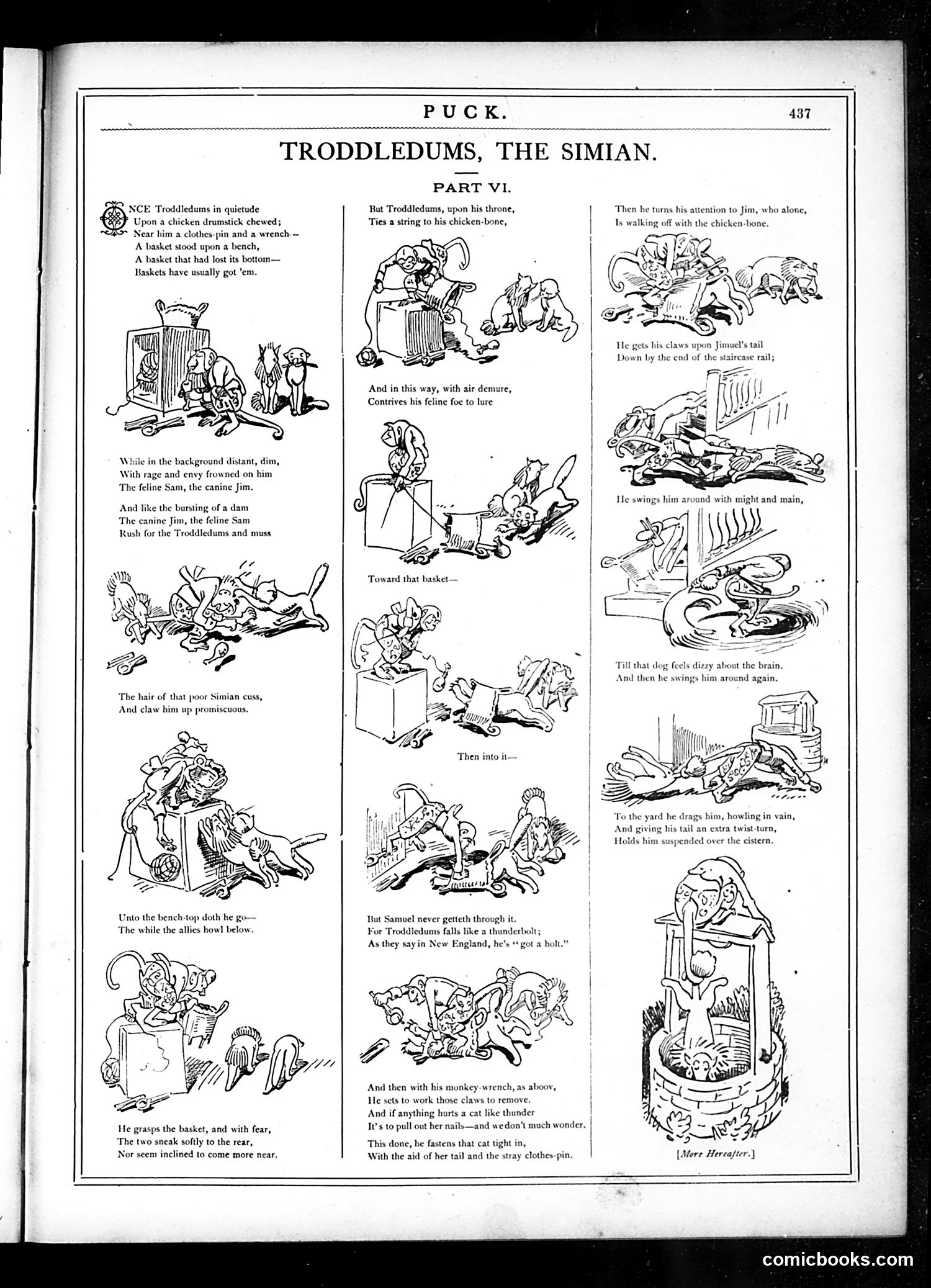
This is a continuation of a serialized satirical story featuring "Troddledums," a monkey character causing mayhem in a household. The narrative follows the primate's destructive rampage through various rooms and domestic spaces. The satire appears to mock human pretension and social order by showing how a single chaotic creature can disrupt an orderly Victorian household. The detailed illustrations depict Troddledums creating havoc—overturning baskets, tangling with pets, and generally wreaking destruction—with accompanying verse describing each scene. Without additional context about which specific public figures or events "Troddledums" represents, I cannot identify the political satire with certainty. The humor relies on slapstick animal chaos rather than obvious political allegory on this particular page.
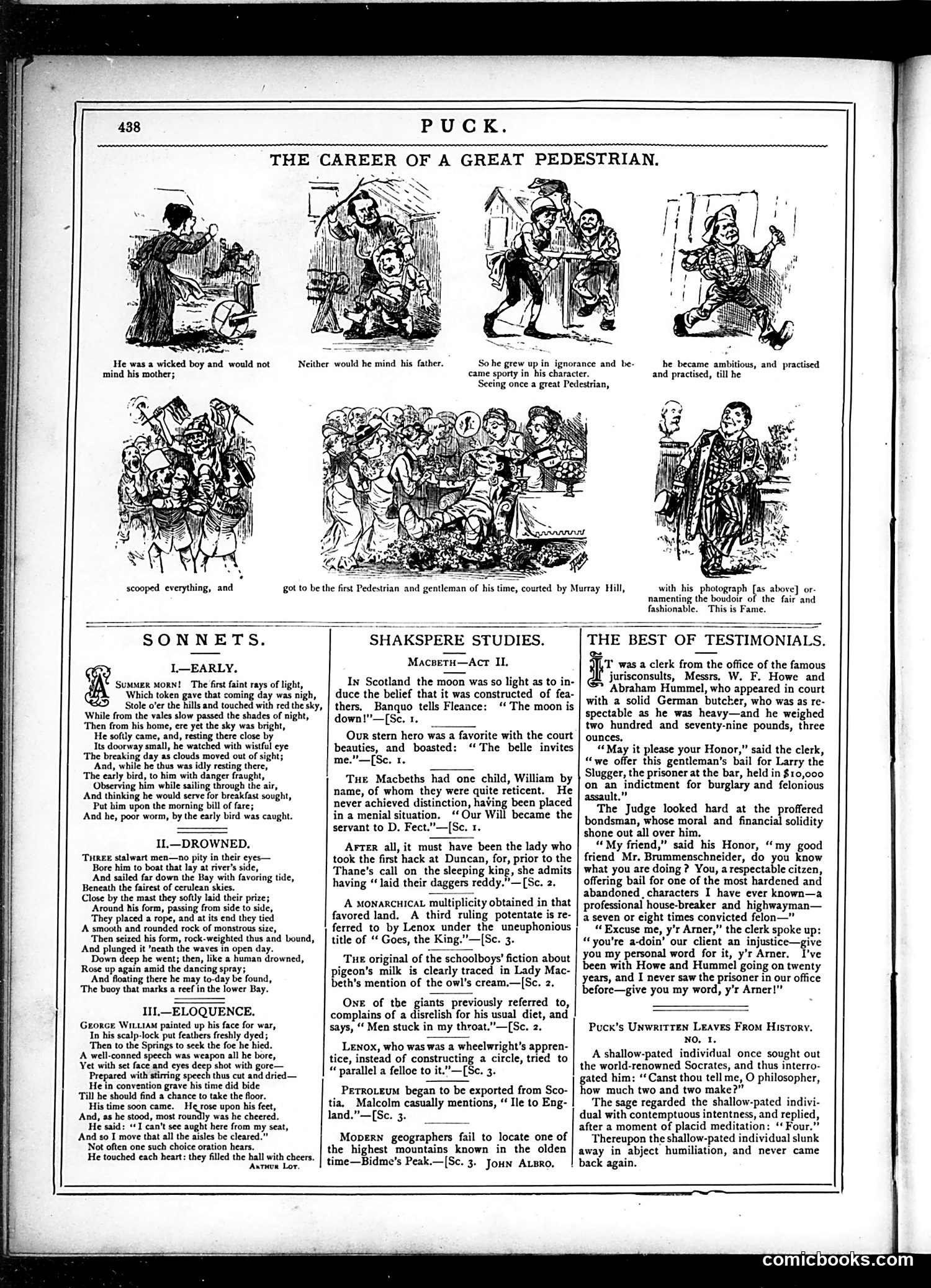
This satirical comic strip mocks someone (identity unclear from the image alone) who aspired to become a great pedestrian—likely meaning a famous walker or traveler. The sequence shows the figure's progression from childhood mischief through adulthood, ultimately achieving recognition "as the first Pedestrian and gentleman of his time." The humor targets the absurdity of pursuing fame through pedestrianism—an odd, undignified ambition. The supporting sections include Shakespearean studies and testimonials praising the "great pedestrian," which appear to parody inflated biographical narratives and dubious character endorsements. The satire likely critiques either a contemporary celebrity known for walking exploits or more broadly mocks pretentious social climbing and the manufacture of fame through trivial accomplishments.
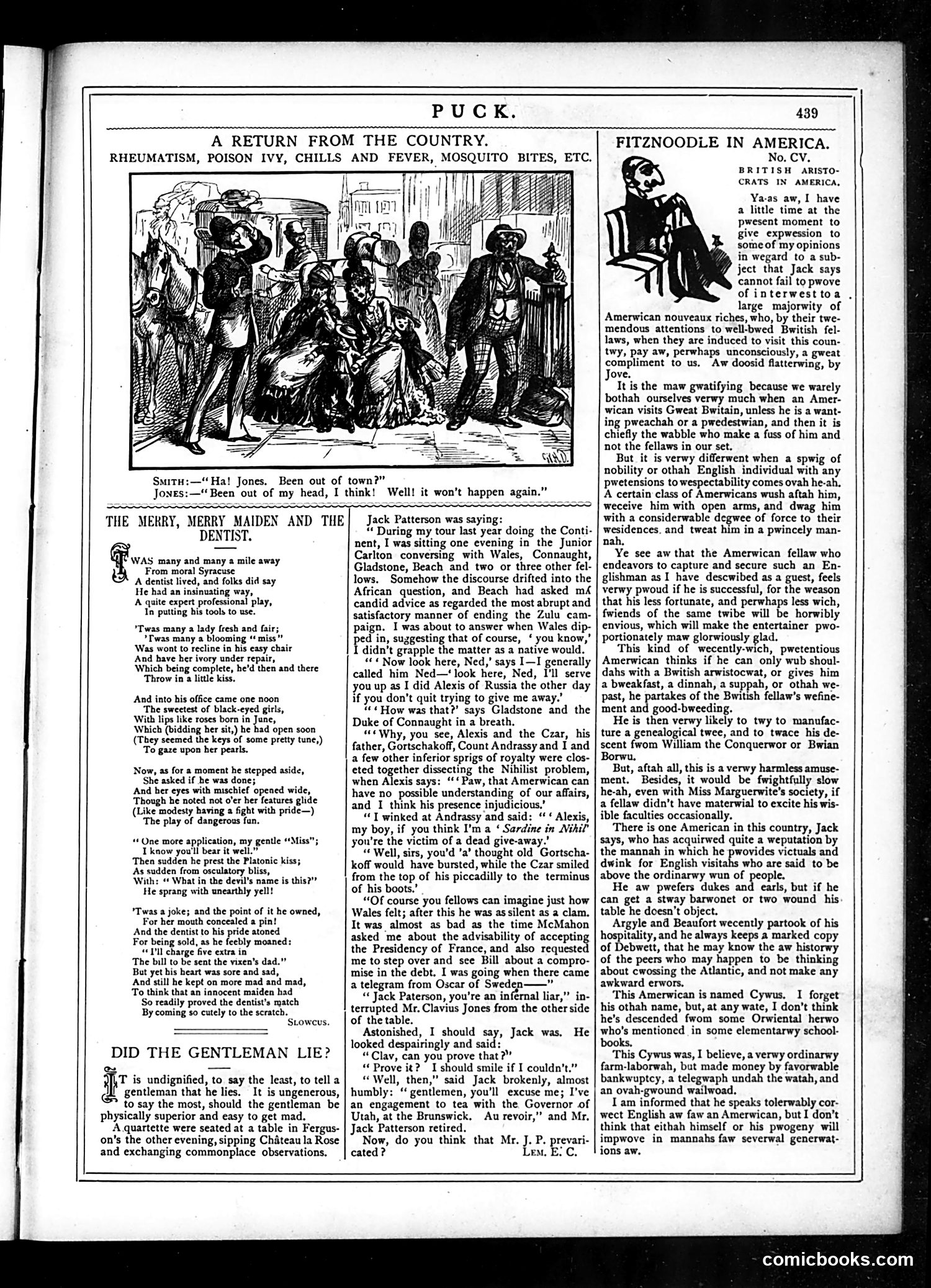
The main cartoon, "A Return from the Country," depicts a crowded indoor scene where a disheveled traveler returns from rural travel afflicted with various ailments—rheumatism, poison ivy, chills, fever, and mosquito bites. The humor mocks the romanticized notion of "roughing it" in nature; the contrast between city dwellers' pastoral fantasies and their actual miserable reality upon return is the satire's target. The right column discusses "Fitznoodle in America," criticizing wealthy British aristocrats visiting America. The text suggests these visitors receive disproportionate social attention despite possessing limited merit, and argues Americans too eagerly fawn over titled foreigners while neglecting their own accomplished citizens. This reflects 19th-century American anxieties about British cultural superiority and social snobbery.
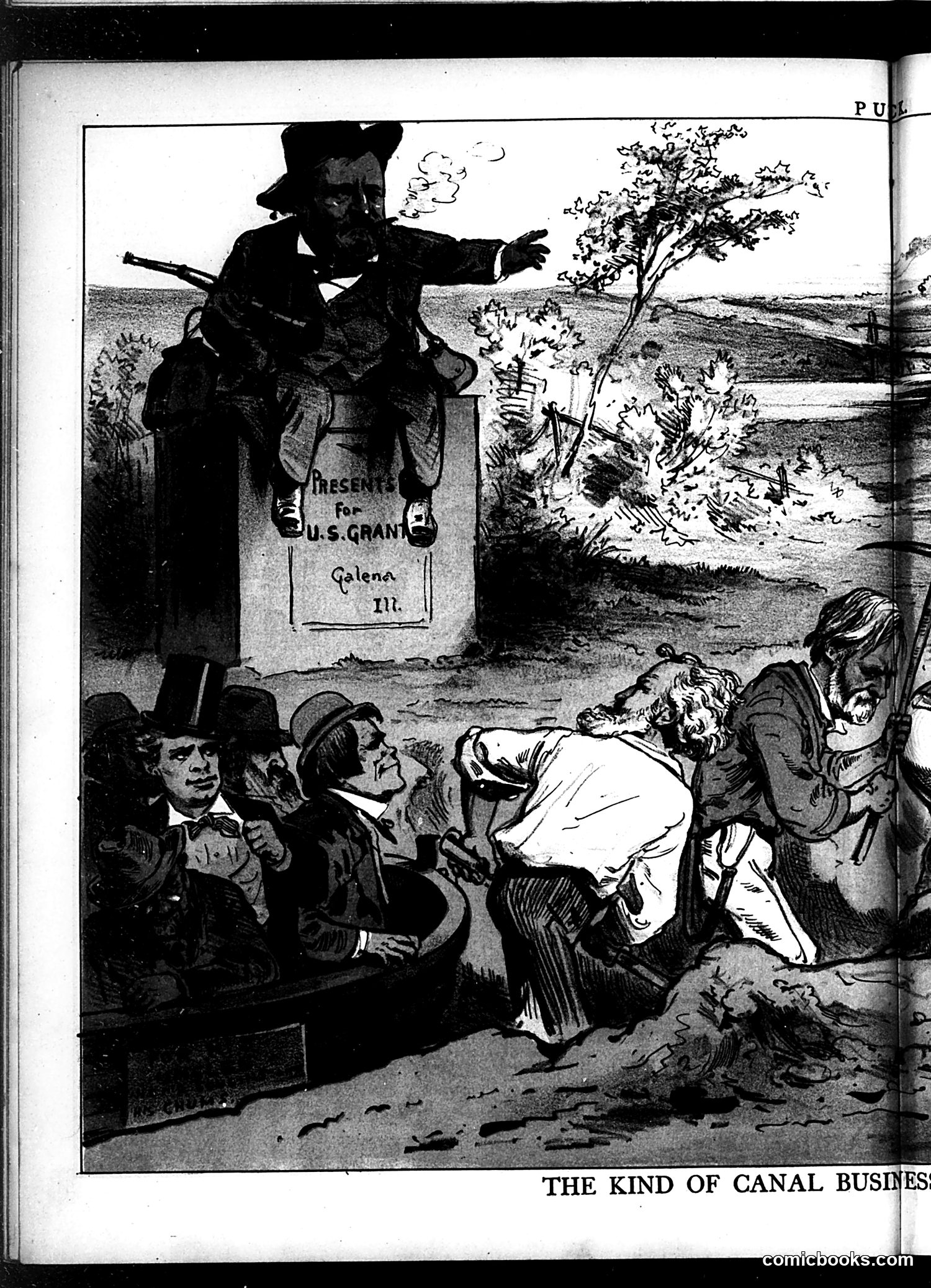
This Puck cartoon satirizes corruption in canal construction, specifically referencing U.S. Grant and Galena, Illinois (Grant's hometown). The figure atop the monument represents a corrupt politician or official overseeing the project. Below, working-class men appear to be digging or laboring, while one figure gestures dismissively toward them—suggesting exploitation or mismanagement of workers and public funds. The title "THE KIND OF CANAL BUSINESS" implies criticism of how canal projects operated as vehicles for graft and insider dealing rather than legitimate public works. The cartoon suggests that canal construction was a scheme where politically connected individuals (like those associated with Grant) profited while ordinary laborers did the actual work under poor conditions.
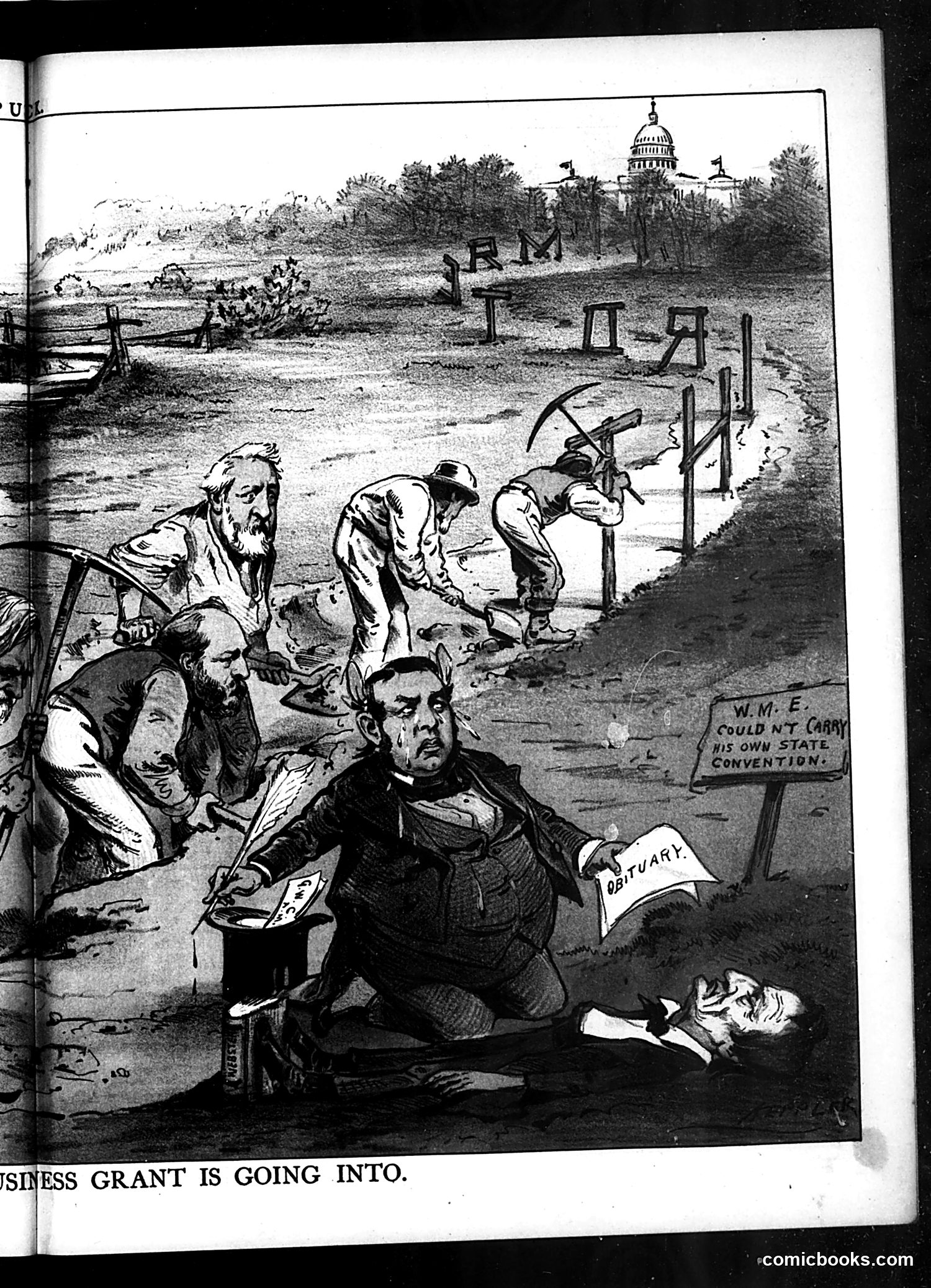
This political cartoon satirizes what appears to be corrupt patronage or misappropriation of government funds. The central figure, labeled with "OBITUARY," is literally being buried by workers while politicians and officials stand nearby. A sign reads "W.M.E. COULDN'T CARRY HIS OWN STATE CONVENTION," suggesting political failure or scandal. The Capitol building visible in the background emphasizes this is federal-level corruption. The gravediggers and burial imagery suggest the cartoon depicts the figurative "death" of some Grant-era business or political initiative through misuse or incompetence. The tone is darkly humorous—treating political/financial corruption as a burial of public trust or legitimate enterprise, with officials presiding over its demise.
This page contains the beginning of a serialized short story titled "Archie Gascoyne: A Romance of Skye," written by John Fraser and published in Puck magazine. It is not a political cartoon or satirical illustration but rather a literary work—specifically a romantic narrative set in Scotland. The text describes mysterious disappearances and domestic upheaval involving characters named Archie, Kenneth, Doctor Macintosh, and Miss Maggie. The story appears to be a mystery-romance involving Highland Scottish settings and characters. This represents Puck's literary content rather than its satirical cartoons. Without accompanying illustrations on this particular page, there is no political satire or social commentary to analyze.
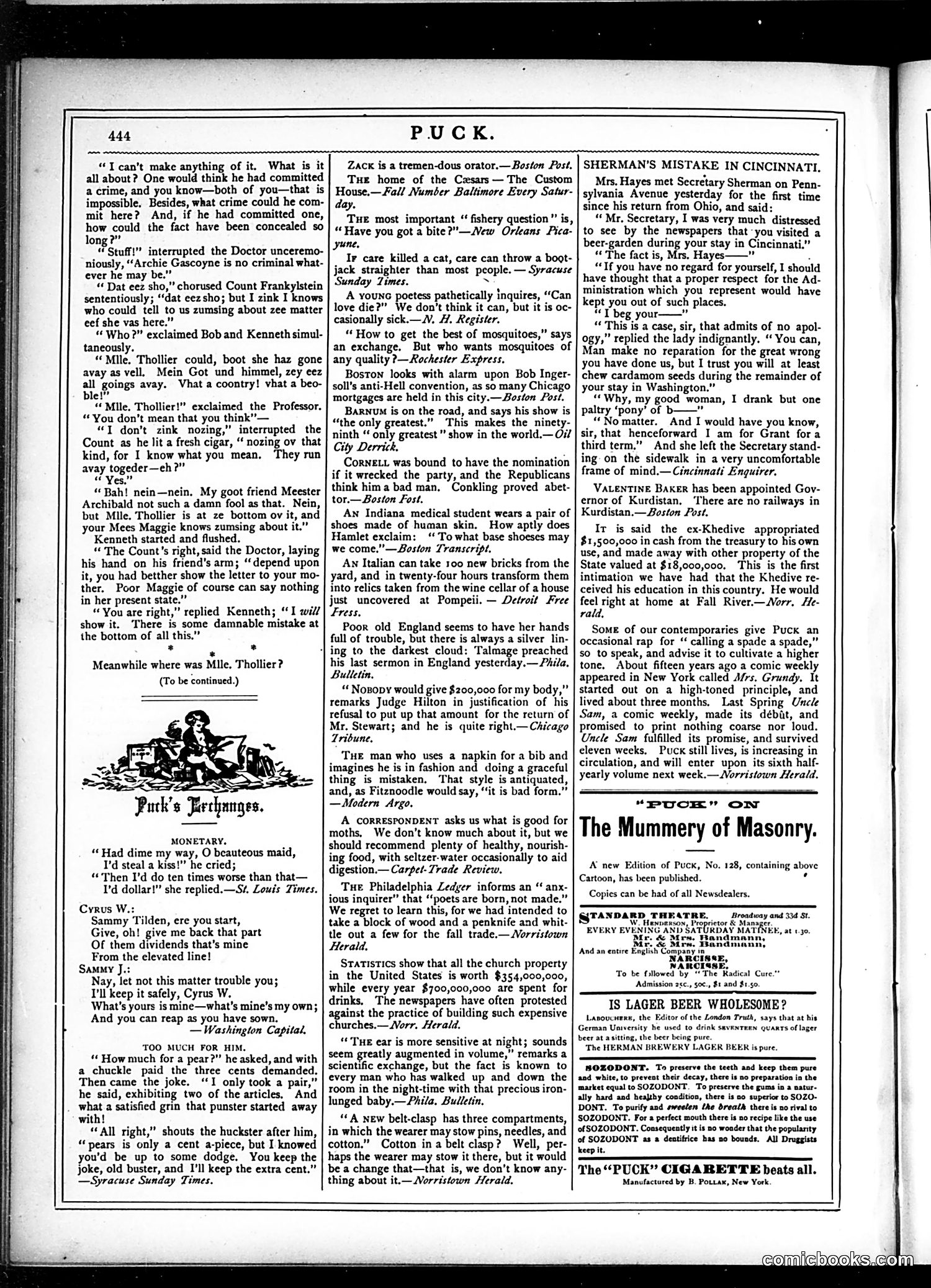
This page consists primarily of **text content** rather than cartoons. It includes: 1. **"Puck's Perplexities"** — a humor column featuring brief jokes and witty exchanges, including one about a miser and his servant (Cyrus W. and Samuel), and another mocking excessive charges for bread. 2. **"Sherman's Mistake in Cincinnati"** — a satirical anecdote about Secretary Sherman being embarrassed by newspaper coverage of his visit to a beer garden, which he tried to keep private. 3. **Various humorous observations** on topics like cat-throwing ability, fashion faux pas, and church property valuations. 4. **Advertisements** for products like "Puck" cigarettes and "The Mummery of Masonry" publication. The page's humor targets social pretension, miserliness, and political figures' attempts at privacy—typical Puck satire of the late 19th century.
This page is primarily **advertising**, not political satire. It contains commercial notices for products and services circa late 1800s, arranged around the margins of the page. The main image shows a **caricatured figure smoking a pipe**, advertising "Puck Smoking Tobacco" manufactured by R. Pollak, New York. The cartoon uses exaggerated facial features typical of period advertising. Other notable ads include: - Isaac Smith's umbrellas - Dunlap & Co. gentlemen's hats - The Bodega (photographer) - Hotel Brighton, Coney Island - G.H. Mumm champagne - Various patent medicines and confectionery The figure in the tobacco advertisement appears to be a generic "Puck" character (the magazine's mascot), rather than a specific political reference. This is a commercial page rather than editorial content containing satire.
This page is primarily **advertising**, not editorial content or satirical cartoons. It contains numerous commercial advertisements for late 19th-century products and services, including: - **J.M. Brunswick & Balke Co.** (billiard tables) - **Pachtmann & Moelich** (watches) - **E. Krueger** (photographer) - **Keep's Shirts** (clothing) - **Frash & Co.** (champagne) - **Ayala-Château d'Ay** (champagne) - Various other beverages, clothing, and services The page header reads "PUCK," identifying this as from the satirical magazine, but this particular page functions as a revenue-generating advertising section rather than containing political satire or editorial cartoons. The advertisements reflect consumer goods and services available to upper-class readers of the era.
This is primarily an **advertising page** from Puck magazine (page 447), featuring no visible political cartoons or satirical illustrations with identifiable figures. The page contains commercial advertisements for: - Pianos (Sohmer, Calenberg & Vaupel) - A Vienna Coffee Pot - Clothing and textiles (Arnold, Constable & Co.) - Furniture (Mathesius & Frey) - Barrett's tailor shop - Various other retail goods and services There is one small decorative illustration—a simple line drawing of a cigar box top—but no political or social satire visible. This appears to be a back-of-magazine advertising section rather than editorial content, which was typical for period magazines seeking revenue.