
Puck, 1879-09-17 · page 4 of 16
Puck — September 17, 1879 — page 4: what you’re looking at
What you’re looking at
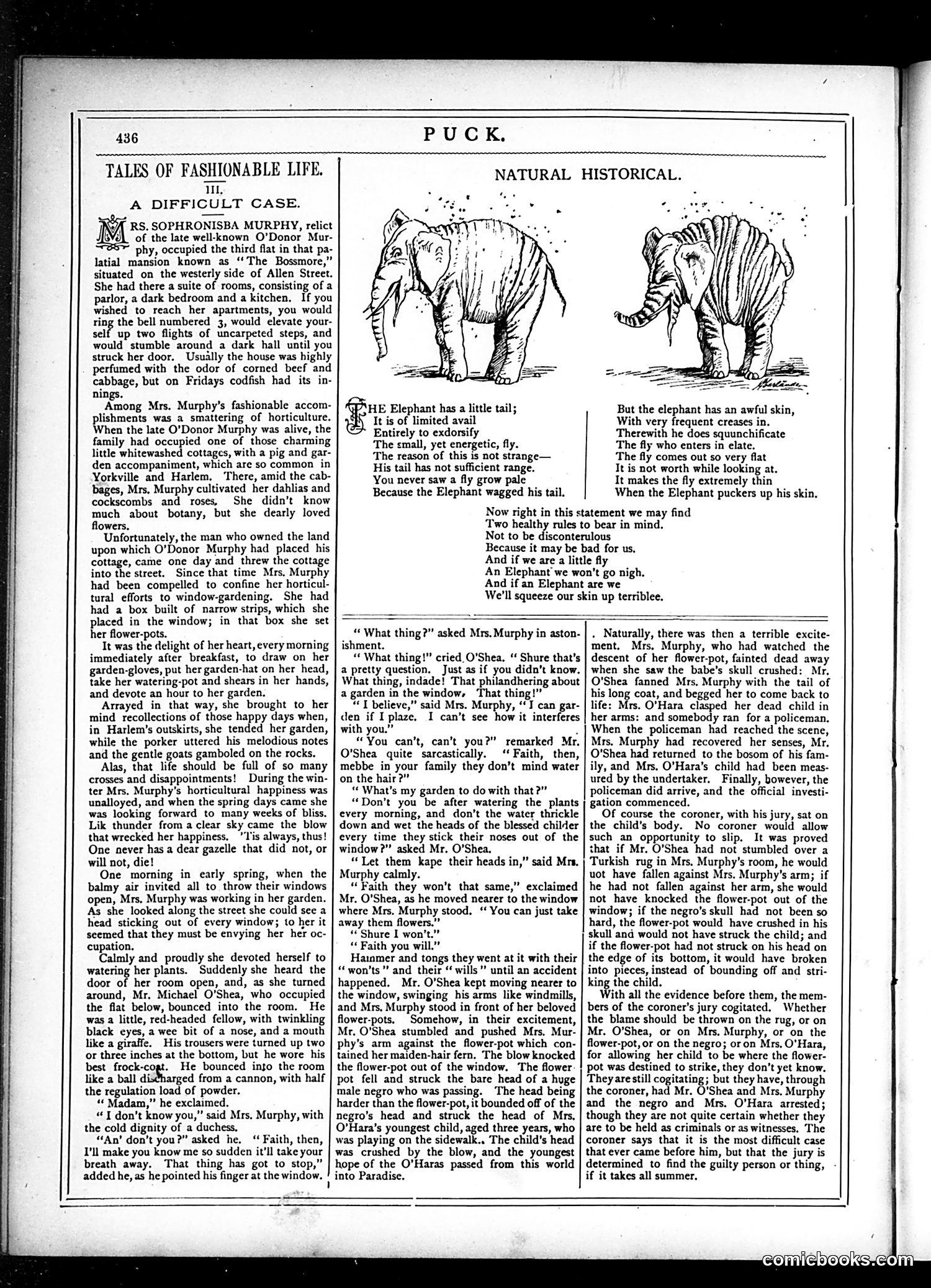
This page contains two distinct sections: **"Tales of Fashionable Life: A Difficult Case"** (left column) and **"Natural Historical"** (right column with elephant illustrations). The left column is a satirical narrative about Mrs. Sophronsba Murphy, a wealthy widow managing her fashionable Dublin residence. The humor centers on her conflict with Mr. O'Shea over window gardening—she waters plants daily; he claims the water damages his property below. The story escalates absurdly when a flower pot falls from her window, nearly killing his child. The right column is not political satire but rather a humorous "natural history" essay about elephants' physical characteristics, using whimsical logic to explain why elephants have wrinkled skin and limited tails. It's presented as pseudo-scientific commentary with light verse. Neither section appears to reference specific political figures or events—rather, they're general social satire aimed at Victorian bourgeois life and pretension.
📄 Transcribed text from this page (OCR, searchable)
Machine-transcribed from the original scan — historical spelling and the odd misread are preserved.
436 PUCK. TALES OF FASHIONABLE LIFE. Mi, A DIFFICULT CASE. Ww RS. SOPHRONISBA MURPHY, relict JN) of the late well-known O’Donor Mur- 3S> phy, occupied the third flat in that pa- latial mansion known as ‘‘The Bossmore,” situated on the westerly side of Allen Street. She had there a suite of rooms, consisting of a parlor, a dark bedroom and a kitchen, If you wished to reach her apartments, you would ring the bell numbered 3, would elevate your- self up two flights of uncarpeted steps, and would stumble around a dark hall until you struck her door. Usually the house was highly perfumed with the odor of corned becf and cabbage, but on Fridays codfish had its in- nings. Among Mrs. Murphy’s fashionable accom- plishments was a smattering of horticulture. When the late O'Donor Murphy was alive, the family had occupied one of those charming little whitewashed cottages, with a pig and gar- den accompaniment, which are so common in Yorkville and Harlem, There, amid the cab- bages, Mrs. Murphy cultivated her dahlias and cockscombs and roses, She didn’t know much about botany, but she dearly loved flowers, Unfortunately, the man who owned the land upon which O'Donor Murphy had placed his cottage, came one day and threw the cottage into the street. Since that time Mrs, Murphy had been compelled to confine her horticul- tural efforts to window-gardening. She had had a box built of narrow strips, which she placed in the window; in that box she set her flower-pots. It was the delight of her heart, every morning immediately after breakfast, to draw on her garden-gloves, put her garden-hat on her head, take her watering-pot and shears in her hands, and devote an hour to her garden. Arrayed in that way, she brought to her mind recollections of those happy days when, in Harlem's outskirts, she tended her garden, while the porker uttered his melodious notes and the gentle goats gamboled on the rocks. Alas, that life should be full of so many crosses and disappointments! During the win- ter Mrs. Murphy’s horticultural happiness was unalloyed, and when the spring days came she was looking forward to many weeks of bliss. Lik thunder from a clear sky came the blow that wrecked her happiness. “T'is always, thus! One never has a dear gazelle that did not, or will not, die! One morning in early spring, when the balmy air invited all to throw their windows open, Mrs. Murphy was working in her garden. As she looked along the street she could see a head sticking out of every window; to her it seemed that they must be envying her her oc- cupation. Calmly and proudly she devoted herself to watering her plants. Suddenly she heard the door of her room open, and, as she turned around, Mr. Michael O’Shea, who occupied the flat below, bounced into the room. He was a little, red-headed fellow, with twinkling black eyes, a wee bit of a nose, and a mouth like a giraffe. His trousers were turned up two or three inches at the bottom, but he wore his best frock-cogt. He bounced into the room like a ball dis¢harged from a cannon, with half the regulation load of powder. “ Madam,” he exclaimed. “J don’t know you,” said Mrs. Murphy, with the cold dignity of a duchess, “An' don’t you?” asked he. “ Faith, then, I'll make you know me so sudden it'll take your breath away. That thing has got to stop,” added he, as he pointed his finger at the window. | NATURAL HISTORICAL. It is of limited avail Entirely to exdorsify The small, yet energetic, fly. ‘The reason of this is not strange— His tail has not sufficient range. You never saw a fly grow pale Because the Elephant wagged his tail. ka Elephant has a little tail; But the elephant has an awful skin, With very frequent creases in. Therewith he does squunchificate The fly who enters in elate. The fly comes out so very flat It is not worth while looking at. It makes the fly extremely thin When the Elephant puckers up his skin, Now right in this statement we may find Two healthy rules to bear in mind. Not to be disconterulous Because it may be bad for us, And if we are a little fly An Elephant we won't go nigh. And if an Elephant are we We'll squeeze our skin up terriblee. “What thing?” asked Mrs. Murphy in aston- ishment. “« What thing!” cried O'Shea. “ Shure that’s a pretty question. Just as if you didn’t know. What thing, indade! That philandhering about a garden in the window, That thing!” “I believe,” said Mrs. Murphy, “I can gar- den if I plaze, I can’t see how it interferes with you.” 3 “You can’t, can't you?” remarked Mr. O'Shea quite sarcastically. ‘Faith, then, mebbe in your family they don’t mind water on the hair?” “What's my garden to do with that ?” “Don’t you be after watering the plants every morning, and don’t the water thrickle down and wet the heads of the blessed childer every time they stick their noses out of the window?” asked Mr. O'Shea, “Let them kape their heads in,” said Mrs. Murphy calmly. “Faith they won’t that same,” exclaimed Mr. O'Shea, as he moved nearer to the window where Mrs. Murphy stood. ‘ You can just take away them flowers.”” “Shure I won't.” “ Faith you will.” Hatomer and tongs they went at it with their “won'ts” and their ‘ wills” until an accident happened. Mr. O’Shea kept moving nearer to the window, swinging his arms like windmills, and Mrs, Murphy stood in front of her beloved flower-pots. Somehow, in their excitement, Mr, O'Shea stumbled and pushed Mrs, Mur- phy’s arm against the flower-pot which con- tained her maiden-hair fern, The blow knocked the flower-pot out of the window. The flower pot fell and struck the bare head of a huge male negro who was passing. The head being harder than the flower-pot, it bounded off of the negro’s head and struck the head of Mrs. O’Hara’s youngest child, aged three years, who was playing on the sidewalk.. The child’s head was crushed by the blow, and the youngest hope of the O'Haras passed from this world into Paradise. . Naturally, there was then a terrible excite- ment. Mrs. Murphy, who had watched the descent of her flower-pot, fainted dead away when she saw the babe’s skull crushed: Mr, O'Shea fanned Mrs. Murphy with the tail of his long coat, and begged her to come back to life: Mrs. O'Hara clasped her dead child in her arms: and somebody ran for a policeman, When the policeman had reached the scene, Mrs, Murphy had recovered her senses, Mr. O'Shea had returned to the bosom of his fam- ily, and Mrs, O’Hara’s child had been meas- ured by the undertaker. Finally, bowever, the policeman did arrive, and the official investi- gation commenced. Of course the coroner, with his jury, sat on the child's body. No coroner would allow such an opportunity to slip. It was proved that if Mr. O'Shea had not stumbled over a Turkish rug in Mrs, Murphy’s room, he would uot have fallen against Mrs. Murphy’s arm; if he had not fallen against her arm, she would not have knocked the flower-pot out of the window; if the negro’s skull had not been so hard, the flower-pot would have crushed in his skull and would not have struck the child; and if the flower-pot had not struck on his head on the edge of its bottom, it would have broken into pieces, instead of bounding off and stri- king the child, ‘ith all the evidence before them, the mem- bers of the coroner's jury cogitated. Whether the blame should be thrown on the rug, or on Mr. O'Shea, or on Mrs, Murphy, or on the flower-pot, or on the negro; oron Mrs, O'Hara, for allowing her child to be where the flower- pot was destined to strike, they don’t yet know. They are still cogitating; but they have, through the coroner, had Mr. O'Shea and Mrs. Murphy and the negro and Mrs. O'Hara arrested; though they are not quite certain whether they are to be held as criminals or as witnesses. The coroner says that it is the most difficult case that ever came before him, but that the jury is determined to find the guilty person or thing, if it takes all summer, cComicbooks*con