
Puck, 1879-09-17 · page 6 of 16
Puck — September 17, 1879 — page 6: what you’re looking at
What you’re looking at
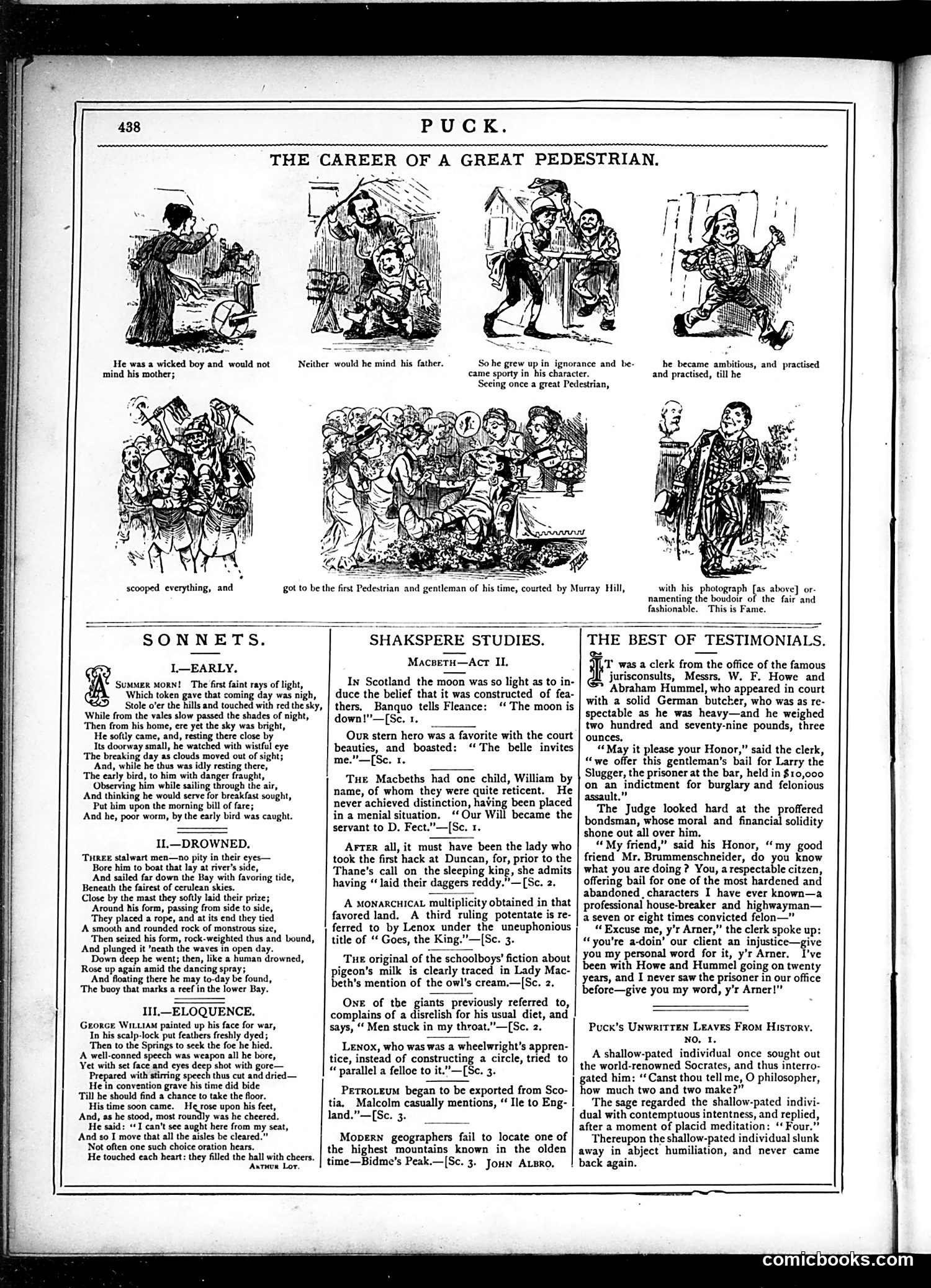
This satirical comic strip mocks someone (identity unclear from the image alone) who aspired to become a great pedestrian—likely meaning a famous walker or traveler. The sequence shows the figure's progression from childhood mischief through adulthood, ultimately achieving recognition "as the first Pedestrian and gentleman of his time." The humor targets the absurdity of pursuing fame through pedestrianism—an odd, undignified ambition. The supporting sections include Shakespearean studies and testimonials praising the "great pedestrian," which appear to parody inflated biographical narratives and dubious character endorsements. The satire likely critiques either a contemporary celebrity known for walking exploits or more broadly mocks pretentious social climbing and the manufacture of fame through trivial accomplishments.
📄 Transcribed text from this page (OCR, searchable)
Machine-transcribed from the original scan — historical spelling and the odd misread are preserved.
PUCK. THE CAREER OF A GREAT PEDESTRIAN. He was a wicked boy and would not mind his mother; scooped everything, and So he grew up in ignorance and be- came sporty in his character. he became ambitious, and practised and practised, till he Seeing once a great Pedestrian, got to be the first Pedestrian and gentleman of his time, courted by Murray Hill, with bis, photograph [as abore] or. namenting the boudoir of the fair and fashionable. This is Fame. SONNETS. I—EARLY. SUMMER MORN! The first faint rays of light, Which token gave that coming day was nigh, Stole o'er the hills and touched with red the sky, While from the vales slow passed the shades of night, Then from his home, ere yet the sky was bright, He softly came, and, resting there close by Its doorway small, he watched with wistful eye ‘The breaking day as clouds moved out of sight; And, while he thus was idly resting there, The early bird, to him with danger fraught, Observing him while sailing through the air, And thinking he would serve for breakfast sought, Put him upon the morning bill of fare; And he, poor worm, by the early bird was caught. I1l.—DROWNED. ‘Tuner stalwart men—no pity in their eyes— Bore him to boat that lay at river’s side, ‘And sailed far down the Bay with favoring tide, Beneath the fairest of cerulean skies. Close by the mast they softly laid their prize; ‘Around his form, passing from side to sid They placed a rope, and at its end they A smooth and rounded rock of monstrous size, ‘Then seized his form, rock-weighted thus and Lound, And plunged it ‘neath the waves in open day. Down deep he went; then, like a human drowned, Rose up again amid the dancing spray; ‘And floating there he may to-day be found, The buoy that marks a reef in the lower Bay. III.—ELOQUENCE, GrorcE WILLIAM painted up his face for war, In his scalp-lock put feathers freshly dyed; Then to the Springs to seek the foe he hied. A well-conned speech was weapon all he bore, Yet with set face and eyes deep shot w Prepared with stirring speech thus cut and dried— He in convention grave his time did bide Till he should find a chance to take the floor. His time soon came. He rose upon bs feet, And, as he stood, most roundly was he cheered. He said: «I can’t see aught here from my seat, ‘And to I move that all the aisles be cleared.” Not often one such choice oration hears. He touched each heart: they filled the hall with cheers. Axtuve Lor. SHAKSPERE STUDIES. Macsetu—Act II. In Scotland the moon was so light as to in- duce the belief that it was constructed of fea- thers, Banquo tells Fleance: ‘‘ The moon is down!"—[Se. 1. Our stern hero was a favorite with the court beauties, and boasted: ‘The belle invites me.”—[Sc. 1. Tue Macbeths had one child, William by name, of whom they were quite reticent. He never achieved distinction, having been placed in a menial situation. ‘‘ Our Will became the servant to D. Fect.”—[Sc. 1. AFTER all, it must have been the lady who took the first hack at Duncan, for, prior to the Thane’s call on the sleeping king, she admits having “ laid their daggers reddy.”—[Sc. 2. A MONARCHICAL multiplicity obtained in that favored land, A third ruling potentate is re- ferred to by Lenox under the uneuphonious title of “ Goes, the King.”—[Sc. 3. ‘Tue original of the schoolboys’ fiction about pigeon’s milk is clearly traced in Lady Mac- beth’s mention of the owl’s cream.—[Sc. 2. One of the giants previously referred to, complains of a disrelish for his usual diet, and says, ‘‘ Men stuck in my throat.”—[Sc. 2. Lenox, who was was a wheelwright’s appren- tice, instead of constructing a circle, tried to “ parallel a felloe to it.”—[Sc. 3. PetTROLEUM began to be exported from Sco- tia. Malcolm casually mentions, “ Ile to Eng- land.”—[Sc. 3. Mopern geographers fail to locate one of the highest mountains known in the olden time—Bidme's Peak.—[Sc. 3. Joun ALBRO. THE BEST OF TESTIMONIALS. ‘T'was a clerk from the office of the famous jurisconsults, Messrs, W. F. Howe and Abraham Hummel, who appeared in court with a solid German butcher, who was as re- spectable as he was heavy—and he weighed two hundred and seventy-nine pounds, three ounces, “May it please your Honor,” said the clerk, “we offer this gentleman's bail for Larry the Slugger, the prisoner at the bar, held in $10,000 on an indictment for burglary and felonious assault.” The Judge looked hard at the proffered bondsman, whose moral and financial solidity shone out all over him, “My friend,” said his Honor, “my good friend Mr. Brummenschneider, do you know what you are doing ? You, arespectable citzen, offering bail for one of the most hardened and abandoned , characters I have ever known—a professional house-breaker and highwayman— a seven or eight times convicted felon—” “Excuse me, y’r Arner,” the clerk spoke up: “you're a-doin’ our client an injustice—give you my personal word for it, y’r Arner. I've been with Howe and Hummel going on twenty years, and I never saw the prisoner in our office before—give you my word, y’r Arner!"” Puck’s Unwritren Leaves From History. NO, 1. A shallow-pated individual once sought out the world-renowned Socrates, and thus interro- gated him: ‘Canst thou tell me, O philosopher, how much two and two make?” ‘The sage regarded the shallow-pated indivi- dual with contemptuous intentness, and replied, after a moment of placid meditation: ‘ Four.” Thereupon the shallow-pated individual slunk away in abject humiliation, and never came back again. comicbooks.com