
Puck, 1879-09-17 · page 10 of 16
Puck — September 17, 1879 — page 10: what you’re looking at
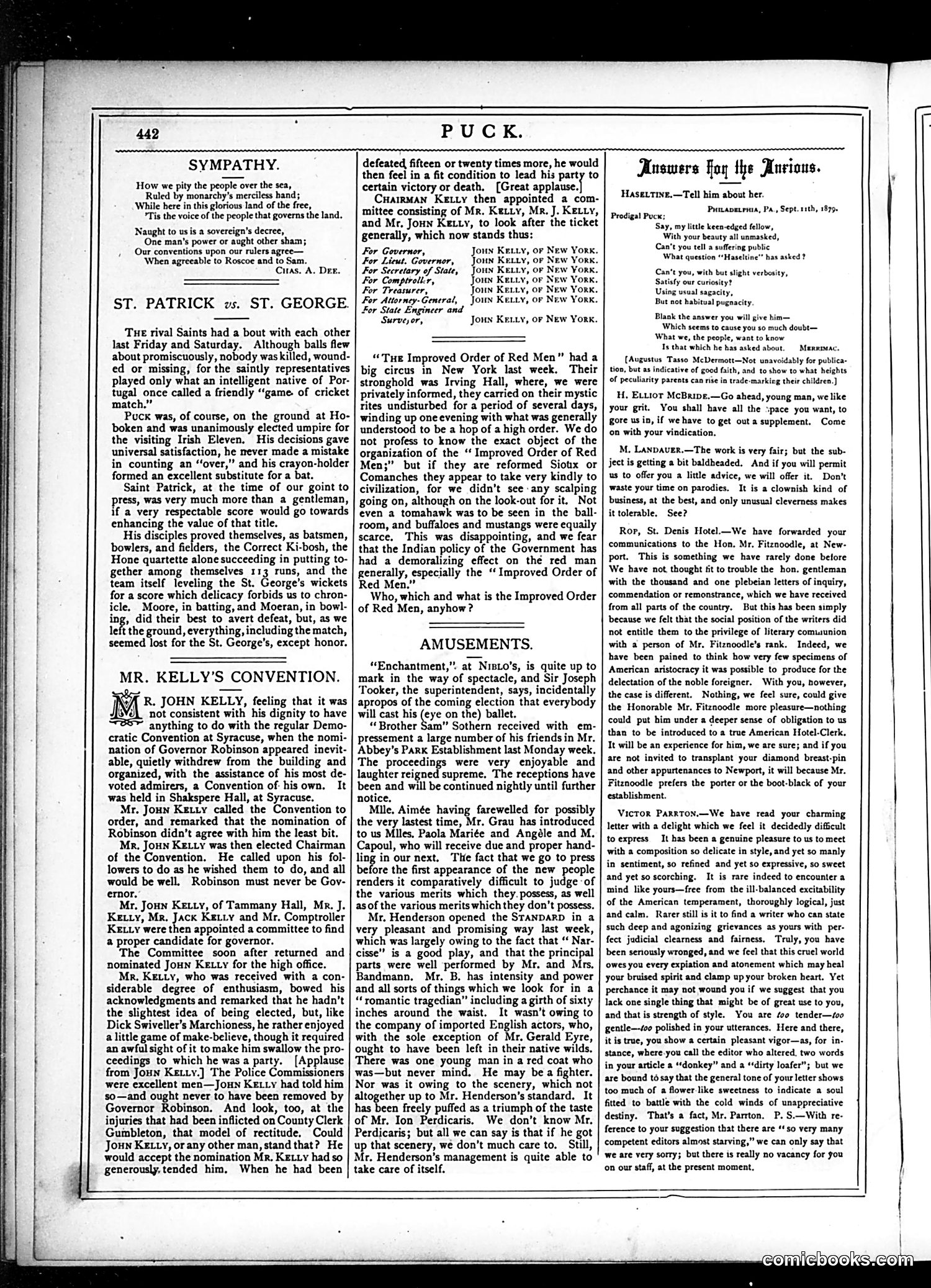
A restored page from Puck, 1879-09-17. Page through the whole issue in the reader above.
📄 Transcribed text from this page (OCR, searchable)
Machine-transcribed from the original scan — historical spelling and the odd misread are preserved.
442 SYMPATHY. How we pity the people over the sea, Ruled by monarchy’s merciless hand; While here in this glorious land of the free, "Tis the voice of the people that governs the land. Naught to us is a sovereign’s decree, ‘One man’s power or aught other sham; Our conventions upon our rulers agree— When agreeable to Roscoe and to Sam. Cuas. A. Dez. ST. PATRICK zs. ST. GEORGE. Tue rival Saints had a bout with each other last Friday and Saturday. Although balls flew about promiscuously, nobody was killed, wound- ed or missing, for the saintly representatives played only what an intelligent native of Por- tugal once called a friendly “game. of cricket match.” Puck was, of course, on the ground at Ho- ‘boken and was unanimously elected umpire for the visiting Irish Eleven. His decisions gave universal satisfaction, he mever made a mistake in counting an “over,” and his crayon-holder formed an excellent substitute for a bat. Saint Patrick, at the time of our goint to press, was very much more than a gentleman, if a very respectable score would go towards enhancing the value of that title. His disciples proved themselves, as batsmen, bowlers, and fielders, the Correct Ki-bosh, the Hone quartette alone succeeding in putting to- gether among themselves 113 runs, and the team itself leveling the St. George’s wickets for a score which delicacy forbids us to chron- icle, Moore, in batting, and Moeran, in bowl- ing, did their best to avert defeat, but, as we left the ground, everything, including the match, seemed lost for the St. George's, except honor. MR. KELLY’S CONVENTION. . JOHN KELLY, feeling that it was not consistent with his dignity to have anything to do with the regular Demo- cratic Convention at Syracuse, when the nomi- nation of Governor Robinson appeared inevit- able, quietly withdrew from the building and organized, with the assistance of his most de- voted admirers, a Convention of: his own. It was held in Shakspere Hall, at Syracuse. Mr. Joun Ketty called the Convention to order, and remarked that the nomination of Robinson didn’t agree with him the least bit. Mr. Joun KEtty was then elected Chairman of the Convention. He called upon his fol- lowers to do as he wished them to do, and all would be well. Robinson must never be Gov- ernor. Mr. Joun Ketty, of Tammany Hall, Mr. J. Ketty, Mr. Jack Ketty and Mr. Comptroller KELLy were then appointed a committee to find a proper candidate for governor. The Committee soon after returned and nominated Joun Ketty for the high office. Mr. Ketty, who was received with a con- siderable degree of enthusiasm, bowed his acknowledgments and remarked that he hadn’t the slightest idea of being elected, but, like Dick Swiveller’s Marchioness, he rather enjoyed a little game of make-believe, though it required an awful sight of it to make him swallow the pro- ceedings to which he was a party. [Applause from Joun Ketty.] The Police Commissioners were excellent men—JouN KELLy had told him so—and ought never to have been removed by Governor Robinson. And look, too, at the injuries that had been inflicted on County Clerk Gumbleton, that model of rectitude. Could Joun KELLY, orany other man, stand that? He would accept the nomination Mr. Ketty had so PUCK. defeated fifteen or twenty times more, he would then feel in a fit condition to lead his party to certain victory or death. [Great applause} CuairMan Ketty then appointed a com- mittee consisting of Mr. Katy, MR. J. Ketty, and Mr. Joun Key, to look after the ticket generally, which now stands thus: Joun Kexty, or New Yorx. Joun Ketty, or New York. Joun Ketty, or New Joun Kexy, or Ni Joun Ketty, or Ne Joun Kerry, or New York. For Governor, For Lieut. Governor, For Secretary of State, For Comptroli:r, For Treasurer, For Attorney-General, For State Engineer and Surveyor, Joun Ketty, or New York. “Tue Improved Order of Red Men” had a big circus in New York last week. Their stronghold was Irving Hall, where, we were privately informed, they carried on their mystic rites undisturbed for a period of several days, winding up one evening with what was generally understood to be a hop of a high order. We do not profess to know the exact object of the organization of the ‘“ Improved Order of Red Men;” but if they are reformed Sioux or Comanches they appear to take very kindly to civilization, for we didn’t see any scalping going on, although on the look-out for it. Not even a tomahawk was to be seen in the ball- room, and buffaloes and mustangs were equaily scarce. This was disappointing, and we fear that the Indian policy of the Government has had a demoralizing effect on thé red man generally, especially the “Improved Order of Red Men.” Who, which and what is the Improved Order of Red 'Men, anyhow ? AMUSEMENTS. “Enchantment,” at Nrezo’s, is quite up to mark in the way of spectacle, and Sir Joseph Tooker, the superintendent, says, incidentally apropos of the coming election that everybody will cast his we on the) ballet. “Brother Sothern received with em- pressement a large number of his friends in Mr. Abbey’s Park Establishment last Monday week. The proceedings were very enjoyable and laughter reigned supreme. The receptions have been and will be continued nightly until further notice. Mile, Aimée having farewelled for possibly the very lastest time, Mr. Grau has introduced to us Miles, Paola Mariée and Angéle and M. Capoul, who will receive due and proper hand- ling in our next, The fact that we go to press before the first appearance of the new people renders it comparatively difficult to judge of the various merits which they. possess, as well asof the various merits which they don’t possess. Mr. Henderson opened the SranparpD in a very pleasant and promising way last week, which was largely owing to the fact that ‘‘ Nar- cisse”” is a good play, and that the principal parts were well performed by Mr. and Mrs. Bandmann, Mr. B, has intensity and power and all sorts of things which we look for in a “romantic tragedian” including a girth of sixty inches around the waist. It wasn’t owing to the company of imported English actors, who, with the sole exception of Mr. Gerald Eyre, ought to have been left in their native wilds. ‘There was one young man in a red coat who was—but never mind. He may be a fighter. Nor was it owing to the scenery, which not altogether up to Mr. Henderson's standard. It Kis been freely puffed as a triumph of the taste of Mr. Ion Perdicaris. We don’t know Mr. Perdicaris; but all we can say is that if he got up that scenery, we don’t much care to. Still, Mr. Henderson’s management is quite able to generously.tended him. When he had been take care of itself. Answers Foy ths Aneious. Hasextine.—Tell him about her. Praangnrwa, Pa, Sept. 11th, 1879. Prodigal Puck: Say, my little keen-edged fellow, With your beauty all unmasked, Can't you tell a suffering public ‘What question ‘“Haseltine” has asked ? Can't you, with but slight verbosity, Satisfy our curiosity? Using usual sagacity, But not habitual pugnacity. Blank the answer you will give him— Which seems to cause you so much doubt— What we, the people, want to know Is that which he has asked about. (Augustus Tasso MeDermott—Not unavoidably for publica- ton, but as indicative of good faith, and to show to what heights of peculiarity parents can rise in trade-markicg their children.} Marriseac. H, Ettior McBrupe.—Go ahead, young man, we like your grit. You shall have all the space you want, to gore us in, if wehave to get out a supplement. Come on with your vindication, M. LanaveR.—The work is very fair; but the sub- ject is getting a bit baldheaded. And if you will permit us to offer you a little advice, we will offer it. Don’t waste your time on parodies. It is a clownish kind of business, at the best, and only unusual cleverness makes ittolerable, See? Ror, St. Denis Hotel—We have forwarded your communications to the Hon, Mr. Fitznoodle, at New- port. This is something we have rarely done betore ‘We have not thought fit to trouble the hon. gentleman with the thousand and one plebeian letters of inquiry, commendation or remonstrance, which we have received from all parts of the country. But this has been simply because we felt that the social position of the writers did not entitle them to the privilege of literary comuunion with a person of Mr. Fitznoodle’s rank. Indeed, we have been pained to think how very few specimens of American aristocracy it was possible to produce for the delectation of the noble foreigner. With you, however, the case is different. Nothing, we feel sure, could give the Honorable Mr. Fitznoodle more pleasure—nothing could put him under a deeper sense of obligation to us than to be introduced to a true American Hotel-Clerk, It will be an experience for him, we are sure; and if you are not invited to transplant your diamond breast-pin and other appurtenances to Newport, it will because Mr. Fitznoodle prefers the porter or the boot-black of your establishment. Victor PARRTON.—We have read your charming letter with a delight which we feel it decidedly difficult to express It has been a genuine pleasure to us to meet with a composition so delicate in style, and yet so manly in sentiment, so refined and yet so expressive, so sweet and yet so scorching. It is rare indeed to encounter a mind like yours—free from the ill-balanced excitability of the American temperament, thoroughly logical, just and calm. Rarer still is it to find a writer who can state such deep and agonizing grievances as yours with per- fect judicial clearness and fairness. Truly, you have been seriously wronged, and we feel that this cruel world owes you every expiation and atonement which may heal your bruised spirit and clamp up your broken heart. Yet perchance it may not wound you if we suggest that you lack one single thing that might be of great use to you, and that is strength of style. You are foo tender—foo gentle—/oo polished in your utterances. Here and there, it is true, you show a certain pleasant vigor—as, for in- stance, where you call the editor who altered, two words in your article a “donkey” and a ‘dirty loafer"; but we are bound td say that the general tone of your letter shows too much of a flower like sweetness to indicate a soul fitted to battle with the cold winds of unappreciative destiny. That's a fact, Mr. Parton. P. S.—With re- ference to your suggestion that there are ‘so very many competent editors almost starving,” we can only say that we are very sorry; but there is really no vacancy for you on our staff, at the present moment.