
Puck, 1879-09-17 · page 7 of 16
Puck — September 17, 1879 — page 7: what you’re looking at
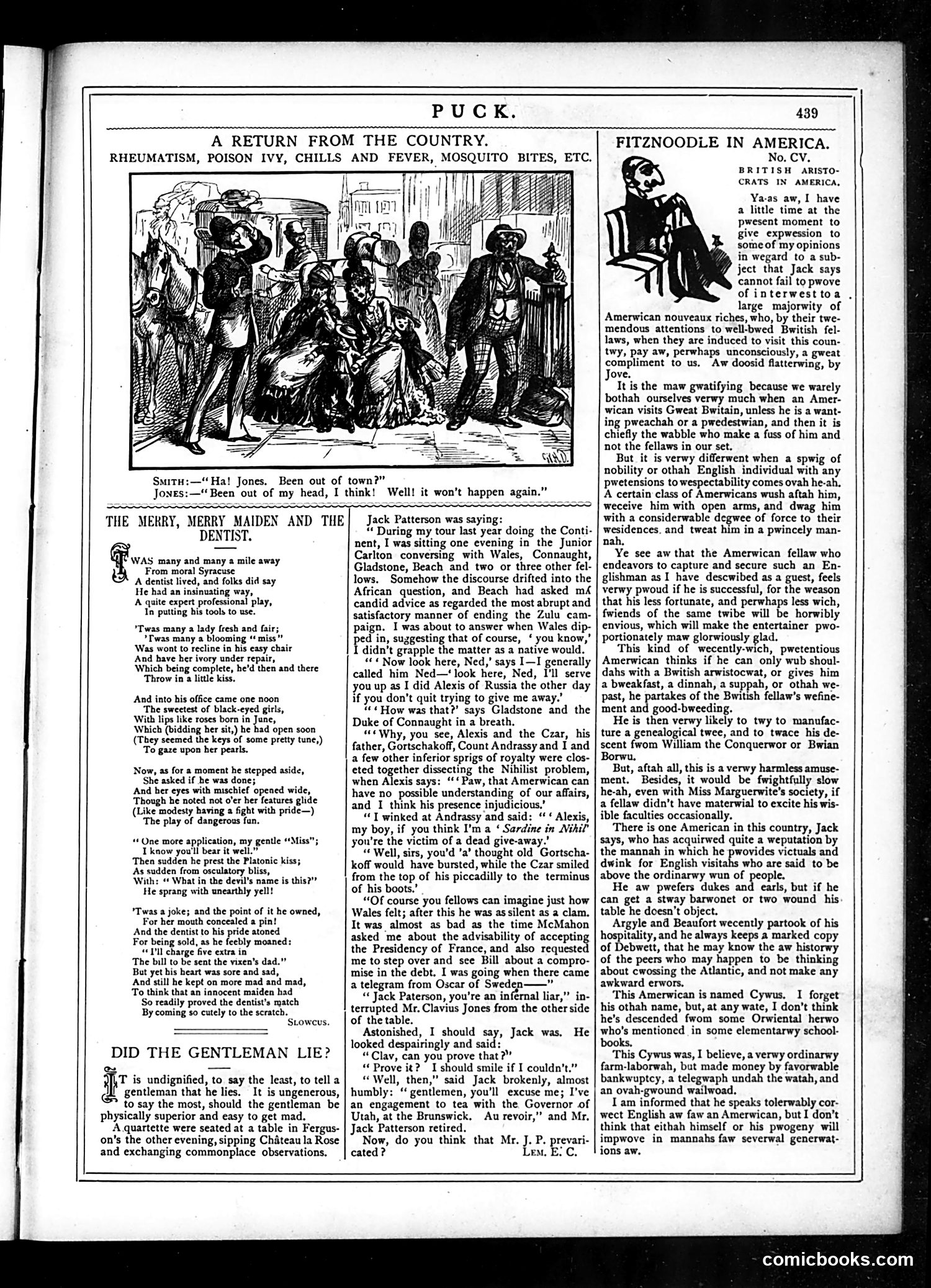
What you’re looking at
The main cartoon, "A Return from the Country," depicts a crowded indoor scene where a disheveled traveler returns from rural travel afflicted with various ailments—rheumatism, poison ivy, chills, fever, and mosquito bites. The humor mocks the romanticized notion of "roughing it" in nature; the contrast between city dwellers' pastoral fantasies and their actual miserable reality upon return is the satire's target. The right column discusses "Fitznoodle in America," criticizing wealthy British aristocrats visiting America. The text suggests these visitors receive disproportionate social attention despite possessing limited merit, and argues Americans too eagerly fawn over titled foreigners while neglecting their own accomplished citizens. This reflects 19th-century American anxieties about British cultural superiority and social snobbery.
📄 Transcribed text from this page (OCR, searchable)
Machine-transcribed from the original scan — historical spelling and the odd misread are preserved.
PUCK. 439 SautH:—“ Ha! Jones. Jone: , MERRY MAIDEN AND THE DENTIST. WAS many and many a mile away From moral Syracuse A dentist lived, and folks did say He had an insinuating way, A quite expert professional play, In putting his tools to use. THE MERRY 'Twas many a lady fresh and fair; "Twas many a blooming * miss”” ‘Was wont to recline in his easy chair And have her ivory under repair, ‘Which being complete, he'd then and there ‘Throw in a little kiss. And into his office came one noon ‘The sweetest of black-eyed girls, With lips like roses born in June, Which (bidding her sit,) he had open soon (They seemed the keys of some pretty tune,) To gaze upon her pearls. Now, as for a moment he stepped aside, She asked if he was done; And her eyes with mischief opened wide, Though he noted not o'er her features glide (Like modesty having a fight with pride—) The play of dangerous fan, “+ One more application, my gentle Miss"; I know you'll bear it well.” ‘Then sudden he prest the Platonic kiss; As sudden from osculatory bliss, ‘With: “ What in the devil’s name is this?” He sprang with unearthly yell! ‘Twas a joke; and the point of it he owned, For her mouth concealed a pin! ‘And the dentist to his pride atoned For being sold, as he feebly moaned: “Dill charge five extra in The bill to be sent the vixen’s dad.” But yet bis heart was sore and sad, And still he kept on more mad and mad, To think that an innocent maiden had So readily proved the dentist's match By coming so cutely to the scratch. ‘SLowcus. DID THE GENTLEMAN LIE? T is undignified, to say the least, to tella gentleman that he lies. It is ungenerous, to say the most, should the gentleman be physically superior and easy to get mad. A quartette were seated at a table in Fergus- on’s the other evening, sipping Chateau la Rose and exchanging commonplace observations. A RETURN FROM THE COUNTRY. RHEUMATISM, POISON IVY, CHILLS AND FEVER, MOSQUITO BITES, ETC. Been out of town?” ; —Been out of my head, I think! Well! it won’t happen again.” Jack Patterson was saying: “¢ During my tour last year doing the Conti- nent, I was sitting one evening in the Junior Carlton conversing with Wales, Connaught, Gladstone, Beach and two or three other fel- lows. Somehow the discourse drifted into the African question, and Beach had asked mf candid advice as regarded the most abrupt and satisfactory manner of ending the Zulu cam- paign. I was about to answer when Wales dip- ped in, suggesting that of course, ‘ you know,’ I didn’t grapple the matter as a native would. ««« Now look here, Ned,’ says I—I generally called him Ned— look here, Ned, I'll serve you up as I did Alexis of Russia the other day if you don’t quit trying to give me away,’ *« How was that?’ says Gladstone and the Duke of Connaught in a breath, “«Why, you see, Alexis and the Czar, his father, Gortschakoff, Count Andrassy and I and a few other inferior sprigs of royalty were clos- eted together dissecting the Nihilist problem, when Alexis says: ‘Paw, that Amerwican can have no possible understanding of our affairs, and I think his presence injudicious.’ “I winked at Andrassy and said: “ ‘ Alexis, my boy, if you think I'm a ‘ Sardine in Nihil’ you're the victim of a dead give-away.’ “ Well, sirs, you'd ’a’ thought old Gortscha- koff would have bursted, while the Czar smiled from the top of his piccadilly to the terminus of his boots.’ “Of course you fellows can imagine just how Wales felt; after this he was as silent as a clam. It was almost as bad as the time McMahon asked me about the advisability of acceptin; the Presidency of France, and also requeste: me to step over and see Bill about a compro- mise in the debt. I was going when there came a telegram from Oscar of Sweden——” “ Jack Paterson, you're an infernal liar,” in- terrupted Mr. Clavius Jones from the other side of the table. Astonished, I should say, Jack was, He looked despairingly and said: “Clay, can you prove that?” “Prove it? I should smile if I couldn't.” “Well, then,” said Jack brokenly, almost humbly: “gentlemen, you'll excuse me; I've an engagement to tea with the Governor of Utah, at the Brunswick. Au revoir,” and Mr, Jack Patterson retired. FITZNOODLE IN AMERICA. No. CV. BRITISH ARISTO- CRATS IN AMERICA. Ya-as aw, I have a little time at the pwesent moment to give expwession to some of my opinions in wegard to a sub- ject that Jack says cannot fail to pwove of interwesttoa large majorwity of Amerwican nouveaux riches, who, by their twe- mendous attentions to well-bwed Bwitish fel- laws, when they are induced to visit this coun- twy, pay aw, perwhaps unconsciously, a gweat a: to us. Aw doosid flatterwing, by jove, It is the maw gwatifying because we warely bothah ourselves verwy much when an Amer- wican visits Gweat Bwitain, unless he is a want- ing pweachah or a pwedestwian, and then it is chiefly the wabble who make a fuss of him and not the fellaws in our set. But it is verwy differwent when a spwig of nobility or othah English individual with any pwetensions to wespectability comes ovah he-ah. A certain class of Amerwicans wush aftah him, weceive him with open arms, and dwag him with a considerwable degwee of force to their wesidences. and tweat him in a pwincely man- nah, Ye see aw that the Amerwican fellaw who endeavors to capture and secure such an En- glishman as I have descwibed as a guest, feels verwy pwoud if he is successful, for the weason that his less fortunate, and perwhaps less wich, fwiends of the same twibe will be horwibly envious, which will make the entertainer pwo- portionately maw glorwiously glad. This kind of wecently-wich, pwetentious Amerwican thinks if he can only wub shoul- dahs with a Bwitish arwistocwat, or gives him a bweakfast, a dinnah, a suppah, or othah we- past, he partakes of the Bwitish fellaw’s wefine- ment and good-bweeding. He is then verwy likely to twy to manufac- ture a genealogical twee, and to twace his de- scent fwom William the Conquerwor or Bwian Borwu. But, aftah all, this is a verwy harmless amuse- ment. Besides, it would be fwightfully slow he-ah, even with Miss Marguerwite's society, if a fellaw didn’t have materwial to excite his wis- ible faculties occasionally, ‘There is one American in this country, Jack says, who has acquirwed quite a weputation by the mannah in which he pwovides victuals and dwink for English visitahs who are said to be above the ordinarwy wun of people. He aw pwefers dukes and earls, but if he can get a stway barwonet or two wound his table he doesn’t object. Argyle and Beaufort wecently partook of his itality, and he always keeps a marked copy of Debwett, that he may know the aw historwy of the peers who may happen to be thinking about cwossing the Atlantic, and not make any awkward erwors. This Amerwican is named Cywus. I forget his othah name, but, at any wate, I don’t think he's descended fwom some Orwiental herwo who’s mentioned in some elementarwy school- books, ‘This Cywus was, I believe, a verwy ordinarwy farm-laborwah, but made money by favorwable bankwuptcy, a telegwaph undah the watah, and an ovah-gwound wailwoad. 1 am informed that he speaks tolerwably cor- wect English aw faw an Amerwican, but I don’t think that cithah himself or his pwogeny will Now, do you think that Mr. J. P. prevari- cated? Lem. E: C. impwove in mannahs faw severwal gencrwat- ions aw. comicbooks.com