
Puck, 1879-09-17 · page 3 of 16
Puck — September 17, 1879 — page 3: what you’re looking at
What you’re looking at
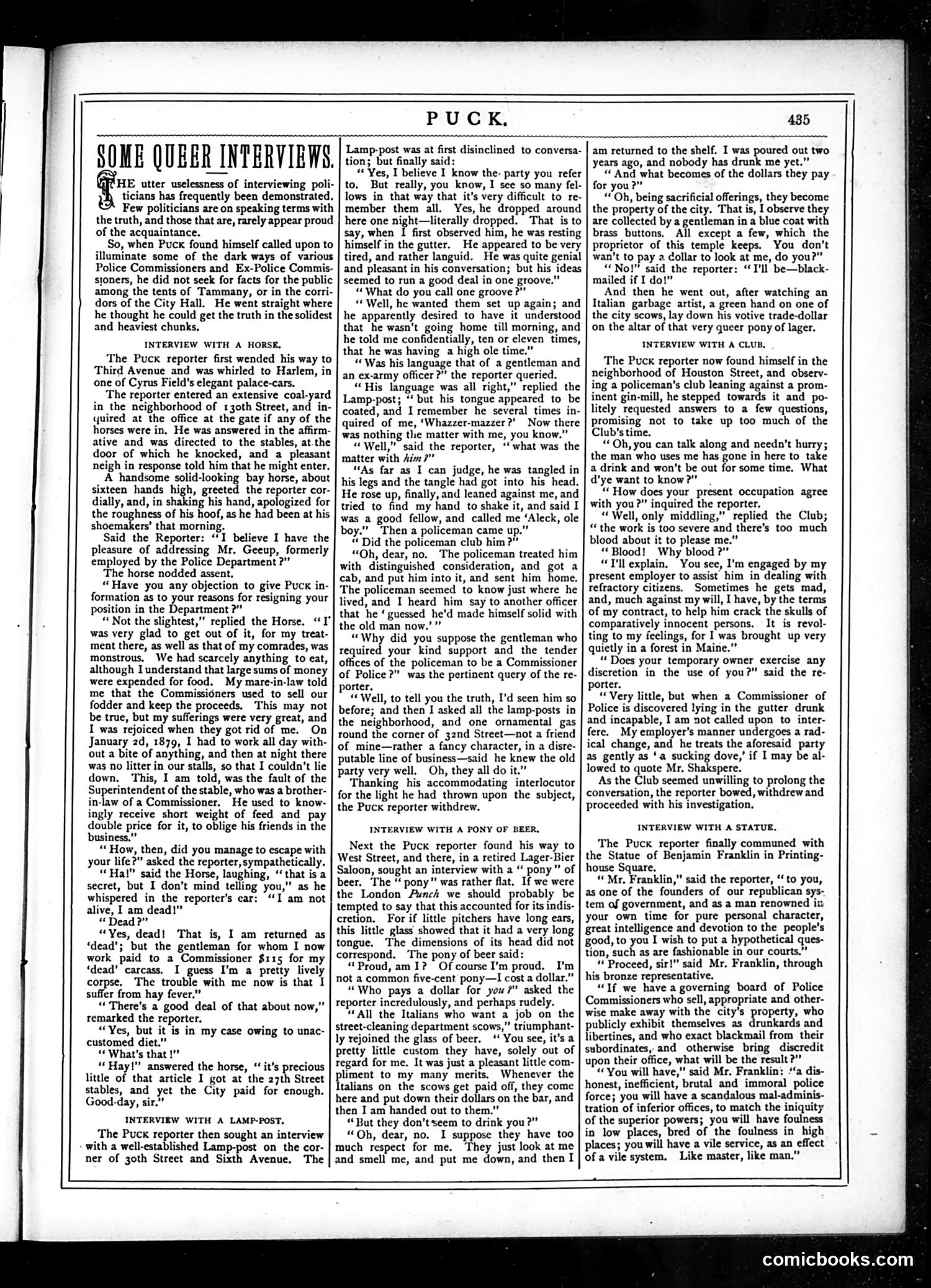
This page contains a series of humorous interviews titled "Some Queer Interviews," featuring satirical conversations between a Puck reporter and various New York City characters: a horse, a policeman's club, a pony of beer, a lamp-post, and a statue of Benjamin Franklin. The satire targets urban life and municipal governance through absurdist comedy. The interviews mock police practices, city infrastructure neglect, and political corruption—having inanimate objects voice complaints about how they're treated by the city and its citizens. The lamp-post, for instance, discusses being used by drunks; the beer pony comments on worker wages and patronage jobs. The humor relies on personification to critique contemporary civic problems indirectly, a common Puck technique for addressing sensitive social issues through whimsy rather than direct political attack.
📄 Transcribed text from this page (OCR, searchable)
Machine-transcribed from the original scan — historical spelling and the odd misread are preserved.
PUCK, 435 DOME QUEER INTERVIEWS. HE utter uselessness of interviewing poli- ticians has frequently been demonstrated. Few politicians are on speaking terms with the truth, and those that are, rarely appear proud of the acquaintance. So, when Puck found himself called upon to illuminate some of the dark ways of various Police Commissioners and Ex-Police Commis- stoners, he did not seek for facts for the public among the tents of Tammany, or in the corri- dors of the City Hall. He went straight where he thought he could get the truth in the solidest and heaviest chunks, INTERVIEW WITH A HORSE, The Puck reporter first wended his way to Third Avenue and was whirled to Harlem, in one of Cyrus Field’s elegant palace-cars. The reporter entered an extensive coal-yard in the neighborhood of r3oth Street, and in- quired at the office at the gate if any of the horses were in, He was answered in the affirm- ative and was directed to the stables, at.the door of which he knocked, and a pleasant neigh in response told him that he might enter. A handsome solid-looking bay horse, about sixteen hands high, greeted the reporter cor- dially, and, in s| g his hand, apologized for the roughness of his hoof, as he had been at his shoemakers’ that morning. Said the Reporter: ‘I believe I have the pleasure of addressing Mr. Geeup, formerly employed by the Police Department ?” The horse nodded assent. “Have you any objection to give Puck in- formation as to your reasons for resigning your position in the Department ?” “Not the slightest,” replied the Horse. “I was very glad to get out of it, for my treat- ment there, as well as that of my comrades, was monstrous. We had scarcely anything to eat, although I understand that large sums of money were expended for food. My mare-in-law told me that the Commissioners used to sell our fodder and keep the proceeds. This may not be true, but my sufferings were very great, and I was rejoiced when they got rid of me. On January 2d, 1879, I had to work all day with- out a bite of anything, and then at night there was no litter in our stalls, so that I couldn’t lie down. This, I am told, was the fault of the Superintendent of the stable, who was a brother- in-law of a Commissioner. He used to know- ingly receive short weight of feed and pay double price for it, to oblige his friends in the business.” “How, then, did you manage to escape with your life?” asked the reporter, sympathetically. “Hal” said the Horse, laughing, “that is a secret, but I don’t mind telling you,” as he whispered in the reporter's car: “I am not alive, I am dead!" “Dead?” “Yes, dead! That is, I am returned as ‘dead’; but the gentleman for whom I now work paid to a Commissioner $115 for my ‘dead’ carcass. I guess I'm a pretty lively corpse, The trouble with me now is that I suffer from hay fever.” “‘ There’s a good deal of that about now,” remarked the reporter. “Yes, but it is in my case owing to unac- customed diet.” “* What's that !’” “Hay!” answered the horse, “it’s precious little of that article I got at the 27th Street stables, and yet the City paid for enough. Good-day, sir.” INTERVIEW WITH A LAMP-POST. The Puck reporter then sought an interview with a well-established Lamp-post on the cor- Lamp-post was at first disinclined to conversa- tion; but finally said: “Yes, I believe I know the- party you refer to. But really, you know, I sce so many fel- lows in that way that it’s very difficult to re- member them all. Yes, he dropped around here one night—literally dropped. That is to say, when [I first observed him, he was resting himself in the gutter. He appeared to be very tired, and rather languid. He was quite genial and pleasant in his conversation; but his ideas seemed to run a good deal in one groove.” “What do you call one groove?” “Well, he wanted them set up again; and he apparently desired to have it understood that he wasn’t going home till morning, and he told me confidentially, ten or eleven times, that he was having a high ole time.” “ Was his language that of a gentleman and an ex-army officer?” the reporter queried. “His language was all right,” replied the Lamp-post; ‘‘ but his tongue appeared to be coated, and I remember he several times in- quired of me, ‘Whazzer-mazzer?' Now there was nothing the matter with me, you know.” “Well,” said the reporter, ‘‘ what was the matter with Aim?” “As far as I can judge, he was tangled in his legs and the tangle had got into his head. He rose up, finally, and leaned against me, and tried to find my hand to shake it, and said I was a good fellow, and called me ‘Aleck, ole boy.” ‘Then a policeman came up.” “ Did the policeman club him?” “Oh, dear, no. The policeman treated him with distinguished consideration, and got a cab, and put him into it, and sent him home. The policeman seemed to know just where he lived, and I heard him say to another officer that he ‘guessed he’d made himself solid with the old man now.’”” “Why did you suppose the gentleman who required your kind support and the tender offices of the policeman to be a Commissioner of Police ?” was the pertinent query of the re- porter, ‘€ Well, to tell you the truth, I’d seen him so before; and then I asked all the lamp-posts in the neighborhood, and one ornamental gas round the corner of 32nd Street—not a friend of mine—rather a fancy character, in a disre- putable line of business—said he knew the old party very well. Oh, they all do it.” Thanking his accommodating interlocutor for the light he had thrown upon the subject, the Puck reporter withdrew. INTERVIEW WITH A PONY OF BEER, Next the Puck reporter found his way to West Street, and there, in a retired Lager-Bier Saloon, sought an interview with a “ pony” of beer. The “ pony” was rather flat. If we were the London Punch we should probably be tempted to say that this accounted for its indis- cretion, For if little pitchers have long ears, this little glass showed that it had a very long tongue. The dimensions of its head did not correspond. ‘The pony of beer said: “Proud, am 1? Of course I'm proud. I’m not a common five-cent pony—I cost a dollar.” “Who pays a dollar for you?” asked the reporter incredulously, and perhaps rudely. “All the Italians who want a job on the street-cleaning department scows,” triumphant- ly rejoined the glass of beer. ‘You see, it’s a pretty little custom they have, solely out of regard for me. It was just a pleasant little com- pliosat to my many merits. Whenever the talians on the scows get paid off, they come here and put down their dollars on the bar, and then I am handed out to them.” “But they don’t seem to drink you?” “Oh, dear, no. I suppose they have too much respect for me. They just look at me and smell me, and put me down, and then I am returned to the shelf. I was poured out two years ago, and nobody has drunk me yet.”” “And what becomes of the dollars they pay for you?” “Oh, being sacrificial offerings, they become the property of the city. That is, I observe they are collected by a gentleman in a blue coat wit! brass buttons. All except a few, which the proprietor of this temple keeps. You don’t wan't to pay a dollar to look at me, do you?” “No!” said the reporter: ‘I'll be—black- mailed if I do!” And then he went out, after watching an Italian garbage artist, a green hand on one of the city scows, lay down his votive trade-dollar on the altar of that very queer pony of lager. INTERVIEW WITH A CLUB. The Puck reporter now found himself in the neighborhood of Houston Street, and observ- ing a policeman’s club leaning against a prom- inent gin-mill, he stepped towards it and po- litely requested answers to a few questions, promising not to take up too much of the Club's time. “Oh, you can talk along and needn't hurry; the man who uses me has gone in here to take a drink and won't be out for some time. What d'ye want to know?” “ How does your present occupation agree with you ?” inquired the reporter. “Well, only middling,” replied the Club; “ the work is too severe and there's too much blood about it to please me.”” “Blood! Why blood ?” “Yl explain. You see, I'm engaged by my present employer to assist him in dealing with refractory citizens. Sometimes he gets mad, and, much against my will, I have, by the terms of my contract, to help him crack the skulls of comparatively innocent persons. It is revol- ting to my feelings, for I was brought up very quietly in a forest in Maine.” “Does your temporary owner exercise any discretion in the use of you?” said the re- porter. “Very little, but when a Commissioner of Police is discovered lying in the gutter drunk and incapable, I am not called upon to inter- fere. My employer's manner undergoes a rad- ical change, and he treats the aforesaid party as gently as ‘a sucking dove,’ if I may be al- lowed to quote Mr, Shakspere. As the Club seemed unwilling to prolong the conversation, the reporter bowed, withdrew and proceeded with his investigation. INTERVIEW WITH A STATUE. The Puck reporter finally communed with the Statue of Benjamin Franklin in Printing- house Square. “Mr. Franklin,” said the reporter, “to you, as one of the founders of our republican sys- tem of government, and as a man renowned in your own time for pure personal character, great intelligence and devotion to the people’s good, to you I wish to put a hypothetical ques- tion, such as are fashionable in our courts.” “ Proceed, sir!” said Mr. Franklin, through his bronze representative. “If we have a governing board of Police Commissioners who sell, appropriate and other- wise make away with the city’s property, who publicly exhibit themselves as drunkards and libertines, and who exact blackmail from their subordinates, and otherwise bring discredit upon their office, what will be the result ?”” “You will have,” said Mr. Franklin: ‘‘a dis- honest, inefficient, brutal and immoral police force; you will have a scandalous mal-adminis- tration of inferior offices, to match the iniquity of the superior powers; you will have foulness in low places, bred of the foulness in high places; you will have a vile service, as an effect of a vile system, Like master, like man.” ner of 3oth Street and Sixth Avenue. The comicbooks.com