
Puck, 1879-09-17 · page 11 of 16
Puck — September 17, 1879 — page 11: what you’re looking at
What you’re looking at
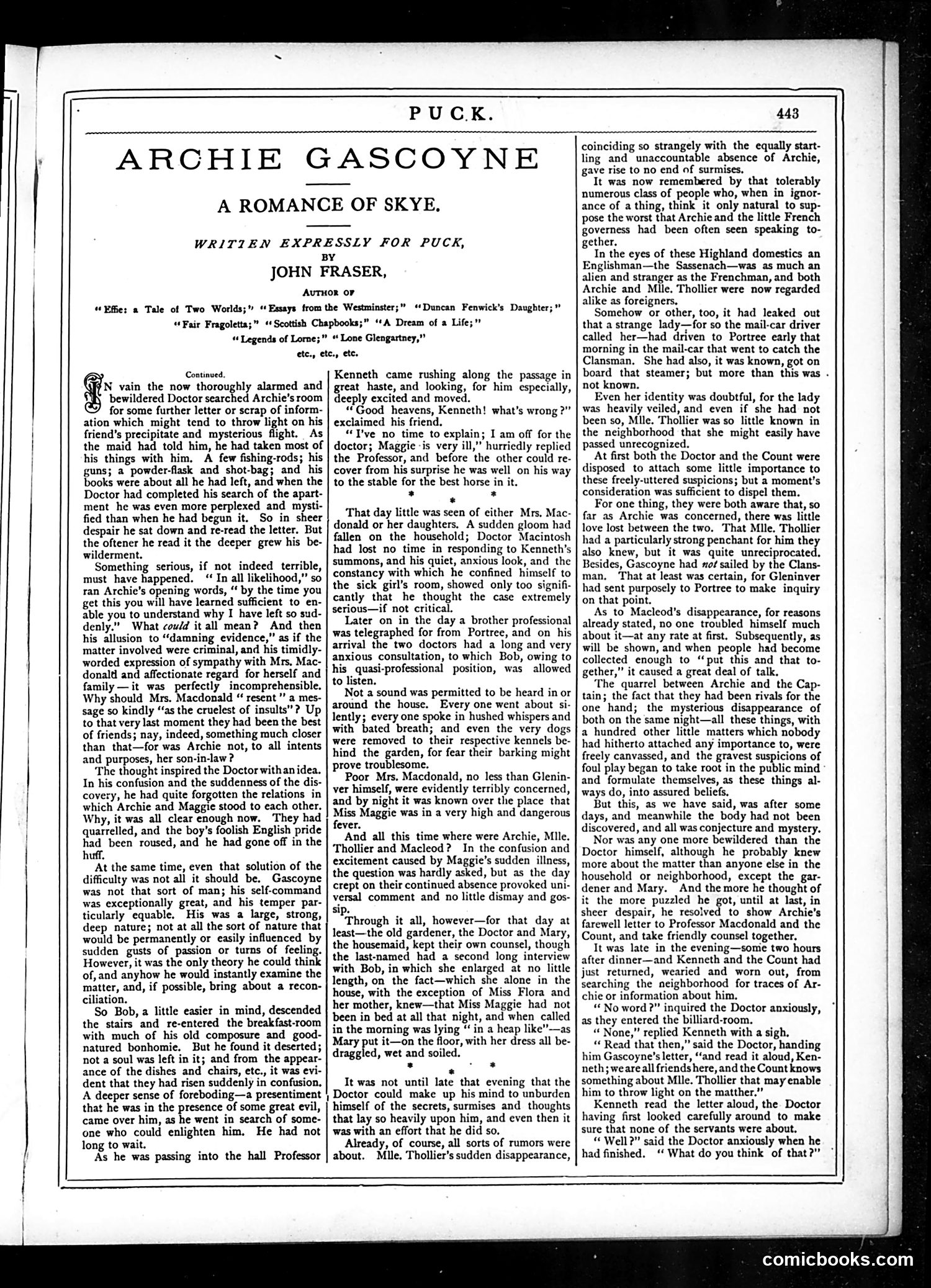
This page contains the beginning of a serialized short story titled "Archie Gascoyne: A Romance of Skye," written by John Fraser and published in Puck magazine. It is not a political cartoon or satirical illustration but rather a literary work—specifically a romantic narrative set in Scotland. The text describes mysterious disappearances and domestic upheaval involving characters named Archie, Kenneth, Doctor Macintosh, and Miss Maggie. The story appears to be a mystery-romance involving Highland Scottish settings and characters. This represents Puck's literary content rather than its satirical cartoons. Without accompanying illustrations on this particular page, there is no political satire or social commentary to analyze.
📄 Transcribed text from this page (OCR, searchable)
Machine-transcribed from the original scan — historical spelling and the odd misread are preserved.
PUCK. 443 ARCHIE GASCOYNE A ROMANCE OF SKYE, WRITTEN EXPRESSLY FOR PUCK, BY JOHN FRASER, AvTHor oF «Effie: a Tale of Two Worlds; «Essays from the Westminster;” ‘Duncan Fenwick’s Daughter; «Fair Fragoletta;” «Scottish Chapbooks;” ‘(A Dream of a Life; «Legends of Lome;” * Lone Glengartney,” etc., etc., etc. Continued, N vain the now thoroughly alarmed and bewildered Doctor searched Archie's room for some further letter or scrap of inform- ation which might tend to throw light on his friend’s precipitate and mysterious flight. As the maid had told him, he had taken most of his things with him. A few fishing-rods; his guns; a powder-flask and shot-bag; and his books were about all he had left, and when the Doctor had completed his search of the apart- ment he was even more perplexed and mysti- fied than when he had begun it. So in sheer despair he sat down and re-read the letter. But the oftener he read it the deeper grew his be- wilderment. Something serious, if not indeed terrible, must have happened. “ In all likelihood,” so ran Archie's opening words, “ by the time you get this you will have learned sufficient to en- able you to understand why I have left so sud- denly.” What cou/d it all mean? And then his allusion to “damning evidence,” as if the matter involved were criminal, and his timidly- worded expression of sympathy with Mrs, Mac- donald and affectionate regard for herself and family — it was perfectly incomprehensible. Why should Mrs. Macdonald “ resent ” a mes- sage so kindly “‘as the cruelest of insults”? Up to that very last moment they had been the best of friends; nay, indeed, something much closer than that—for was Archie not, to all intents and purposes, her son-in-law? The thought inspired the Doctor withan idea. In his confusion and the suddenness of the dis- covery, he had quite forgotten the relations in which Archie and Maggie stood to each other. Why, it was all clear enough now. They had quarrelled, and the boy’s foolish English pride had been roused, and he had gone off in the huff. At the same time, even that solution of the difficulty was not all it should be. Gascoyne was not that sort of man; his self-command was exceptionally great, and his temper par- ticularly equable, His was a large, strong, deep nature; not at all the sort of nature that would be permanently or easily influenced by sudden gusts of passion or turns of feeling. However, it was the only theory he could thi: of, and anyhow he would instantly examine the matter, and, if possible, bring about a recon- ciliation. So Bob, a little easier in mind, descended the stairs and re-entered the breakfast-room with much of his old composure and good- natured bonhomie. But he found it deserted; not a soul was left in it; and from the appear- ance of the dishes and chairs, etc., it was evi- dent that they had risen suddenly in confusion, A deeper sense of foreboding—a presentiment that he was in the presence of some great evil, came over him, as he went in search of some- one who could enlighten him. He had not long to wait. As he was passing into the hall Professor Kenneth came rushing along the passage in great haste, and looking, for him especially, deeply excited and moved. “Good heavens, Kenneth! what’s wrong ?” exclaimed his friend. “T’ve no time to explain; I am off for the doctor; Maggie -is very ill,”” hurriedly replied the Professor, and before the other could re- cover from his surprise he was well on his way to the stable for the best horse in it. * * * That day little was seen of either Mrs. Mac- donald or her daughters, A sudden gloom had fallen on the household; Doctor Macintosh had lost no time in responding to Kenneth’s summons, and his quiet, anxious look, and the constancy with which he confined himself to the sick girl’s room, showed only too signifi- cantly that he thought the case extremely serious—if not critical. Later on in the day a brother professional was telegraphed for from Portree, and on his arrival the two doctors had a long and very anxious consultation, to which Bob, owing to his quasi-professional position, was allowed to listen. Not a sound was permitted to be heard in or around the house. Every one went about si- lently; every one spoke in hushed whispers and with bated breath; and even the very dogs were removed to their respective kennels be- hind the garden, for fear their barking might prove troublesome. Poor Mrs. Macdonald, no less than Glenin- ver himself, were evidently terribly concerned, and by night it was known over the place that Miss Maggie was in a very high and dangerous fever. And all this time where were Archie, Mlle. Thollier and Macleod? In the confusion and excitement caused by Maggie’s sudden illness, the question was hardly asked, but as the day crept on their continued absence provoked uni- versal comment and no little dismay and gos- sip. Through it all, however—for that day at least—the old gardener, the Doctor and Mary, the housemaid, kept their own counsel, though the last-named had a second long interview with Bob, in which she enlarged at no little length, on the fact—which she alone in the house, with the exception of Miss Flora and her mother, knew—that Miss Maggie had not been in bed at all that night, and when called in the morning was lying “ in a heap like”—as Mary put it—on the floor, with her dress all be- draggled, wet and soiled. * ‘8 * It was not until late that evening that the Doctor could make up his mind to unburden himself of the secrets, surmises and thoughts that lay so heavily upon him, and even then it was with an effort that he did so. Already, of course, all sorts of rumors were about. Mlle. Thollier’s sudden disappearance, coinciding so strangely with the equally start- ling and unaccountable absence of Archie, gave rise to no end of surmises. It was now remembered by that tolerably numerous class of people who, when in ignor- ance of a thing, think it only natural to sup- pose the worst that Archie and the little French governess had been often seen speaking to- gether, In the eyes of these Highland domestics an Englishman—the Sassenach—was as much an alien and stranger as the Frenchman, and both Archie and Mlle. Thollier were now regarded alike as foreigners, Somehow or other, too, it had leaked out that a strange lady—for so the mail-car driver called her—had driven to Portree early that morning in the mail-car that went to catch the Clansman. She had also, it was known, got on board that steamer; but more than this was . not known. Even her identity was doubtful, for the lady was heavily veiled, and even if she had not been so, Mile. Thollier was so little known in the neighborhood that she might easily have passed unrecognized. At first both the Doctor and the Count were disposed to attach some little importance to these freely-uttered suspicions; but a moment's consideration was sufficient to dispel them. For one thing, they were both aware that, so far as Archie was concerned, there was little love lost between the two. That Mlle. Thollier had a particularly strong penchant for him the’ also knew, but it was quite unreciprocated, Besides, Gascoyne had nof sailed by the Clans- man, That at least was certain, for Gleninver had sent purposely to Portree to make inquiry on that point. As to Macleod’s disappearance, for reasons already stated, no one troubled himself much about it—at any rate at first. Subsequently, as will be shown, and when people had become collected enough to “put this and that to- gether,” it caused a great deal of talk. The quarrel between Archie and the Cap- tain; the fact that they had been rivals for the one hand; the mysterious disappearance of both on the same night—all these things, with a hundred other little matters which nobody had hitherto attached any importance to, were freely canvassed, and the gravest suspicions of foul play began to take root in the public mind and formulate themselves, as these things al- ways do, into assured beliefs, But this, as we have said, was after some days, and meanwhile the body had not been discovered, and all was conjecture and mystery. Nor was any one more bewildered than the Doctor himself, although he probably knew more about the matter than anyone else in the household or neighborhood, except the gar- dener and Mary. And the more he thought of it the more puzzled he got, until at last, in sheer despair, he resolved to show Archie's farewell letter to Professor Macdonald and the Count, and take friendly counsel together, It was late in the evening—somie two hours after dinner—and Kenneth and the Count had just returned, wearied and worn out, from searching the neighborhood for traces of Ar- chie or information about him, “No word ?” inquired the Doctor anxiously, as they entered the billiard-room. “None,” replied Kenneth with a sigh, “Read that then,” said the Doctor, handing him Gascoyne’s letter, ‘‘and read it aloud, Ken- neth; weareall friends here, and the Count knows something about Mlle. Thollier that may enable him to throw light on the matther,”” Kenneth read the letter aloud, the Doctor having first looked carefully around to make sure that none of the servants were about. “ Well?” said the Doctor anxiously when he had finished. ‘‘ What do you think of that?” | i} | | comicbooks.com