
A complete issue · 16 pages · 1879
Puck — September 10, 1879
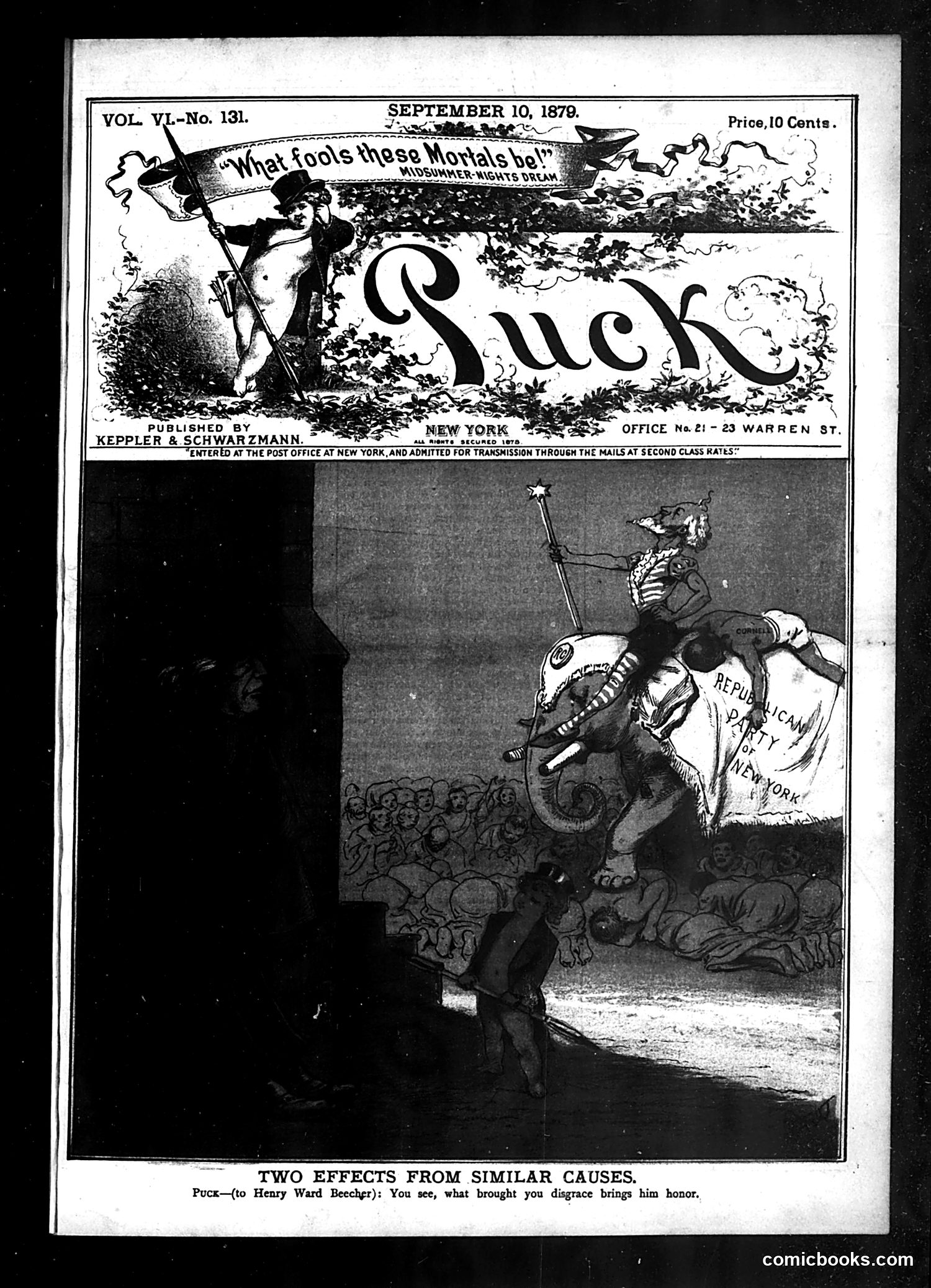
This cartoon critiques the Republican Party's political troubles. The main image depicts an elephant (the Republican symbol) wearing a banner labeled "Republican Party of New York," ridden by a figure wielding a spear or lance. The elephant appears distressed or defeated, surrounded by sleeping or fallen figures below. The caption "TWO EFFECTS FROM SIMILAR CAUSES" suggests parallel negative consequences. The reference to "Henry Ward Beecher" in the OCR text likely connects to scandals affecting Republican credibility. The dream-sequence header "What fools these Mortals be" (Shakespeare reference) emphasizes the satirical mockery of Republican misfortunes and internal party discord during this period.
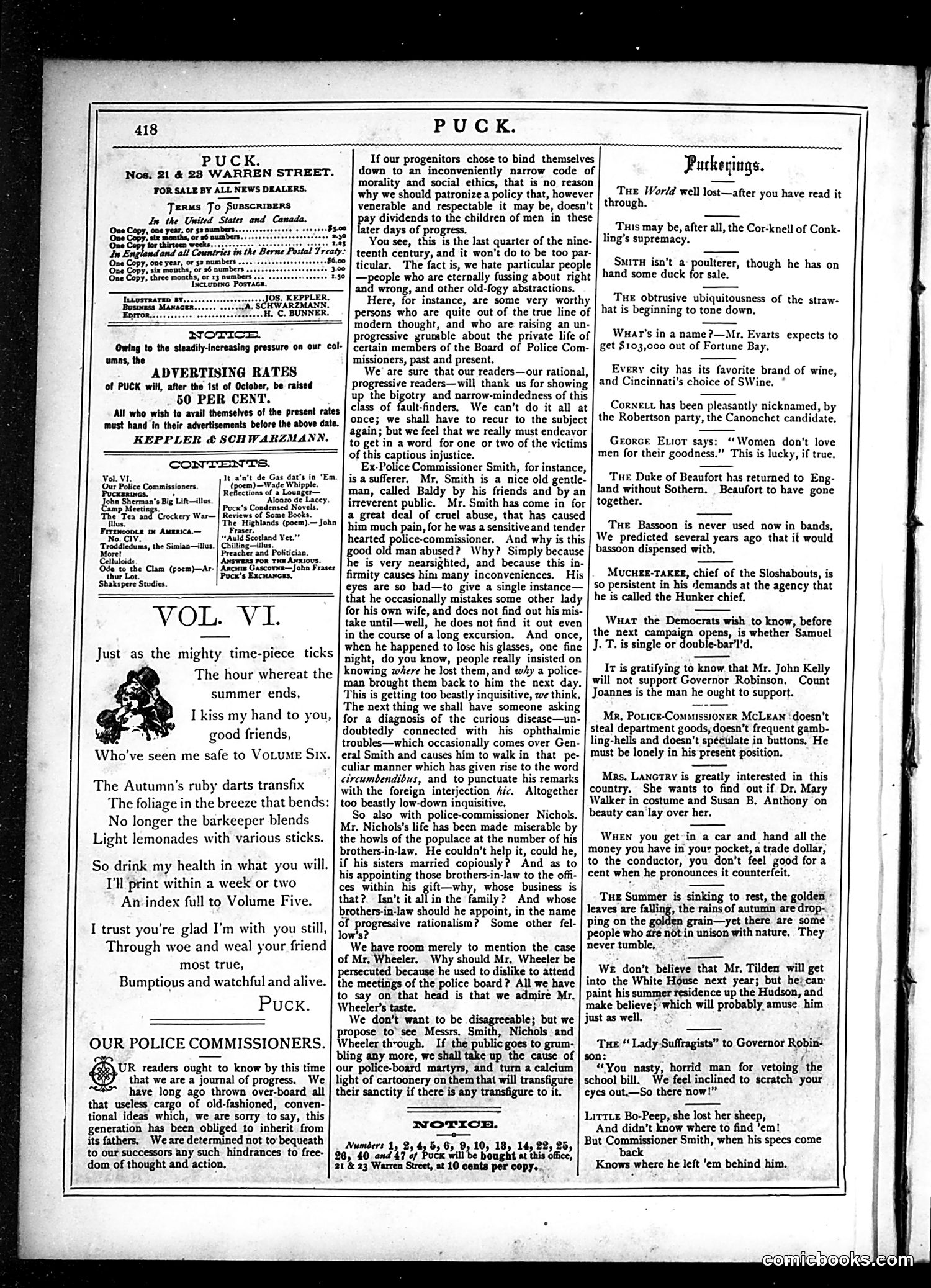
This page is primarily **text content rather than political cartoons**. The main section, "Our Police Commissioners," critiques New York City police leadership for inheriting "over-load all that useless cargo of old-fashioned, conventional ideas" from previous generations, blocking progress and reform. The piece specifically attacks **Police Commissioner Smith** (called "a nice old gentlemen" sarcastically), accusing him of causing pain through "cruel abuse" despite his gentle demeanor. It mocks his narrow-mindedness and suggests his brothers-in-law receive nepotistic appointments. The satire targets institutional resistance to modernization and **police department corruption/favoritism**, using Smith as a symbol of outdated, ineffectual leadership. The tone suggests this was written during a period of police reform debates in early 1900s New York.
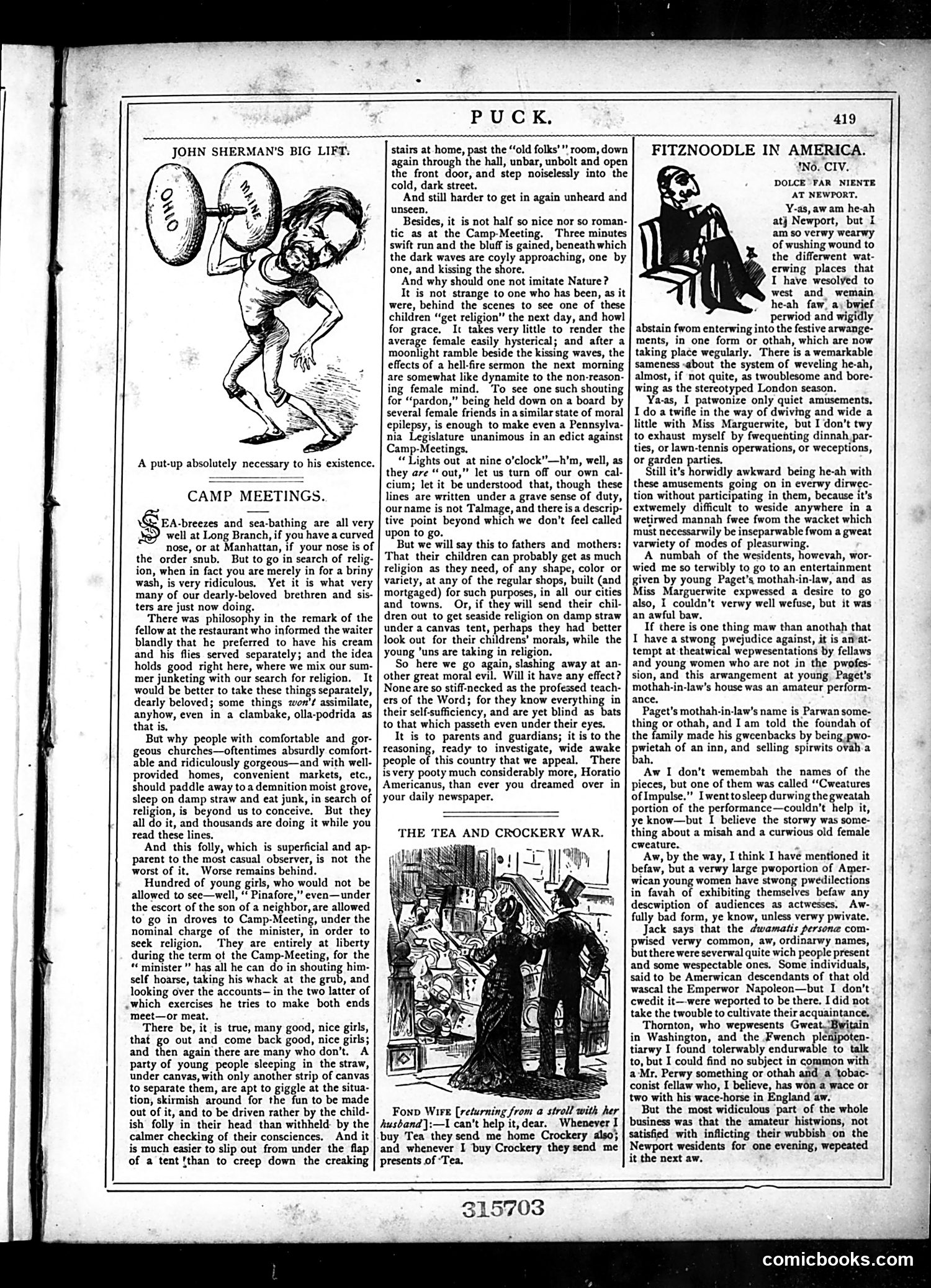
**"John Sherman's Big Lift"** (top cartoon): Shows a figure straining to lift enormous weights labeled "OHIO." This satirizes John Sherman, likely referencing his political influence or ambitions in Ohio politics during the Gilded Age. **"Camp Meetings"** section: A lengthy editorial criticizing religious camp meetings as sites of moral hypocrisy. The author mocks the spectacle of emotional "religion" among attendees while questioning its genuine spiritual value. References to young people, "half-fire sermons," and staged religiosity suggest satire of camp meeting theatricality and questionable ethics. **"The Tea and Crockery War"** (bottom illustration): An engraving depicting what appears to be domestic conflict, though context remains unclear from visible text alone. The page exemplifies Puck's satirical approach to American social and political institutions.
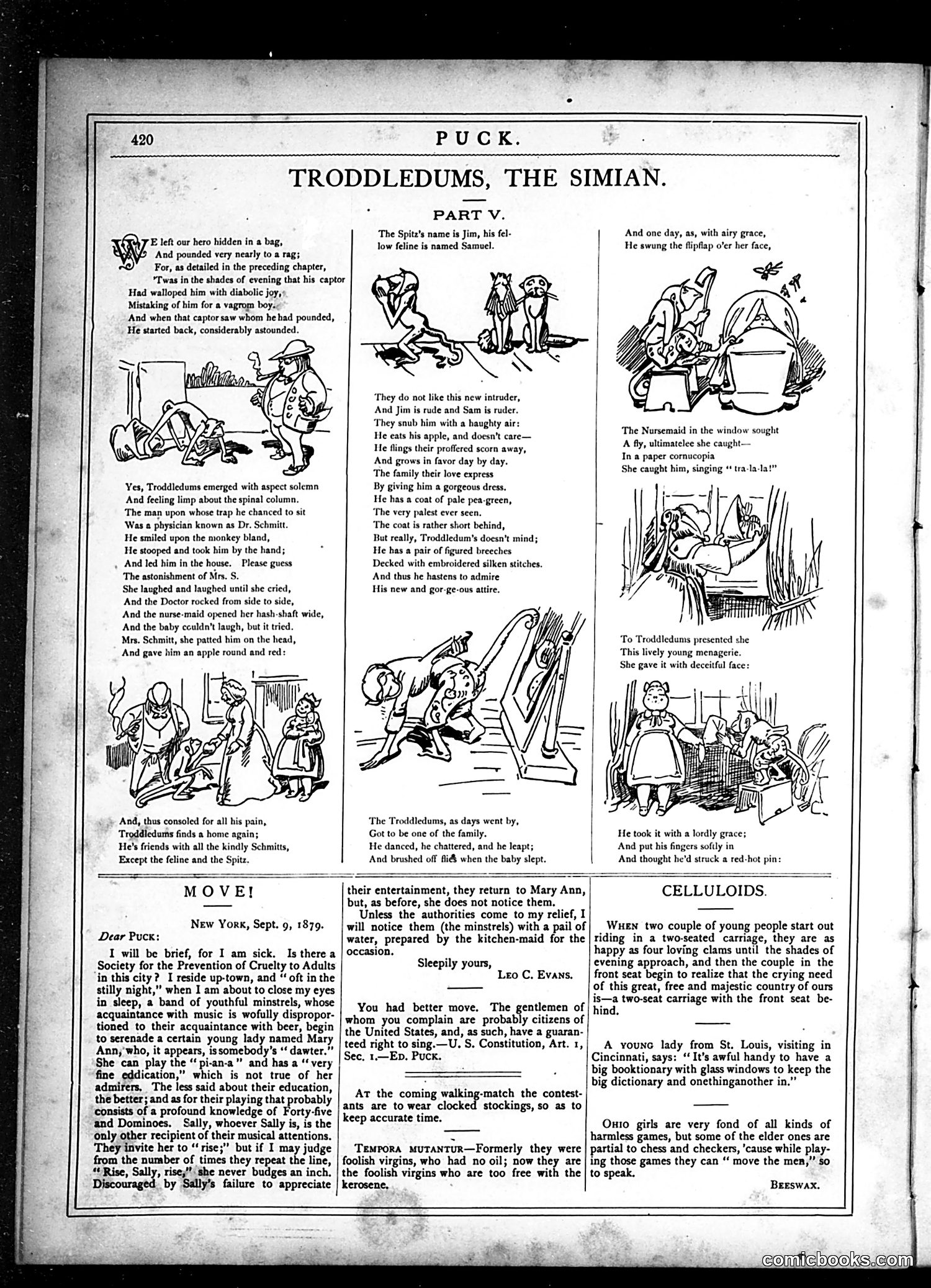
This is a serialized children's story in verse, not political satire. It follows the misadventures of Troddledums, a character apparently trapped in a bag and involved with other characters named Jim, Samuel, and a Nursemaid. The illustrated narrative shows domestic comedy—the protagonist being dressed up, interactions with other figures, and various humorous situations. The accompanying "Move!" section contains readers' letters addressing unrelated topics: music education, constitutional rights to sing, and walking-match contest rules. "Celluloids" appears to be a brief humor column about young couples and regional observations. This page is primarily entertainment and correspondence rather than political commentary.
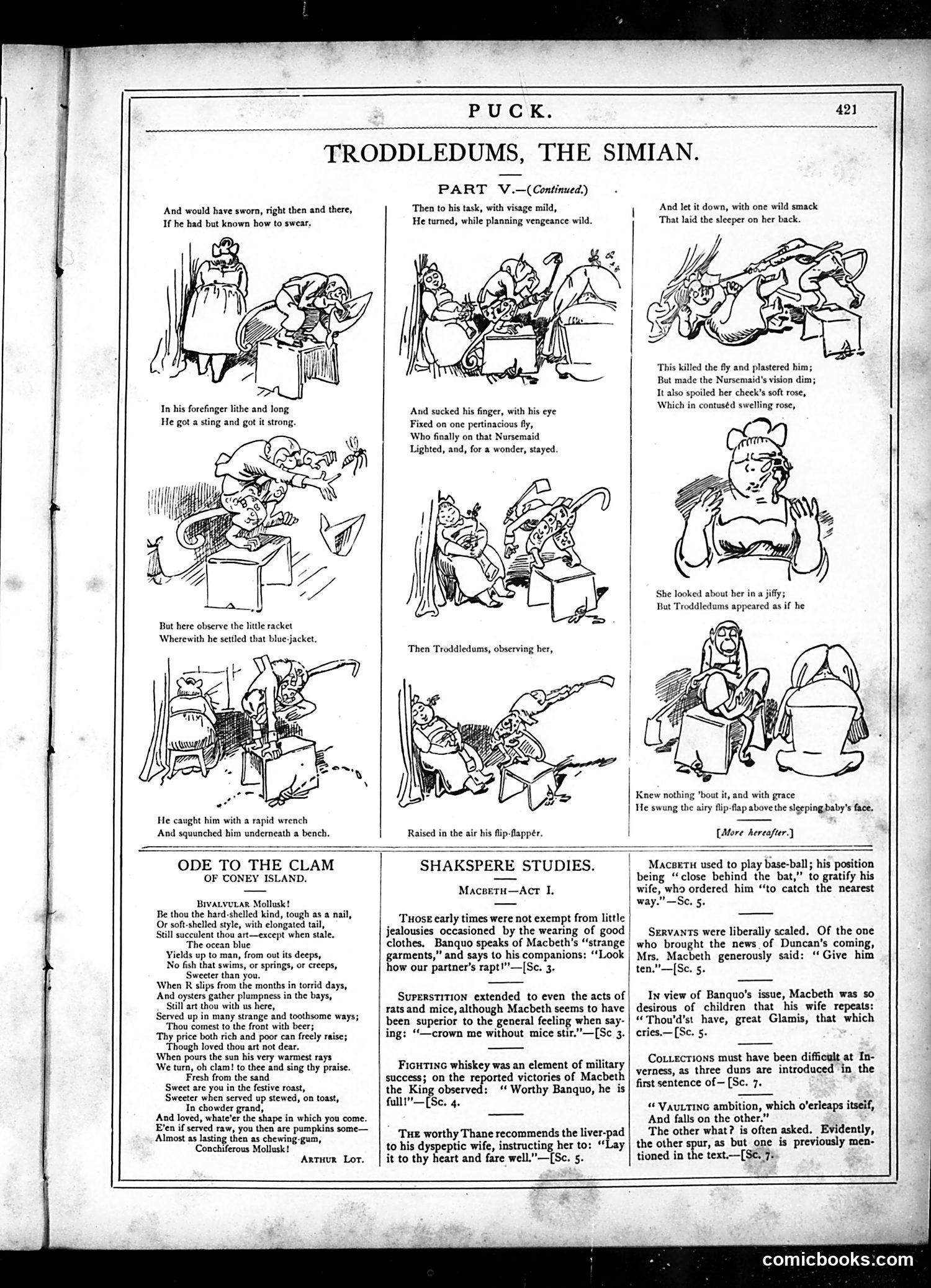
This page contains a serialized comic narrative "Troddledums, the Simian" (Part V) depicting slapstick humor involving a character and various mishaps. The comic shows physical comedy: someone getting stung, having their face slapped, and experiencing other indignities. Below are three separate sections: an "Ode to the Clam" poem about shellfish, "Shakespere Studies" discussing Macbeth's jealousy and superstitions, and notes on Macbeth's Act I regarding servant treatment and military whiskey consumption. These appear to be typical Puck content—mixing crude physical humor comics with literary commentary and light verse. The material reflects late 19th/early 20th-century American humor sensibilities without obvious political satire on this particular page.
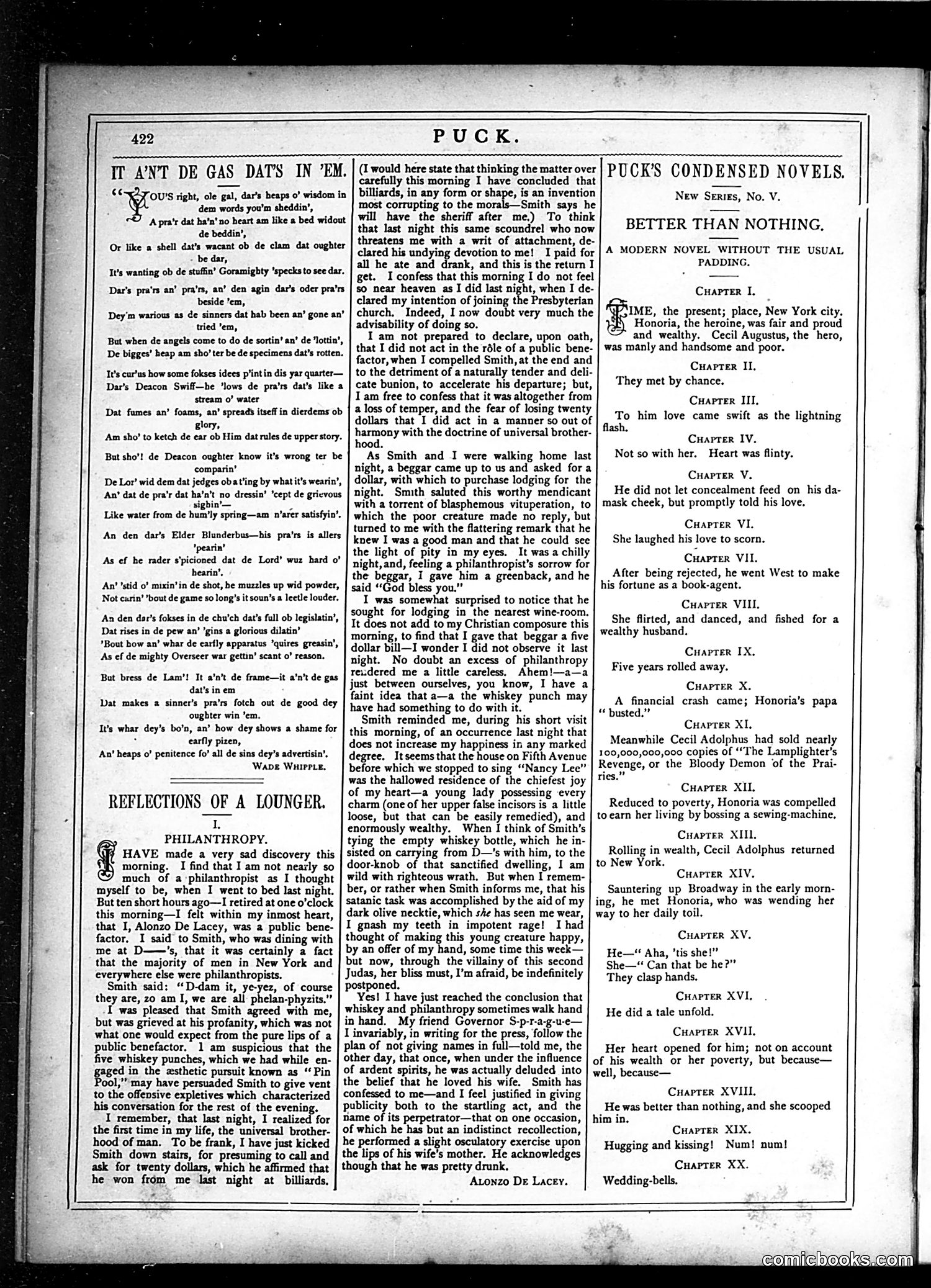
This page contains no political cartoon. Instead, it features two distinct sections: 1. **"It Ain't de Gas Dat's in 'Em"** (left column): A dialect poem in African American Vernacular English, likely from the late 19th century. The poem uses religious and moral themes to critique behavior, employing heavy stereotypical dialect. 2. **"Puck's Condensed Novels"** (right column): A serialized parody titled "Better Than Nothing," described as "A Modern Novel Without the Usual Padding." It consists of extremely brief chapter summaries mocking the conventions of sentimental Victorian fiction. The page is primarily literary content rather than visual satire. The dialect poem reflects period attitudes toward race, while the novel parody satirizes popular fiction tropes—both common Puck features beyond traditional cartooning.
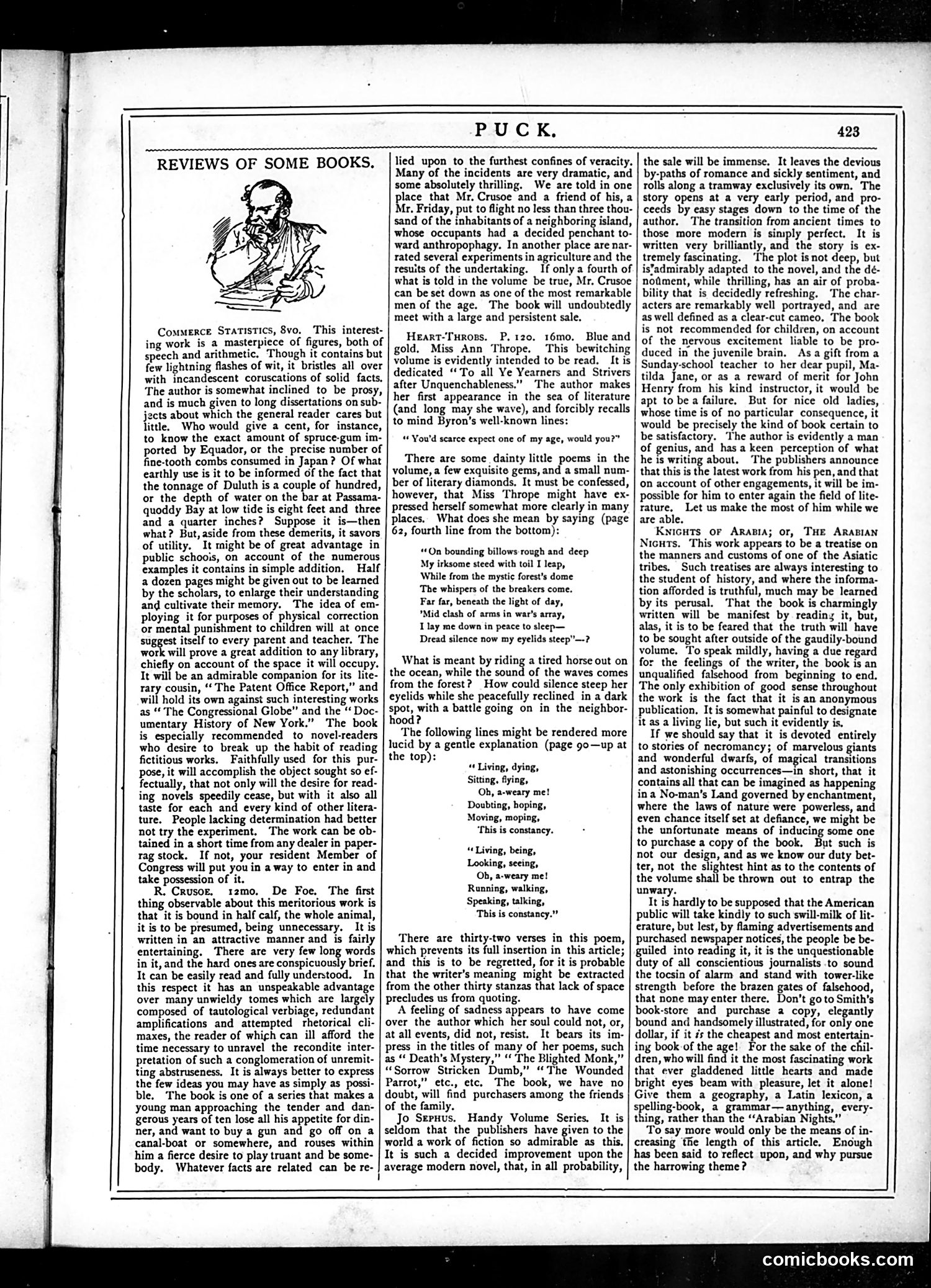
This page consists primarily of literary book reviews rather than political cartoons. The illustration shows a caricatured figure (appears to be a reviewer or critic) examining books, rendered in Puck's typical satirical style. The reviews cover works including "Commerce Statistics," "Heart-Throes" by Miss Ann Thorpe, and "The Nights of Arabia." The critics discuss these books with characteristic Puck irreverence—mocking pretentious literary works while occasionally praising genuine merit. The satire targets publishers' marketing claims, sentimental poetry, and what the reviewers consider overwrought or derivative fiction. The tone suggests Puck's role as cultural arbiter, using humor to deflate inflated literary reputations and expose commercial book-marketing tactics to educated readers.
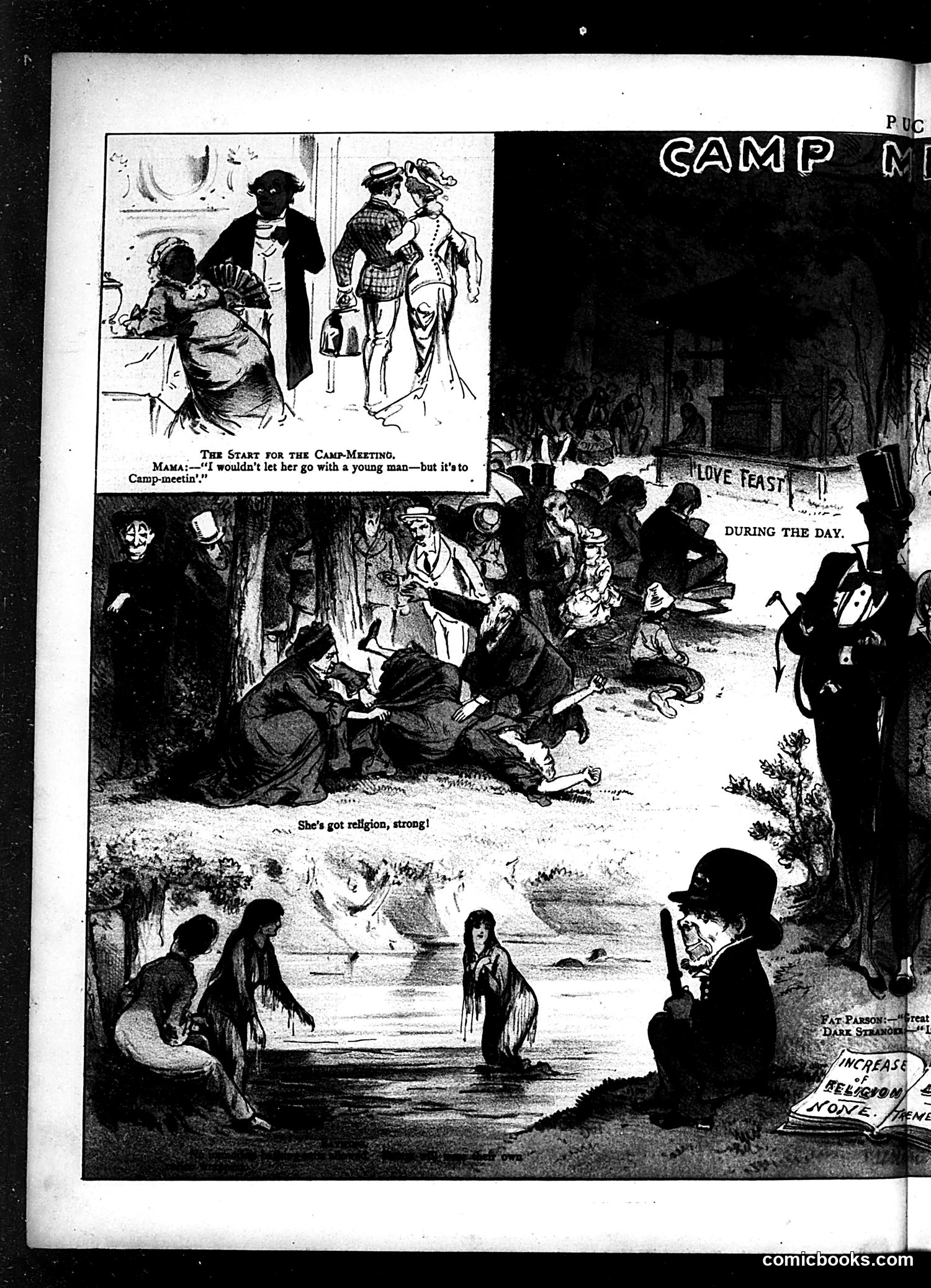
This satirical page mocks religious camp meetings—popular American evangelical gatherings of the era. The top cartoon shows a mother warning her daughter against attending with a young man, calling it a "Camp-meetin'" (implying impropriety occurs there). The larger illustration depicts a nighttime camp meeting "during the day," showing attendees in various states of religious fervor and apparent hysteria. One figure exclaims "She's got religion, strong!" The scene satirizes emotional excess and questionable behavior at these events, particularly near water where figures wade about. The visible partial text references "increase" and appears to mock the manipulative conversion tactics used. Puck's satire suggests camp meetings were less about genuine piety and more about social chaos disguised as religious devotion.
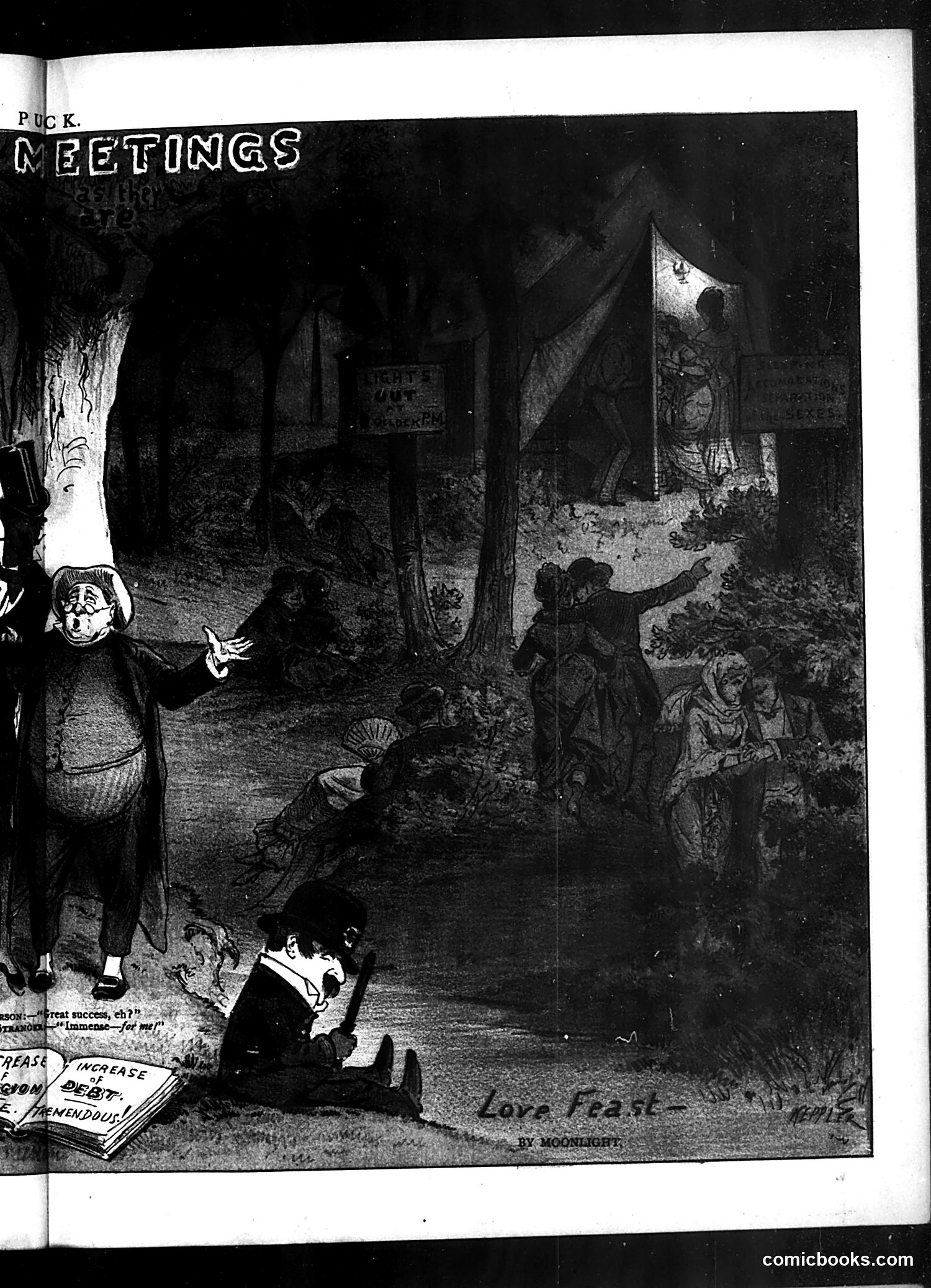
This Puck illustration, credited "BY MOONLIGHT," depicts a nighttime forest scene with what appears to be a secret meeting or gathering. The cartoon shows figures in period dress (likely late 19th century) assembled around a tent or temporary structure, with a lantern illuminating the scene. While the OCR text is fragmentary and unclear, the image suggests satire of clandestine political activity—possibly referencing secret societies, underground political movements, or illicit gatherings. The "BY MOONLIGHT" credit emphasizes the secretive nature of the depicted action. Without clearer text or additional context, the specific political figures or events being mocked remain uncertain, though the composition suggests criticism of hidden political machinations common to Puck's satirical approach.
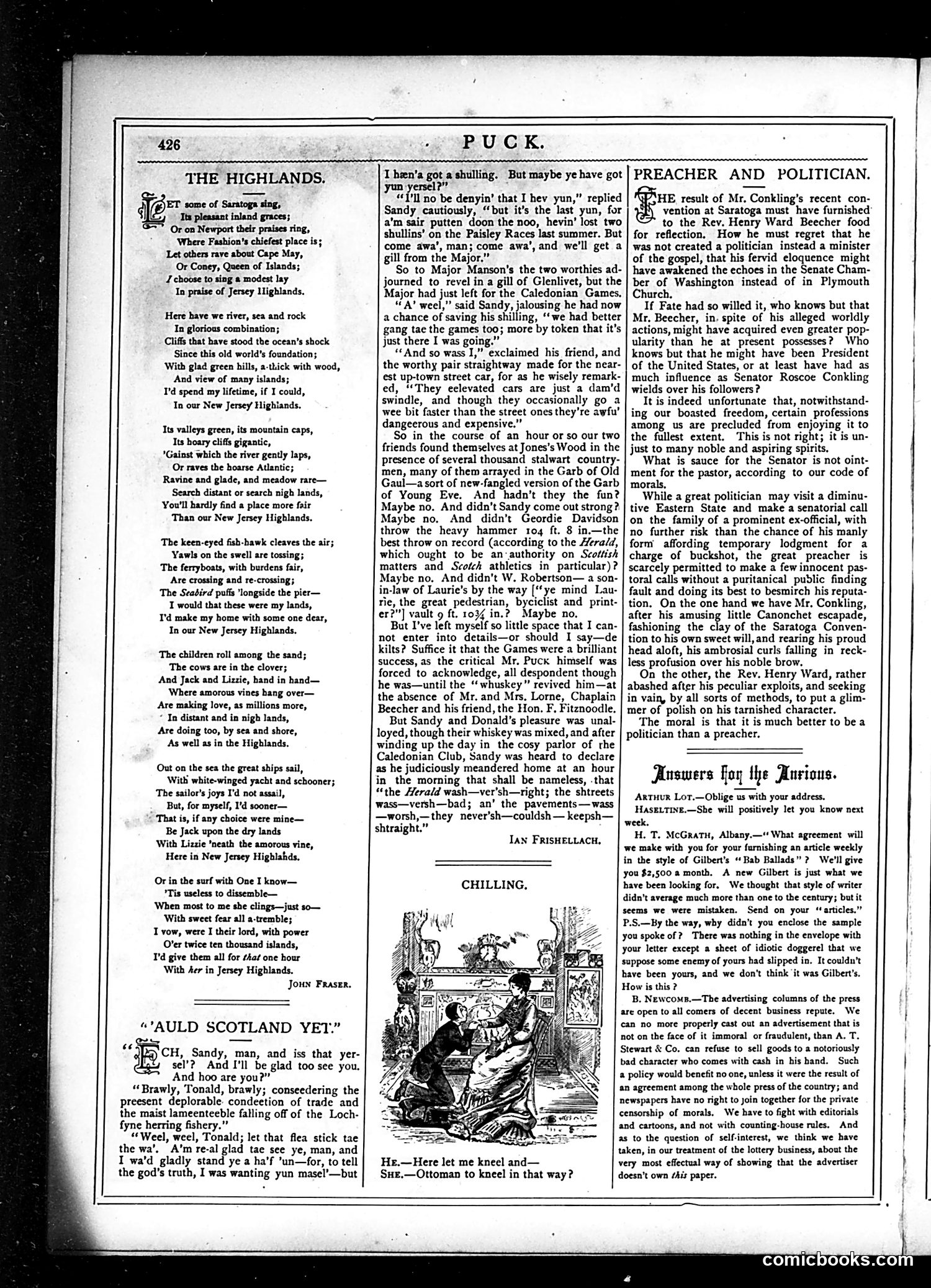
This page contains poetry and prose rather than political cartoons. The main content includes "The Highlands" (a Scottish poem), "Chilling" (a short story with illustration), and "'Auld Scotland Yet!'" (dialogue). The one visible illustration shows a domestic scene of a man and woman in an ottoman/cushioned seat, with the caption "He.—Here let me kneel and— / She.—Ottoman to kneel in that way?" This appears to be a visual pun playing on the word "ottoman" (furniture) versus "Ottoman" (Turkish). The "Answers for the Curious" section addresses reader inquiries about advertising standards and newspaper ethics. No clear political satire is evident on this particular page.
This page contains the opening of "Archie Gascoyne: A Romance of Skye," a serialized fiction story written by John Fraser and published in Puck magazine. The text is a narrative adventure involving characters named John, Archie, and a Captain, with action set in Scotland (Skye). The story describes dramatic events including a horse accident and rescue scenes. This is **not a political cartoon or satire**—it's a serialized short story, likely included to provide entertainment content for Puck's readers. The magazine combined satirical cartoons with fiction to fill its pages. Without seeing illustrations accompanying this text, there's no political commentary or social satire evident on this particular page.
This page is primarily **advice columns and reader letters** rather than political satire. The visible content includes: **"The Mushery"** - A humorous advice section addressing domestic and social matters. Topics include: - A woman concerned about her husband's behavior with a "booty" - A boy's clothing preferences (drab colors) - Tomato preservation techniques - Apple storage methods - Horse care advice **"Puck's Verbiage"** - A poem about babies and pigs with satirical social commentary, likely mocking domestic life or parenting. The page contains **no prominent political cartoons** visible. Instead, it reflects Puck's role as a magazine mixing humor, satire, and practical advice for American readers of the era. The tone is lighthearted domestic humor rather than sharp political commentary.
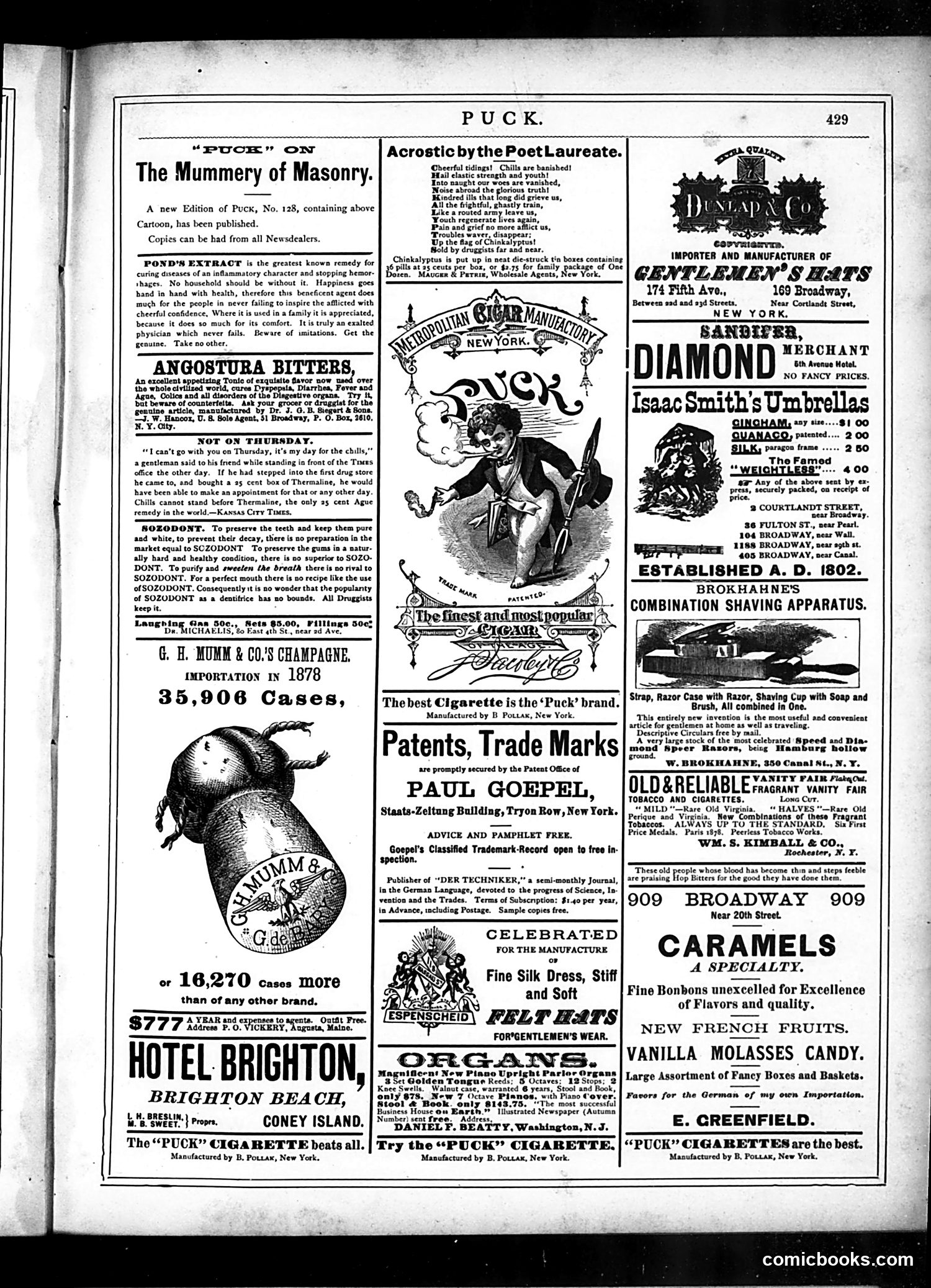
This page is primarily **advertisements and commercial content** rather than political satire. The dominant central image shows a caricatured figure labeled "Puck" (the magazine's mascot) promoting cigars as "the finest and most popular" brand manufactured by B. Pollak, New York. The page contains small editorial items at top-left, including a brief note about "The Mummery of Masonry" and remedies like "Angostura Bitters" and "Solodon." The remainder consists of period business advertisements for products (umbrellas, champagne, felt hats, caramels, candy) and services typical of late-19th-century American commerce. No significant political messaging or satire is evident on this particular page.
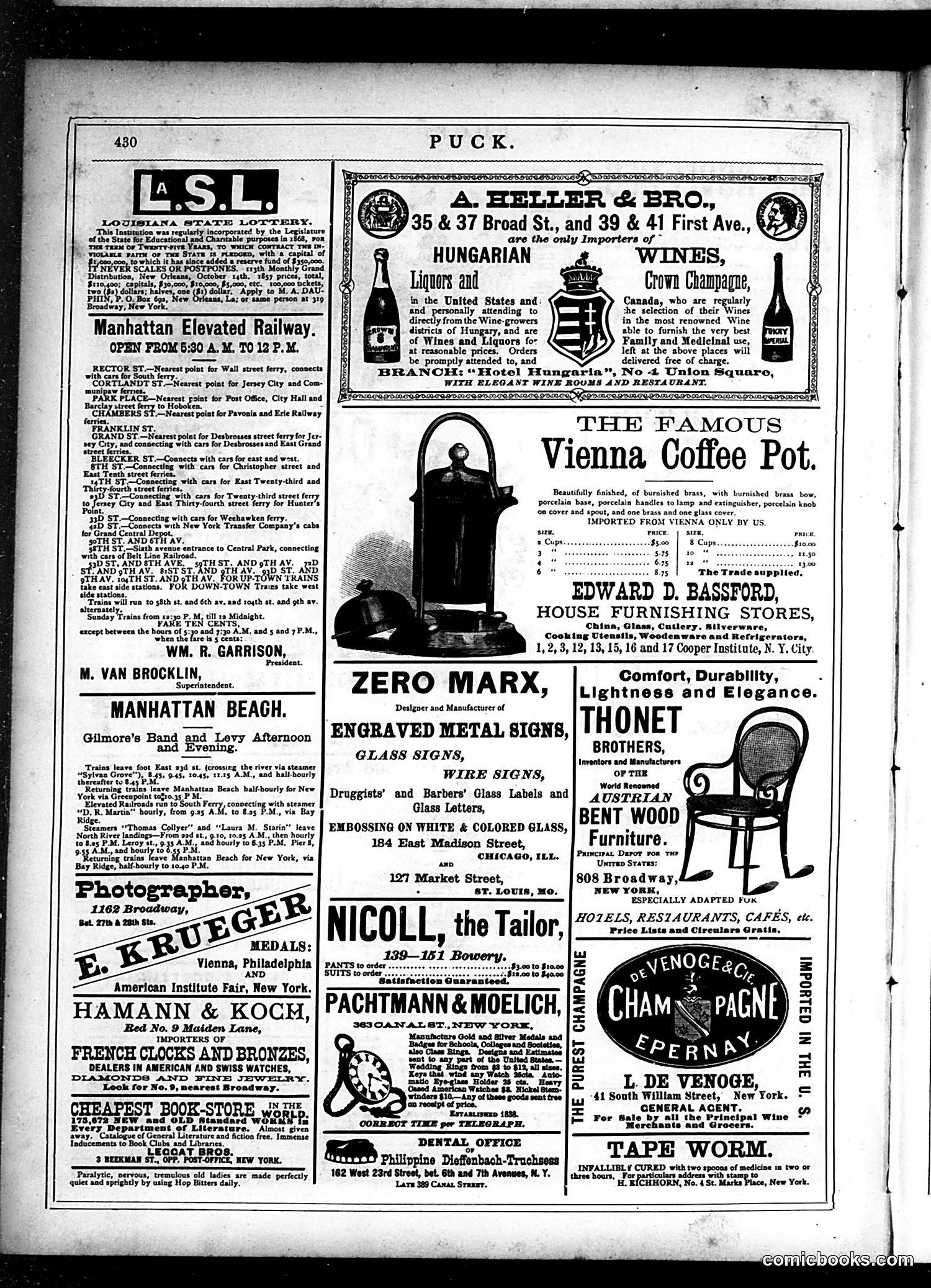
This page is primarily **advertising**, not editorial content or political cartoons. It contains approximately 20 commercial advertisements from late 19th-century New York businesses, including: - A.Heller & Bros. (Hungarian wines and liquors) - The famous Vienna Coffee Pot (imported coffee service) - Edward D. Bassford (housefurnishings) - Zero Marx (engraved metal signs) - Thonet Brothers (bent wood furniture) - Nicoll the Tailor - Pachtmann & Moelich (champagne importers) - Various other vendors (photographer, bookseller, dentist) There is also information about the **Manhattan Beach** railway line and Gilmore's Band entertainment. No political satire or editorial cartoons are visible on this page—it's a revenue-generating advertisements section typical of Puck magazine's business model.
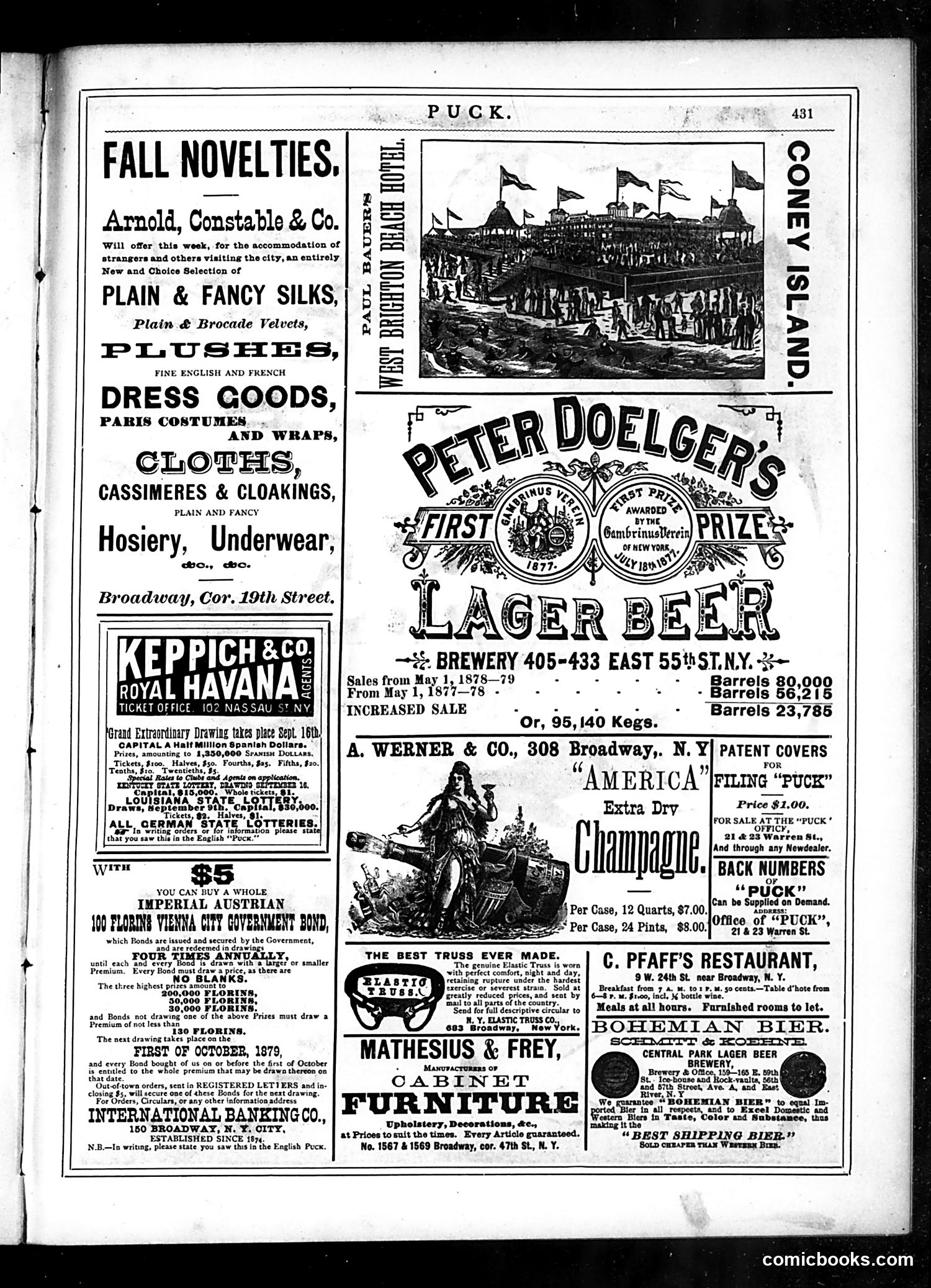
This page is primarily **advertising** rather than editorial content. It contains commercial advertisements from 1879 for New York businesses including: - Arnold, Constable & Co. (silks and dress goods) - Keppich & Co. (Royal Havana cigars and lottery tickets) - Peter Doelger's Lager Beer (brewery in Manhattan) - Various restaurants, furniture makers, and patent medicines The only illustrated content is a large engraving at top showing what appears to be a **Coney Island scene** with crowds, buildings, and flags—likely promotional imagery advertising the beach destination as a fall novelty attraction. The page reflects late-19th-century American consumer culture and New York City's commercial landscape, but contains no political satire or editorial cartooning—just period advertisements and promotional imagery.
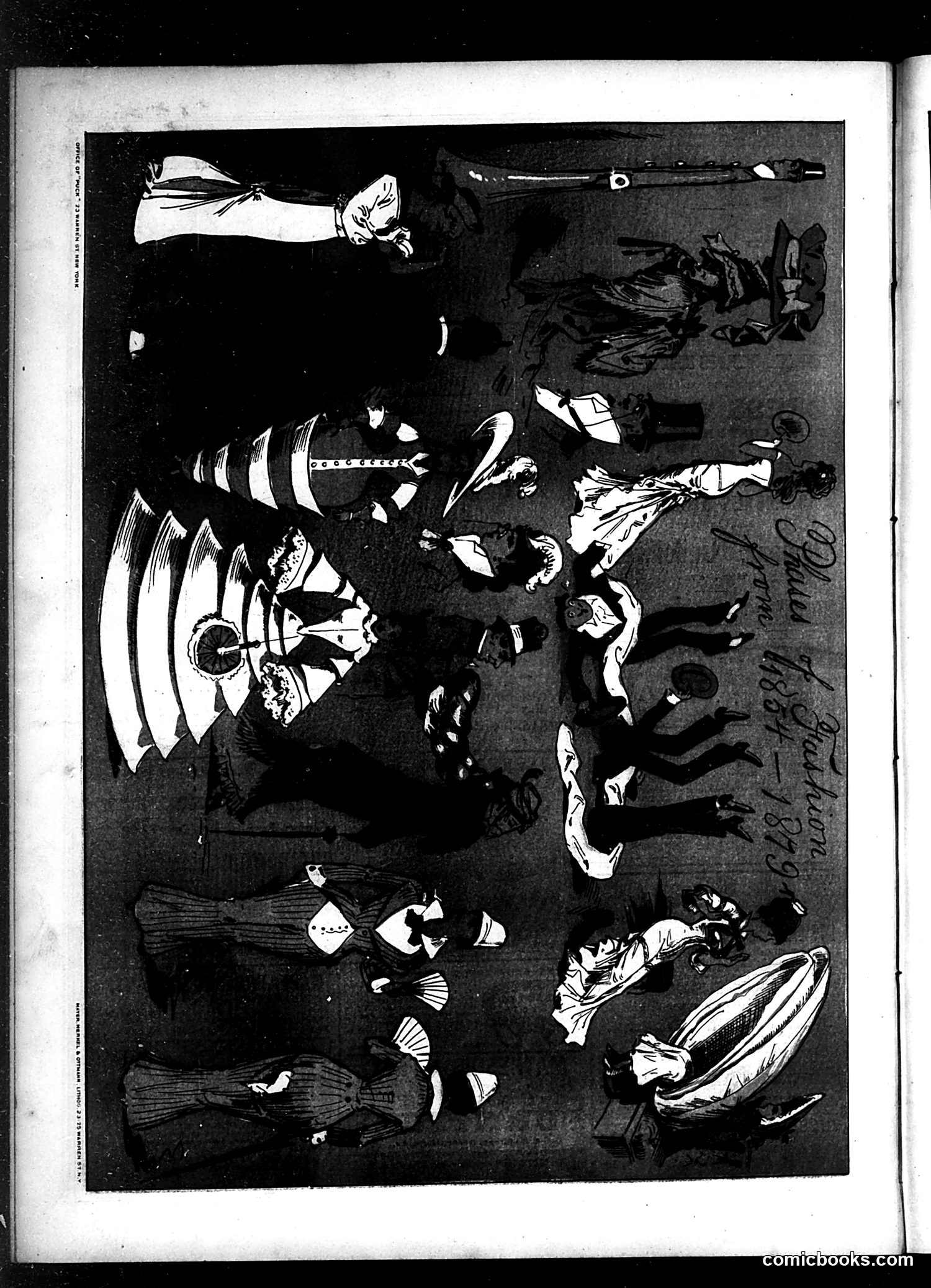
This page appears to be a **fashion or costume illustration plate**, shown rotated 90 degrees. It displays various clothing items and accessories arranged for reference or documentation purposes, rather than a political cartoon. The image shows **white garments and textiles against dark backgrounds** — including what appear to be bonnets, wrapped fabrics, striped clothing, and other period dress items. There's also what looks like a long implement (possibly a parasol or walking stick) at the top. Without readable text identifying these items or their satirical purpose, I cannot definitively explain what social or political commentary this page intends. It may be documenting fashion trends, mocking particular styles, or referencing specific cultural practices of the era — but the specific targets and joke are **unclear from the visible evidence alone**.