
Puck, 1879-09-10 · page 6 of 16
Puck — September 10, 1879 — page 6: what you’re looking at
What you’re looking at
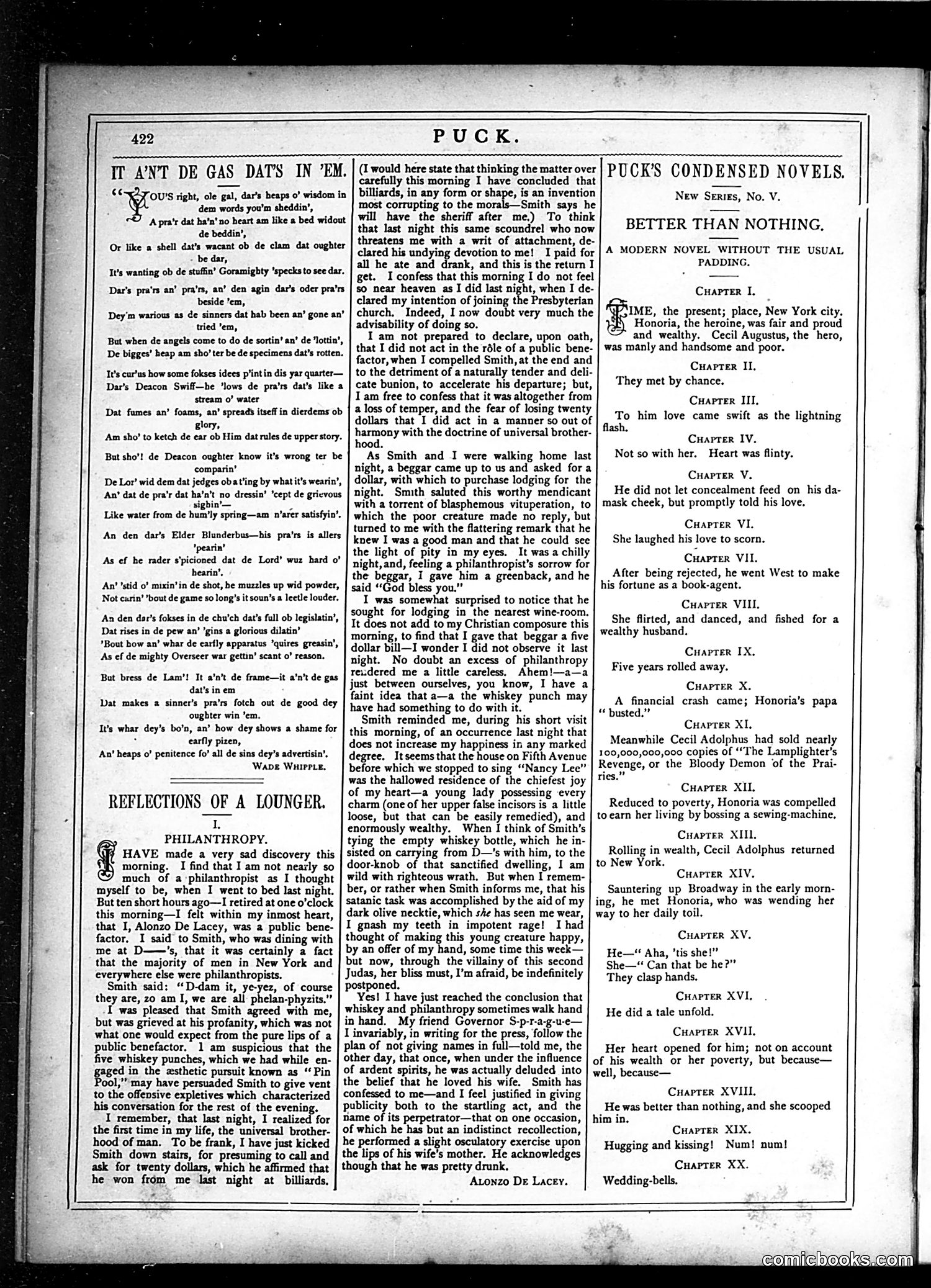
This page contains no political cartoon. Instead, it features two distinct sections: 1. **"It Ain't de Gas Dat's in 'Em"** (left column): A dialect poem in African American Vernacular English, likely from the late 19th century. The poem uses religious and moral themes to critique behavior, employing heavy stereotypical dialect. 2. **"Puck's Condensed Novels"** (right column): A serialized parody titled "Better Than Nothing," described as "A Modern Novel Without the Usual Padding." It consists of extremely brief chapter summaries mocking the conventions of sentimental Victorian fiction. The page is primarily literary content rather than visual satire. The dialect poem reflects period attitudes toward race, while the novel parody satirizes popular fiction tropes—both common Puck features beyond traditional cartooning.
📄 Transcribed text from this page (OCR, searchable)
Machine-transcribed from the original scan — historical spelling and the odd misread are preserved.
PUCK. IT A’N'T DE GAS DATS IN ’EM. we right, ole gal, dar’s heaps o wisdom in ‘dem words you'm sheddin’, ‘Apra'r dat ha'n'no heart am like a bed widout de beddin’, Or like a shell dat’s wacant ob de clam dat oughter be dar, I's wanting ob de stuffin’ Goramighty ‘specks to see dar. Dar's pra'rs an’ pra'rs, an’ den agin dar’s oder pra'rs beside 'em, Dey'm warious as de sinners dat hab been an’ gone an’ tried 'em, But when de angels come to do de sortin’ an’ de ‘lottin', De bigges’ heap am sho’ ter be de specimens dat’s rotten. It's cur’as how some fokses idees p'intin dis yar quarter— Dar's Deacon Swiff—he ‘lows de pra'rs dat’s like a stream o’ water Dat fames an’ foams, an’ spreads itseff in dierdems ob glory, ‘Am sho’ to ketch de ear ob Him dat rules de upper story. But sho’! de Deacon oughter know it’s wrong ter be comparin’ De Lor’ wid dem dat jedges obat'ing by what it’s wearin’, An‘ dat de pra’r dat ha’n't no dressin’ ‘cept de grievous sighin’— 5 Like water from de hum'ly spring—am n’arer satisfyin’. An den dar’s Elder Blunderbus—his pra'rs is allers 'pearin’ As ef he rader s'picioned dat de Lord’ wuz hard o’ hearin’, ‘An! ‘stid 0? mixin’ in de shot, he muzzles up wid powder, Not curin’ bout de game so long’s it soun’s a leetle louder. An den dar’s fokses in de chu'ch dat’s full ob legislatin’, Dat rises in de pew an’ ’gins a glorious dilatin’ "Bout how an’ whar de earfly apparatus “quires greasin’, ‘As ef de mighty Overseer war gettin’ scant o reason. But bress de Lam’! It a’n’t de frame—it a'n’t de gas dat’s in em Dat makes a sinner’s pra’rs fotch out de good dey oughter win ’em. It’s whar dey’s bo's, an’ how dey shows a shame for : carfly pizen, An’ heaps o’ penitence fo’ all de sins dey’s advertisin’, Wane WHirrLe. REFLECTIONS OF A LOUNGER. 1, PHILANTHROPY. HAVE made a very sad discovery this morning. I find that I am not nearly so much of a philanthropist as I thought myself to be, when I went to bed last night. But ten short hours ago—I retired at one o’clock this morning—I felt within my inmost heart, that I, Alonzo De Lacey, was a public bene- factor. I said’ to Smith, who was dining with me at D——'’s, that it was certainly a fact that the majority of men in New York and everywhere else were philanthropists. Smith said: ‘“D-dam it, ye-yez, of course they are, zo am I, we are all phelan-phyzits.” I was pleased that Smith agreed with me, but was grieved at his profanity, which was not what one would expect from the pure lips of a public benefactor. 1 am suspicious that the five whiskey punches, which we had while en- gesed in the esthetic pursuit known as “Pin ool," may have persuaded Smith to give vent to the offensive expletives which characterized his conversation for the rest of the evening. I remember, that last night, I realized for the first time in my life, the universal brother- hood of man. To be frank, I have just kicked Smith down stairs, for presuming to call and ask for twenty dollars, which he affirmed that he won from me ‘last night at billiards, (Iwould here state that thinking the matter over carefully this morning I have concluded that billiards, in any form or shape, is an invention most corrupting to the morals—Smith says he will have the sheriff after me.) To think that last night this same scoundrel who now threatens me with a writ of attachment, de- clared his undying devotion to me! I paid for all he ate and drank, and this is the return I get. I confess that this morning I do not feel so near heaven as I did last night, when I de- clared my intention of joining the Presbyterian church. “Indeed, I now doubt very much the advisability of doing so. I am not prepared to declare, upon oath, that I did not act in the réle of a public bene- factor, when I compelled Smith, at the end and to the detriment of a naturally tender and deli- cate bunion, to accelerate his departure; but, I am free to confess that it was altogether from a loss of temper, and the fear of losing twenty dollars that I did act in a manner so out of harmony with the doctrine of universal brother- hood. As Smith and I were walking home last night, a beggar came up to us and asked fora dollar, with which to purchase lodging for the night. Smith saluted this worthy mendicant with a torrent of blasphemous vituperation, to which the poor creature made no reply, but turned to me with the flattering remark that he knew I was a good man and that he could see the light of pity in my eyes. It was a chilly night, and, feeling a philanthropist’s sorrow for the Degen, I gave him a greenback, and he said “God bless you.” I was somewhat surprised to notice that he sought for lodging in the nearest wine-room. It does not add to my Christian composure this morning, to find that I gave that beggar a five dollar bill—I wonder I did not observe it last night. No doubt an excess of philanthropy reudered me a little careless, Ahem!—a—a just between ourselves, you know, I have a faint idea that a—a the whiskey punch may have had something to do with it. Smith reminded me, during his short visit this morning, of an occurrence last night that does not increase my happiness in any marked degree. Itseems that the house on Fifth Avenue before which we stopped to sing “Nancy Lee” was the hallowed residence of the chiefest joy of my heart—a young lady possessing every charm (one of her upper false incisors is a little loose, but that can be easily remedied), and enormously wealthy. When I think of Smith's tying the empty whiskey bottle, which he in- sisted on carrying from D—’s with him, to the door-knob of that sanctified dwelling, I am wild with righteous wrath. But when I remem- ber, or rather when Smith informs me, that his satanic task was accomplished by the aid of my dark olive necktie, which she has seen me wear, I gnash my teeth in impotent rage! I had thought of making this young creature happy, by an offer of my hand, some time this week— but now, through the villainy of this second Judas, her bliss must, I’m afraid, be indefinitely postponed. Yes! I have just reached the conclusion that whiskey and philanthropy sometimes walk hand in hand. My friend Governor S-p-r-a-g-u-e— L invariably, in writing for the press, follow the plan of not giving names in full—told me, the other day, that once, when under the influence of ardent spirits, he was actually deluded into the belief that he loved his wife. Smith has confessed to me—and I feel justified in giving publicity both to the startling act, and the name of its perpetrator—that on one occasion, of which he has but an indistinct recollection, he performed a slight osculatory exercise upon the lips of his wife's mother. He acknowledges though that he was pretty drunk. Atonzo De Lacey. PUCK’S CONDENSED NOVELS. New Series, No. V. BETTER THAN NOTHING, A MODERN NOVEL WITHOUT THE USUAL PADDING. Cuapter I. IME, the present; place, New York city. Honoria, the heroine, was fair and proud and wealthy. Cecil Augustus, the hero, was manly and handsome and poor. Cuapter II, ‘They met by chance. Cuapter III, To him love came swift as the lightning flash, Cuarrer IV. Not so with her. Heart was flinty. Cuarter V. He did not let concealment feed on his da- mask cheek, but promptly told his love. Cuaprer VI. She laughed his love to scorn. Cuarter VII. After being rejected, he went West to make his fortune as a book-agent. Cuarter VIII. She flirted, and danced, and fished for a wealthy husband. Cuarrer IX, Five years rolled away. CuHarTER X. A financial crash came; Honoria’s papa “ busted.” Cuapter XI. Meanwhile Cecil Adolphus had sold nearly 100,000,000,000 copies of “The Lamplighter’s Revenge, or the Bloody Demon of the Prai- ies.” Cuapter XII. Reduced to poverty, Honoria was compelled toearn her living by bossing a sewing-machine. Cuapter XII, Rolling in wealth, Cecil Adolphus returned to New York. Cuaprer XIV. Sauntering up Broadway in the early morn- ing, he met Honoria, who was wending her way to her daily toil. CuapTer XV. He—* Aha, ’tis she!” She— Can that be he?” They clasp hands. CuarTer XVI, He did a tale unfold. Cuarter XVII, Her heart opened for him; not on account of his wealth or her poverty, but because— well, because— Cuaprer XVII. He was better than nothing, and she scooped him in. Cuapter XIX. Hugging and kissing! Num! num! Cuapter XX. Wedding-bells.