
Puck, 1879-09-10 · page 5 of 16
Puck — September 10, 1879 — page 5: what you’re looking at
What you’re looking at
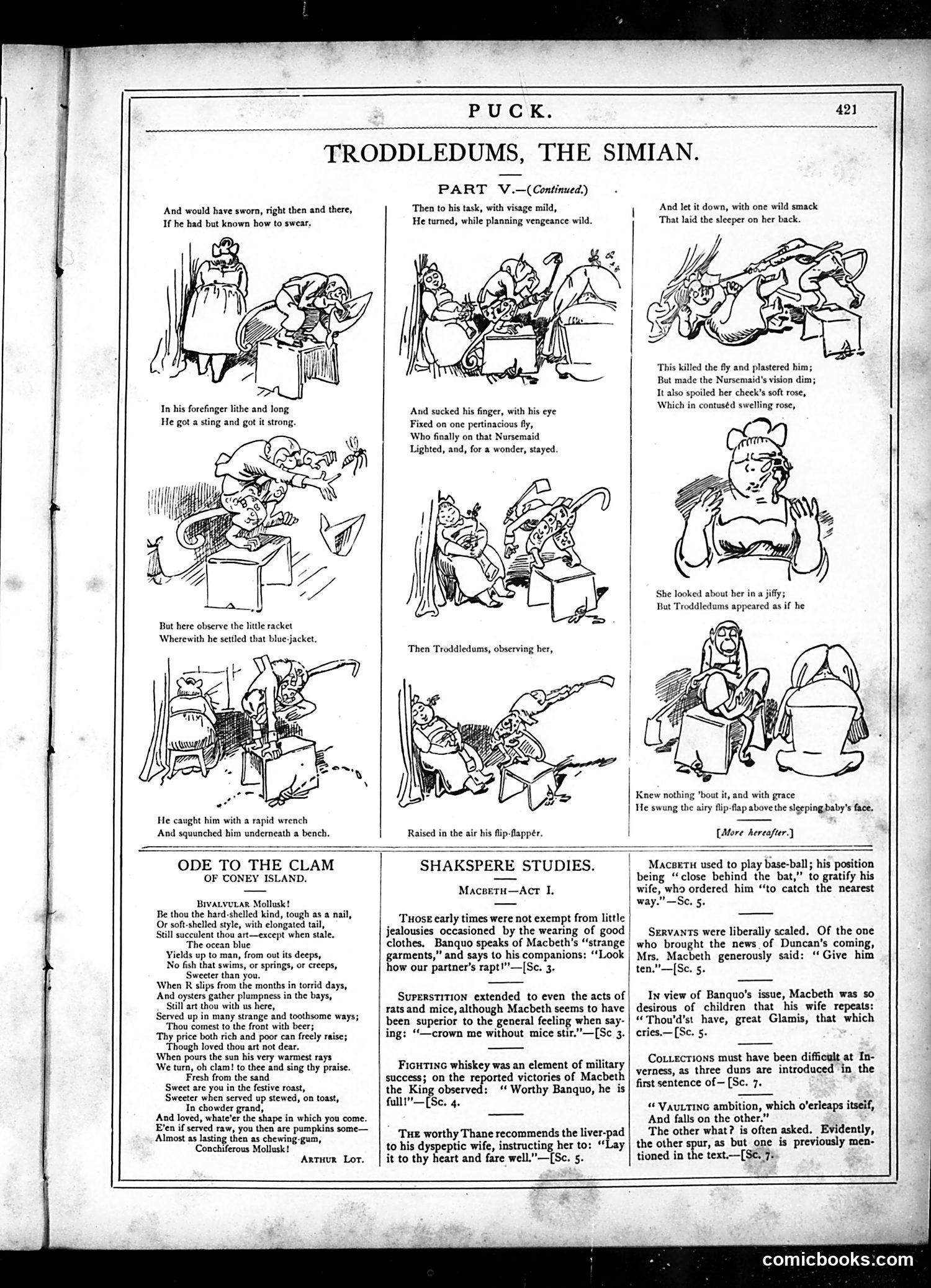
This page contains a serialized comic narrative "Troddledums, the Simian" (Part V) depicting slapstick humor involving a character and various mishaps. The comic shows physical comedy: someone getting stung, having their face slapped, and experiencing other indignities. Below are three separate sections: an "Ode to the Clam" poem about shellfish, "Shakespere Studies" discussing Macbeth's jealousy and superstitions, and notes on Macbeth's Act I regarding servant treatment and military whiskey consumption. These appear to be typical Puck content—mixing crude physical humor comics with literary commentary and light verse. The material reflects late 19th/early 20th-century American humor sensibilities without obvious political satire on this particular page.
📄 Transcribed text from this page (OCR, searchable)
Machine-transcribed from the original scan — historical spelling and the odd misread are preserved.
aaa PUCK. TRODDLEDUMS, THE SIMIAN. And would have sworn, right then and there, If he had but known how to swear. In his forefinger lithe and long He got a sting and got it strong. But here observe the little racket Wherewith he settled that blue-jacket, He caught him with a rapid wrench And squunched him underneath a bench. PART V.—(Continued:) Then to his task, with visage mild, He turned, while planning vengeance wild. And sucked his finger, with his eye Fixed on one pertinacious fy, Who finally on that Nursemaid Lighted, and, for a wonder, stayed. Raised in the air his flip-lappér. | And let it down, with one wild smack That laid the sleeper on her back. This killed the fy and plastered him; But made the Nursemaid’s vision dim; It also spoiled her cheek’s soft rose, Which in contuséd swelling rose, She looked about her in a jiffy; But Troddledums appeared as if he Knew nothing "bout it, and with grace He swung the airy flip-flap above the sleeping baby's face, [Alore hereafter] ODE TO THE CLAM OF CONEY ISLAND. BIVALYULAR Mollusk! Be thou the hard-shelled kind, tough as a nail, Or soft-shelled style, with elongated tail, Still succulent thou art—except when stale, The ocean blue Yields up to man, from out its deeps, No fish that swims, or springs, or creeps, ‘Sweeter than you. When R slips from the months in torrid days, And oysters gather plumpness in the bays, Still art thou with us here, Served up in many strange and toothsome ways; Thou comest to the front with beer; Thy price both rich and poor can freely raise; Though loved thou art not dear. When pours the sun his very warmest rays We turn, oh clam! to thee and sing thy praise. Fresh from the sand Sweet are you in the festive roast, Sweeter when served up stewed, on toast, In chowder grand, And loved, whate'er the shape in which you come. Even if served raw, you then are pumpkins some— Almost as lasting then as chewing-gum, Conchiferous Mollusk! Arriur Lor. SHAKSPERE STUDIES. Macsetu—Acrt I, THosE early times were not exempt from little jealousies occasioned by the wearing of good clothes. Banquo speaks of Macbeth’s “strange garments,” and says to his companions: ‘‘Look how our partner’s rapt!""—[Sc. 3. | | SupersTITION extended to even the acts of | ratsand mice, although Macbeth seems to have been superior to the general feeling when say- ing: ‘‘—crown me without mice stir.”—[Sc 3. Ficutinc whiskey was an element of military success; on the reported victories of Macbeth the King observed: “ Worthy Banquo, he is full!”"—[Sc. 4. Tue worthy Thane recommends the liver-pad to his dyspeptic wife, instructing her to: “Lay it to thy heart and fare well.”—[Sc. 5. Macsetu used to play base-ball; his position being “close behind the bat,’ to gratify his wife, who ordered him “to catch the nearest way.” —Sc. 5. Servants were liberally scaled. Of the one who brought the news of Duncan's coming, Mrs. Macbeth generously said: ‘‘ Give him ten,”—[Sc. 5. In view of Banquo’s issue, Macbeth was so desirous of children that his wife repeats: “Thou'd’st have, great Glamis, that which cries.—[Sc. 5. CotLections must have been difficult at In- verness, as three duns are introduced in the first sentence of—[Sc. 7. “ VauLtine ambition, which o’erleaps itseif, And falls on the other.” The other what? is often asked. Evidently, the other spur, as but one is previously men- tioned in the text.—[Se. 7: comicbooks:com