
Puck, 1879-09-10 · page 3 of 16
Puck — September 10, 1879 — page 3: what you’re looking at
What you’re looking at
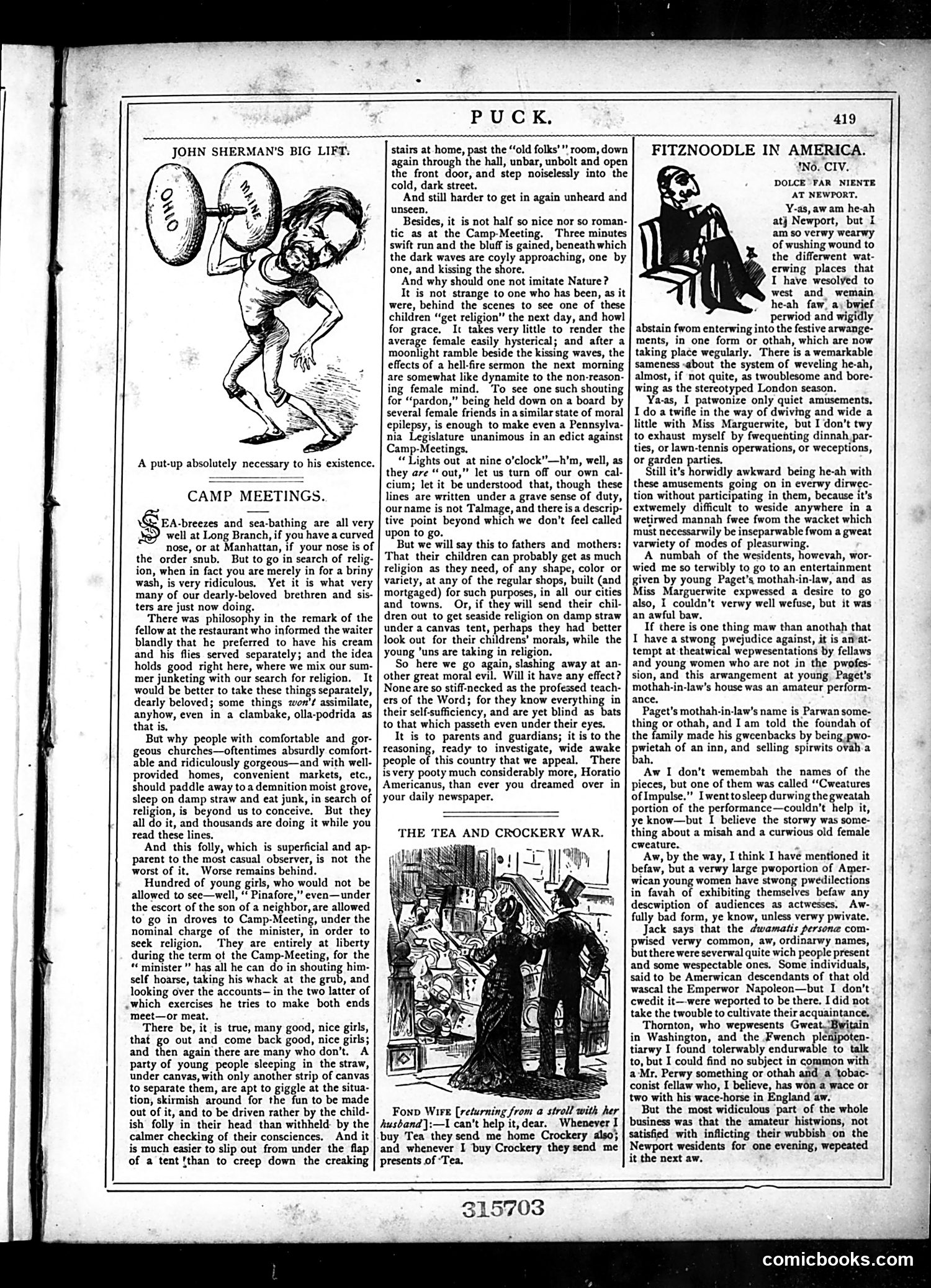
**"John Sherman's Big Lift"** (top cartoon): Shows a figure straining to lift enormous weights labeled "OHIO." This satirizes John Sherman, likely referencing his political influence or ambitions in Ohio politics during the Gilded Age. **"Camp Meetings"** section: A lengthy editorial criticizing religious camp meetings as sites of moral hypocrisy. The author mocks the spectacle of emotional "religion" among attendees while questioning its genuine spiritual value. References to young people, "half-fire sermons," and staged religiosity suggest satire of camp meeting theatricality and questionable ethics. **"The Tea and Crockery War"** (bottom illustration): An engraving depicting what appears to be domestic conflict, though context remains unclear from visible text alone. The page exemplifies Puck's satirical approach to American social and political institutions.
📄 Transcribed text from this page (OCR, searchable)
Machine-transcribed from the original scan — historical spelling and the odd misread are preserved.
PUCK. 419 JOHN SHERMAN'S BIG LIFT. A put-up absolutely necessary to his existence. CAMP MEETINGS. ‘A-breezes and sea-bathing are all very well at Long Branch, if you have a curved nose, or at Manhattan, if your nose is of the order snub. But to go in search of relig- ion, when in fact you are merely in for a briny wash, is very ridiculous, Yet it is what very many of our dearly-beloved brethren and sis- ters are just now doing. There was philosophy in the remark of the fellow at the restaurant who informed the waiter blandly that he preferred to have his cream and his flies served separately; and the idea holds good right here, where we mix our sum- mer junketing with our search for religion. It would be better to take these things separately, dearly beloved; some things won't assimilate, anyhow, even in a clambake, olla-podrida as that is. But why people with comfortable and gor- geous churches—oftentimes absurdly comfort- able and ridiculously gorgeous—and with well- provided homes, convenient markets, etc., should paddle away toa demnition moist grove, sleep on damp straw and eat junk, in search of religion, is beyond us to conceive, But they all do it, and thousands are doing it while you read these lines. ‘And this folly, which is superficial and ap- parent to the most casual observer, is not the worst of it, Worse remains behind. | Hundred of young girls, who would not be allowed to see—well, ‘ Pinafore,” even—under the escort of the son of a neighbor, are allowed to go in droves to Camp-Meeting, under the nominal charge of the minister, in order to seek religion. They are entirely at liberty during the term ot the Camp-Meeting, for the * minister” has all he can do in shouting him- self hoarse, taking his whack at the grub, and looking over the accounts— in the two latter of .which exercises he tries to make both ends meet—or meat. There be, it is true, many good, nice girls, that go out and come back good, nice girls; and then again there are many who don’t. A party of young people sleeping in the straw, under canvas, with only another strip of canvas to separate them, are apt to giggle at the situa- tion, skirmish around for the fun to be made out of it, and to be driven rather by the child- ish folly in their head than withheld: by the calmer checking of their consciences. And it is much easier to slip out from under the flap of a tent {than to creep down the creaking stairs at home, past the “‘old fol room, down again through the hall, unbar, unbolt and open the front door, and step noiselessly into the cold, dark street. And still harder to get in again unheard and unseen, Besides, it is not half so nice nor so roman- tic as at the Camp-Meeting. Three minutes swift run and the bluff is gained, beneathwhich the dark waves are coyly approaching, one by one, and kissing the shore. And why should one not imitate Nature? It is not strange to one who has been, as it were, behind the scenes to see one of these children “get religion” the next day, and howl for grace. It takes very little to render the average female easily hysterical; and after a moonlight ramble beside the kissing waves, the effects of a hell-fire sermon the next morning are somewhat like dynamite to the non-reason- ing female mind. ‘To see one such shouting for “pardon,” being held down on a board by several female friends in a similar state of moral epilepsy, is enough to make even a Pennsylva- nia Legislature unanimous in an edict against Camp-Meetings, “ Lights out at nine o’clock”—h’m, well, as they are “ out,” let us turn off our own cal- cium; let it be understood that, though these lines ‘are written under a grave sense of duty, ourname is not Talmage, and there is a descrip- tive point beyond which we don’t feel called upon to go. But we will say this to fathers and mothers: That their children can probably get as much religion as they need, of any shape, color or variety, at any of the regular shops, built (and mortgaged) for such purposes, in all our cities and towns. Or, if they will send their chil- dren out to get seaside religion on damp straw under a canvas tent, perhaps they had better look out for their childrens’ morals, while the young ‘uns are taking in religion. So here we go again, slashing away at an- other great moral evil. Will it have any effect? None are so stiff-necked as the professed teach- ers of the Word; for they know everything i their self-sufficiency, and are yet blind as to that which passeth even under their eyes. It is to parents and guardians; it is to the reasoning, ready to investigate, wide awake people of this country that we appeal. There is very pooty much considerably more, Horatio Americanus, than ever you dreamed over in your daily newspaper. ts THE TEA AND CROCKERY WAR. Fonp Wire [returning from a stroll with her husband}:—I can't help it, dear. Whenever I buy Tea they send me home Crockery also} and whenever I buy Crockery they send me presents of “Tea, FITZNOODLE IN AMERICA. !No. CIV. DOLCE’ FAR NIENTE AT NEWPORT. Y-as, aw am he-ah atj Newport, but 1 am so verwy wearwy of wushing wound to the differwent wat- erwing places that I have wesolyed to west and wemain he-ah faw, a, bwief perwiod and wigidly abstain fwom enterwing into the festive arwange- ments, in one form or othah, which are now taking place wegularly. There is a wemarkable sameness -about the system of weveling he-ah, almost, if not quite, as twoublesome and bore- wing as the stereotyped London season. Ya-as, I patwonize only quiet amusements, Ido a twifle in the way of dwiving and wide a little with Miss Marguerwite, but I don’t twy to exhaust myself by fwequenting dinnah,par- ties, or lawn-tennis operwations, or weceptions, or garden parties, Still it’s horwidly awkward being he-ah with these amusements going on in everwy dirwec- tion without participating in them, because it’s extwemely difficult to weside anywhere in a wetirwed mannah fwee fwom the wacket which must necessarwily be inseparwable fwom a gweat varwiety of modes of pleasurwing. A numbah of the wesidents, howevah, wor- wied me so terwibly to go to an entertainment given by young Paget's mothah-in-law, and as Miss Marguerwite expwessed a desire to go also, I couldn’t verwy well wefuse, but it was an awful baw. If there is one thing maw than anothah that I have a stwong pwejudice against, it is an’at- tempt at theatwical wepwesentations by fellaws and young women who are not in the pwofes- sion, and this arwangement at young Paget’s mothah-in-law’s house was an amateur perform- ance. Paget's mothah-in-law’s name is Parwan some- thing or othah, and I am told the foundah of the family made his gwcenbacks by being pwo- pwietah of an inn, and selling spirwits ovah'a bah, Aw I don’t wemembah the names of the pieces, but one of them was called ‘“‘Cweatures of Impulse.” went tosleep durwing the gweatah portion of the performance—couldn’t help it, ye know—but I believe the storwy was some- thing about a misah and a curwious old female cweature. ‘ ‘Aw, by the way, I think I have mentioned it befaw, but a verwy large pwoportion of Amer- wican young women have stwong pwedilections in favah of exhibiting themselves befaw any descwiption of audiences as actwesses, Aw- fully bad form, ye know, unless verwy pwivate. Jack says that the dwamatis persona com- ywised verwy common, aw, ordinarwy names, bat there were severwal quite wich people present and some wespectable ones, Some individuals, said to be Amerwican descendants of that old wascal the Emperwor Napoleon—but I don’t cwedit it—were weported to be there. I did not take the twouble to cultivate their acquaintance, Thornton, who wepwesents Gweat Bwitain in Washington, and the Fwench plenipoten- tiarwy I found tolerwably endurwable to talk to, but I could find no subject in common with a Mr. Perwy something or othah and a ‘tobac- conist fellaw who, I believe, has won a wace or two with his wace-horse in England aw. But the most widiculous part of the whole business was that the amateur histwions, not satisfied with inflicting their wubbish on the Newport wesidents for one evening, wepeated it the next aw. 315703 comicbooks.com