
Puck, 1879-09-10 · page 10 of 16
Puck — September 10, 1879 — page 10: what you’re looking at
What you’re looking at
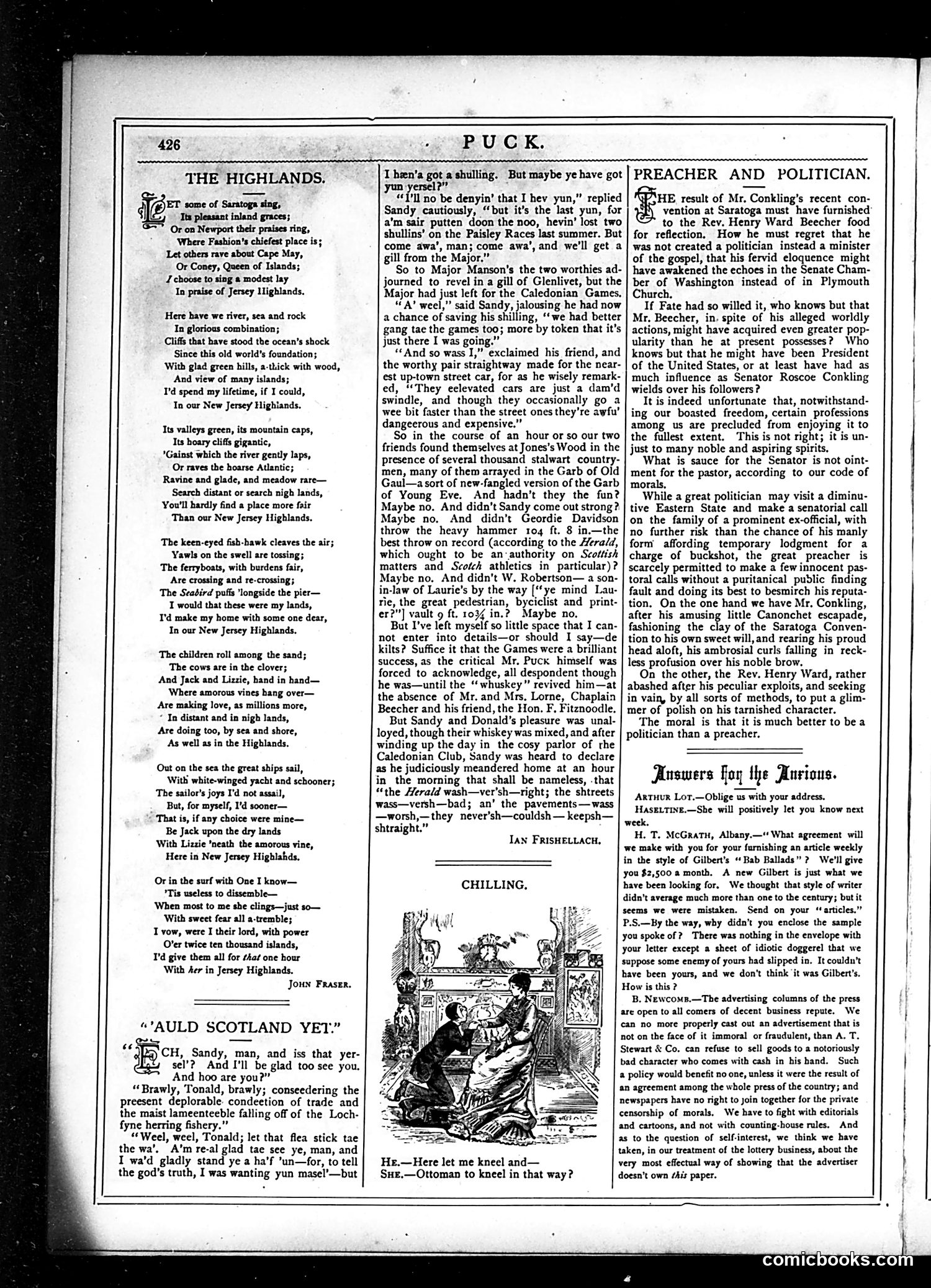
This page contains poetry and prose rather than political cartoons. The main content includes "The Highlands" (a Scottish poem), "Chilling" (a short story with illustration), and "'Auld Scotland Yet!'" (dialogue). The one visible illustration shows a domestic scene of a man and woman in an ottoman/cushioned seat, with the caption "He.—Here let me kneel and— / She.—Ottoman to kneel in that way?" This appears to be a visual pun playing on the word "ottoman" (furniture) versus "Ottoman" (Turkish). The "Answers for the Curious" section addresses reader inquiries about advertising standards and newspaper ethics. No clear political satire is evident on this particular page.
📄 Transcribed text from this page (OCR, searchable)
Machine-transcribed from the original scan — historical spelling and the odd misread are preserved.
426 THE HIGHLANDS. ET some of Saratoga sing, Its pleasant inland graces; Or on Newport their praises ring, ‘Where Fashion's chiefest place is; Let others rave about Cape May, Or Coney, Queen of Islands; ‘J choose to sing a modest lay In praise of Jersey Highlands. Here have we river, sea and rock In glorious combination; Cliffs that have stood the ocean’s shock Since this old world’s foundation; With glad green hills, a-thick with wood, ‘And view of many islands; I'd spend my lifetime, if I could, In our New Jersey Highiands, Its valleys green, its mountain caps, Its hoary clifis gigantic, ’Gainst which the river gently laps, Or raves the hoarse Atlantic; Ravine and glade, and meadow rare— Search distant or search nigh lands, You'll hardly find a place more fair Than our New Jersey Highlands. The keen-eyed fish-hawk cleaves the air; Yawls on the swell are tossing; The ferryboats, with burdens fair, Are crossing and re-crossing; The Seabird pufis "longside the pier— I would that these were my lands, T'd make my home with some one dear, In our New Jersey Highlands. The children roll among the sand; The cows are in the clover; ‘And Jack and Lizzie, hand in hand— Where amorous vines hang over— Are making love, as millions more, In distant and in nigh lands, Are doing too, by sea and shore, ‘As well as in the Highlands. Out on the sea the great ships sail, With white-winged yacht and schooner; The sailor’s joys I'd not assail, But, for myself, I'd sooner— ‘That is, if any choice were mine— Be Jack upon the dry lands With Lizzie ‘neath the amorous vine, Here in New Jersey Highlahds, Or in the surf with One I know— "Tis useless to dissemble— When most to me she clings—just so— With sweet fear all a-tremble; I vow, were I their lord, with power O’er twice ten thousand islands, I'd give them all for ¢kaf one hour With Aer in Jersey Highlands. Joun Fraser. “*AULD SCOTLAND YET.” = ces ‘Sha CH, Sandy, man, and iss that yer- sel’? And I'll be glad too see you. And hoo are you?” “Brawly, Tonald, brawly; conseedering the preesent deplorable: condeetion of trade and the maist lameenteeble falling off of the Loch- fyne herring fishery.” “Weel, weel, Tonald; let that flea stick tae the wa’, A’m re-al glad tae see ye, man, and I wa'd gladly stand ye a ha’f ’un—for, to tell the god’s truth, I was wanting yun masel’—but - PUCK. T hen’a got a shulling. But maybe ye have got yun yersel?” “I'll no be denyin’ that I hev yun,” replied Sandy cautiously, “but it’s the last yun, for a’m sair putten doon the noo, hevin’ lost two shullins’ on the Paisley Races last summer. But come awa’, man; come awa’, and we'll get a gill from the Major.” So to Major Manson's the two worthies ad- journed to revel in a gill of Glenlivet, but the Major had just left for the Caledonian Games, A’ weel,” said Sandy, jalousing he had now a chance of saving his shilling, ‘‘we had better gang tae the games too; more by token that it’s just there I was going.” “And so wass I,” exclaimed his friend, and the worthy pair straightway made for the near- est up-town street car, for as he wisely remark- ed, ‘They eelevated cars are just a dam’d swindle, and though they occasionally go a wee bit faster than the street ones they're awfu’ dangeerous and expensive.” So in the course of an hour or so our two friends found themselves at Jones's Wood in the presence of several thousand stalwart country- men, many of them arrayed in the Garb of Oid Gaul—a sort of new-fangled version of the Garb of Young Eve. And hadn’t they the fun? Maybe no. And didn’t Sandy come out strong? Maybe no, And didn’t Geordie Davidson throw the heavy hammer 104 ft. 8 in.—the best throw on record (according to the Hera/d, which ought to be an-authority on Scottish matters and Scotch athletics in particular)? Maybe no. And didn't W. Robertson— a son- in-law of Laurie’s by the way [ye mind Lau- rie, the great pedestrian, byciclist and print- er?”] vault 9 ft. 1034 in.? Maybe no. But I’ve left myself so little space that I can- not enter into details—or should I say—de kilts? Suffice it that the Games were a brilliant success, as the critical Mr. Puck himself was forced to acknowledge, all despondent though he was—until the “ whuskey” revived him—at the absence of Mr. and Mrs. Lorne, Chaplain Beecher and his friend, the Hon. F, Fitznoodle, But Sandy and Donald’s pleasure was unal- loyed, though their whiskey was mixed, and after winding up the day in the cosy parlor of the Caledonian Club, Sandy was heard to declare as he judiciously meandered home at an hour in the morning that shall be nameless, .that “the Herald wash—ver'sh—right; the shtreets wass—versh—bad; an’ the pavements—wass —worsh,—they never’sh—couldsh— keepsh— shtraight.” TAN FRISHELLACH, CHILLING, He.—Here let me kneel and— SuE.—Ottoman to kneel in that way? PREACHER AND POLITICIAN. HE result of Mr. Conkling’s recent con- vention at Saratoga must have furnished’ to the Rev. Henry Ward Beecher food for reflection, How he must regret that he was not created a politician instead a minister of the gospel, that his fervid eloquence might have awakened the echoes in the Senate Cham- ber of Washington instead of in Plymouth Church, If Fate had so willed it, who knows but that Mr, Beecher, in. spite of his alleged worldly actions, might have acquired even greater pop- ularity than he at present possesses? Who knows but that he might have been President of the United States, or at least have had as much influence as Senator Roscoe Conkling wields over his followers? It is indeed unfortunate that, notwithstand- ing our boasted freedom, certain professions among us are precluded from enjoying it to the fullest extent. This is not right; it is un- just to many noble and aspiring spirits, What is sauce for the Senator is not oint- ment for the pastor, according to our code of morals, While a great politician may visit a diminu- tive Eastern State and make a senatorial call on the family of a prominent ex-official, with no further risk than the chance of his manly form affording temporary lodgment for a charge of buckshot, the great preacher is scarcely permitted to make a few innocent pas- toral calls without a puritanical public finding fault and doing its best to besmirch his reputa- tion, On the one hand we have Mr. Conkling, after his amusing little Canonchet escapade, fashioning the clay of the Saratoga Conven- tion to his own sweet will, and rearing his proud head aloft, his ambrosial curls falling in reck- less profusion over his noble brow. On the other, the Rev. Henry Ward, rather abashed after his peculiar exploits, and seeking in vain, by all sorts of methods, to put a glim- mer of polish on his tarnished character. The moral is that it is much better to bea politician than a preacher. Answers Foy the Aurious. Artur Lor.—Oblige us with your address. HAsELTINE.—She will positively let you know next week. H. T. McGrati, Albany.— What agreement will we make with you for your furnishing an article weekly in the style of Gilbert's “Bab Ballads” ? We'll give you $2,500 a month, A new Gilbert is just what we have been looking for. We thought that style of writer didn't average much more than one to the century; but it seems we were mistaken. Send on your “articles.” P.S.—By the way, why didn't you enclose the sample you spoke of? There was nothing in the envelope with your letter except a sheet of idiotic doggerel that we suppose some enemy of yours had slipped in. It couldn’t have been yours, and we don't think ‘it was Gilbert's. How is this ? B, Newcomp.—The advertising columns of the press are open to all comers of decent business repute. We can no more properly cast out an advertisement that is not on the face of it immoral or fraudulent, than A. T. Stewart & Co. can refuse to sell goods to a notoriously bad character who comes with cash in his hand. Such a policy would benefit noone, unless it were the result of an agreement among the whole press of the country; and newspapers have no right to join together for the private censorship of morals. We have to fight with editorials and cartoons, and not with counting-house rules. And as to the question of self-interest, we think we have taken, in our treatment of the lottery business, about the very most effectual way of showing that the advertiser doesn’t own this paper.