
Puck, 1879-09-10 · page 7 of 16
Puck — September 10, 1879 — page 7: what you’re looking at
What you’re looking at
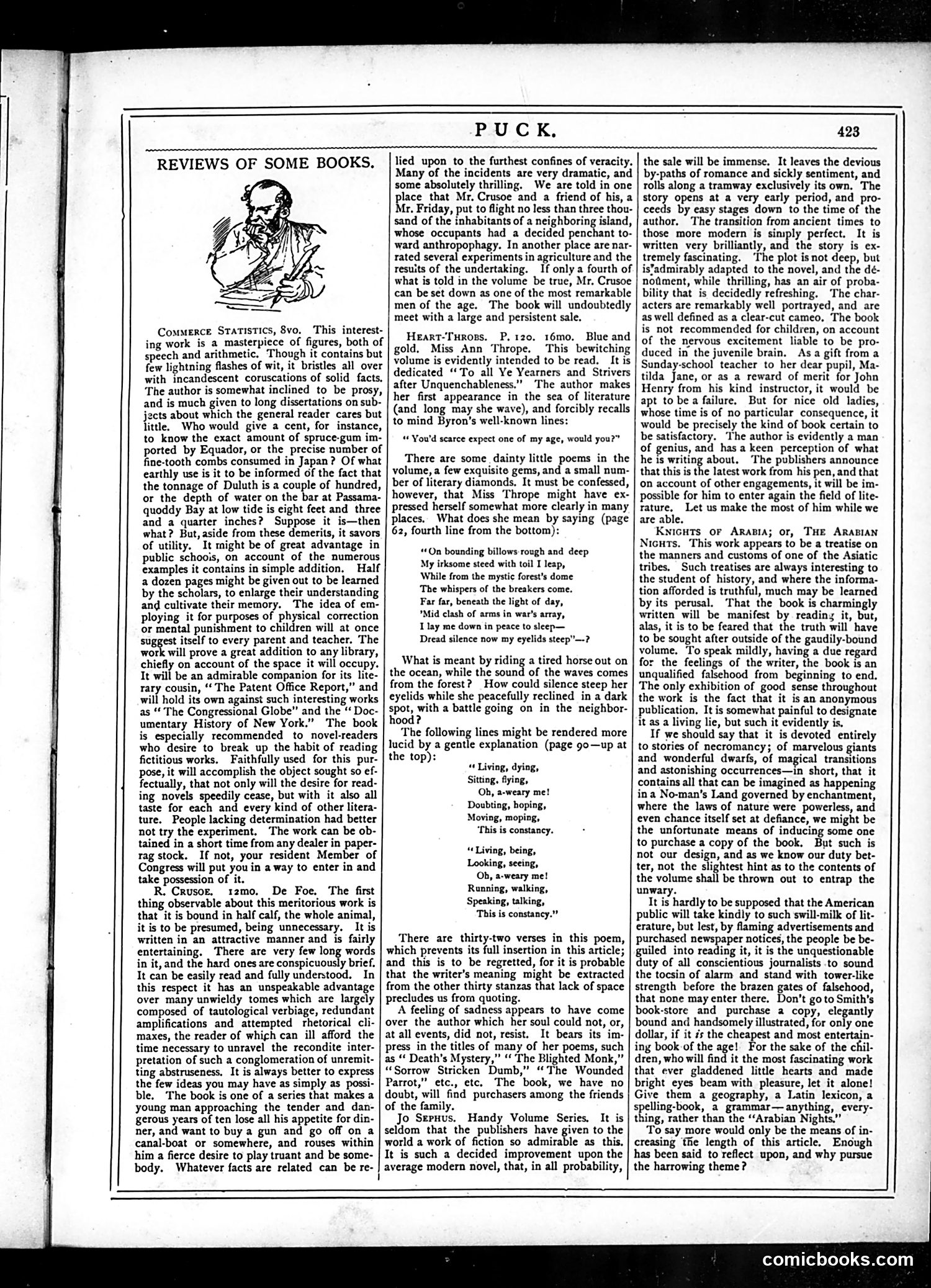
This page consists primarily of literary book reviews rather than political cartoons. The illustration shows a caricatured figure (appears to be a reviewer or critic) examining books, rendered in Puck's typical satirical style. The reviews cover works including "Commerce Statistics," "Heart-Throes" by Miss Ann Thorpe, and "The Nights of Arabia." The critics discuss these books with characteristic Puck irreverence—mocking pretentious literary works while occasionally praising genuine merit. The satire targets publishers' marketing claims, sentimental poetry, and what the reviewers consider overwrought or derivative fiction. The tone suggests Puck's role as cultural arbiter, using humor to deflate inflated literary reputations and expose commercial book-marketing tactics to educated readers.
📄 Transcribed text from this page (OCR, searchable)
Machine-transcribed from the original scan — historical spelling and the odd misread are preserved.
PUCK, 423 REVIEWS OF SOME BOOKS, Commerce Statistics, 8vo, This interest- ing work is a masterpiece of figures, both of speech and arithmetic. Though it contains but few lightning flashes of wit, it bristles all over with incandescent coruscations of solid facts. The author is somewhat inclined to be prosy, and is much given to long dissertations on sub- jects about which the general reader cares but little. Who would give a cent, for instance, to know the exact amount of spruce-gum im- ported by Equador, or the precise number of fine-tooth combs consumed in Japan? Of what earthly use is it to be informed of the fact that the tonnage of Duluth is a couple of hundred, or the depth of water on the bar at Passama- quoddy Bay at low tide is eight feet and three and a quarter inches? Suppose it is—then what? But, aside from these demerits, it savors of utility, ‘It might be of great advantage in public schoois, on account of the numerous examples it contains in simple addition, Half a dozen pages might be given out to be learned by the scholars, to enlarge their understanding and cultivate their memory. The idea of em- ploying it for purposes of physical correction or mental punishment to children will at once suggest itself to every parent and teacher. The work will prove a great addition to any library, chiefly on account of the space it will occupy. It will be an admirable companion for its lite- rary cousin, ‘‘ The Patent Office Report,” and will hold its own against such interesting works as “ The Congressional Globe” and the ‘ Doc- umentary History of New York.” The book is especially recommended to novel-readers who desire to break up the habit of reading fictitious works. Faithfully used for this pur- pose, it will accomplish the object sought so ef- fectually, that not only will the desire for read- ing novels speedily cease, but with it also all taste for each and every kind of other litera- ture. People lacking determination had better not try the experiment. The work can be ob- tained in a short time from any dealer in paper- rag stock. If not, your resident Member of Congress will put you in a way to enter in and take possession of it. R. Crusoz. 12mo. De Foe. The first thing observable about this meritorious work is that it is bound in half calf, the whole animal, it is to be presumed, being unnecessary. It is written in an attractive manner and is fairly entertaining. There are very few long words in it, and the hard ones are conspicuously brief, It can be easily read and fully understood. In this respect it has an unspeakable advantage over many unwieldy tomes which are largely composed of tautological verbiage, redundant amplifications and attempted rhetorical cli- maxes, the reader of whigh can ill afford the time necessary to unravel the recondite inter- pretation of such a conglomeration of unremit- ting abstruseness, It is always better to express the few ideas you may have as simply as possi- ble, The book is one of a series that makes a young man approaching the tender and dan- gerous years of ten lose all his appetite for din- ner, and want to buy a gun and go off on a canal-boat or somewhere, and rouses within him a fierce desire to play truant and be some- body. lied upon to the furthest confines of veracity. Many of the incidents are very dramatic, and some absolutely thrilling. We are told in one lace that Mr. Crusoe and a friend of his, a fr. Friday, put to flight no less than three thou- sand of the inhabitants of a neighboring island, whose occupants had a decided penchant to- ward anthropophagy. In another place are nar- rated several experiments in agriculture and the results of the undertaking. If only a fourth of what is told in the volume be true, Mr. Crusoe can be set down as one of the most remarkable men of the age. The book will undoubtedly meet with a large and persistent sale. Heart-Tuross. P, 120, 16mo. Blue and gold, Miss Ann Thrope. This bewitching volume is evidently intended to be read. It is dedicated ‘To all Ye Yearners and Strivers after Unquenchableness.” The author makes her first appearance in the sea of literature (and long may she wave), and forcibly recalls to mind Byron's well-known lines: “ You'd scarce expect one of my age, would you?” There are some dainty little poems in the volume, a few exquisite gems, and a small num- ber of literary diamonds, It must be confessed, however, that Miss Thrope might have ex- pressed herself somewhat more clearly in many places. What does she mean by saying (page 62, fourth line from the bottom): On bounding billows rough and deep My irksome steed with toil I leap, While from the mystic forest's dome The whispers of the breakers come. Far far, beneath the light of day, 'Mid clash of arms in war's array, I lay me down in peace to sleep— Dread silence now my eyelids steep”? What is meant by riding a tired horse out on the ocean, while the wound of the waves comes from the forest? How could silence steep her eyelids while she peacefully reclined in a dark spot, with a battle going on in the neighbor- hood? ‘The following lines might be rendered more lucid by a gentle explanation (page 9o—up at the top): «+ Living, dying, Sitting, flying, Oh, a-weary me! Doubting, hoping, Moving, moping, ‘This is constancy. “Living, being, Looking, seeing, Ob, a-weary me! Running, walking, Speaking, talking, This is constancy.” There are thirty-two verses in this poem, which prevents its full insertion in this article; and this is to be regretted, for it is probable that the writer’s meaning might be extracted from the other thirty stanzas that lack of space precludes us from quoting. A feeling of sadness appears to have come over the author which her soul could not, or, at all events, did not, resist. It bears its im- press in the titles of many of her poems, such as “ Death's Mystery,” ‘ The Blighted Monk,” “Sorrow Stricken Dumb,” “The Wounded Parrot,” etc., etc. The book, we have no doubt, will find purchasers among the friends of the family. Jo Sepuus. Handy Volume Series, It is seldom that the publishers have given to the world a work of fiction so admirable as this, It is such a decided improvement upon the Whatever facts are related can be re- | average modern novel, that, in all probability, the sale will be immense. It leaves the devious by-paths of romance and sickly sentiment, and rolls along a tramway exclusively its own. The story opens at a very early period, and pro- ceeds by easy stages down to the time of the author, The transition from ancient times to those more modern is simply perfect. It is written very brilliantly, ‘and the story is ex- tremely fascinating. The plot is not deep, but is'admirably adapted to the novel, and the dé- nodiment, while thrilling, has an air of proba- bility that is decidedly refreshing. ‘The char- acters are remarkably well portrayed, and are as well defined as a clear-cut cameo, The book is not recommended for children, on account of the nervous excitement liable to be pro- duced in the juvenile brain. Asa gift from a Sunday-school teacher to her dear pupil, Ma- tilda Jane, or as a reward of merit for John Henry from his kind instructor, it would be apt to bea failure, But for nice old ladies, whose time is of no perpcue consequence, it would be precisely the kind of book certain to be satisfactory. The author is evidently a man of genius, and has a keen perception of what he is Abita 3 about, The publishers announce that this is the latest work from his pen, and that on account of other engagements, it will be im- possible for him to enter again the field of lite- rature, Let us make the most of him while we are able. KNIGHTS OF ARABIA; or, THE ARABIAN Nicuts. This work appears to be a treatise on the manners and customs of one of the Asiatic tribes. Such treatises are always interesting to the student of history, and where the informa- tion afforded is truthful, much may be learned by its perusal. That the book is charmingly written will be manifest by reading it, but, alas, it is to be feared that the truth will have to be sought after outside of the gaudily-bound volume, To speak mildly, having a due regard for the feelings of the writer, the book is an unqualified falsehood from beginning to end. The only exhibition of good sense throughout the work is the fact that it is an anonymous publication, It is somewhat painful to designate it as a living lie, but such it evidently is, If we should say that it is devoted entirely to stories of necromancy; of marvelous giants and wonderful dwarfs, of magical transitions and astonishing occurrences—in short, that it contains all that can be imagined as happening ina No-man's Land governed by enchantment, where the laws of nature were powerless, and even chance itself set at defiance, we might be the unfortunate means of inducing some one to purchase a copy of the book. But such is not our design, and as we know our duty bet- ter, not the slightest hint as to the contents of the volume shall be thrown out to entrap the unwary. It is hardly to be supposed that the American public will take kindly to such swill-milk of lit- erature, but lest, by flaming advertisements and purchased newspaper notices, the people be be- guiled into reading it, it is the unquestionable duty of all conscientious journalists to sound the tocsin of alarm and stand with tower-like strength before the brazen gates of falsehood, that none may enter there. Don't goto Smith's book-store and purchase a copy, elegantly bound and handsomely illustrated, for only one dollar, if it #s the cheapest and most entertain- ing book-of the age! For the sake of the chil- dren, who will find it the most fascinating work that ever gladdened little hearts and made bright eyes beam with pleasure, let it alone! Give them a geography, a Latin lexicon, a spelling:book, a mar— anything, every- thing, rather than the ‘Arabian Nights,” To say more would only be the means of in- creasing the length of this article. Enough has been said to reflect upon, and why pursue the harrowing theme? comicbooks.com