
Puck, 1879-09-10 · page 11 of 16
Puck — September 10, 1879 — page 11: what you’re looking at
What you’re looking at
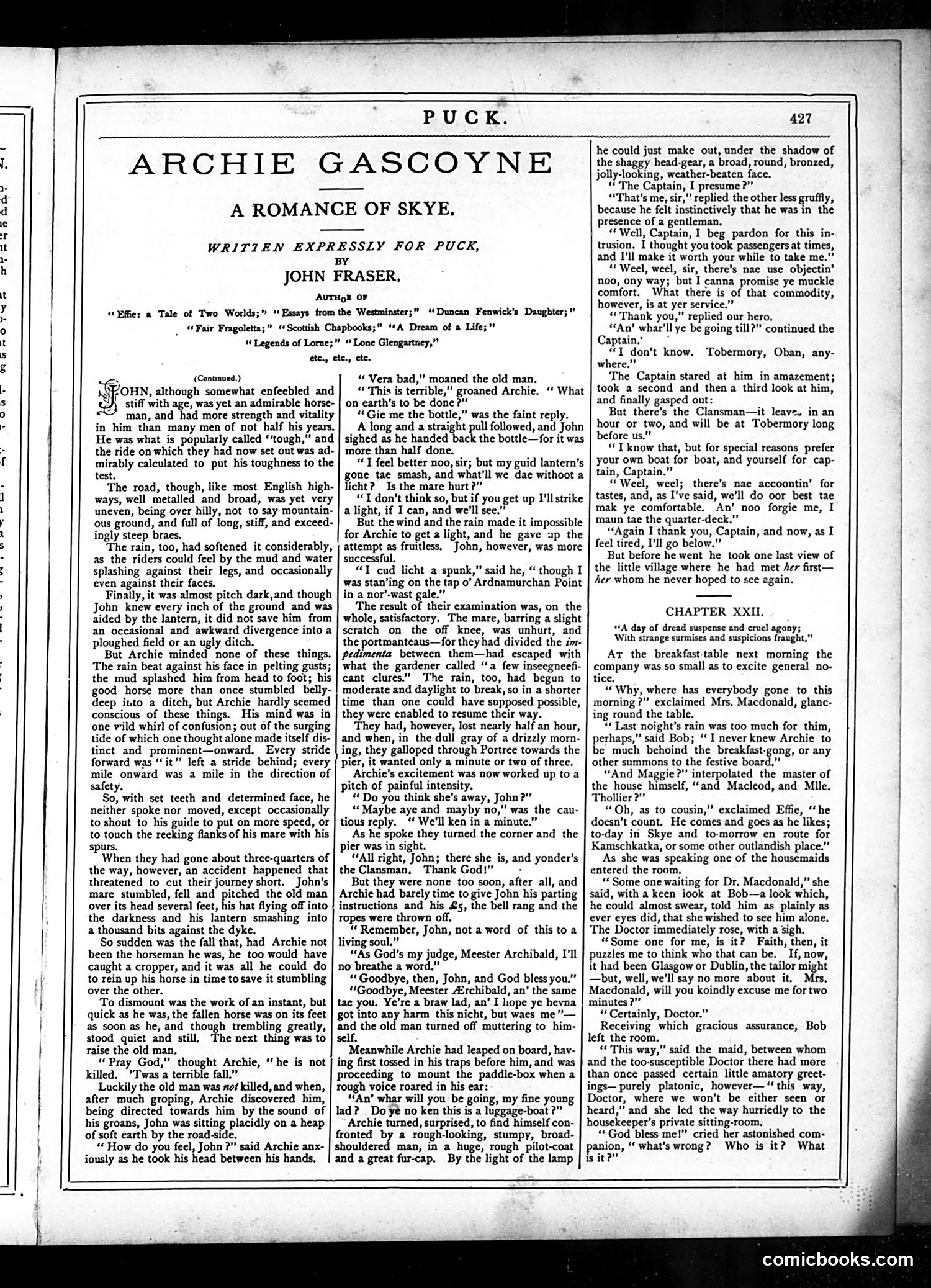
This page contains the opening of "Archie Gascoyne: A Romance of Skye," a serialized fiction story written by John Fraser and published in Puck magazine. The text is a narrative adventure involving characters named John, Archie, and a Captain, with action set in Scotland (Skye). The story describes dramatic events including a horse accident and rescue scenes. This is **not a political cartoon or satire**—it's a serialized short story, likely included to provide entertainment content for Puck's readers. The magazine combined satirical cartoons with fiction to fill its pages. Without seeing illustrations accompanying this text, there's no political commentary or social satire evident on this particular page.
📄 Transcribed text from this page (OCR, searchable)
Machine-transcribed from the original scan — historical spelling and the odd misread are preserved.
PUCK. 427 ARCHIE GASCOYNE A ROMANCE OF SKYE, WRITIEN EXPRESSLY FOR PUCK, BY JOHN FRASER, AUTHR OF “« Effie: a Tale of Two Worlds;” ‘Essays from the Westminster;” ‘Duncan Fenwick’s Daughter; " | Fair Fragoletta; «Scottish Chapbooks;” ‘*A Dream of a Life;’” « Legends of Lorne;" * Lone Glengartney,” ete., etc., ete. =. (Continued.) NG 'OHN, although somewhat enfeebled and stiff with age, was yet an admirable horse- man, and had more strength and vitality in him than many men of not half his years. He was what is popularly called “tough,” and the ride on which they had now set out was ad- mirably calculated to put his toughness to the test. The road, though, like most English high- ways, well metalled and broad, was yet very uneven, being over hilly, not to say mountain- ous ground, and full of long, stiff, and exceed- ingly steep braes, The rain, too, had softened it considerably, as the riders could feel by the mud and water splashing against their legs, and occasionally even against their faces. Finally, it was almost pitch dark,and though John knew every inch of the ground and was aided by the lantern, it did not save him from an occasional and awkward divergence into a ploughed field or an ugly ditch. But Archie minded none of these things. ‘The rain beat against his face in pelting gusts; the mud splashed him from head to foot; his good horse more than once stumbled belly- deep into a ditch, but Archie hardly seemed conscious of these things. His mind was in one wild whirl of confusion; out of the surging tide of which one thought alone made itself dis- tinct and prominent—onward. Every stride forward was ‘it’ left a stride behind; every mile onward was a mile in the direction of safety. So, with set teeth and determined face, he neither spoke nor moved, except occasionally to shout to his guide to put on more speed, or to touch the reeking flanks of his mare with his spurs. When they had gone about three-quarters of, the way, however, an accident happened that threatened to cut their journey short. John’s mare stumbled, fell and pitched the old man over its head several feet, his hat flying off into the darkness and his lantern smashing into a thousand bits against the dyke. So sudden was the fall that, had Archie not been the horseman he was, he too would have caught a cropper, and it was all he could do to rein up his horse in time to save it stumbling over the other. To dismount was the work of an instant, but quick as he was, the fallen horse was on its feet as soon as he, and though trembling greatly, stood quiet and still, The next thing was to raise the old man, “Pray God,” thought Archie, “he is not killed. "Twas a terrible fall.” Luckily the old man was of killed, and when, after much groping, Archie discovered him, being directed towards him by the sound of his groans, John was sitting placidly on a heap of soft earth by the road-side. “ How do you feel, John ?” said Archie anx- iously as he took his head between his hands, “Vera bad,” moaned the old man. “ This is terrible,” groaned Archie. ‘ What on earth’s to be done?” “Gie me the bottle,” was the faint reply. A long and a straight pull followed, and John sighed as he handed back the bottle—for it was more than half done. “T feel better noo, sir; but my guid lantern’s one tae smash, and what'll we dae withoot a licht? Is the mare hurt ?”” “I don’t think so, but if you get up I'll strike a light, if I can, and we'll see.” But the wind and the rain made it impossible for Archie to get a light, and he gave up the attempt as fruitless. John, however, was more successful. “1 cud licht a spunk,” said he, “ though I was stan’ing on the tap o’ Ardnamurchan Point in a nor’-wast gale.” The result of their examination was, on the whole, satisfactory. The mare, barring a slight scratch on the off knee, was unhurt, and the portmanteaus—for they had divided the im- pedimenta between them—had escaped with what the gardener called “a few inseegneefi- cant clures.” The rain, too, had begun to moderate and daylight to break, so in a shorter time than one could have supposed possible, they were enabled to resume their way. They had, however, lost nearly half an hour, and when, in the dull gray of a drizzly morn- ing, they galloped through Portree towards the pier, it wanted only a minute or two of three. Archie's excitement was now worked up to a pitch of painful intensity. “ Do you think she’s away, John?” “Maybe aye and mayby no,” was the cau- tious reply. ‘‘ We'll ken in a minute.” As he spoke they turned the corner and the pier was in sight. “All right, John; there she is, and yonder’s the Clansman, Thank God!” * But they were none too soon, after all, and Archie had barely time to give John his parting instructions and his £5, the bell rang and the ropes were thrown off, “Remember, John, not a word of this toa living soul.” “As God's my judge, Meester Archibald, Ill no breathe a word.” “Goodbye, then, John, and God bless you.” “Goodbye, Meester Archibald, an’ the same tae you. Ye're a braw lad, an’ I hope ye hevna got into any harm this nicht, but waes me ”— and the old man turned off muttering to him- self. Meanwhile Archie had leaped on board, hav- ing first tossed in his traps before him, and was proceeding to mount the paddle-box when a rough voice roared in his ear: ‘An’ whar will you be going, my fine young lad? Do yé no ken this is a luggage-boat ?” Archie turned, surprised, to find himself con- fronted by a rough-looking, stumpy, broad- shouldered man, in a huge, rough pilot-coat and a great fur-cap. By the light of the lamp he could just make out, under the shadow of the shaggy head-gear, a broad, round, bronzed, jolly-looking, weather-beaten face. “The Captain, I presume?” “That’s me, sir,” replied the other less gruffly, because he felt instinctively that he was in the presence of a gentleman, “Well, Captain, I beg pardon for this in- trusion. I thought you took passengers at tim: and I'll make it worth your while to take me. “Weel, weel, sir, there’s nae use objecti noo, ony way; but I canna promise ye muckle comfort. What there is of that commodity, however, is at yer service.” “Thank you,” replied our hero. “An’ whar'll ye be going till?” continued the Captain.” y “1 don’t know. Tobermory, Oban, any- where.” The Captain stared at him in amazement; took a second and then a third look at him, and finally gasped out: But there’s the Clansman—it leave. in an hour or two, and will be at Tobermory long before us.” “T know that, but for special reasons prefer your own boat for boat, and yourself for cap- tain, Captain.” “Weel, weel; there’s nae accoontin’ for tastes, and, as I've said, we'll do oor best tae mak ye comfortable. ‘An’ noo forgie me, I maun tae the quarter-deck.”” “Again I thank you, Captain, and now, as I feel tired, I'll go below.” But before he went he took one last view of the little village where he had met Aer first— her whom he never hoped to see again. CHAPTER XXII. “A day of dread suspense and cruel agony; With strange surmises and suspicions fraught.” Ar the breakfast-table next morning the company was so small as to excite general no- tice. “Why, where has everybody gone to this morning ?” exclaimed Mrs, Macdonald, glanc- ing round the table. “ Last noight’s rain was too much for thim, perhaps,” said Bob; “I never knew Archie to be much behoind the breakfast-gong, or any other summons to the festive board.” “And Maggie?” interpolated the master of the house himself, ‘and Macleod, and Mlle. Thollier?”” “Oh, as to cousin,” exclaimed Effie, ‘he doesn’t count. He comes and goes as he likes; to-day in Skye and to-morrow en route for Kamschkatka, or some other outlandish place.” As she was speaking one of the housemaids entered the room. “Some one waiting for Dr. Macdonald,” she said, with a keen look at Bob—a look which, he could almost swear, told him as plainly as ever eyes did, that she wished to see him alone, The Doctor immediately rose, with a sigh. “Some one for me, is it? Faith, then, it puzzles me to think who that can be. If, now, it had been Glasgow or Dublin, the tailor might —but, well, we'll say no more about it, Mrs, Macdonald, will you koindly excuse me for two minutes?” “Certainly, Doctor.” Receiving which gracious assurance, Bob left the room, “This way,” said the maid, between whom and the too-susceptible Doctor there had more than once passed certain little amatory greet- ings— purely platonic, however—‘ this way, Doctor, where we won't be either seen or heard,” and she led the way hurriedly to the housekeeper’s private sitting-room, “ God bless me!” cried her astonished com- panion, “what’s wrong? Who is it? What is it?” comicbooks.com