
A complete issue · 16 pages · 1879
Puck — August 20, 1879
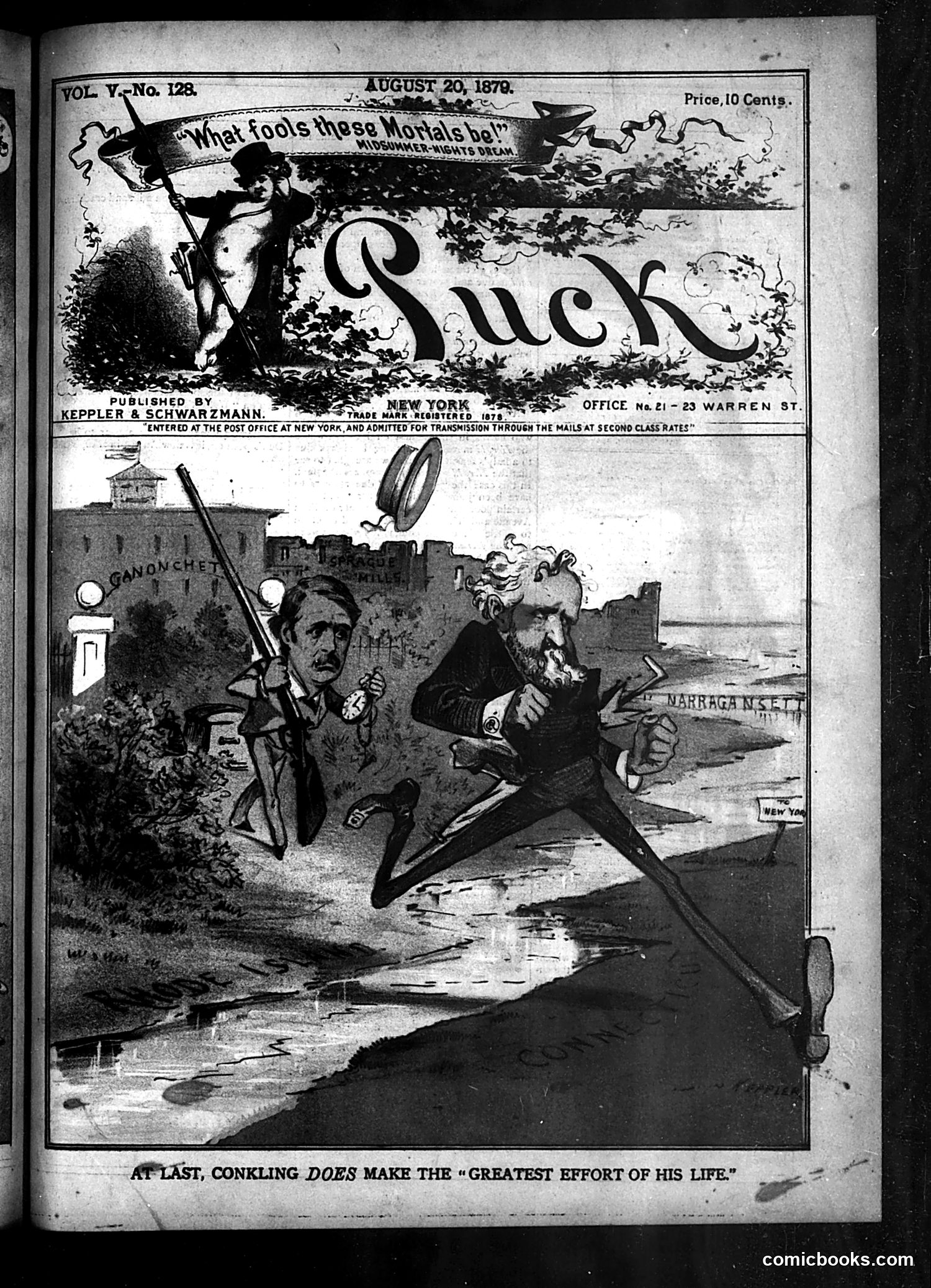
This cartoon satirizes a political or public figure (likely Conkling, based on the caption) making what the magazine presents as a desperate effort. The main illustration shows two men in a confrontation near what appears to be a fortified location ("Canonchet") with water and a boat visible. One figure wields a rifle while the other strikes a defensive pose. The header references "A Midsummer-Night's Dream," suggesting the situation is fantastical or absurd. Without clearer identification of the specific political conflict being referenced, the exact nature of this "greatest effort" remains unclear, though it appears to mock a notable public figure's actions during this period.
This page consists primarily of editorial commentary and brief satirical items rather than illustrated cartoons. The main content includes: **"Our Chameleon Contemporary"** — a critique of the Herald newspaper's inconsistent editorial stance, particularly regarding Governor Sprague's minimal charitable contributions during wartime. Puck satirizes the Herald's shifting positions and questions its credibility. **Brief items** mock various public figures: Conkling (described as hog-like), references to scandals involving "Lettelier," and critiques of journalistic sensationalism around a robbery victim. The page demonstrates Puck's role as satirical watchdog, targeting newspaper hypocrisy and public figures' behavior. Without visible illustrations, the satire relies entirely on sharp written commentary—typical of 19th-century political magazines that combined visual and textual mockery.
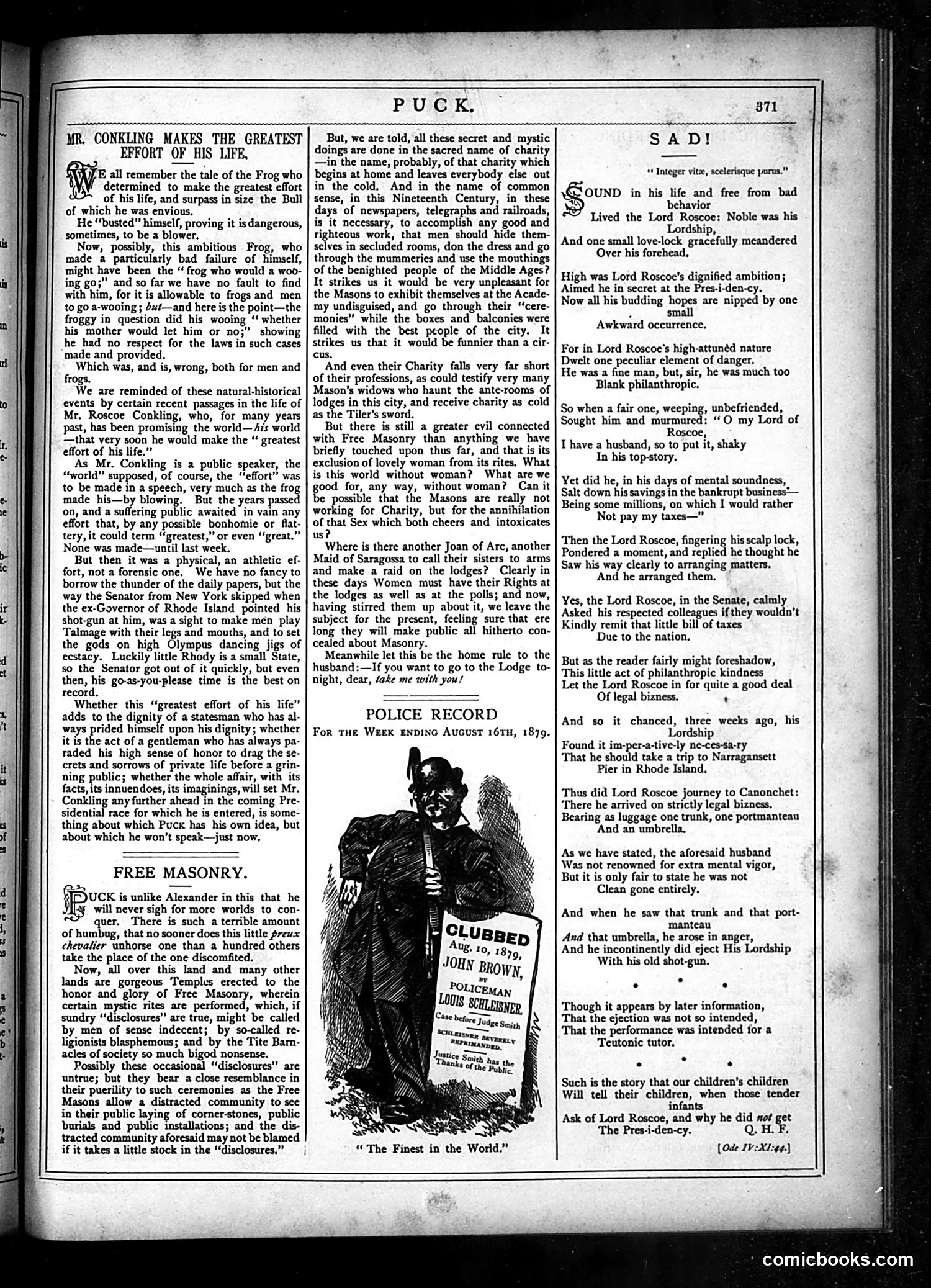
This page contains political satire criticizing Senator Roscoe Conkling of New York. The main cartoon depicts a policeman labeled "John Brown, Policeman" who has "clubbed" someone on August 16, 1879—referencing an actual incident. The accompanying poem "SADI" mocks Conkling's response to this police brutality. The satire suggests Conkling, despite claiming to support charity and reform, failed to properly address the assault. The text criticizes him for prioritizing self-interest and political gain over justice. The left column attacks "Free Masonry," using Conkling as an example of elite hypocrisy—someone who publicly promotes virtue while privately enabling corruption. The satire's central point: Conkling's claimed "greatest effort of his life" for public service masks his actual indifference to justice for ordinary citizens.
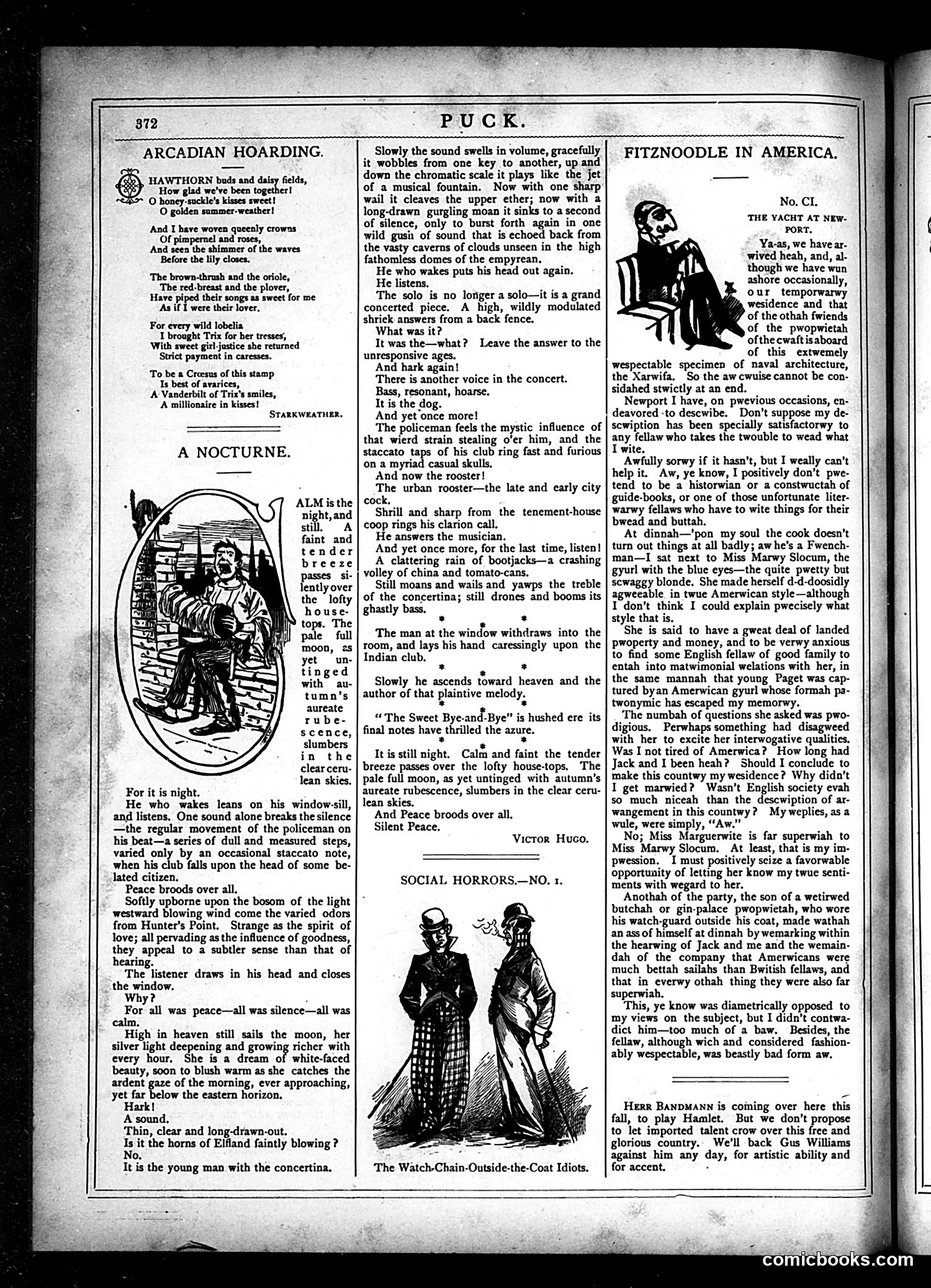
This page contains three distinct pieces: 1. **"Arcadian Hoarding"** - A poem about rural/pastoral life, apparently satirizing romantic notions of country living. 2. **"A Nocturne"** - A poem with an illustration showing a man at a window listening to urban nighttime sounds (police whistles, tomato cans, etc.). This appears to satirize the contrast between poetic idealization of night and harsh urban reality. 3. **"Fitznoodle in America"** - A prose piece mocking an English visitor's observations about American naval architecture and society. The tone suggests satire of British tourists' pretentious commentary on American life and customs. 4. **"Social Horrors—No. 1"** - A small illustration with accompanying text about social faux pas, likely satirizing etiquette violations among the upper classes. The page exemplifies Puck's characteristic blend of satirical verse, social commentary, and humor targeting both American and British audiences.
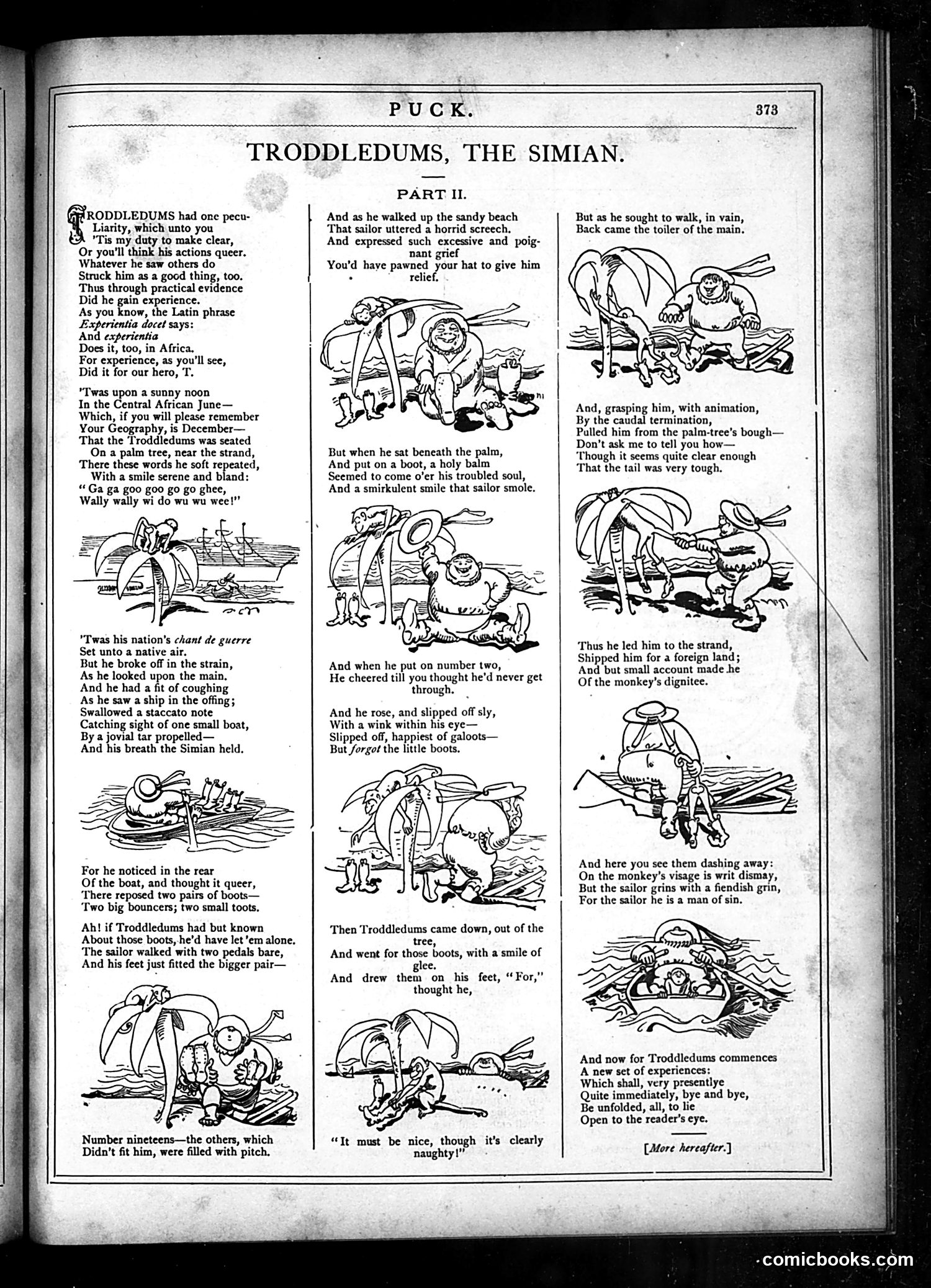
This is a humorous narrative poem illustrated with comic drawings, not a political cartoon. It tells the absurdist story of Troddledums, a Simian (ape-like creature) who encounters a sailor on a beach in Africa. The plot involves Troddledums discovering oversized boots and attempting to wear them, creating physical comedy. The sailor eventually takes Troddledums aboard ship, leading to further misadventures at sea. The satire appears to target Victorian attitudes toward colonialism and racial hierarchies—depicting an African scenario with comedic "civilization" of a primitive creature. The exaggerated illustrations emphasize the absurdity. This reflects typical 19th-century Puck content mixing light humor with problematic racial and imperial themes now recognized as offensive.
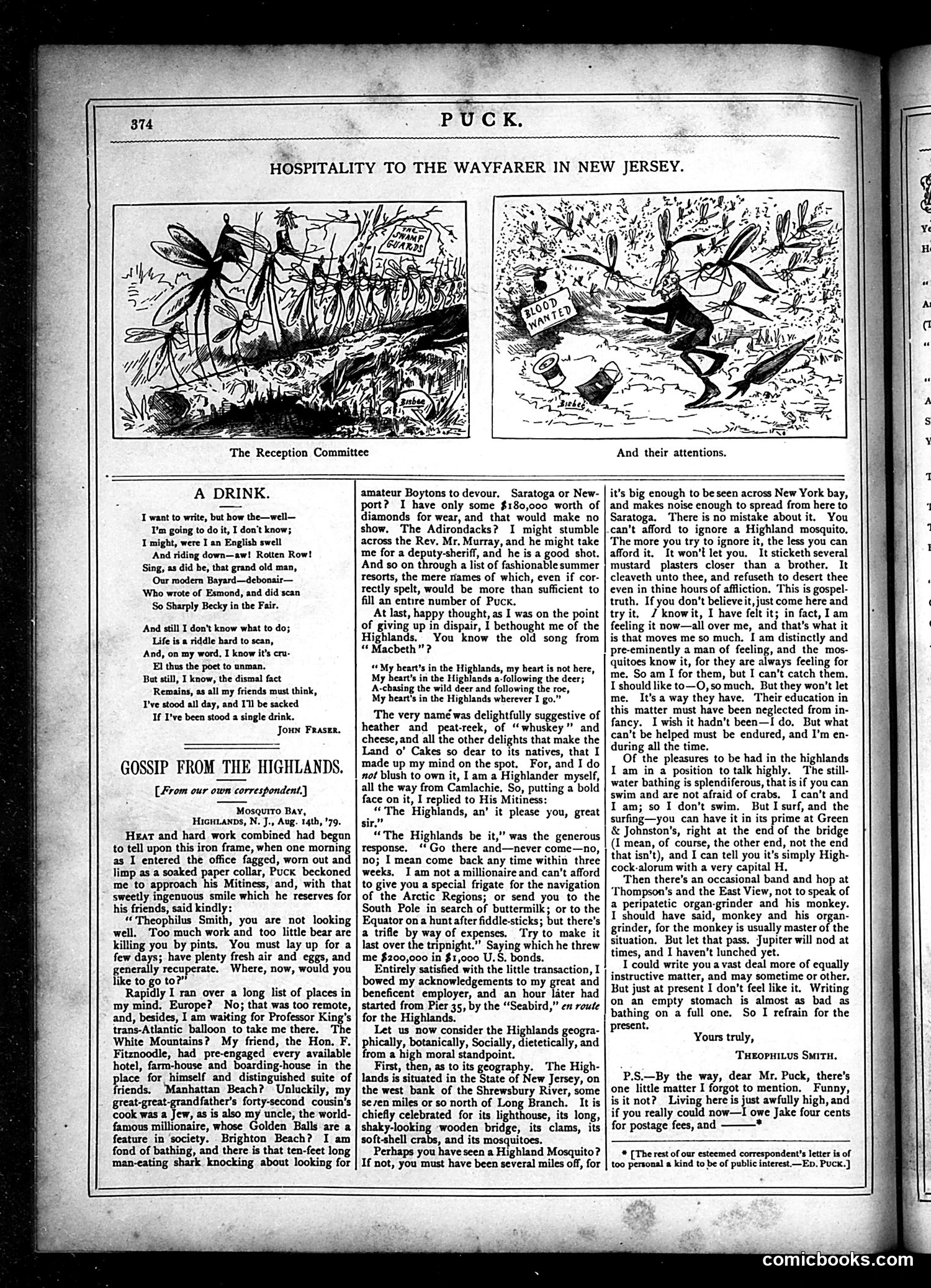
This two-panel cartoon satirizes New Jersey's treatment of travelers. The left panel shows a "Reception Committee" of grotesquely exaggerated mosquitoes greeting a wayfarer (traveler). The right panel depicts "their attentions"—the insects attacking the unfortunate visitor. The satire targets New Jersey's notorious mosquito problem, particularly in coastal/swampy areas. Rather than welcoming hospitality, the state "receives" travelers through disease-carrying insects. The accompanying text from a correspondent humorously complains about Highland mosquitoes, describing them as pests worse than actual human company—suggesting New Jersey's mosquito reputation was so severe it became the butt of national jokes in period humor magazines.
This page contains two distinct pieces: a poem titled "The Girl Who Bangeth Her Hair" (left) and a prose story "How a Mastodon's Tooth Was Fitted to a Human Jaw" (right). The poem satirizes a woman with an elaborate hairstyle—"antique and queer"—ridiculing the fashion of teased, voluminous hair popular in the late 19th/early 20th century. It mocks both her appearance and vanity through repeated warnings: "Beware of the woman who bangs her hair!" The story recounts how Professor Drift discovered a prehistoric mastodon tooth in Iowa, which was mistakenly fitted into someone's mouth. The tale appears humorous pseudo-scientific satire, mocking both credulous believers in pseudoscience and the professorial class's pretensions to expertise. The repeated exclamation "Can it be possible!" emphasizes the absurdity throughout. Both pieces use satire to critique contemporary vanities and intellectual pretensions.
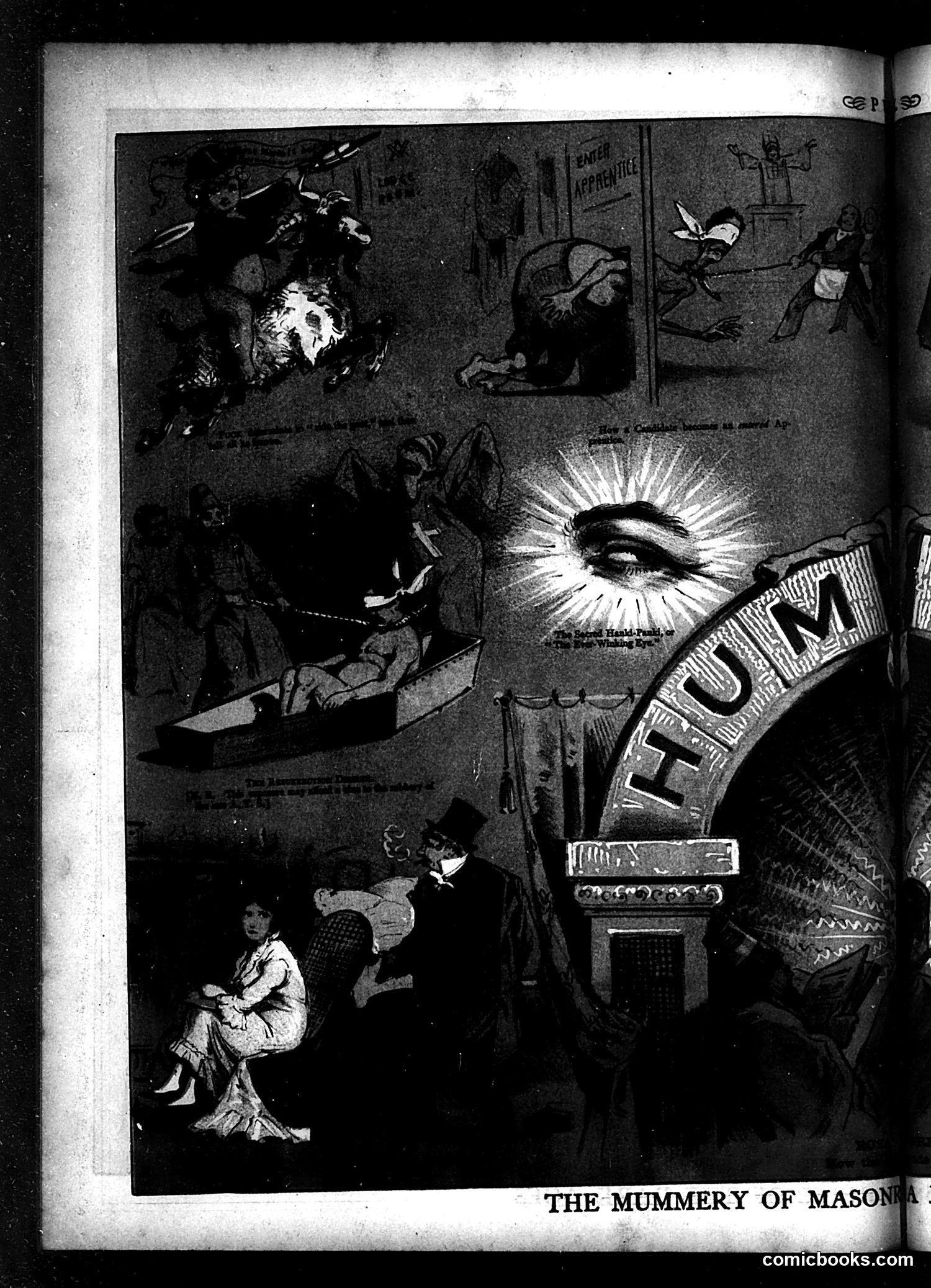
This Puck satirical illustration critiques Freemasonry through grotesque imagery. The title "The Mummery of Masonry" (visible at bottom) suggests the cartoonist views Masonic rituals as theatrical pretense or deception. The page depicts mysterious robed figures, an eye symbol (the "all-seeing eye" associated with Masonic symbolism), and dramatic scenes suggesting secret ceremonies. The large "THUMP" text and surreal composition convey mockery of what the cartoonist sees as absurd ritual theater. The imagery appeals to period anti-Masonic sentiment—common in late 19th/early 20th-century America—which viewed Freemasonry's secrecy and fraternal oaths with suspicion and hostility. The satire ridicules both Masonic secrecy and the public's fascination with hidden societies, suggesting the "mummery" (foolish performance) underlying Masonic mystique.
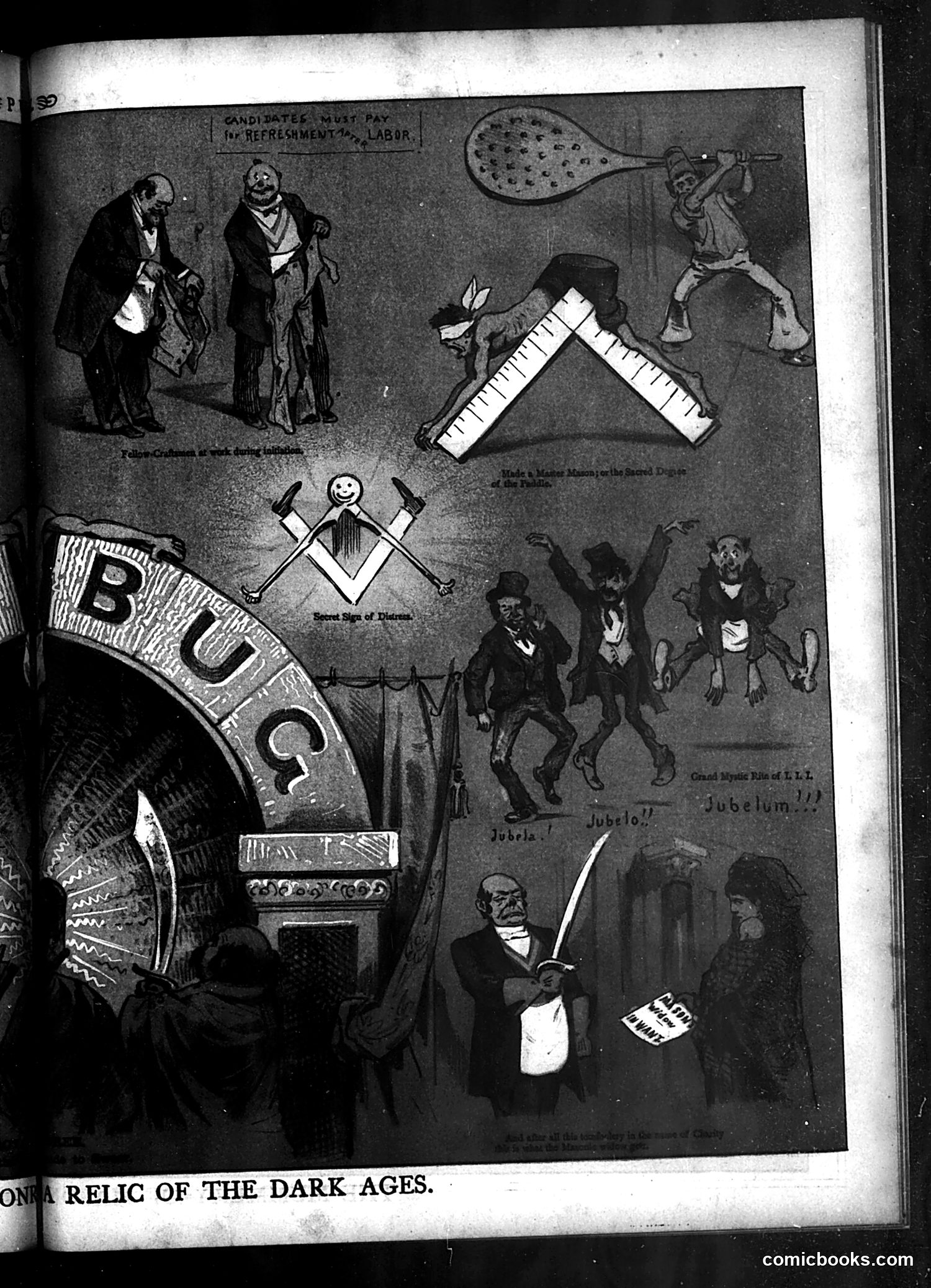
This Puck cartoon satirizes electoral practices through medieval imagery. The large "BUC" (likely "BUCKET," suggesting ballot-stuffing) wheel dominates the left side, operated by shadowy figures—presumably corrupt political operatives. The central "Roman Sign of Distress" shows a stick figure being stretched, representing voters subjected to electoral manipulation. Upper panels depict "Candidates Must Pay in Refreshment to Labor," mocking the practice of treating voters with food and drink in exchange for votes—a common form of electoral corruption in the Gilded Age. The bottom scene shows violence and chaos ("Jubelum," possibly "Jubilation"), with armed men fighting, suggesting the intimidation and physical coercion surrounding elections. The title condemns these practices as backwards "Dark Ages" corruption incompatible with modern democracy.
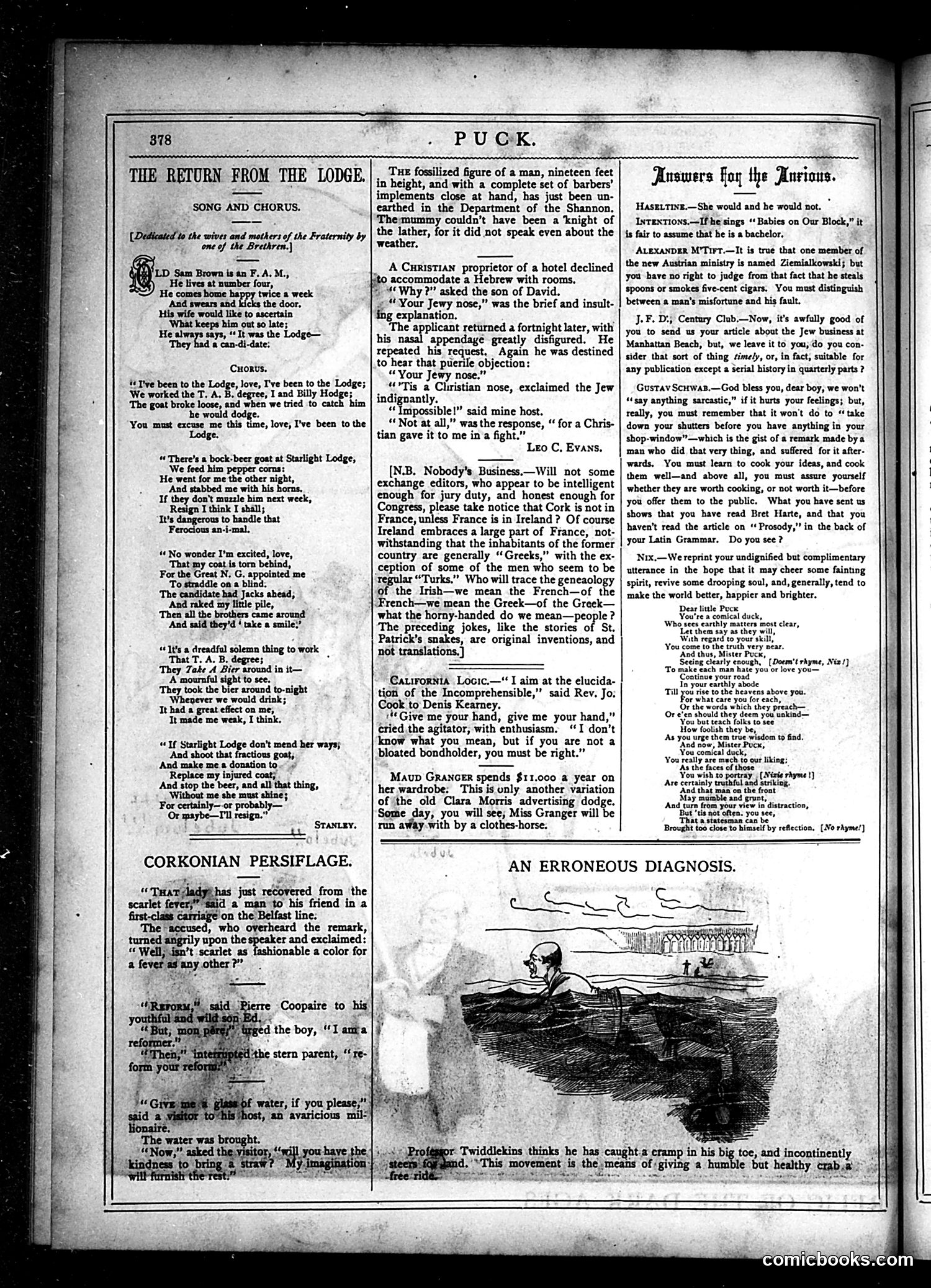
This page contains primarily **humorous stories and poems** rather than political cartoons. The main cartoon, titled "AN ERRONEOUS DIAGNOSIS," shows a man swimming or wading in water while a professor on shore observes him. The caption indicates the professor has misidentified the man's movement—thinking he has a cramp in his toe, when the "movement is the means of giving a humble but healthy crab a free ride." It's a straightforward **visual joke about mistaken observation**: what appears to be a medical crisis is actually an unwitting act of charity. The humor relies on the absurdity of the misreading and the image's clarity in showing what the professor cannot see. The rest of the page contains songs, comic dialogues, and satirical short pieces typical of Puck's format—no specific political references are evident from the visible content.
This page contains **serialized fiction**, not a political cartoon. It's Chapter XIX of "Archie Gascoyne: A Romance of Skye," written by John Fraser and published in Puck magazine. The text is a romantic narrative focusing on interpersonal drama between characters named Archie, Maggie, and the Count. The passage explores Archie's emotional conflict—he struggles with jealousy and doubt regarding Maggie's feelings while attempting to maintain dignity and trust. There is **no political satire or social commentary** visible on this page. This represents Puck's literary content rather than its satirical cartoons. The magazine supplemented its humor with serialized fiction to maintain reader engagement between issues.
This page contains primarily **text content rather than political cartoons**—it's a serialized story or narrative feature titled "Puck's Beginnings" (visible in the header illustration). The main content appears to be **dialogue-heavy fiction**, featuring characters named Archie, Maggie, and others in what seems to be a romantic or domestic narrative. References to reading poetry ("Lord of Burleigh," Tennyson) and literary discussion suggest this is targeting an educated, middle-class audience. The right column contains brief **satirical notes** on contemporary issues: constitutional gun rights, thermometer measurements, ice-making, and social customs like Hottentots marrying practices. Without visible political caricatures on this particular page, the satire appears **subtle and text-based** rather than graphically illustrated—typical of Puck's mixed format combining visual and written humor.
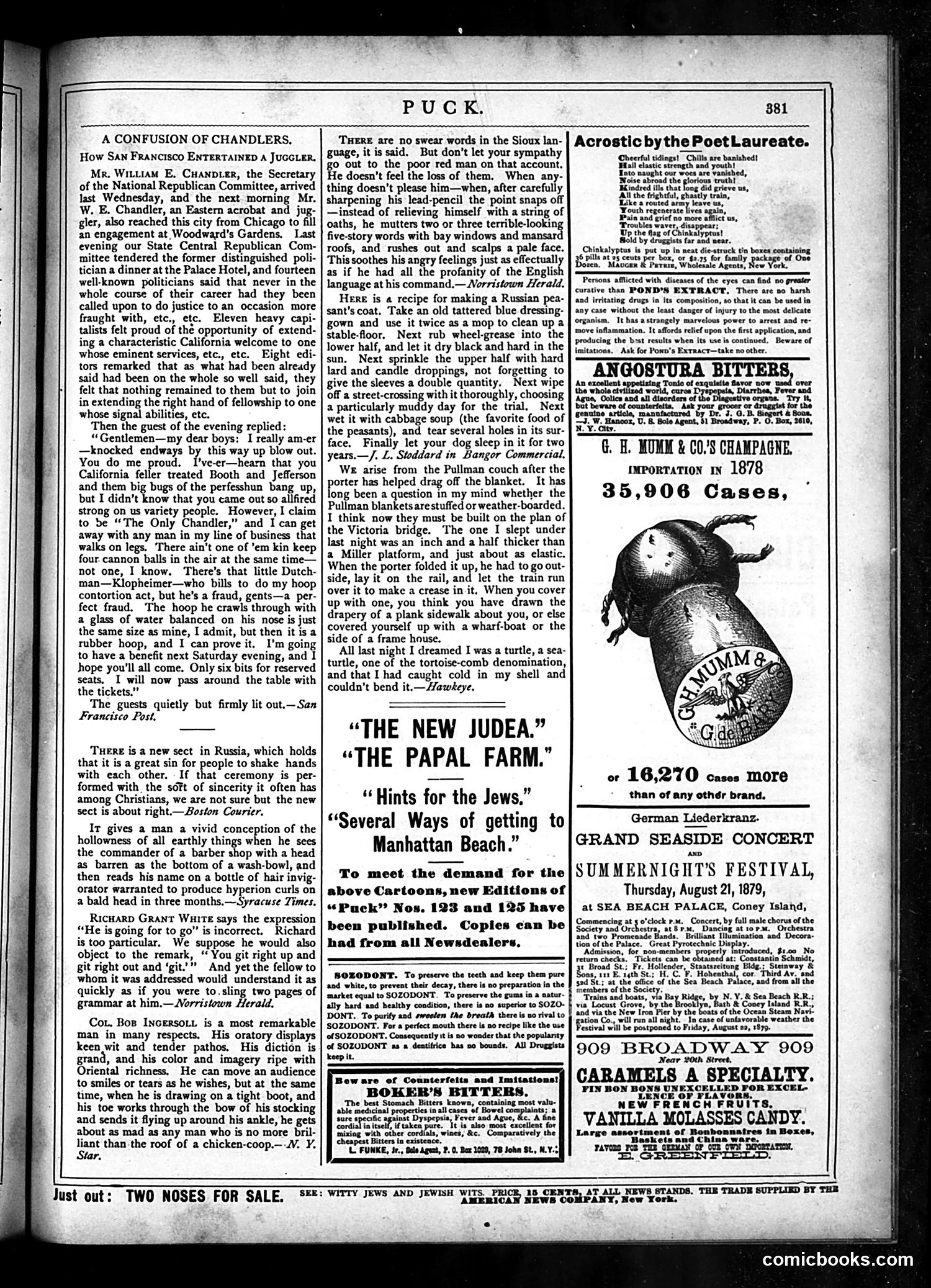
This page is primarily **advertising and miscellaneous content** rather than political satire. The main features include: 1. **"A Confusion of Chandlers"** - A humorous anecdote about William E. Chandler, Secretary of the National Republican Committee, attending a social event where he encountered another man with the same surname, creating awkward confusion. 2. **Various advertisements** for consumer products (champagne, bitters, candy, concert announcements). 3. **Brief satirical notes** on Russian customs and Col. Bob Ingersoll's personality. The page lacks the prominent political cartoons typical of Puck's satirical content. It focuses instead on personality humor and commercial announcements, making it representative of the magazine's miscellaneous filler material between major satirical pieces.
This page is **primarily advertisements** with no discernible political cartoon or satirical content. The ads feature various 1890s-era products and services: smoking tobacco, lamps, umbrellas, beer, shaving apparatus, hotels, tailors, and medications. The only illustration with potential satirical intent is the "Puck Smoking Tobacco" logo showing a cherub-like figure—Puck himself, the magazine's mascot—though this is simply a brand image rather than commentary. The page represents Puck's advertising revenue stream rather than its editorial content. Without visible masthead dates or specific product references to datable events, no particular political or social satire can be identified from this merchandise-heavy layout.
This page is primarily **advertisements**, not editorial content or cartoons. It displays commercial listings typical of a late 19th-century publication, including: - Louisiana State Lottery - Keppich & Co. (steamship tickets to Havana) - Various champagne and wine merchants - Mineral water distributors - Hotels and restaurants - A furniture manufacturer - Shirt and clothing suppliers The only image with potential satirical content is a decorative logo for "Cosselli & Co." Hungarian wines at bottom right, which appears to be a standard merchant's mark rather than political commentary. **This is essentially a classified advertising section**, reflecting the commercial ecosystem supporting Puck's readership in New York during this era.
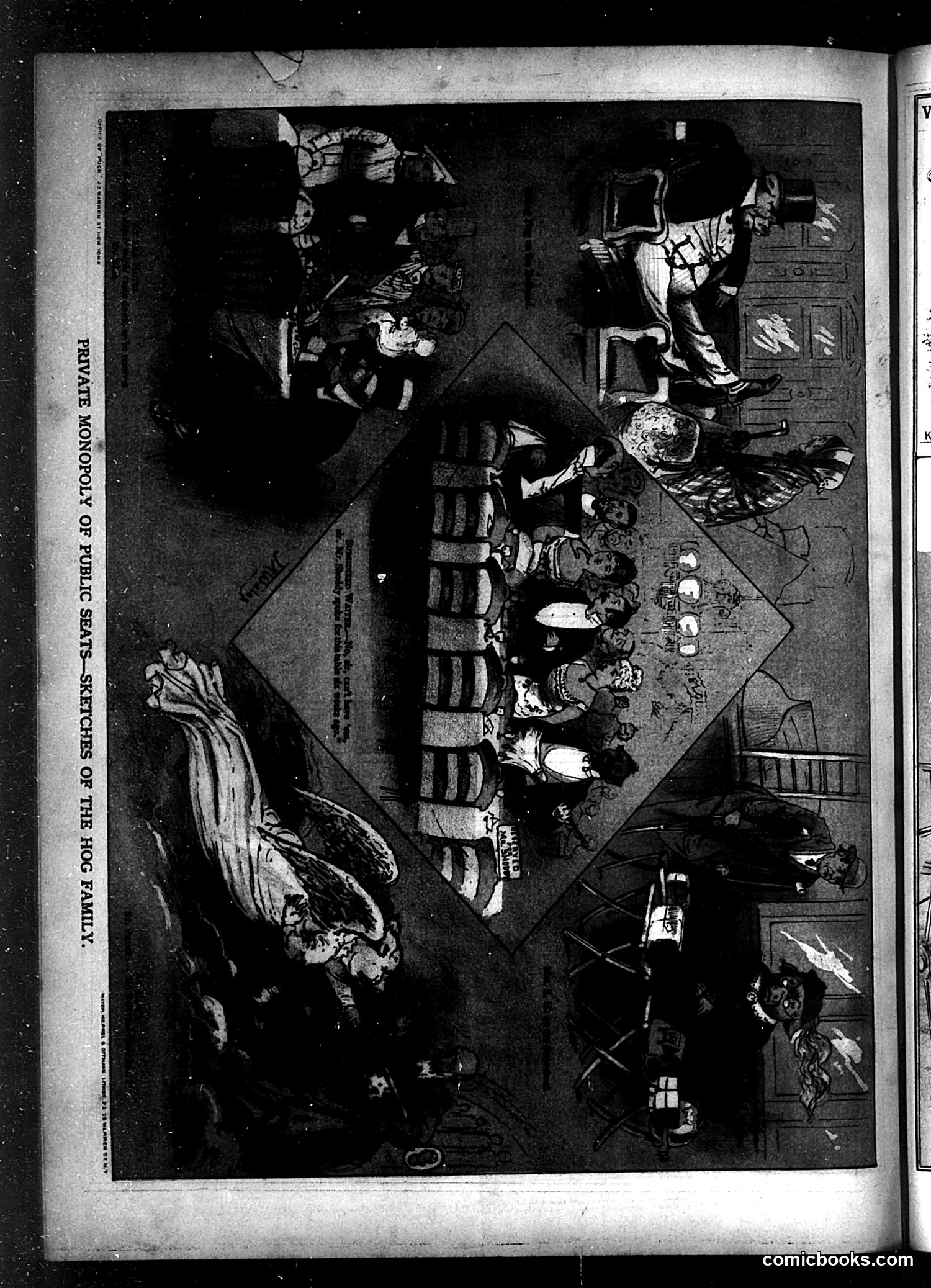
This page appears to be rotated 90 degrees, showing what seems to be a multi-panel satirical illustration typical of Puck magazine's style. The OCR text is incomplete, making full context difficult to establish with certainty. The image depicts various figures in what appears to be an interior domestic or institutional setting, with multiple characters engaged in different activities. The style and composition suggest social or political commentary characteristic of Puck's editorial cartoons from the late 19th or early 20th century. Without clearer text or caption identification, I cannot definitively identify specific political figures or the exact satirical message intended. The detailed linework and character expressions suggest commentary on contemporary social conditions or political behavior, but the precise subject remains unclear from this reproduction.