
Puck, 1879-08-20 · page 2 of 16
Puck — August 20, 1879 — page 2: what you’re looking at
What you’re looking at
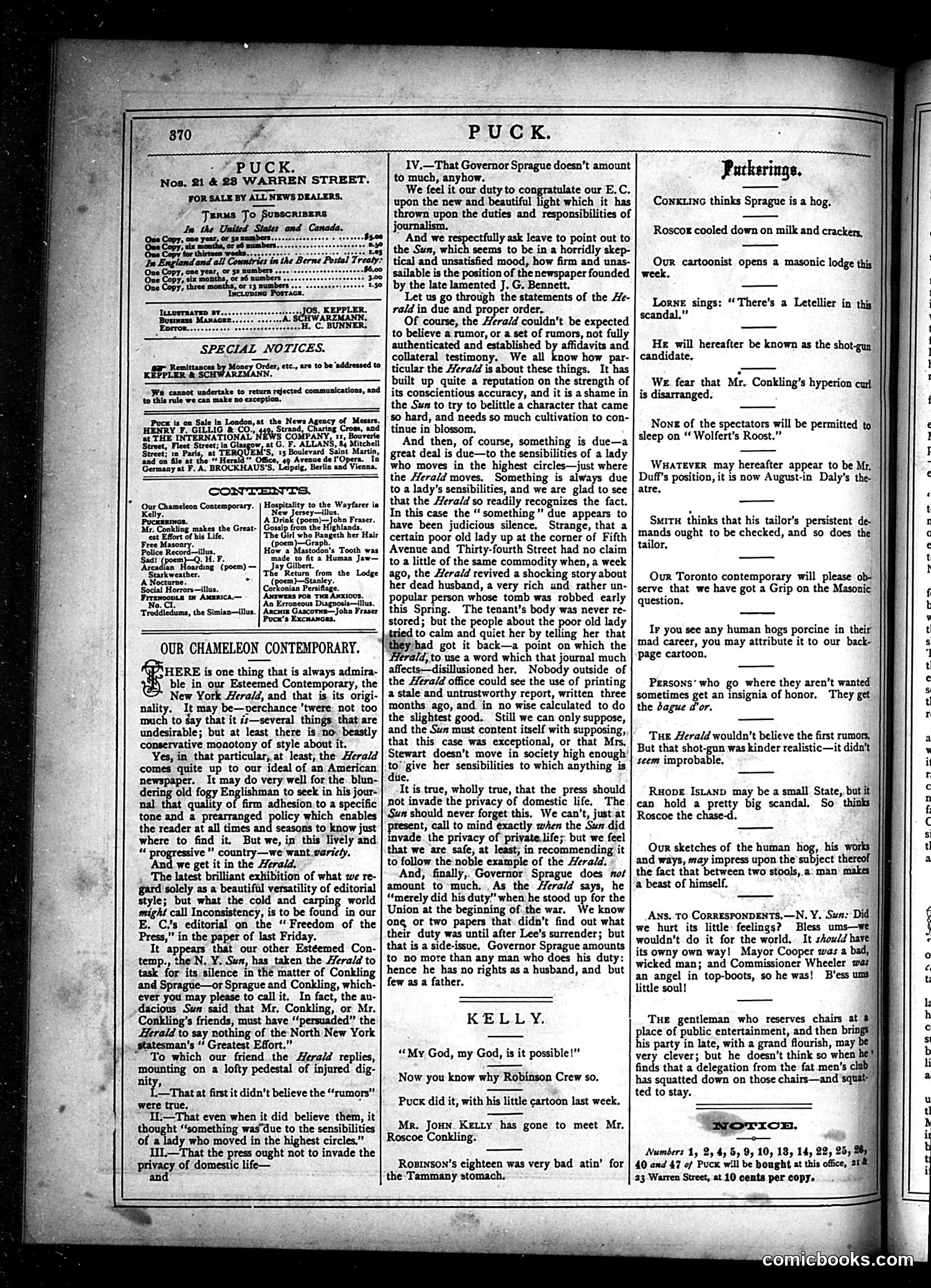
This page consists primarily of editorial commentary and brief satirical items rather than illustrated cartoons. The main content includes: **"Our Chameleon Contemporary"** — a critique of the Herald newspaper's inconsistent editorial stance, particularly regarding Governor Sprague's minimal charitable contributions during wartime. Puck satirizes the Herald's shifting positions and questions its credibility. **Brief items** mock various public figures: Conkling (described as hog-like), references to scandals involving "Lettelier," and critiques of journalistic sensationalism around a robbery victim. The page demonstrates Puck's role as satirical watchdog, targeting newspaper hypocrisy and public figures' behavior. Without visible illustrations, the satire relies entirely on sharp written commentary—typical of 19th-century political magazines that combined visual and textual mockery.
📄 Transcribed text from this page (OCR, searchable)
Machine-transcribed from the original scan — historical spelling and the odd misread are preserved.
PUCK. * -* PUCK. Nos. 21 & 28 WARREN STREET. SPECIAL NOTICES. fiona, ener, Orders ete., are to be addressed to KEFPLER&SCHWARZMANN, 0 to return rejected communications, and cannot undertake Tis fale we can make no exception: to this London, at the News of Messrs. hus aady ig Cross, and NAL COMPANY, 11, at G. F. ALLANS, 84 a ace PS cpap: Beis tad View CONTENTS. ‘Our Chameleon Contemporary. | Hospitality to the Wayfarer in Kelly, PoP cca Oe rink (poem)—John Fraser. Gossip from the Highlands. ‘The Girl who Rangeth her Hair Hees assoden'y Tooth ue made to ft a Human Jaw— Conkling makes the Great- est Effort of his Life. Seeing foarding (poem) — ‘Starkweather. jocturne. Social Horrors—illus. Frezwoopus pe gilbert ah je Return ‘from the Lodge + | (poem)—Stanley. No. Cl. ‘Troddledums, the Simian—illus. OUR CHAMELEON CONTEMPORARY. HERE is one thing that is always admira- ble in our Esteemed Contemporary, the New York Hera/d, and that is its origi- nality. It may be—verchance ’twere: not too much to Say that it is—several things that are undesirable; but at least there is no, beastly conservative monotony of style about it. Yes, in that particular, at least, the Herald comes quite up to our ideal of an American newspaper. It may do very well for the. blun- dering old fogy Englishman to seek in his jour- nal that quality of firm adhesion. to a specific tone and a prearranged Policy which enables the reader at all times and seasons to know just where to find it, But we, in this lively and “or ive” country—we want.varicly, And we get it in the Herald, , The latest brilliant exhibition of what we re- gard'solely as a beautiful versatility of editorial style; but what the cold and carping world might call Inconsistency, is to be found in our E. C,’s editorial on the ‘Freedom of the Press,” in the paper of last Friday. It ap that our other Estéemed Con- temp., theN, Y. Sus, has taken the Hera/d to task for its, silence in the matter of Conkling and Sprague—or Sprague and Conkling, which- eat padina? pleas to call it In fact, the au- dacious Sun said that Mr. Conkling, or Mr. Conkling’s friends, must have “persuaded” the Herald to say nothing of the North New York statesman’s “ Greatest Effort.” “To which our friend the Aera/d replies, mounting on a lofty pedestal of injured dig- —That at first it didn’t believe the “rumors” were true, IL—That even when it did believe them, it boueht something was due to the sensibilities of bu) moved in the highest circles,” : it the press ought not to invade the Privacy of domestic life— an | tical and unsatisfied mood, how firm and unas- ‘they-had got it back—a point on which the IV.—That Governor Sprague doesn’t amount to much, anyhow. We feel it our duty to congratulate our E.C. upon the new and beautiful light which it has thrown upon the duties and responsibilities of journalism, And we the Sun, whi fully ask leave to point out to seems to be in a horridly skep- sailable is the position of the newspaper founded by the late lamented J. G, Bennett. Let us go through the statements of the He- rald in due and proper order. Of course, the Hera/d couldn't be expected to believe a rumor, or a set of rumors, not fully authenticated and established by affidavits and collateral testimony. We all know how par- ticular the Hera/d is about these things. It has built up quite a reputation on the strength of its conscientious accuracy, and it is a shame in the Sun to try to belittle a character that came so hard, and needs so much cultivation to con- tinue in blossom, And then, of course, something is due—a great deal is due—to the sensibilities of a lady who moves in the highest circles—just where the Herald moves, Something is always due to a lady’s sensibilities, and we are glad to see that the Hera/d so readily recognizes the fact. In this case the “something” due appears to have been judicious silence. Strange, that a certain poor old lady up at the corner of Fifth Avenue and Thirty-fourth Street had no claim to a little of the same commodity when, a week ago, the Herald revived a shocking story about her dead husband, a very rich and. rather un- popular person whose tomb was robbed early this Spring. The tenant’s body was never re- stored; but the people about the poor old lady tried to calm and quiet her by telling her that ‘Herald, to use a word which that journal much affects—disillusioned her, Nobody outside of the Hera/d office could see the use of printing a stale and untrustworthy report, written three months ago, and. in no wise calculated to do the slightest good. Still we can only suppose, and the Sun must content itself with supposing, that this case was exceptional, or that Mrs. Stewart doesn’t move in society high enough fh give her sensibilities to which anything is. ue, It is true, wholly true, that the press should not invade the privacy of domestic life. The Sun should never forget this. We can’t, just at present, call to mind exactly when the Sun did invade. the privacy of private.life;: but we feel that we are safe, at least; in recommending it to follow the noble example of the Herald. And, finally, Governor Sprague does not amount to much. .As the ‘Herald says, he “merely did his duty” when he stood up for the Union at the beginning of the war. We know one, or two papers that didn’t find out what their duty was until after Lee’s surrender; but that is a side-issue, Governor Sprague amounts to no more than any man who does his duty: hence he has no rights as a husband, and but few as a father. KELLY. “My God, my God, is it possible!” Now you know why Robinson Crew so. Puck did it, with his little cartoon last week. Mr. Joun Ketry has gone to meet Mr, Roscoe Conkling. Ropinson’s eighteen was very bad atin’ for the-Tammany stomach, Puckerings, Conxuinc thinks Sprague is a hog, Roscog cooled down on milk and crackers, Our cartoonist opens a masonic lodge this week. Lorne sings: “There's a Letellier in this” scandal.” He will hereafter be known as the shot-gun candidate, We fear that Mr. Conkling’s hyperion curl is disarranged. Nong of the spectators will be permitted to sleep on “ Wolfert’s Roost.” WHATEVER may hereafter appear to be Mr, Duff's position, it is now August-in Daly’s the- atre. Suri thinks that his tailor’s persistent de- mands ought to be checked, and so does the tailor, Our Toronto contemporary will please ob- serve that we have got a Grip on the Masonic question. Ir you see any human hogs porcine in their mad career, you may attribute it to our back- page cartoon. Persons‘ who go where they aren’t wanted sometimes get an insignia of honor. They get the dague a’or. Tue Herald wouldn't believe the first rumors, But that shot-gun was kinder realistic—it didn’t seem improbable. Ruope. Istanp may be a small State,, but it can hold a pretty big scandal. So thinks Roscoe the chase-d. Our sketches of the human hog, his works | and ways, may impress upon the’ subject thereof the fact that between two stools,.a:man makes a beast of himself. Ans. TO CoRRESPONDENTS.—N, Y. Sun: Did we hurt its little feelings? Bless ums—we wouldn’t do it for the world. It shoudd have its owny own way! Mayor Cooper was a bad, | wicked man; and Commissioner Wheeler wat ]} an angel in top-boots, so he was! Bess ums |} little soul! Tue gentleman who reserves chairs at # place of public entertainment, and then brings his party in late, with a grand flourish, may be} very clever; but he doesn’t think so when he | finds that a delegation from the fat men’s has squatted down on those chairs—and 'squat=" ted to stay. NOTICE. Numbers 1, 25 45 5, 9, 10, 18, 14, 22, 25, 285) 40 and 47 of Pucx will be bought at this office, 21% 23 Warren Street, at 10 cents per copy. ; comicbooks.com