
Puck, 1879-08-20 · page 3 of 16
Puck — August 20, 1879 — page 3: what you’re looking at
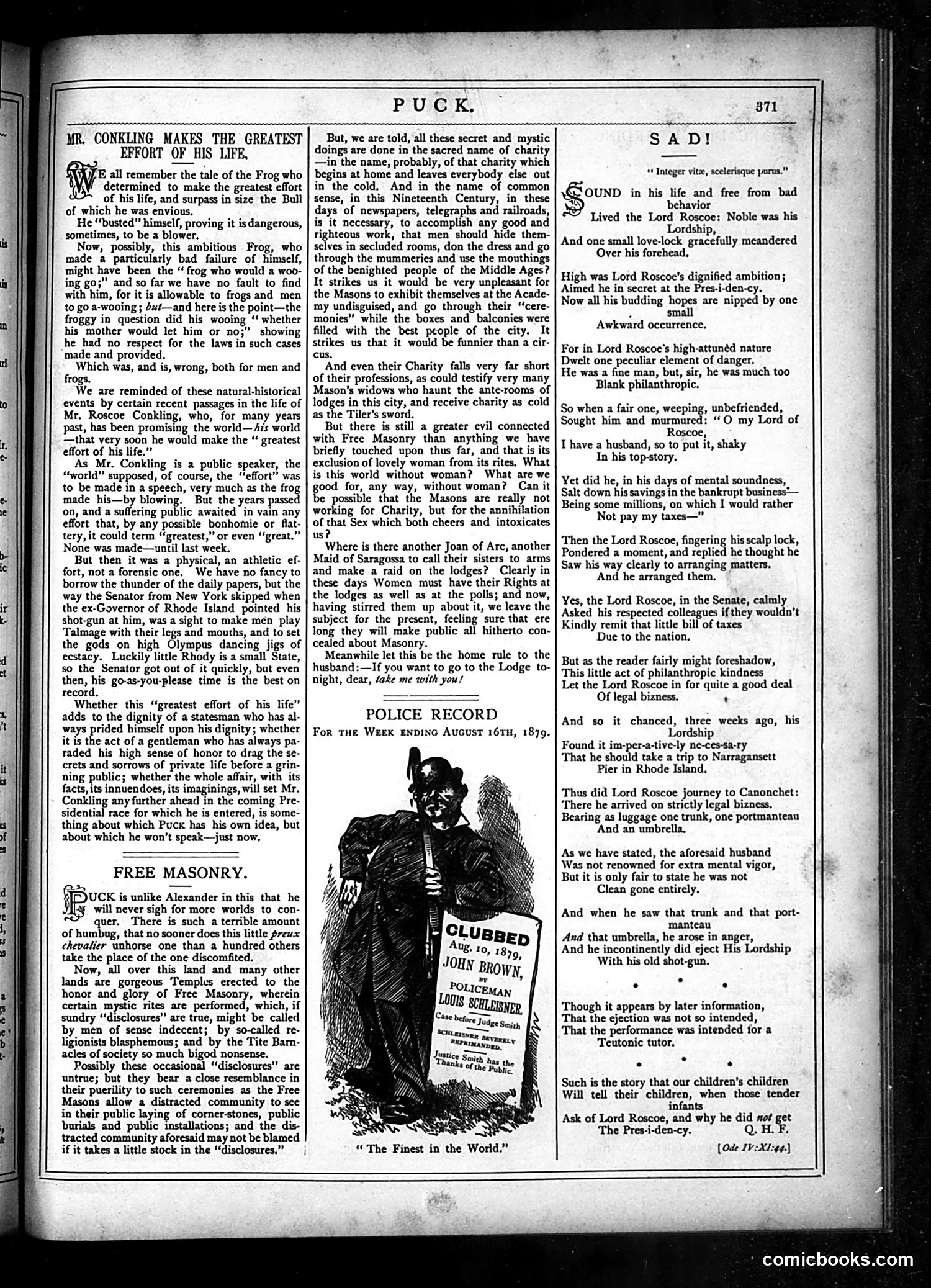
What you’re looking at
This page contains political satire criticizing Senator Roscoe Conkling of New York. The main cartoon depicts a policeman labeled "John Brown, Policeman" who has "clubbed" someone on August 16, 1879—referencing an actual incident. The accompanying poem "SADI" mocks Conkling's response to this police brutality. The satire suggests Conkling, despite claiming to support charity and reform, failed to properly address the assault. The text criticizes him for prioritizing self-interest and political gain over justice. The left column attacks "Free Masonry," using Conkling as an example of elite hypocrisy—someone who publicly promotes virtue while privately enabling corruption. The satire's central point: Conkling's claimed "greatest effort of his life" for public service masks his actual indifference to justice for ordinary citizens.
📄 Transcribed text from this page (OCR, searchable)
Machine-transcribed from the original scan — historical spelling and the odd misread are preserved.
| | PUCK, MR. CONKLING MAKES THE GREATEST EFFORT OF HIS LIFE, E all remember the tale of the Frog who AA determined to make the greatest effort of his life, and surpass in size the Bull of which he was envious. He “busted” himself, proving it is dangerous, sometimes, to be a blower. Now, possibly, this ambitious Frog, who made a particularly bad failure of himself, might have been the “‘ frog who would a woo- ing go;” and so far we have no fault to find with him, for it is allowable to frogs and men to go a-wooing ; 5u¢—and here is the point—the froggy in question did his wooing ‘ whether his mother would let him or no;” showing he had no respect for the laws in such cases made and provided. Which was, and is, wrong, both for men and frogs. We are reminded of these natural-historical events by certain recent passages in the life of Mr. Roscoe Conkling, who, for many years past, has been promising the world— Ais world —that very soon he would make the “ greatest effort of his life.” As Mr. Conkling is a public speaker, the “world” supposed, of course, the “effort” was to be made in a speech, very much as the fro; made his—by blowing. But the years passed on, and a suffering public awaited in vain any effort that, by any possible bonhomie or flat- tery, it could term “greatest,” or even “great.” None was made—until last week. But then it was a physical, an athletic ef- fort, not a forensic one. We have no fancy to borrow the thunder of the daily papers, but the way the Senator from New York skipped when the ex-Governor of Rhode Island pointed his shot-gun at him, was a sight to make men play Talmage with their legs and mouths, and to set the gods on high Olympus dancing jigs of ecstacy. Luckily little Rhody is a small State, so the Senator got out of it quickly, but even then, his go-as-you-please time is the best on record, Whether this ‘greatest effort of his life” adds to the dignity of a statesman who has al- ways prided himself upon his dignity; whether it is the act of a gentleman who has always pa- raded his high sense of honor to drag the se- crets and sorrows of private life before a grin- ning public; whether the whole affair, with its facts, its innuendos, its imaginings, will set Mr. Conkling any further ahead in the coming Pre- sidential race for which he is entered, is some- thing about which Puck has his own idea, but about which he won't speak—just now. FREE MASONRY. Ads i UCK is unlike Alexander in this that he will never sigh for more worlds to con- quer. There is such a terrible amount of humbug, that no sooner does this little preux chevalier unhorse one than a hundred others take the place of the one discomfited. Now, all over this land and many other lands are gorgeous Temples erected to the honor and glory of Free Masonry, wherein certain mystic rites are performed, which, if sundry “disclosures” are true, might be called by men of sense indecent; by so-called re- ligionists blasphemous; and by the Tite Barn- acles of society so much bigod nonsense, Possibly these occasional “disclosures” are untrue; but they bear a close resemblance in their puerility to such ceremonies as the Free Masons allow a distracted community to see in their public laying of corner-stones, public burials and public installations; and the dis- tracted community aforesaid may not be blamed if it takes a little stock in the “disclosures,” But, we are told, all these secret and mystic doings are done in the sacred name of charity —in the name, probably, of that charity which begins at home and leaves everybody else out in the cold. And in the name of common sense, in this Nineteenth Century, in these days of newspapers, telegraphs and railroads, is it necessary, to accomplish any good and righteous work, that men should hide them- selves in secluded rooms, don the dress and go through the mummeries and use the mouthings of the benighted people of the Middle Ages? It strikes us it would be very unpleasant for the Masons to exhibit themselves at the Acade- my undisguised, and go through their ‘‘cere- monies” while the boxes and balconies were filled with the best people of the city. It strikes us that it would be funnier than a cir- cus. And even their Charity falls very far short of their professions, as could testify very many Mason's widows who haunt the ante-rooms of lodges in this city, and receive charity as cold as the Tiler’s sword. But there is still a greater evil connected with Free Masonry than anything we have briefly touched upon thus far, and that is its exclusion of lovely woman from its rites, What is this world without woman? What are we good for, any way, without woman? Can it be possible that the Masons are really not working for Charity, but for the annihilation of that Sex which both cheers and intoxicates us? Where is there another Joan of Arc, another Maid of Saragossa to call their sisters to arms and make a raid on the lodges? Clearly in these days Women must have their Rights at the lodges as well as at the polls; and now, having stirred them up about it, we leave the subject for the present, feeling sure that ere long they will make public all hitherto con- cealed about Masonry. Meanwhile let this be the home rule to the husband:—If you want to go to the Lodge to- night, dear, fake me with you! POLICE RECORD For THE WEEK ENDING AUGUST 16TH, 1879. i “The Finest in the World.” SAD! « Integer vita, scelerisque purus.” OUND in his life and free from bad behavior Lived the Lord Roscoe: Noble was his Lordship, And one small love-lock gracefully meandered Over his forehead, High was Lord Roscoe's dignified ambition; Aimed he in secret at the Pres-i-den-cy. Now all his budding hopes are nipped by one small Awkward occurrence, For in Lord Roscoe's high-attunéd nature Dwelt one peculiar element of danger. He was a fine man, but, sir, he was much too Blank philanthropic. So when a fair one, weeping, unbefriended, Sought him and murmured: “O my Lord of Roscoe, I have a husband, so to put it, shaky In his top-story. Yet did he, in his days of mental soundness, Salt down his savings in the bankrupt business— Being some millions, on which I would rather Not pay my taxes—"" Then the Lord Roscoe, fingering his scalp lock, Pondered a moment, and replied he thought he Saw his way clearly to arranging matters. And he arranged them, Yes, the Lord Roscoe, in the Senate, calmly Asked his respected colleagues if they wouldn’t Kindly remit that little bill of taxes Due to the nation, But as the reader fairly might foreshadow, This little act of philanthropic kindness Let the Lord Roscoe in for quite a good deal Of legal bizness. * And so it chanced, three weeks ago, his Lordship Found it im-per-a-tive-ly ne-ces-sa-ry That he should take a trip to Narragansett Pier in Rhode Island. Thus did Lord Roscoe journey to Canonchet: There he arrived on strictly legal bizness. Bearing as luggage one trunk, one portmanteau And an umbrella, As we have stated, the aforesaid husband Was not renowned for extra mental vigor, But it is only fair to state he was not Clean gone entirely. And when he saw that trunk and that port- manteau And that umbrella, he arose in anger, And he incontinently did eject His Lordship With his old shot-gun. . . . ‘Though it appears by later information, That the ejection was not so intended, That the performance was intended for a Teutonic tutor, . hf . Such is the story that our children’s children Will tell their children, when those tender infants Ask of Lord Roscoe, and why he did nof get The Pres-i-den-cy. Q.H. [Ode 1¥:X1:44.] * comicbooks.com