
Puck, 1879-08-20 · page 11 of 16
Puck — August 20, 1879 — page 11: what you’re looking at
What you’re looking at
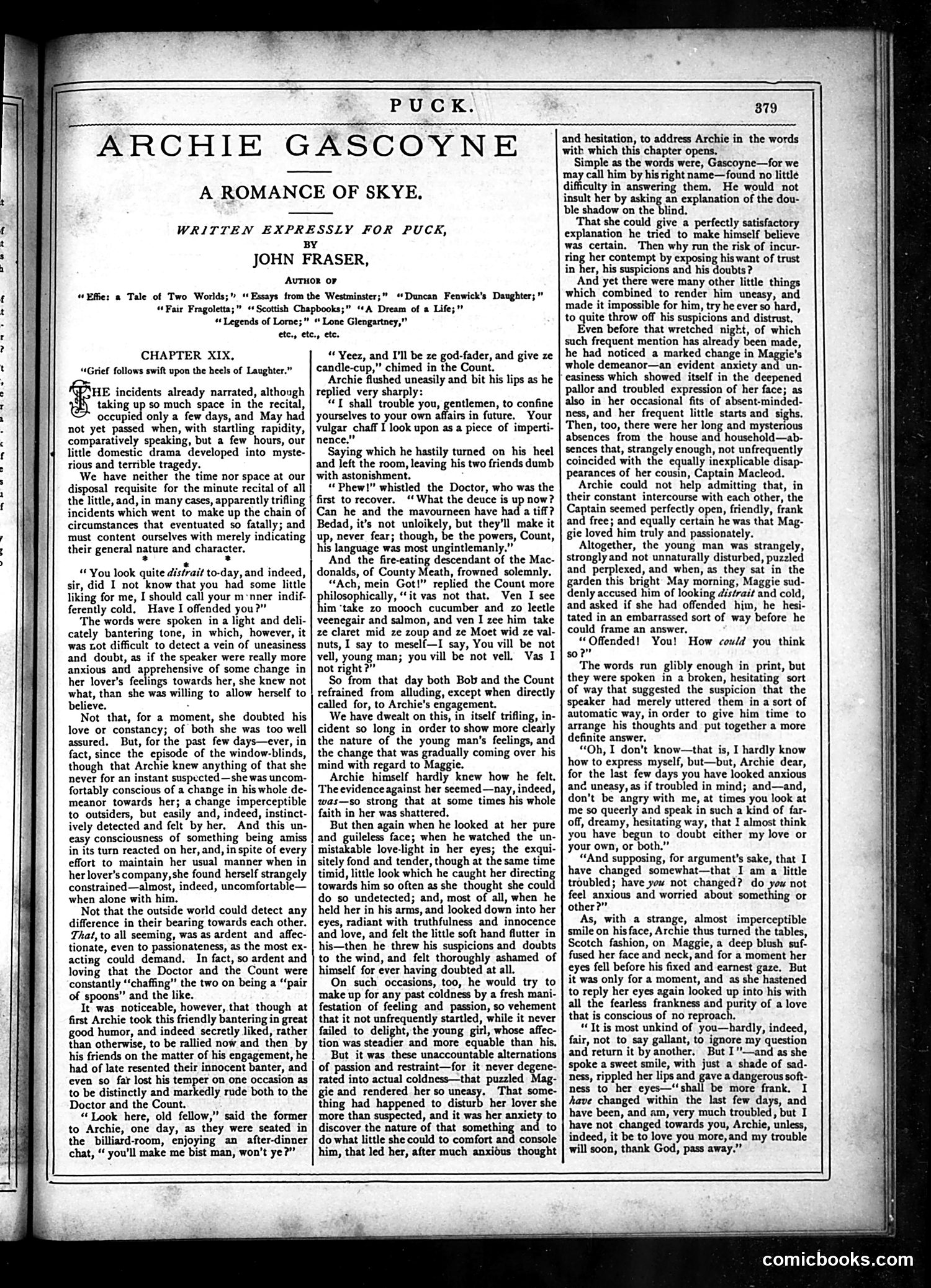
This page contains **serialized fiction**, not a political cartoon. It's Chapter XIX of "Archie Gascoyne: A Romance of Skye," written by John Fraser and published in Puck magazine. The text is a romantic narrative focusing on interpersonal drama between characters named Archie, Maggie, and the Count. The passage explores Archie's emotional conflict—he struggles with jealousy and doubt regarding Maggie's feelings while attempting to maintain dignity and trust. There is **no political satire or social commentary** visible on this page. This represents Puck's literary content rather than its satirical cartoons. The magazine supplemented its humor with serialized fiction to maintain reader engagement between issues.
📄 Transcribed text from this page (OCR, searchable)
Machine-transcribed from the original scan — historical spelling and the odd misread are preserved.
PUCK. 879 ARCHIE GASCOYNE A ROMANCE OF SKYE. WRITTEN EXPRESSLY FOR PUCK, BY JOHN FRASER, AUTHOR OF “Effie: a Tale of Two Worlds; ‘Essays from the Westminster; “Duncan Fenwick's Daughter; «Fair Fragoletta;” “Scottish Chapbooks;” “A Dream of a Life;’” «+ Legends of Lorne;" « Lone Glengartney,” ete., etc., ete. CHAPTER XIX. “Grief follows swift upon the heels of Laughter.” HE incidents already narrated, although oust ¢ so much space in the recital, occupied only a few days, and May had not yet passed when, with startling rapidity, comparatively speaking, but a few hours, our little domestic drama developed into myste- rious and terrible tragedy. We have neither the time nor space at our disposal requisite for the minute recital of all the little, and, in many cases, apparently trifling incidents which went to make up the chain of circumstances that eventuated so fatally; and must content ourselves with merely indicating their general nature and character. * “You look quite distrait to-day, and indeed, sir, did I not know that you had some little liking for me, I should call your m-nner indif- ferently cold. Have I offended you?” The words were spoken in a light and deli- cately bantering tone, in which, however, it was tot difficult to detect a vein of uneasiness and doubt, as if the speaker were really more anxious and apprehensive of some change in her lover's feelings towards her, she knew not what, than she was willing to allow herself to believe. . Not that, for a moment, she doubted his love or constancy; of both she was too well assured. But, for the past few days—ever, in fact, since the episode of the window-blinds, though that Archie knew anything of that she never for an instant suspected—she was uncom- fortably conscious of a change in his whole de- meanor towards her; a change imperceptible to outsiders, but easily and, indeed, instinct- ively detected and felt by her, And this un- easy consciousness of something being amiss in its turn reacted on her, and, in spite of every effort to maintain her usual manner when in her lover’s company, she found herself strangely constrained—almost, indeed, uncomfortable— when alone with him. Not that the outside world could detect any difference in their bearing towards each other. That, to all seeming, was as ardent and affec- tionate, even to passionateness, as the most ex- acting could demand. In fact, so ardent and loving that the Doctor and the Count were constantly “‘chaffing” the two on being a “pair of spoons” and the like. It was noticeable, however, that though at first Archie took this friendly bantering in great good humor, and indeed secretly liked, rather than otherwise, to be rallied now and then by his friends on the matter of his engagement, he had of late resented their innocent banter, and even so far lost his temper on one occasion as to be distinctly and markedly rude both to the Doctor and the Count. “ Look here, old fellow,” said the former to Archie, one day, as they were seated in the bDilliard-room, enjoying an after-dinner chat, “‘ you'll make me bist man, won't ye?” “ Yeez, and I'll be ze god-fader, and give ze candle-cup,” chimed in the Count. Archie flushed uneasily and bit his lips as he replied very sharply: “T shall trouble you, gentlemen, to confine yourselves to your own affairs in future. Your vulgar chaff I look upon as a piece of imperti- nence,”" Saying which he hastily turned on his heel and left the room, leaving his two friends dumb with astonishment. “Phew!” whistled the Doctor, who was the first to recover. ‘‘ What the deuce is up now? Can he and the mavourneen have had a tiff? Bedad, it’s not unloikely, but they'll make it up, never fear; though, be the powers, Count, his language was most ungintlemanly.” And the fire-eating descendant of the Mac- donalds, of County Meath, frowned solemnly. “Ach, mein Got!” replied the Count more hilosophically, “it vas not that. Ven I see im ‘take zo mooch cucumber and zo leetle veenegair and salmon, and ven I zee him take ze claret mid ze zoup and ze Moet wid ze val- nuts, I say to meself—I say, You vill be not vell, young man; you vill be not vell. Vas I not right ?” So from that day both Bob and the Count refrained from alluding, except when directly called for, to Archie's engagement. We have dwealt on this, in itself trifling, in- cident so long in order to show more clearly the nature of the young man's feelings, and the change that was gradually coming over his mind with regard to Maggie. Archie himself hardly knew how he felt. The evidence against her seemed—nay, indeed, was—so strong that at some times his whole faith in her was shattered. But then again when he looked at her pure and guileless face; when he watched the un- mistakable love-light in her eyes; the exqui- sitely fond and tender, though at the same time timid, little look which he caught her directing towards him so often as she thought she could do so undetected; and, most of all, when he held her in his arms, and looked down into her eyes, radiant with truthfulness and innocence and love, and felt the little soft hand flutter in his—then he threw his suspicions and doubts to the wind, and felt thoroughly ashamed of himself for ever having doubted at all. On such occasions, too, he would try to make up for any past coldness by a fresh mani- festation of feeling and passion, so vehement that it not unfrequently startled, while it never failed to delight, the young gitl, whose affec- tion was steadier and more equable than his, But it was these unaccountable alternations of passion and restraint—for it never degene- rated into actual coldness—that puzzled Mag- gie and rendered her so sna, That some- thing had happened to disturb her lover she more than suspected, and it was her anxiety to discover the nature of that somethin; to do what little she could to comfort and console him, that led her, after much anxious thought and hesitation, to address Archie in the words with which this chapter opens, Simple as the words were, Gascoyne—for we may call him by his right name—found no little difficulty in answering them. He would not insult her by asking an explanation of the dou- ble shadow on the blind. That she could give a perfectly satisfactory explanation he tried to make himself believe was certain. Then why run the risk of incur- ring her contempt by exposing his want of trust in her, his suspicions and his doubts? And yet there were many other little things which combined to render him uneasy, and made it impossible for him, try he ever so hard, to quis throw off his suspicions and distrust. wen before that wretched night, of which such frequent mention has already been made, he had noticed a marked change in Maggie's whole demeanor—an evident anxiety and un- easiness which showed itself in the deepened pallor and troubled expression of her face; as also in her occasional fits of absent-minded- ness, and her frequent little starts and sighs. Then, too, there were her long and mysterious absences from the house and household—ab- sences that, strangely enough, not unfrequently coincided with the equally inexplicable disap- pearances of her cousin, Captain Macleod. Archie could not help admitting that, in their constant intercourse with each other, the Captain seemed perfectly open, friendly, frank and free; and equally certain he was that Mag- gie loved him truly and passionately. Altogether, the young man was strangely, strongly and not unnaturally disturbed, puzzled and perplexed, and when, as they sat in the garden this bright’ May morning, Maggie sud- denly accused him of looking dis/rait and cold, and asked if she had offended him, he hesi- tated in an embarrassed sort of way before he could frame an answer. “Offended! You! so?” The words run glibly enough in print, but they were spoken in a broken, hesitating sort of way that suggested the suspicion that the speaker had merely uttered them in a sort of automatic way, in order to give him time to arrange his thoughts and put together a more definite answer. “Oh, I don’t know—that is, I hardly know how to express myself, but—but, Archie dear, for the last few days you have looked anxious and uneasy, as if troubled in mind; and—and, don’t be angry with me, at times you look at me so queerly and speak in such a kind of far- off, dreamy, hesitating way, that I almost think you have begun to doubt either my love or your own, or both,” “And supposing, for argument’s sake, that I have changed somewhat—that I am a little troubled; have you not changed? do you not feel anxious and worried about something or other?” As, with a strange, almost imperceptible smile on his face, Archie thus turned the tables, Scotch fashion, on Maggie, a deep blush suf- fused her face and neck, and for a moment her eyes fell before his fixed and earnest gaze. But it was only for a moment, and as she hastened to reply her eyes again looked up into his with all the fearless frankness and Ray, of a love that is conscious of no reproach. “Tt is most unkind of you—hardly, indeed, fair, not to say gallant, to ignore my question and return it by another. But I'"—and as she spoke a sweet smile, with just a shade of sad- ness, rippled her lips and gave a dangerous soft- ness to her eyes—‘‘shall be more frank. I have changed within the last few days, and have been, and am, very much troubled, but I have not changed towards you, Archie, unless, indeed, it be to love you more, and my trouble will soon, thank God, pass away.” How could you think comicbooks.com