
Puck, 1879-08-20 · page 12 of 16
Puck — August 20, 1879 — page 12: what you’re looking at
What you’re looking at
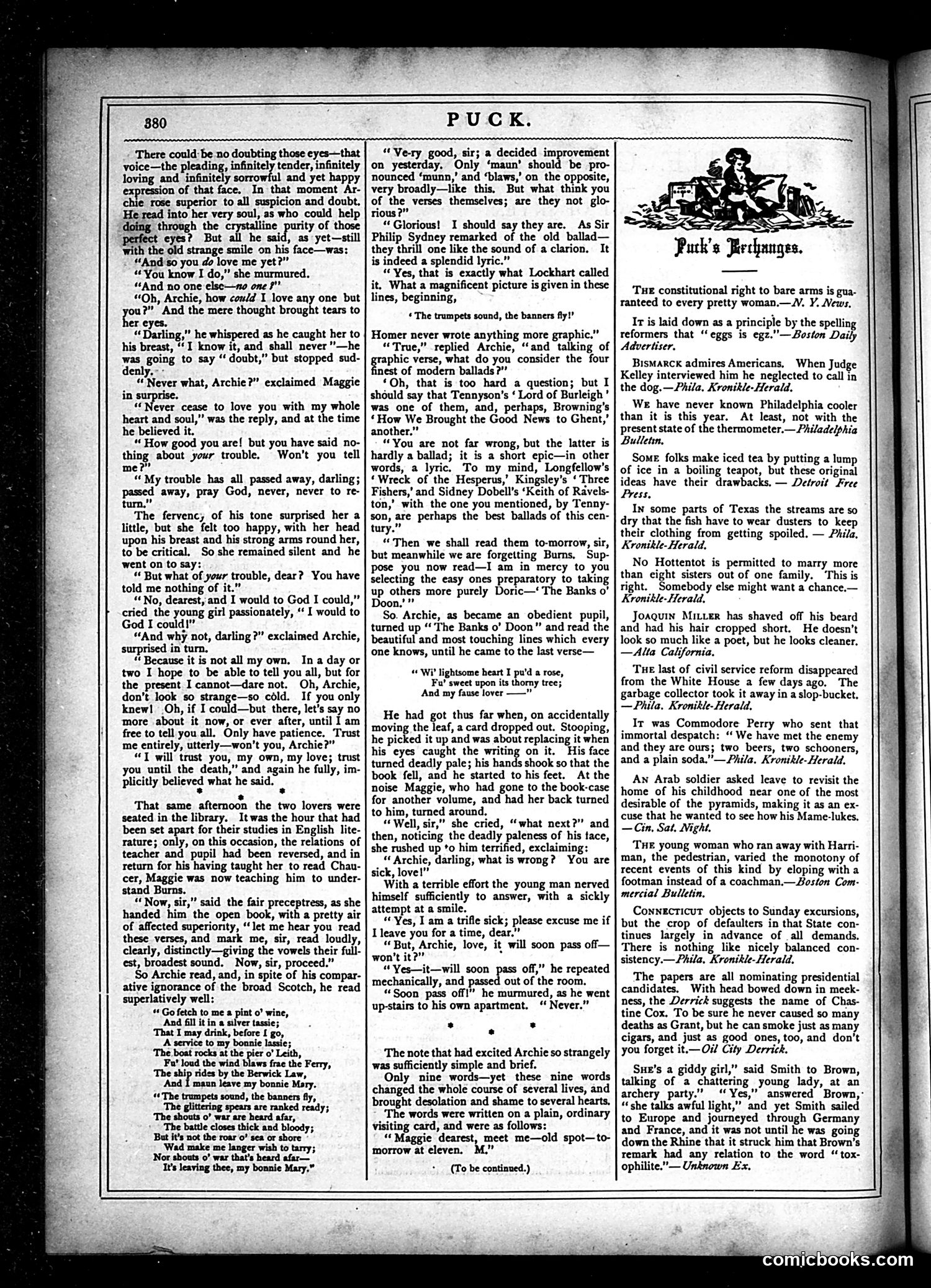
This page contains primarily **text content rather than political cartoons**—it's a serialized story or narrative feature titled "Puck's Beginnings" (visible in the header illustration). The main content appears to be **dialogue-heavy fiction**, featuring characters named Archie, Maggie, and others in what seems to be a romantic or domestic narrative. References to reading poetry ("Lord of Burleigh," Tennyson) and literary discussion suggest this is targeting an educated, middle-class audience. The right column contains brief **satirical notes** on contemporary issues: constitutional gun rights, thermometer measurements, ice-making, and social customs like Hottentots marrying practices. Without visible political caricatures on this particular page, the satire appears **subtle and text-based** rather than graphically illustrated—typical of Puck's mixed format combining visual and written humor.
📄 Transcribed text from this page (OCR, searchable)
Machine-transcribed from the original scan — historical spelling and the odd misread are preserved.
PUCK. There could: be no doubting those eyes—that voice—the pleading, antnlsely, tender, infinitely loving and infinitely sorrowful and yet happy expression of that face. In that moment Ar- chie rose superior to all suspicion and doubt. He read into her very soul, as who could help doing through the crystalline purity of those perfect eyes? But all he said, as yet—still ‘with the old strange smile on his face—was: “And so you do love me yet?” “You know I do,” she murmured. “And no one else—no one #” “Oh, Archie, how con/d I love any one but uu?” And the mere thought brought tears to er eyes. “Darling,” he whispered as he caught her to his breast, “I know it, and shall never ’—he was going to say “doubt,” but stopped sud- denly, - - “Never what, Archie?” exclaimed Maggie in surprise. “Never cease to love you with my whole heart and soul,” was the reply, and at the time he believed it. “ How good you are! but you have said no- thing about your trouble. Won't you tell me?” “My trouble has all passed away, darling; passed away, pray God, never, never to re- turn," The fervency of his tone surprised her a little, but she felt too happy, with her head upon his breast and his strong arms round her, to be critical. So she remained silent and he went on to say: “ But what of your trouble, dear? You have told me nothing of it.” “No, dearest, and I would to God I could,” cried the young girl passionately, ‘ I would to God I could!” “And why not, darling?” exclaimed Archie, surprised in turn, “ Because it is not all my own. In a day or two I hope to be able to tell you all, but for the present I cannot—dare not. Oh, Archie, don’t look so strange—so cdld. If you only knew! .Oh, if I could—but there, let’s say no more about it now, or ever after, until 1 am free to tell you all. Only have patience. Trust me entirely, utterly—won't you, Archie?” “T will trust you, my own, my love; trust you until the death,” and again he fully, im- plicitly believed what he said. i ‘That same afternoon the two lovers were seated in the library. It was the hour that had been set apart for their studies in English lite- rature; only, on this occasion, the relations of teacher and pupil had been reversed, and in return for his having taught her to read Chau- cer, Maggie was now teaching him to under- stand Burns. “Now, sir,” said the fair preceptress, as she handed him the open book, with a pretty air of affected superionty, ‘let me hear you read these verses, and mark me, sir, read loudly, clearly, distinctly—giving the vowels their full- est, broadest sound. Now, sir, proceed.” So Archie read, and, in spite of his compar- ative ignorance of the broad Scotch, he read superlatively well: “ Go fetch to me a pint o’ wine, And fill it in a silver tassie; ‘That I may drink, before { go, A service to my bonnie lassie; ‘The boat rocks at the pier o’ Leith, Fa’ loud the wind blaws frac the Ferry, The ship rides by the Berwick Law, And I maun leave my bonnie Mary. «The trumpets sound, the banners fly, The glittering spears are ranked ready; The battle closes thick and bloody; Batts not the roar o! sea or shore make me langer wish to tarry; Nor abouts o° war thas heard afar? It's leaving thee, my bonnie Mary,” “Ve-ry good, sir; a decided improvement on yesterday, Only ‘maun’ should be pro- nounced ‘munn,’ and ‘blaws,’ on the opposite, very broadly—like this, But what think you of the verses themselves; are they not glo- rious?” “Glorious! I should say they are. As Sir Philip Sydney remarked of the old ballad— they thrill one like the sound of a clarion. It is indeed a splendid lyric.” “Yes, that is exactly what Lockhart called it, What a magnificent picture is given in these lines, beginning, ‘« The trumpets sound, the banners fly!’ Homer never wrote anything more graphic.” “True,” replied Archie, “and talking of phic verse, what do you consider the four nest of modern ballads?” ‘Oh, that is too hard a question; but I should say that Tennyson’s ‘ Lord of Burleigh’ was one of them, and, perhaps, Browning’s “How We Brought the Good News to Ghent,’ another.” “You are not far wrong, but the latter is hardly a ballad; it is a short epic—in other words, a lyric. To my mind, Longfellow’s ‘Wreck of the Hesperus,’ Kingsley’s ‘ Three Fishers,’ and Sidney Dobell’s ‘Keith of Ravels- ton,’ with the one you mentioned, by Tenny- son, are perhaps the best ballads of this cen- tury.” “Then we shall read them to-morrow, sir, but meanwhile we are forgetting Burns. Sup- you now read—I am in mercy to you selecting the easy ones preparatory to taking up others more purely Doric—' The Banks 0° Doon,’” So. Archie, as became an obedient pupil, turned up ‘‘ The Banks o’ Doon” and read the beautiful and most touching lines which every one knows, until he came to the last verse— «Wi? lightsome heart I pu'd a rose, Fu’ sweet upon its thorny tree; And my fause lover —" He had got thus far when, on accidentally moving the leaf, a card dropped out. Stooping, he picked it up and was about replacing it when his eyes caught the writing on it. His face turned deadly pale; his hands shook so that the book fell, and he started to his feet. At the noise Maggie, who had gone to the book-case for another volume, and had her back turned to him, turned around. “Well, sir,” she cried, “what next?” and then, noticing the deadly paleness of his tace, she rushed up to him terrified, exclaiming: * Archie, darling, what is wrong? You are sick, love!” With a terrible effort the young man nerved himself sufficiently to answer, with a sickly attempt at a smile. “Yes, I am a trifle sick; please excuse me if I leave you for a time, dear.” “But, Archie, love, it will soon pass off— won't it . “ Yes—it—will soon off,” he repeated mechanically, and passed out of the room, “Soon pass off!” he murmured, as he went up-stairs to his own apartment. ‘ Never.” The note that had excited Archie so strangely was sufficiently simple and brief. Only nine words—yet these nine words changed the whole course of several lives, and brought desolation and shame to several hearts, ‘The words were written on a plain, ordinary visiting card, and were as follows: “Maggie dearest, meet me—old spot—to- morrow at eleven. M.” (To be continued.) Puck's Ferchanges, ‘Tue constitutional right to bare arms is gua- ranteed to every pretty woman.—J. Y. News. Ir is laid down as a principle by the spelling reformers that “eggs is egz.""—Boston Daily Advertiser, Bismarck admires Americans, When Judge Kelley interviewed him he neglected to call in the dog.—Piila, Kronikle-Herald, We have never known Philadelphia cooler than it is this ia At least, not with the present state of the thermometer.— Philadelphia Bulletin, Some folks make iced tea by putting a lump of ice in a boiling teapot, but these original ideas have their drawbacks. — Detroit Free Press. In some parts of Texas the streams are so dry that the fish have to wear dusters to keep their clothing from getting spoiled. — Phila, Kronikle-Herald, No Hottentot is permitted to marry more than eight sisters out of one family. ‘This is right. Somebody else might want a chance,— Kronikle-Herald, Joaquin Mitver has shaved off his beard and had his hair cropped short. He doesn’t look so much like a poet, but he looks cleaner. —Alta California, Tue last of civil service reform disappeared from the White House a few days ago. The garbage collector took it away in a slop-bucket, —Phila. Kronikle-Herald, Ir was Commodore Perry who sent that immortal despatch: “ We have met the enemy and they are ours; two beers, two schooners, and a plain soda.”— Phila. Kronikle-Herald, An Arab soldier asked leave to revisit the home of his childhood near one of the most desirable of the pyramids, making it as an ex- cuse that he wanted to see how his Mame-lukes. —Cin, Sat, Night. ‘Tye young woman who ran away with Harri- man, the pedestrian, varied the monotony of recent events of this kind by eloping with a footman instead of a coachman.—Boston Com- mercial Bulletin, Connecticut objects to Sunday excursions, but the crop of defaulters in that State con- tinues largely in advance of all demands. There is nothing like nicely balanced con- sistency.— Phila, Kronikle-Herald, The papers are all nominating presidential candidates, With head bowed down in meek- ness, the Derrick suggests the name of Chas- tine Cox. To be sure he never caused so many deaths as Grant, but he can smoke just as many cigars, and just as good ones, too, and don’t you forget it.— Oil City Derrick. Sue's a giddy girl,” said Smith to Brown, talking of a chattering young lady, at an archery party.” ‘ Yes," answered Brown,: “she talks awful light,” and yet Smith sailed to Europe and journeyed through Germany and France, and it was not until he was going down the Rhine that it struck him that Brown’s remark had any relation to the word “ tox- ophilite.”"— Unknown Ex, ~-Comicbooks.com