
Puck, 1879-08-20 · page 4 of 16
Puck — August 20, 1879 — page 4: what you’re looking at
What you’re looking at
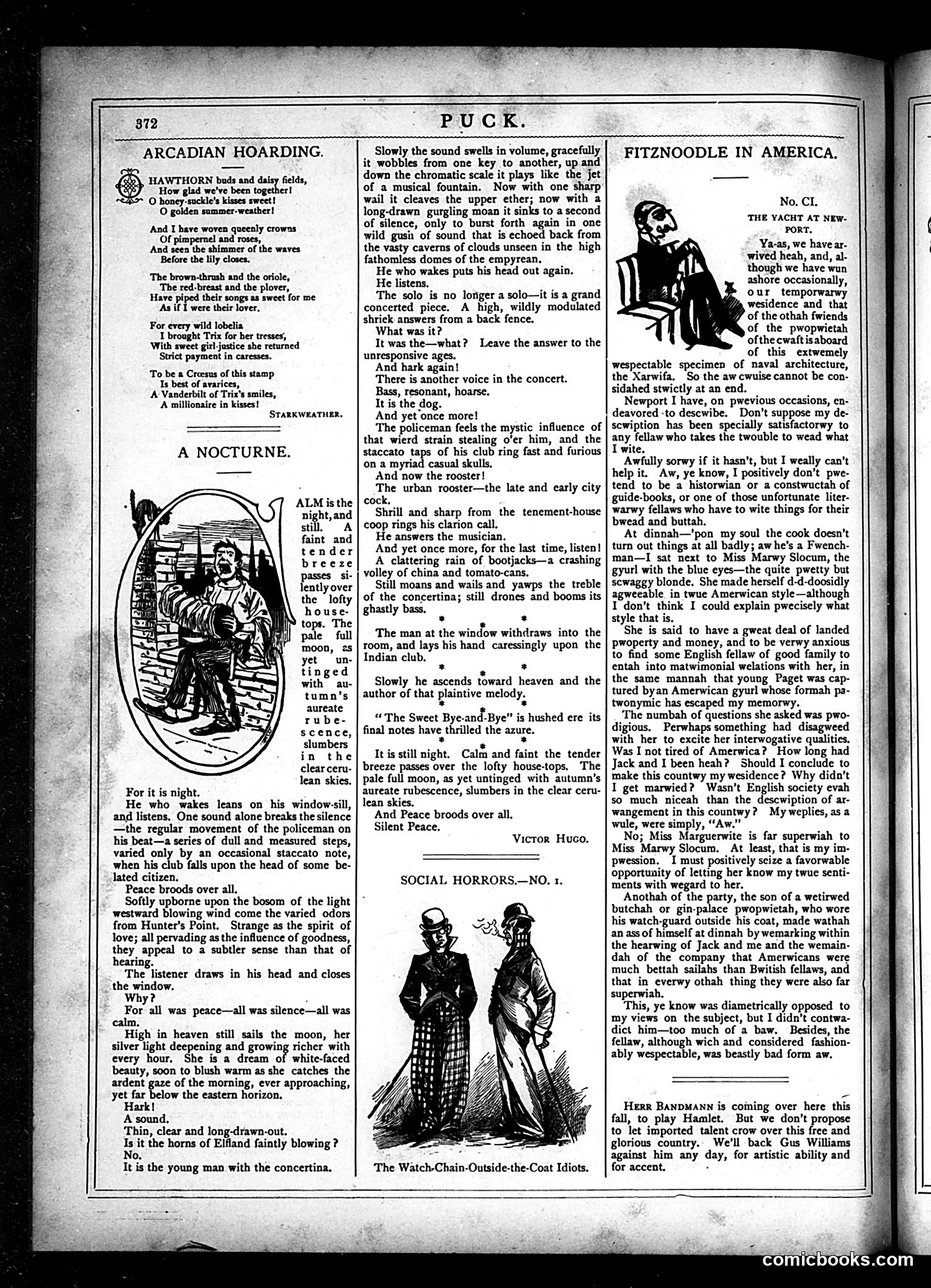
This page contains three distinct pieces: 1. **"Arcadian Hoarding"** - A poem about rural/pastoral life, apparently satirizing romantic notions of country living. 2. **"A Nocturne"** - A poem with an illustration showing a man at a window listening to urban nighttime sounds (police whistles, tomato cans, etc.). This appears to satirize the contrast between poetic idealization of night and harsh urban reality. 3. **"Fitznoodle in America"** - A prose piece mocking an English visitor's observations about American naval architecture and society. The tone suggests satire of British tourists' pretentious commentary on American life and customs. 4. **"Social Horrors—No. 1"** - A small illustration with accompanying text about social faux pas, likely satirizing etiquette violations among the upper classes. The page exemplifies Puck's characteristic blend of satirical verse, social commentary, and humor targeting both American and British audiences.
📄 Transcribed text from this page (OCR, searchable)
Machine-transcribed from the original scan — historical spelling and the odd misread are preserved.
PUCK. ARCADIAN HOARDING. © HAWTHORN buds and daisy fields, How glad we've been together! honey-suckle’s kisses sweet! golden summer-weather! And I have woven queenly crowns Of pimpernel and roses, And en he thitumer ofthe waves Before the lily closes. The brown-thrush and the oriole, ‘The red-breast and the plover, Have piped their songs as sweet for me ‘As if I were their lover. For every wild lobelia I brought Trix for her tresses, With sweet girl justice she returned Strict payment in caresses. To be a Croesus of this stamp Is best of avarices, A Vanderbilt of A millionaire in kisses! STARKWEATHER. A NOCTURNE. ALM isthe ight, and still A faint and tender breeze passes si- lently over the lofty house- tops. The pale full moon, 2s yet un- tinged with au- tumn’s aureate rube- scence, slumbers in the clear ceru- lean skies. Ii 3 alll For it is night. He who wakes leans on his windowsill, and listens. One sound alone breaks the silence —the regular movement of the policeman on his beat—a series of dull and measured steps, varied only by an occasional staccato note, when his club falls upon the head of some be- lated citizen, Peace broods over all, Softly upborne upon the bosom of the light westward blowing wind come the varied odors from Hunter's Point. Strange as the spirit of love; all pervading as the influence of goodness, they appeal to a subtler sense than that of hearing. The listener draws in his head and closes the window. For all was peace—all was silence—all was igh in heaven still sails the moon, her silver light deepening and growing richer with every hour, She is a dream of white-faced beauty, soon to blush warm as she catches the ardent gaze of the morning, ever approaching, yet far below the eastern horizon, Hark! A sound, Thin, clear and long-drawn-out. _ it the horns of Elfland faintly blowing ? lo. It is the young man with the concertina. Slowly the sound swells in volume, gracefully it wobbles from one key to another, up and down the chromatic scale it plays like the jet of a musical fountain. Now with one sharp wail it cleaves the upper ether; now with a long-drawn gurgling moan it sinks to a second of silence, only to burst forth again in one wild gush of sound that is echoed back from the vasty caverns of clouds unseen in the high fathomless domes of the empyrean. He who wakes puts his head out again. He listens, The solo is no longer a solo—it is a grand concerted piece. A high, wildly modulated shriek answers from a back fence, What was it? It was the—what? Leave the answer to the unresponsive ages. ‘And hark again! There is another voice in the concert. Bass, resonant, hoarse. It is the dog. And yet once more! The policeman feels the mystic influence of that wierd strain stealing o’er him, and the staccato taps of his club ring fast and furious on a myriad casual skulls, And now the rooster! The urban rooster—the late and early city cock. Shrill and sharp from the tenement-house coop rings his clarion call. He answers the musician. And yet once more, for the last time, listen! A clattering rain of bootjacks—a crashing volley of china and tomato-cans. Still moans and wails and yawps the treble 3 still drones and booms its * The man at the window withdraws into the room, and lays his hand caressingly upon the Indian club. . Slowly he ascends toward heaven and the author of that plaintive melody. . ‘s “The Sweet Bye-and-Bye” is hushed ere its final notes have thrilled the azure. 2 * * It is still night. Calm and faint the tender breeze passes over the lofty house-tops. The pale full moon, as yet untinged with autumn’s aureate rubescence, slumbers in the clear ceru- lean skies. And Peace broods over all. Silent Peace. Victor Huco, SOCIAL HORRORS.—NO. 1. The Watch-Chain-Outside-the-Coat Idiots. FITZNOODLE IN AMERICA, No, CL. THE YACHT AT NEW- PORT. Ya-as, we have ar- wived heah, and, al- though we have wun ashore occasionally, our temporwarwy wesidence and that of the othah fwiends of the pwopwietah ofthe cwaft isaboard of this extwemely wespectable specimen of naval architecture, the Xarwifa. So the aw cwuise cannot be con- sidahed stwictly at an end. Newport I have, on pwevious occasions, en- deavored -to descwibe. Don’t suppose my de- scwiption has been specially satisfactorwy to any fellaw who takes the twouble to wead what I wite. Awfully sorwy if it hasn't, but I weally can’t help it. “Aw, ye know, I positively don’t pwe- tend to be a historwian or a constwuctah of guide-books, or one of those unfortunate liter- warwy fellaws who have to wite things for their bwead and buttah. At dinnah—'pon my soul the cook doesn’t turn out things at all badly; aw he’s a Fwench- man—I sat next to Miss Marwy Slocum, the gyurl with the blue eyes—the quite pwetty but scwaggy blonde. She made herself d-d-doosid), agweeable_ in twue Amerwican style—althoug! I don’t think I could explain pwecisely what style that is She is said to have a gweat deal of landed pwoperty and money, and to be verwy anxious to find some English fellaw of good family to entah into matwimonial welations with her, in the same mannah that young Paget was cap- tured byan Amerwican gyurl whose formah pa- twonymic has escaped my memorwy. The numbah of questions she asked was pwo- gious. Perwhaps something had disagweed with her to excite her interwogative qualities, Was I not tired of Amerwica? How long had Jack and I been heah? Should I conclude to make this countwy my wesidence? Why didn’t I get marwied? Wasn't English society evah so much niceah than the descwiption of ar- wangement in this countwy? My weplies, as a wule, were simply, “Aw.” No; Miss Marguerwite is far superwiah to Miss Marwy Slocum. At least, that is my im- pwession. I must positively seize a favorwable opportunity of letting her know my twue senti- ments with wegard to her. Anothah of the party, the son of a wetirwed butchah or gin-palace pwopwietah, who wore his watch-guard outside his coat, made wathah an ass of If at dinnah by wemarking within the hearwing of Jack and me and the wemain- dah of the company that Amerwicans were much bettah sailahs than Bwitish fellaws, and that in everwy othah thing they were also far superwiah, This, ye know was diametrically opposed to my views on the subject, but I didn’t contwa- dict him—too much of a baw. Besides, the fellaw, although wich and considered fashion- ably wespectable, was beastly bad form aw. Herr BANDMANN is coining over here this fall, to play Hamlet. But we don’t propose to let imported talent crow over this free and glorious country.. We'll back Gus Williams against him any day, for artistic ability and for accent, :