
A complete issue · 16 pages · 1879
Puck — August 6, 1879
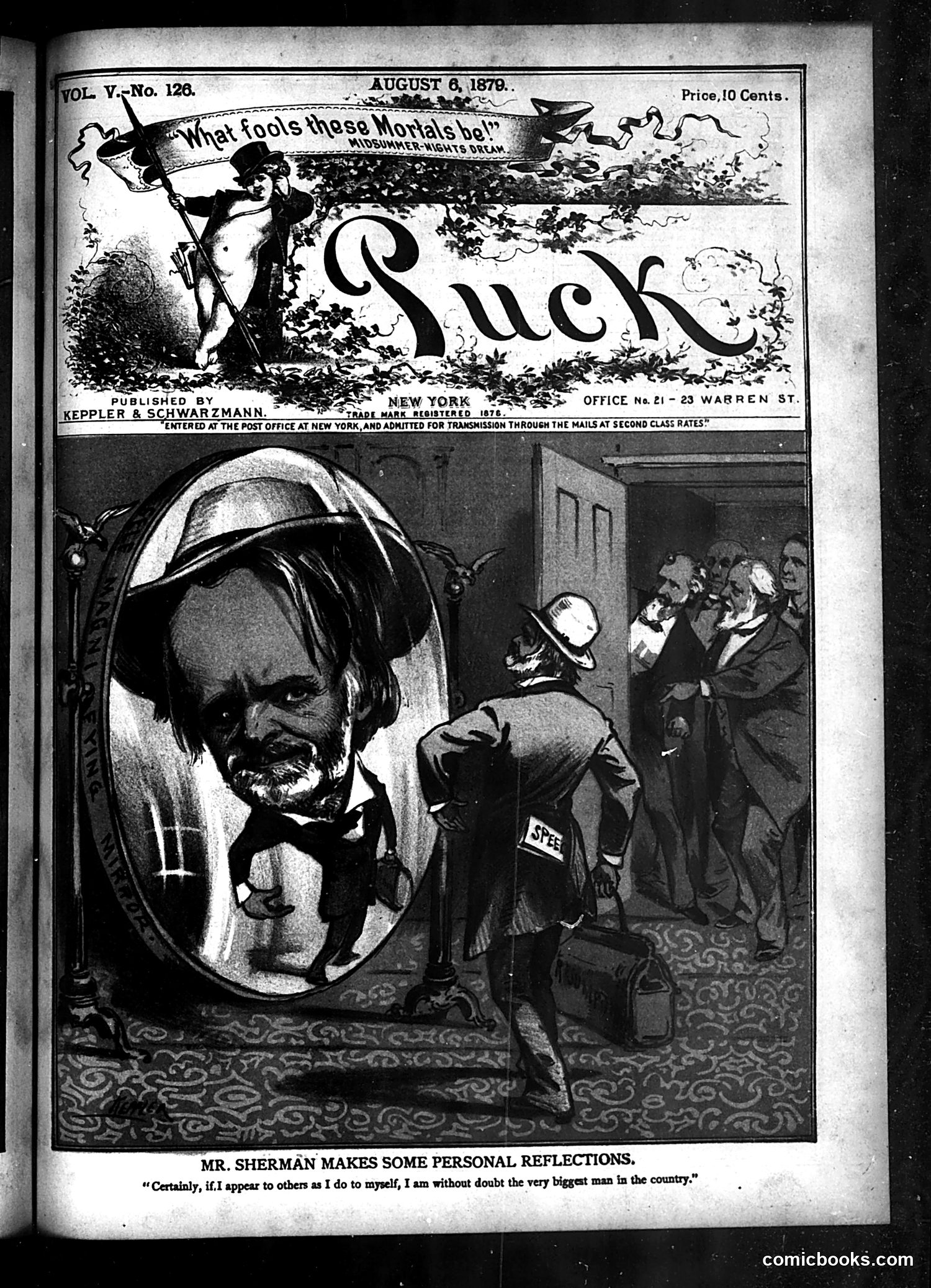
This cartoon satirizes **General William Tecumseh Sherman**, the Civil War general and current military figure. The title "Mr. Sherman Makes Some Personal Reflections" accompanies an image of Sherman examining his own reflection in a mirror, with the caption: "Certainly, if I appear to others as I do to myself, I am without doubt the very biggest man in the country." The satire mocks Sherman's apparent vanity and inflated self-regard. The mirror reflection device emphasizes self-delusion—the gap between how he sees himself versus how others perceive him. This suggests Sherman was viewed as arrogant or boastful during this period, making him a target for Puck's political humor.
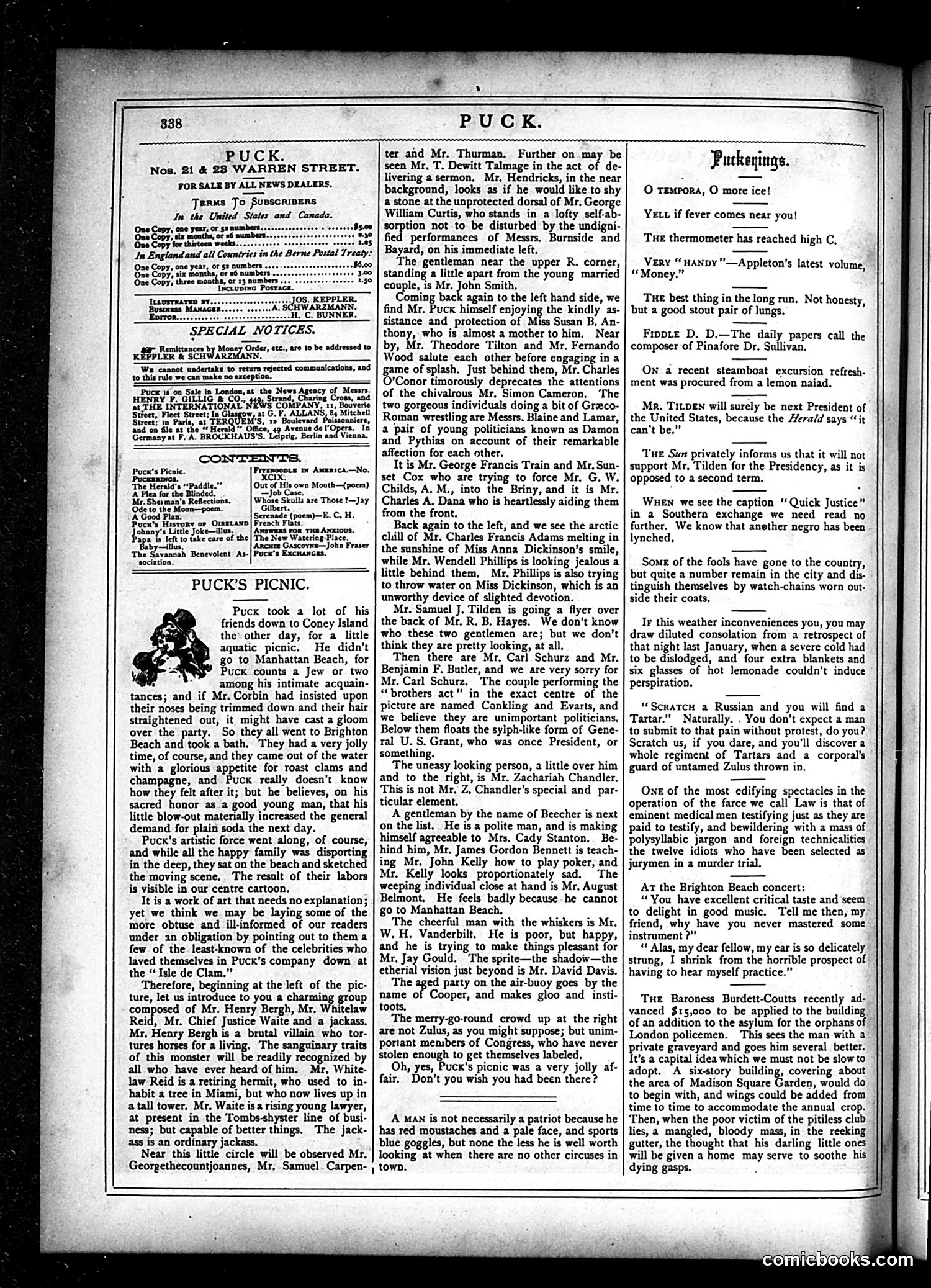
This page consists primarily of **text content rather than political cartoons**. The main feature is "Puck's Picnic," a humorous narrative describing a social outing to Coney Island where various recognizable public figures are observed and satirized. The text mocks attendees including politicians and social figures, commenting on their appearances, behaviors, and relationships. References include criticisms of individuals' physical features, romantic entanglements, and perceived pretensions. A small illustration shows Puck (the magazine's mascot) at the picnic. The satire employs the typical Puck approach: social observation and gentle mockery of prominent New Yorkers' vanities and foibles, rather than sharp political attack. The right column contains brief satirical items called "Puckerings"—short, pithy social commentaries on current events and personalities.
This page contains letters to the editor rather than cartoons. The content addresses prison conditions and reform: **"The Herald's 'Paddle' and the 'Paddle' of Sing-Sing"**: An ex-convict named Richard Turpin criticizes the use of corporal punishment ("paddling") in Sing-Sing Prison. He argues this brutal discipline contradicts claims of rehabilitation and compares it unfavorably to newspaper-style punishment. **"A Plea for the Blinded"**: A blind man describes visiting Puck's office, highlighting that cheap "Libraries" (serialized fiction sold cheaply) are making literature accessible to poor people who couldn't otherwise afford books. The page appears primarily concerned with social commentary on prison reform and literacy access for working-class readers—both progressive concerns of the era.
This page contains three distinct pieces: **"An Ode to the Moon"** (a romantic poem), **"A Good Plan"** (an editorial essay), and **"Puck's History of Oireland"** (a satirical history section). The main satirical content targets Irish identity and stereotypes. "Puck's History of Oireland" uses intentional misspelling ("Oireland") to mock Irish dialect and appears to chronicle Irish historical figures and characteristics. The editorial "A Good Plan" critiques religious hypocrisy—specifically how gambling and morality intersect in religious communities, suggesting that religious institutions don't adequately address gambling's moral problems while maintaining strict doctrinal positions. The overall tone reflects 19th-century satirical magazine conventions: irreverent toward institutions, ethnic caricature, and moral commentary disguised as humor.
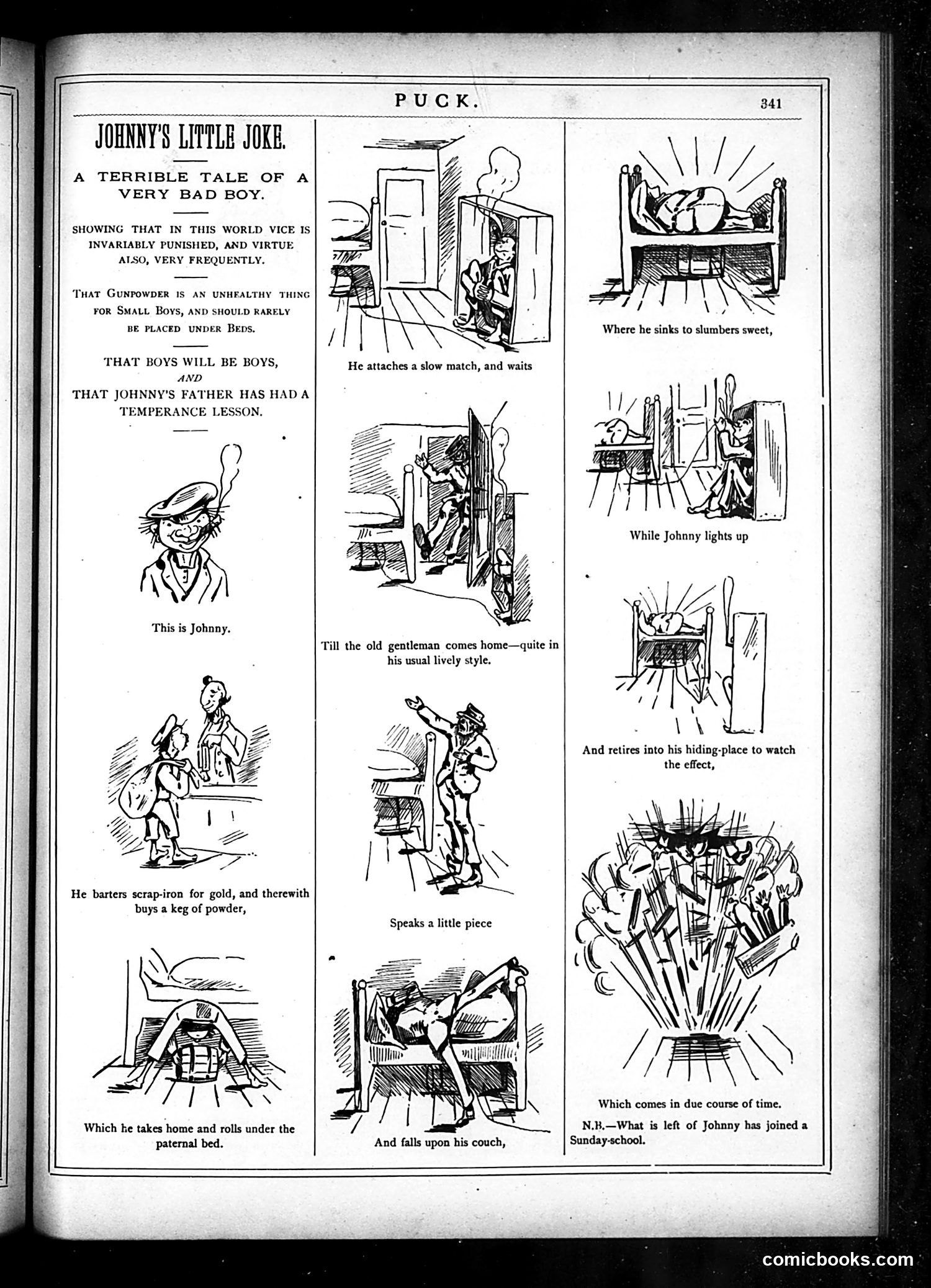
This is a Victorian-era cautionary tale in comic form, not political satire. It depicts a mischievous boy named Johnny who commits increasingly dangerous pranks, culminating in a gunpowder explosion. The narrative warns against three things: that vice goes unpunished in the world, that gunpowder is unsafe for children, and that "boys will be boys"—though Johnny's father should have disciplined him better. The story progresses from Johnny trading scrap metal for gunpowder, to placing a slow-burning match under his father's bed, to the resulting explosion that destroys the bedroom furniture and sends the father flying. The moral appears to be: lack of parental discipline leads to disaster. This reflects Victorian anxieties about child-rearing and the dangers of unsupervised access to explosive materials.
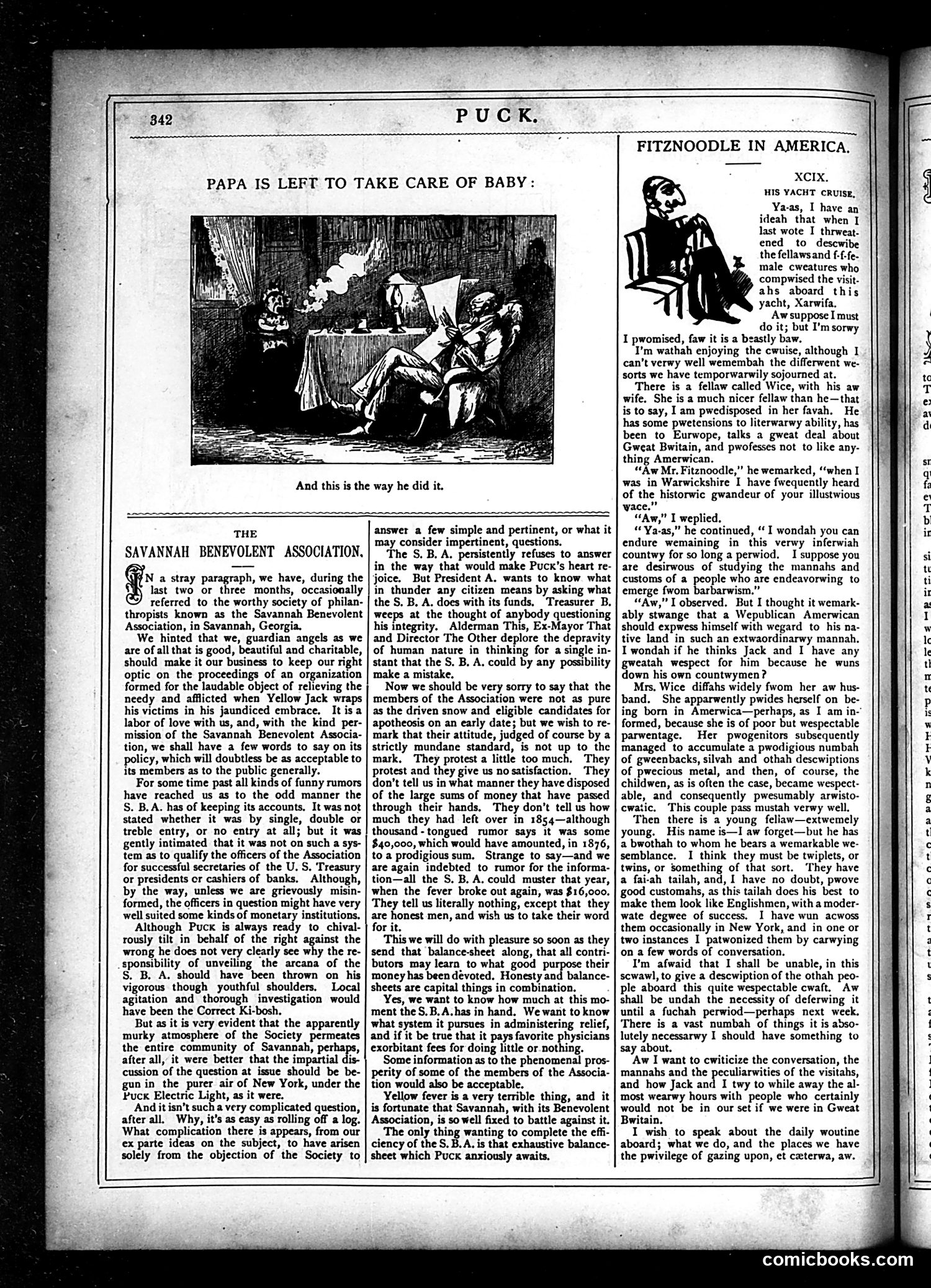
**Main Cartoon:** "Papa is Left to Take Care of Baby" depicts a man awkwardly managing an infant and household chaos—a humorous commentary on gender roles. The caption "And this is the way he did it" suggests satirizing men's incompetence at domestic tasks, a common joke in late 19th-century humor. **"Fitznoodle in America" Column:** This appears to be satirical travel writing, with the narrator critiquing American manners and customs. References to "Warwickshire" and complaints about American behavior suggest British perspective mocking transatlantic cultural differences—typical Puck satire comparing "civilized" Europe to "uncultured" America. **"The Savannah Benevolent Association" Section:** Criticizes a charitable organization's mismanagement of funds and accountability, exposing organizational corruption through detailed financial accusations.
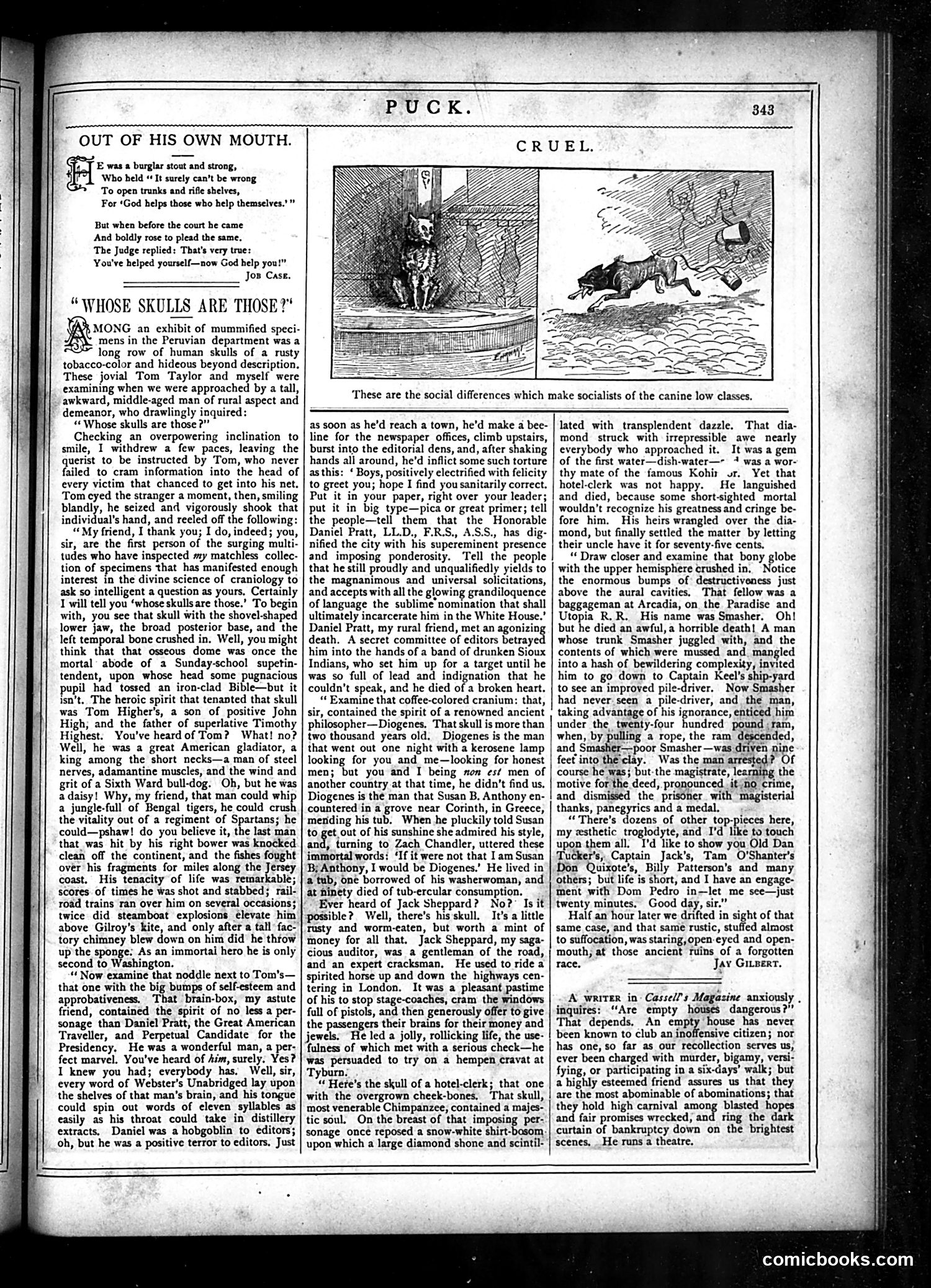
This Puck page satirizes class disparities and cruel treatment of animals by the wealthy. The left cartoon depicts a well-dressed man in an upscale setting, while the right shows a man driving a cart pulled by an overworked, exhausted horse. The caption states: "These are the social differences which make socialists of the canine low classes." The satire suggests that just as the poor suffer under the wealthy's indifference, working animals experience similar exploitation. The juxtaposition implies hypocrisy: the upper classes may condemn cruelty in principle (the judge's statement about God helping those who help themselves), yet they perpetuate suffering through their treatment of beasts of burden. This reflects progressive-era concerns about animal welfare and class inequality.
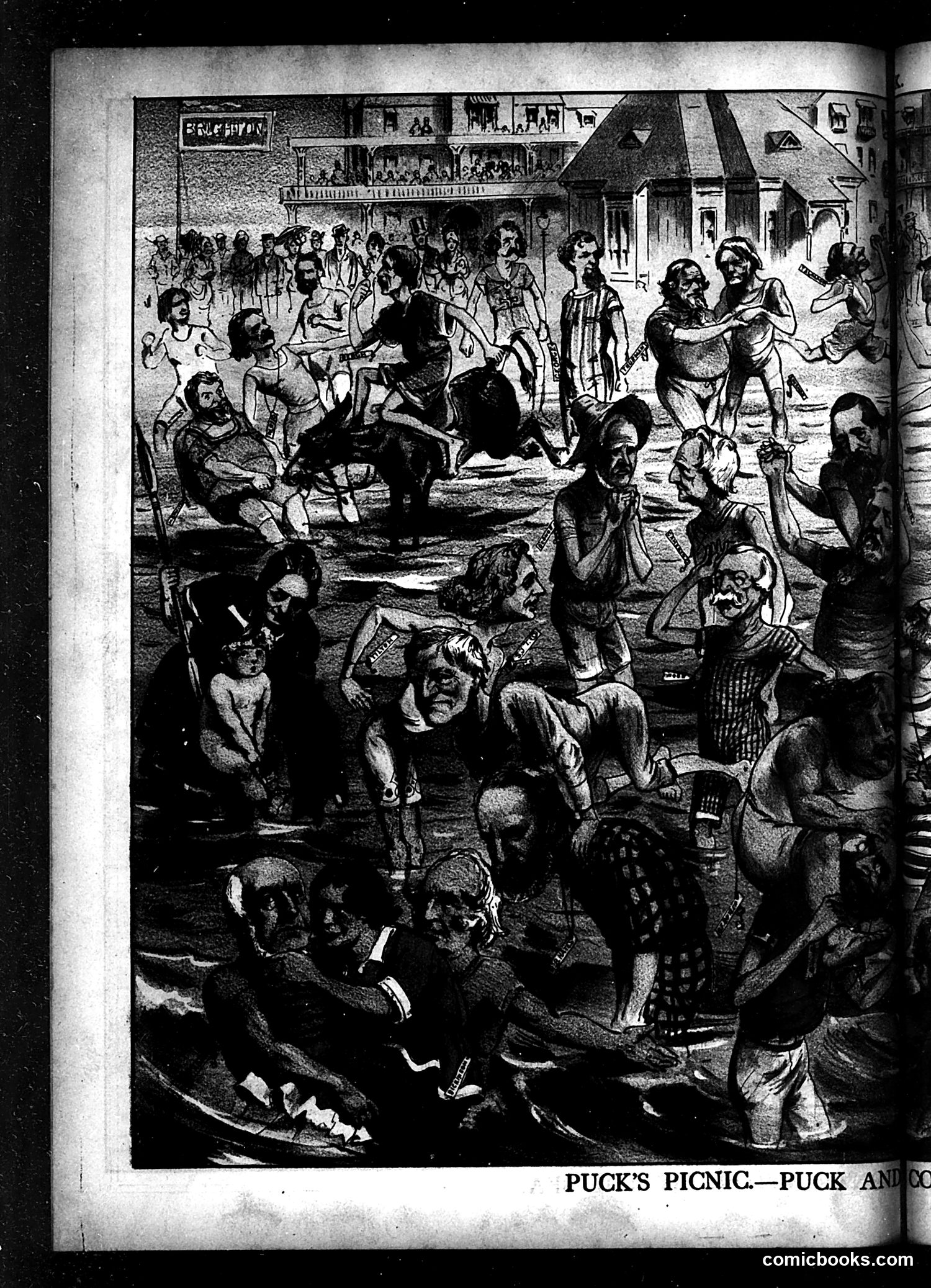
This appears to be a satirical illustration depicting a chaotic outdoor gathering or picnic scene. The composition shows numerous figures of varying sizes and conditions—some standing, many seated or crouching on the ground in disorganized clusters. The architectural backdrop suggests an urban or town setting. The title indicates this represents "Puck and Co," likely referencing Puck magazine itself and its associated satirists or cartoonists. The deliberately disheveled, crowded composition with figures in various states of distress or confusion appears to mock either the magazine's contributors, its readership, or the general chaos of contemporary social/political commentary. Without clearer facial features or identifying details visible in this reproduction, specific individuals cannot be definitively identified.
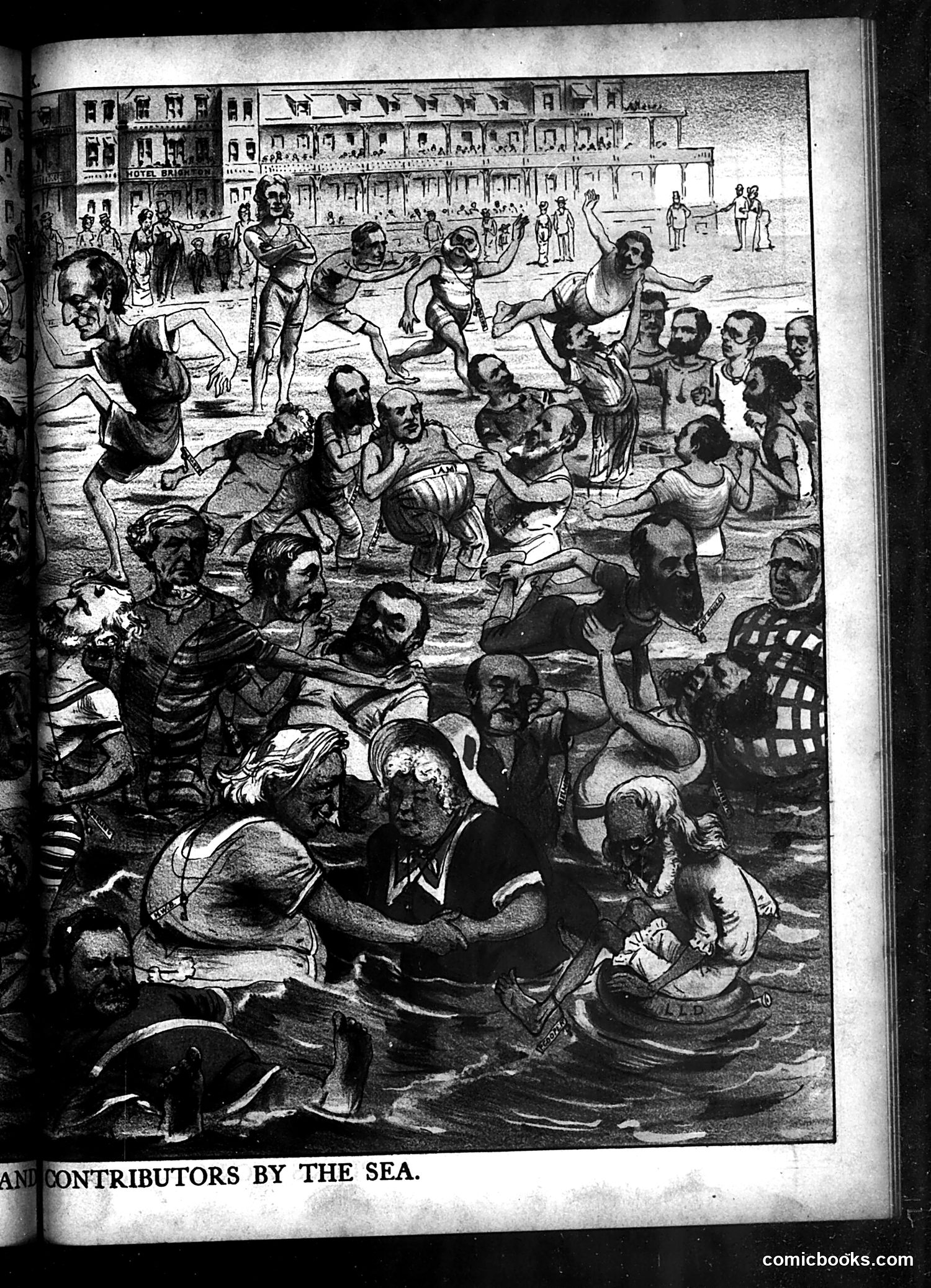
This satirical cartoon depicts a chaotic beach scene with well-dressed gentlemen and ladies in Victorian-era clothing engaged in various swimming and bathing activities. The title "And Contributors by the Sea" suggests these are prominent public figures—likely political or social contributors of the era. The satire appears to mock the undignified behavior of important men when engaged in leisure activities, showing them splashing, flailing, and generally losing their composure in the water. The contrast between their formal dress (visible on shore) and their awkward swimming antics creates the humor. Without identifying specific individuals from the caricatures alone, the cartoon's point seems to be deflating the pretensions of the powerful by showing them in vulnerable, ridiculous circumstances—a common Puck magazine approach to social criticism.
This page contains three sections: a poem titled "Serenade," a "French Flats" cartoon section, and "Literary Notes" with reader correspondence. The "French Flats" section satirizes middle-class Philadelphians renting boarding houses in the city. It mocks the pretentiousness of ordinary people attempting to live like aristocrats in cramped urban quarters, with pointed humor about their awkward attempts at gentility and the practical indignities of flat-dwelling (cats, lack of space, presumptuous neighbors). The "Answers for the Anxious" section provides advice to readers on etiquette questions—addressing concerns about social propriety, dining customs, and proper behavior—reflecting late 19th-century middle-class anxieties about correct conduct. The primary satire targets social aspiration and the gap between middle-class pretense and reality.
This page contains **fiction, not political satire**. It's Chapter XVII of "Archie Gascoyne: A Romance of Skye," a serialized romantic story by John Fraser written expressly for Puck magazine. The narrative follows Archie's romantic entanglements, particularly involving Miss Macdonald and another woman named Maggie. The text depicts internal conflict—Archie struggles with his feelings while Captain Macleod observes the emotional turmoil. There's dialogue about love, duty, and social obligation typical of Victorian-era romantic fiction. This represents Puck's diversified content strategy: while famous for political satire, the magazine also published serialized fiction to attract broader readership. No political figures or contemporary events appear to be referenced on this particular page.
This page contains no political cartoon, but rather a section titled "Puck's Jestings" - a collection of satirical news items and humorous anecdotes clipped from various newspapers and journals. The items mock contemporary social absurdities: a woman's heart "palpitating" over romantic disappointment, a man surviving a fall from a train, European royalty's social climbing, factory workers' meager wages, fashionable women's follies, and bureaucratic incompetence (Russian customs authorities). The humor relies on irony, exaggeration, and social commentary rather than visual caricature. The single small illustration depicts what appears to be a street scene or accident. These brief satirical observations reflect Puck's mission: commenting on the day's news and social pretensions through wit rather than elaborate political cartooning.
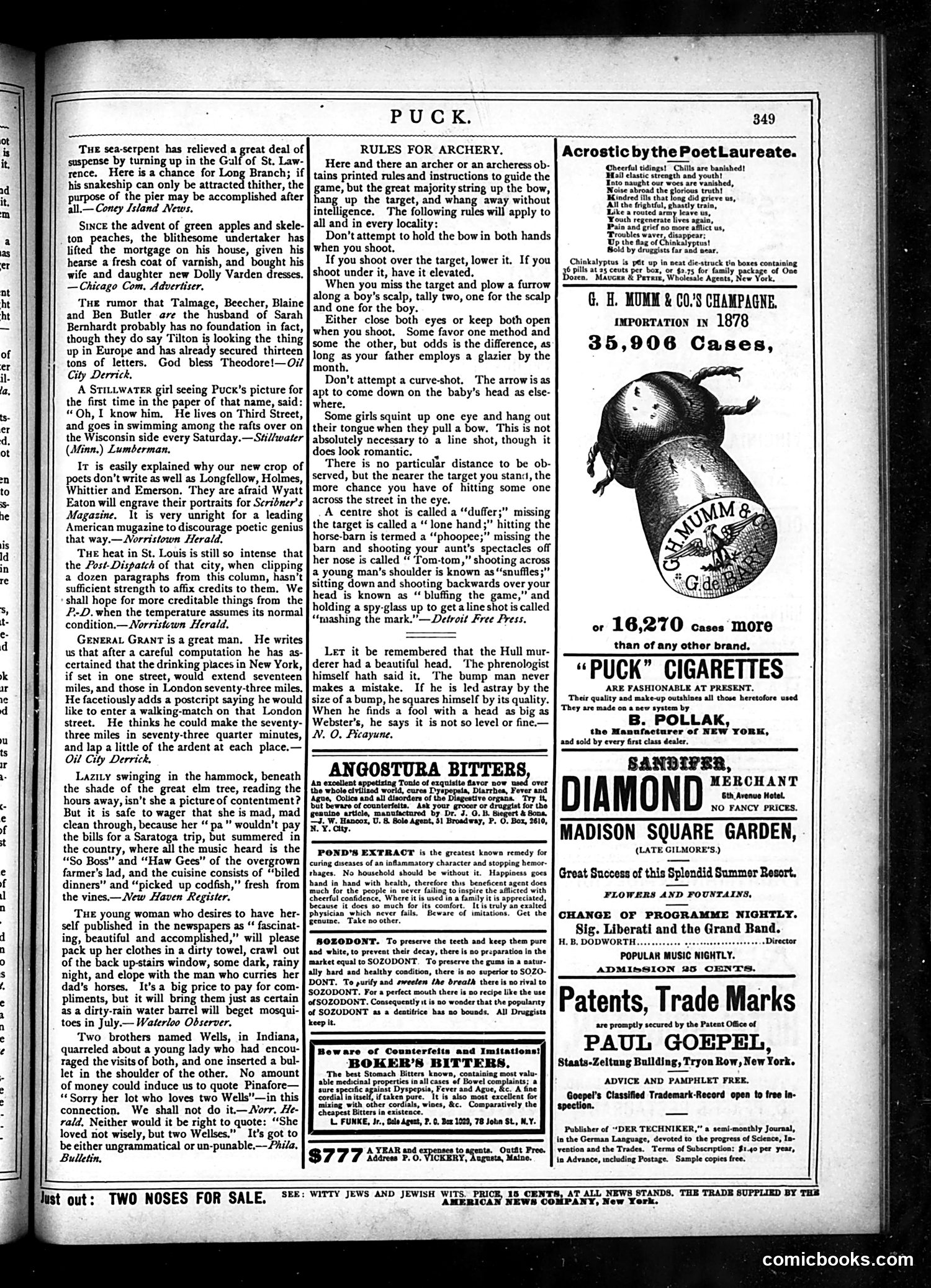
This page is primarily **advertising and instructional content** rather than political satire. The main features include: 1. **"Rules for Archery"** - practical instructional column offering shooting tips and terminology (e.g., "duffer," "long hand," "phoopiee") 2. **"Acrostic by the Poet Laureate"** - a poetry feature with uncertain satirical intent 3. **Multiple advertisements** dominating the page, including G.H. Mumm & Co.'s champagne (35,906 cases), Puck Cigarettes, Diamond Merchant jewelry, Madison Square Garden, and Patents/Trademarks services 4. **Various product endorsements** for bitters, tooth powder, and other consumer goods typical of 1870s-era magazines **The page lacks clear political cartoons or satirical commentary.** It appears to be a standard mixed-content magazine page balancing editorial features with revenue-generating advertisements.
This page is primarily **advertising**, not satirical content. It contains numerous commercial advertisements for late 19th-century New York businesses and products, including: - Puck Smoking Tobacco (featuring a cherub/putto figure) - Marburg Bros. Virginia Cut Cavendish tobacco - E.D. Bassford's hardware and housewares - Isaac Smith's umbrellas - Ruinart champagne - Hotel Brighton in Coney Island - Metropolitan Elevated Railway schedules - Manhattan Beach excursions - Albany and Troy day boats The page also advertises **E. Krueger, Photographer** with medals from Philadelphia and the American Institute Fair. There is no identifiable political cartoon or satirical content visible on this page—it functions as a standard advertising section typical of Puck magazine's revenue model.
This page is **primarily advertisements** rather than editorial cartoon content. The visible ads include: - A Louisiana State Lottery advertisement - Kepp's Shirts (clothing) - Barrett, "The Great New York Tailor" - Keppich & Co. Royal Havana cigars - Bohemian Bier (beer) - Mathesius & Frey (cabinet furniture) - European Mineral Waters - Dental rooms and other commercial services The only potentially satirical content is a small architectural illustration of what appears to be a gazebo or pavilion for "West Brighton Beach" and "Coney Island," advertising champagne and accommodations—though this functions more as a business advertisement than political satire. The page reflects Puck's business model: revenue from paid advertising subsidized the satirical content found elsewhere in the magazine.
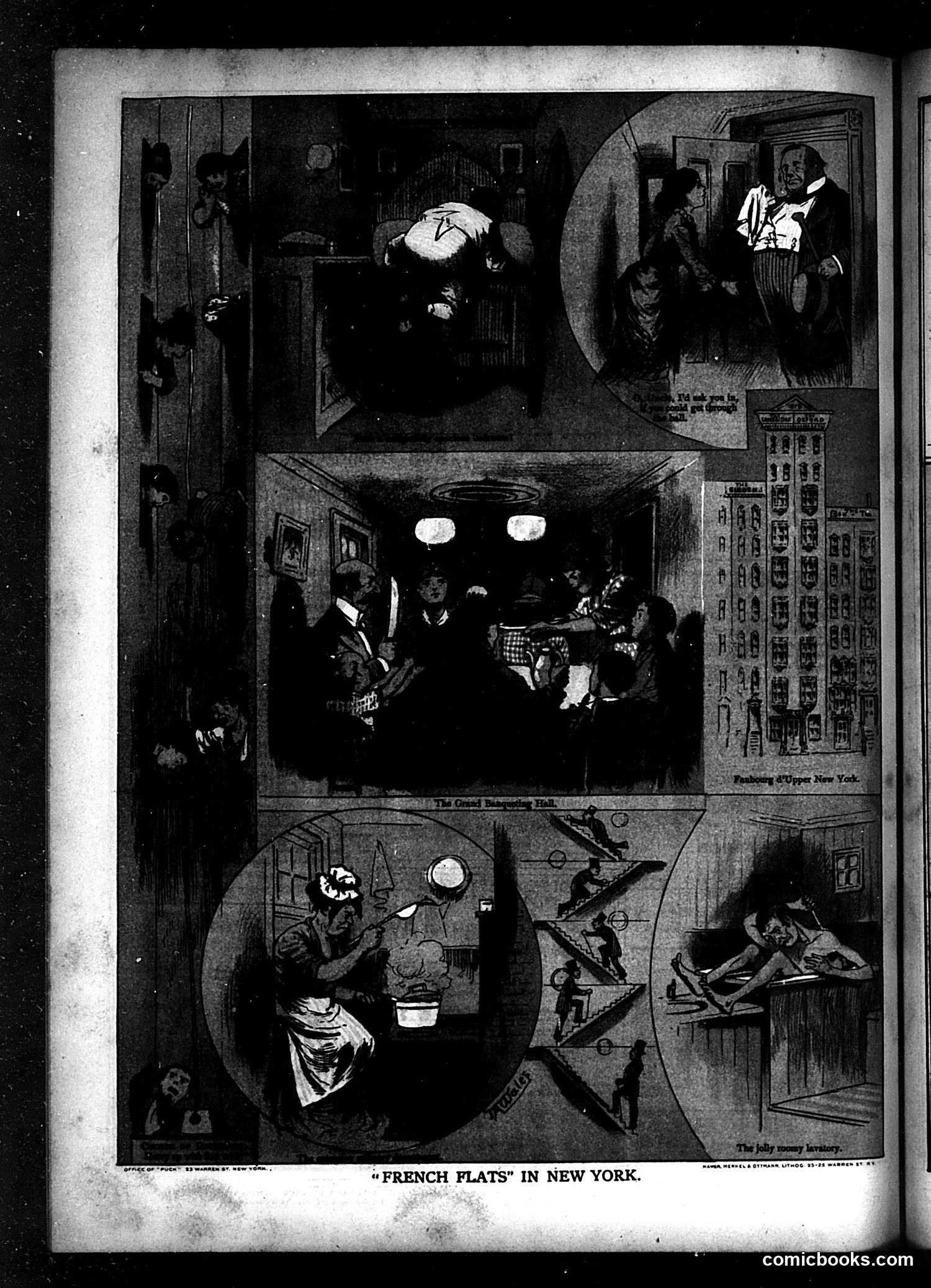
This satirical page lampoons the early 20th-century American adoption of French apartment living arrangements. The cartoon depicts various scenarios within these modern "French flats"—likely referring to smaller, European-style shared residential spaces that were becoming fashionable among New York's urban classes. The individual panels appear to show satirical domestic scenes: wealthy residents in cramped quarters, social gatherings in confined spaces, and the general awkwardness of adapting French architectural styles to American living. The central panel labeled "The Grand Illumination Ball" suggests a crowded social event. The satire mocks how Americans eagerly embraced French aesthetics and housing models despite their impracticality for American living habits and space expectations. The exaggerated, cramped conditions in each panel underscore the joke about this architectural trend.